Recognition: 2 theorem links
· Lean TheoremAb initio calculation of symmetry-breaking observables
Pith reviewed 2026-05-13 02:15 UTC · model grok-4.3
The pith
Generalizing the IMSRG flow to parity-violating operators yields the first ab initio anapole and Schiff moment predictions for medium-mass nuclei.
A machine-rendered reading of the paper's core claim, the machinery that carries it, and where it could break.
Core claim
By generalizing the IMSRG flow equations to evolve the weak symmetry-breaking Hamiltonian and the anapole or Schiff operators alongside the strong nuclear Hamiltonian, the authors construct a systematically improvable framework for computing these parity-violating moments and obtain the first ab initio predictions of the anapole moment in 29Si and the Schiff moments in 129Xe.
What carries the argument
The generalized IMSRG flow equations that simultaneously evolve the strong nuclear Hamiltonian, the weak parity-violating Hamiltonian, and the anapole or Schiff operators.
If this is right
- The method supplies systematically improvable predictions for parity-violating moments in nuclei of direct experimental interest.
- It enables ab initio calculations for other medium-mass and heavy systems where phenomenological approaches have been required until now.
- The predictions can be refined by including higher-order terms in the IMSRG expansion or larger model spaces.
- These results provide benchmarks that can guide the interpretation of ongoing and future parity-violation experiments.
Where Pith is reading between the lines
- The same generalization could be applied to compute other nuclear symmetry-violating observables such as electric dipole moments.
- If the method proves accurate in these cases, similar operator-evolution techniques might improve ab initio treatments of weak processes in nuclear reactions.
- Confirmation of the predicted moments by experiment would support using this framework to constrain beyond-Standard-Model parameters from nuclear data.
- Further extension to even heavier nuclei could connect directly to searches for permanent electric dipole moments in atoms and molecules.
Load-bearing premise
The generalized IMSRG flow captures the effects of parity-violating operators in medium-mass nuclei without introducing uncontrolled approximations.
What would settle it
A precise experimental measurement of the anapole moment in 29Si that differs significantly from the calculated value would show the framework misses important contributions.
Figures


read the original abstract
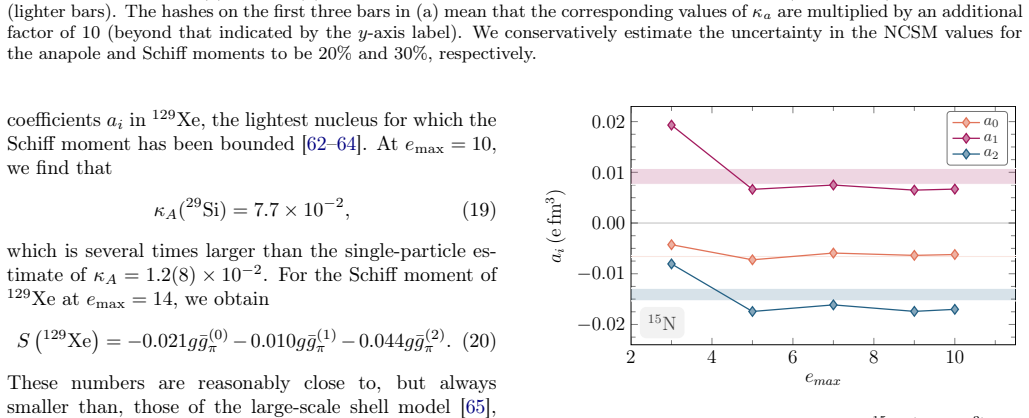
Symmetry-violating observables such as the nuclear anapole and Schiff moments provide sensitive probes of the fundamental symmetries of nature and physics beyond the Standard Model. Their interpretation has been hindered, however, by the lack of ab initio nuclear structure calculations in the medium-mass and heavy nuclei of interest to experimentalists. To provide them, we introduce a new version of the in-medium similarity renormalization group (IMSRG) designed to target parity-violating operators. By generalizing the IMSRG flow equations to evolve the weak symmetry-breaking Hamiltonian - and the anapole or Schiff operators - alongside the strong nuclear Hamiltonian, we construct a systematically improvable framework for computing these parity-violating moments. We benchmark the method against the no-core shell model in light nuclei and obtain the first ab initio predictions of the anapole moment in $^{29}$Si and the Schiff moments in $^{129}$Xe. These heavier systems are of direct experimental interest.
Editorial analysis
A structured set of objections, weighed in public.
Referee Report
Summary. The manuscript introduces a generalized in-medium similarity renormalization group (IMSRG) framework that evolves the weak parity-violating Hamiltonian and the anapole or Schiff operators simultaneously with the strong nuclear Hamiltonian. It benchmarks the approach against no-core shell model results in light nuclei and reports the first ab initio predictions for the anapole moment of 29Si and the Schiff moments of 129Xe.
Significance. If the truncation errors are controlled, the work supplies the first systematically improvable ab initio calculations of parity-violating moments in medium-mass and heavy nuclei that are directly relevant to ongoing experiments searching for physics beyond the Standard Model. The technical extension of IMSRG to symmetry-breaking operators is a clear advance, and the provision of concrete predictions for 129Xe strengthens the connection to experiment.
major comments (1)
- [Application to 29Si and 129Xe] The central claim that the generalized IMSRG flow yields systematically improvable results for 29Si and 129Xe rests on the assumption that the chosen truncation (typically IMSRG(2)) captures all relevant induced correlations from the parity-violating operators. The light-nucleus NCSM benchmarks test this only in regimes where many-body effects are simpler; no explicit convergence checks, induced three-body operator analysis, or quantitative error estimates are provided for the heavier systems, leaving the accuracy of the predictions for 129Xe unverified.
Simulated Author's Rebuttal
We thank the referee for the positive evaluation of our work and for the constructive major comment. We address it point by point below, acknowledging the limitations of the current calculations while clarifying the systematic character of the approach.
read point-by-point responses
-
Referee: The central claim that the generalized IMSRG flow yields systematically improvable results for 29Si and 129Xe rests on the assumption that the chosen truncation (typically IMSRG(2)) captures all relevant induced correlations from the parity-violating operators. The light-nucleus NCSM benchmarks test this only in regimes where many-body effects are simpler; no explicit convergence checks, induced three-body operator analysis, or quantitative error estimates are provided for the heavier systems, leaving the accuracy of the predictions for 129Xe unverified.
Authors: We agree that the light-nucleus benchmarks do not constitute a direct convergence test for 29Si or 129Xe. The IMSRG(2) truncation is the standard approximation employed throughout the IMSRG literature for medium-mass nuclei, and the light-nucleus comparisons show that it reproduces NCSM results for the anapole and Schiff moments to within a few percent. We therefore expect the induced higher-body contributions from the parity-violating operators to remain modest, consistent with the behavior observed for the strong Hamiltonian. Explicit IMSRG(3) calculations or a full induced three-body operator analysis for 129Xe are, however, computationally prohibitive at present. In the revised manuscript we will add a dedicated paragraph that quantifies the expected truncation uncertainty by extrapolating from the light-nucleus discrepancies and from analogous strong-interaction IMSRG studies, thereby providing readers with a clearer assessment of the accuracy of the 129Xe predictions. revision: partial
Circularity Check
No significant circularity: generalized IMSRG flow equations yield independent predictions
full rationale
The derivation introduces a generalization of the IMSRG flow to evolve parity-violating operators and the weak Hamiltonian in tandem with the strong interaction. This produces operator matrix elements that are then evaluated in the evolved basis for the target nuclei. Benchmarks against exact NCSM results in light nuclei serve as external validation rather than input fitting. Predictions for 29Si and 129Xe follow directly from the same evolved operators without redefinition or parameter adjustment tied to the final observables. No load-bearing step reduces by construction to a prior result from the same authors or to a fitted quantity renamed as a prediction. The framework remains systematically improvable under the stated truncation, with no self-referential closure identified in the chain.
Axiom & Free-Parameter Ledger
axioms (1)
- domain assumption The IMSRG flow equations remain valid when extended to include parity-violating operators.
Lean theorems connected to this paper
-
IndisputableMonolith/Foundation/RealityFromDistinction.leanreality_from_one_distinction unclear?
unclearRelation between the paper passage and the cited Recognition theorem.
By generalizing the IMSRG flow equations to evolve the weak symmetry-breaking Hamiltonian and the anapole or Schiff operators alongside the strong nuclear Hamiltonian, we construct a systematically improvable framework...
-
IndisputableMonolith/Cost/FunctionalEquation.leanwashburn_uniqueness_aczel unclear?
unclearRelation between the paper passage and the cited Recognition theorem.
dH(s)/ds = [η(s), H(s)] ... dO(s)/ds = [η(s), O(s)]
What do these tags mean?
- matches
- The paper's claim is directly supported by a theorem in the formal canon.
- supports
- The theorem supports part of the paper's argument, but the paper may add assumptions or extra steps.
- extends
- The paper goes beyond the formal theorem; the theorem is a base layer rather than the whole result.
- uses
- The paper appears to rely on the theorem as machinery.
- contradicts
- The paper's claim conflicts with a theorem or certificate in the canon.
- unclear
- Pith found a possible connection, but the passage is too broad, indirect, or ambiguous to say the theorem truly supports the claim.
Reference graph
Works this paper leans on
- [1]
-
[2]
Engel, Annual Review of Nuclear and Particle Science 75, 129–151 (2025)
J. Engel, Annual Review of Nuclear and Particle Science 75, 129–151 (2025)
work page 2025
-
[3]
T. E. Chupp, P. Fierlinger, M. J. Ramsey-Musolf, and J. T. Singh, Rev. Mod. Phys.91, 015001 (2019)
work page 2019
-
[4]
V. Dmitriev, I. Khriplovich, and V. Telitsin, Nuclear Physics A577, 691 (1994)
work page 1994
-
[5]
V. V. Flambaum and D. W. Murray, Phys. Rev. C56, 1641 (1997)
work page 1997
-
[6]
W. C. Haxton, C.-P. Liu, and M. J. Ramsey-Musolf, Physical Review C65(2002)
work page 2002
-
[7]
V. F. Dmitriev, R. A. Sen’kov, and N. Auerbach, Phys. Rev. C71, 035501 (2005)
work page 2005
- [9]
-
[10]
A. Ekström, C. Forssén, G. Hagen, G. R. Jansen, W. Jiang, and T. Papenbrock, Frontiers in Physics11 (2023)
work page 2023
-
[11]
E. Epelbaum, H.-W. Hammer, and U.-G. Meißner, Rev. Mod. Phys.81, 1773 (2009)
work page 2009
- [12]
-
[13]
H. Hergert, S. Bogner, T. Morris, A. Schwenk, and K. Tsukiyama, Physics Reports621, 165 (2016), memo- rial Volume in Honor of Gerald E. Brown
work page 2016
-
[14]
Hergert, Physica Scripta92, 023002 (2016)
H. Hergert, Physica Scripta92, 023002 (2016)
work page 2016
-
[15]
J. Simonis, S. R. Stroberg, K. Hebeler, J. D. Holt, and A. Schwenk, Physical Review C96(2017)
work page 2017
-
[16]
N.M.Parzuchowski, S.R.Stroberg, P.Navrátil, H.Herg- ert, and S. K. Bogner, Physical Review C96(2017)
work page 2017
-
[17]
Gysberset al., Nature Phys.15, 428 (2019)
P. Gysberset al., Nature Phys.15, 428 (2019)
work page 2019
-
[18]
S. R. Stroberg, J. D. Holt, A. Schwenk, and J. Simonis, Phys. Rev. Lett.126, 022501 (2021)
work page 2021
- [19]
-
[20]
J. M. Yao, A. Belley, R. Wirth, T. Miyagi, C. G. Payne, S. R. Stroberg, H. Hergert, and J. D. Holt, Phys. Rev. C103, 014315 (2021)
work page 2021
- [21]
-
[22]
B. S. Hu, J. Padua-Argüelles, S. Leutheusser, T. Miyagi, S. R. Stroberg, and J. D. Holt, Phys. Rev. Lett.128, 072502 (2022)
work page 2022
-
[23]
B. Hu, W. Jiang, T. Miyagi, Z. Sun, A. Ekström, C. Forssén, G. Hagen, J. D. Holt, T. Papenbrock, S. R. Stroberg, and I. Vernon, Nature Physics (2022)
work page 2022
- [24]
- [25]
- [26]
-
[27]
S. Ban, J. Dobaczewski, J. Engel, and A. Shukla, Phys. Rev. C82, 015501 (2010)
work page 2010
-
[28]
T. D. Morris, N. M. Parzuchowski, and S. K. Bogner, Phys. Rev. C92, 034331 (2015)
work page 2015
-
[29]
S. R. Stroberg, S. K. Bogner, H. Hergert, and J. D. Holt, Ann. Rev. Nucl. Part. Sci.69, 307 (2019)
work page 2019
- [30]
-
[31]
N. Shimizu, T. Mizusaki, Y. Utsuno, and Y. Tsunoda, Comput. Phys. Commun.244, 372 (2019)
work page 2019
-
[32]
Y. B. Zel’dovich,33, 1488 (1957)
work page 1957
-
[33]
Y. B. Zel’dovich,33, 1531 (1957)
work page 1957
- [34]
- [35]
-
[36]
M.S.Safronova, D.Budker, D.DeMille, D.F.J.Kimball, A. Derevianko, and C. W. Clark, Rev. Mod. Phys.90, 025008 (2018)
work page 2018
- [37]
-
[38]
W. C. Haxton, E. M. Henley, and M. J. Musolf, Phys. Rev. Lett.63, 949 (1989)
work page 1989
-
[39]
B. Desplanques, J. F. Donoghue, and B. R. Holstein, Annals of Physics124, 449 (1980)
work page 1980
-
[40]
B.et al.(NPDGamma Collaboration) (NPDGamma Collaboration), Phys
D. B.et al.(NPDGamma Collaboration) (NPDGamma Collaboration), Phys. Rev. Lett.121, 242002 (2018)
work page 2018
-
[41]
Y. Hao, P. Navrátil, E. B. Norrgard, M. Iliaš, E. Eliav, R. G. E. Timmermans, V. V. Flambaum, and A. Borschevsky, Phys. Rev. A102, 052828 (2020)
work page 2020
-
[42]
J. de Vries, E. Epelbaum, L. Girlanda, A. Gnech, E. Mereghetti, and M. Viviani, Frontiers in Physics8 (2020)
work page 2020
-
[43]
L. I. Schiff, Phys. Rev.132, 2194 (1963)
work page 1963
- [44]
-
[45]
W. C. Haxton and E. M. Henley, Phys. Rev. Lett.51, 1937 (1983)
work page 1937
-
[46]
N. R. Roberson, C. R. Gould, and J. D. Bowman (1987)
work page 1987
- [47]
-
[48]
V. Flambaum, I. Khriplovich, and O. Sushkov, Nuclear Physics A449, 750 (1986)
work page 1986
-
[49]
O. P. Sushkov, V. V. Flambaum, and I. B. Khriplovich, Sov. Phys. - JETP60:5(1984)
work page 1984
-
[50]
S. R. Stroberg, T. D. Morris, and B. C. He, Phys. Rev. C110, 044316 (2024). 7
work page 2024
-
[51]
B. C. He and S. R. Stroberg, Phys. Rev. C110, 044317 (2024)
work page 2024
- [52]
-
[53]
Computational schemes for the Magnus expansion of the in-medium similarity renormalization group
M. Heinz, “On computational schemes for the magnus expansion of the in-medium similarity renormalization group,” (2026), arXiv:2601.16133 [nucl-th]
work page internal anchor Pith review Pith/arXiv arXiv 2026
- [54]
- [55]
-
[56]
K. B. Ng, S. Foster, L. Cheng, P. Navrátil, and S. Malbrunot-Ettenauer, Phys. Rev. Lett.136, 112501 (2026)
work page 2026
-
[57]
V. Somà, P. Navrátil, F. Raimondi, C. Barbieri, and T. Duguet, Phys. Rev. C101, 014318 (2020)
work page 2020
-
[58]
D. R. Entem and R. Machleidt, Phys. Rev. C68, 041001 (2003)
work page 2003
- [59]
-
[60]
V. F. Dmitriev and V. B. Telitsin, Nuclear Physics A 613, 237–252 (1997)
work page 1997
-
[61]
J. Karthein, S. M. Udrescu, S. B. Moroch, I. Belose- vic, K. Blaum, A. Borschevsky, Y. Chamorro, D. De- Mille, J. Dilling, R. F. Garcia Ruiz, N. R. Hutzler, L. F. Pašteka, and R. Ringle, Phys. Rev. Lett.133, 033003 (2024)
work page 2024
-
[62]
M. A. Rosenberry and T. E. Chupp, Phys. Rev. Lett.86, 22 (2001)
work page 2001
-
[63]
N. Sachdeva, I. Fan, E. Babcock, M. Burghoff, T. Chupp, S. Degenkolb, P. Fierlinger, S. Haude, E. Kraegeloh, W. Kilian, S. Knappe-Grüneberg, F. Kuchler, T. Liu, M. Marino, J. Meinel, K. Rolfs, Z. Salhi, A. Schnabel, J. Singh, S. Stuiber, W. Terrano, L. Trahms, and J. Voigt, Physical Review Letters123(2019)
work page 2019
-
[64]
F. Allmendinger, I. Engin, W. Heil, S. Karpuk, H.-J. Krause, B. Niederländer, A. Offenhäusser, M. Repetto, U. Schmidt, and S. Zimmer, Phys. Rev. A100, 022505 (2019)
work page 2019
- [65]
- [66]
-
[67]
C. Sanderson and R. Curtin, Journal of Open Source Software1, 26 (2016)
work page 2016
-
[68]
Miyagi, The European Physical Journal A59, 150 (2023)
T. Miyagi, The European Physical Journal A59, 150 (2023)
work page 2023
-
[69]
V. Flambaum, I. Khriplovich, and O. Sushkov, Physics Letters B146, 367 (1984)
work page 1984
- [70]
-
[71]
P. Fadeev and V. V. Flambaum, Phys. Rev. C100, 015504 (2019). End of Matter Single particle estimates—Well-known “single- particle” estimates, coming from the assumption that the parity violating nuclear moment is due only to a valence nucleon, are based on a picture in which both the strong nucleon-nucleon interaction and the P- or T-violating in- teract...
work page 2019
discussion (0)
Sign in with ORCID, Apple, or X to comment. Anyone can read and Pith papers without signing in.