Recognition: 2 theorem links
· Lean TheoremCorrelations Between Quantum Battery Capacity and Quantum Resources for Two-qubit System
Pith reviewed 2026-05-13 02:29 UTC · model grok-4.3
The pith
In a two-qubit quantum battery, capacity decreases monotonically with entanglement, steering, Bell nonlocality and coherence, peaking when they vanish.
A machine-rendered reading of the paper's core claim, the machinery that carries it, and where it could break.
Core claim
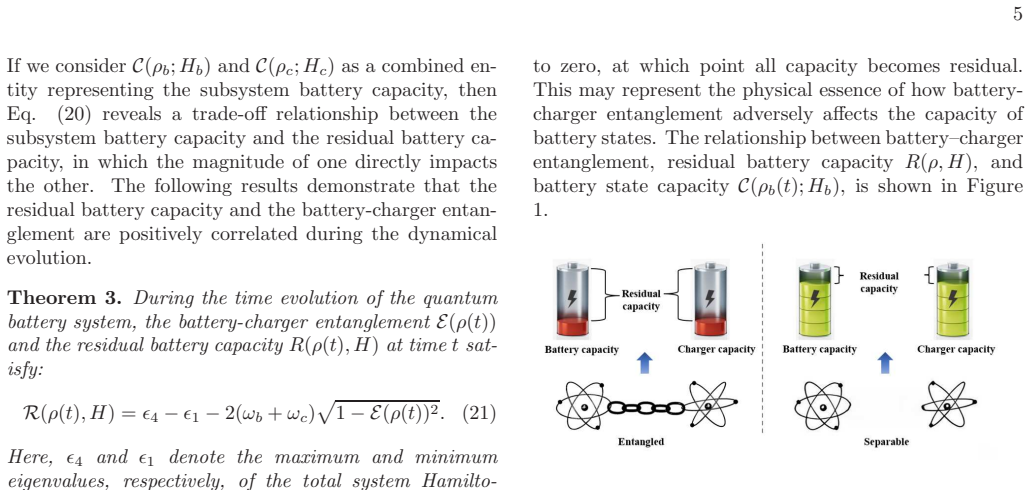
The battery capacity decreases monotonically with the quantum entanglement, steering, Bell nonlocality and coherence, and peaks when these four quantum resources vanish. We reveal the capacity gap between the total system capacity and the sum of the battery and charger spin capacities, which is the residual battery capacity, and establish its positive correlation with entanglement. Unlike the first four resources, although the battery capacity decreases monotonically with quantum imaginarity, its disappearance under system detuning does not guarantee a peak capacity. The quantum state texture shows a positive correlation with battery capacity, but a negative correlation with entanglement, 0,
What carries the argument
The mutually coupled two-qubit battery-charger system and the standard quantitative measures of quantum resources (entanglement, steering, Bell nonlocality, coherence, imaginarity, and state texture) applied to its time evolution under a fixed Hamiltonian.
Load-bearing premise
The chosen two-qubit Hamiltonian and the standard definitions of battery capacity as maximum extractable work and of the resource measures remain valid throughout the evolution without other dynamical effects altering the monotonicities.
What would settle it
A simulation or experiment in the same coupled two-qubit dynamics showing battery capacity increasing or remaining constant as entanglement increases would falsify the reported monotonic decrease.
Figures


read the original abstract
We investigate the relationship between quantum battery capacity and quantum resources in a two-qubit system consisting of mutually coupled battery and charger subsystems. We find that the battery capacity decreases monotonically with the quantum entanglement, steering, Bell nonlocality and coherence, and peaks when these four quantum resources vanish. Moreover, we reveal the capacity gap between the total system capacity and the sum of the battery and charger spin capacities, which is the residual battery capacity, and establish its positive correlation with entanglement. Furthermore, unlike the first four resources, although the battery capacity decreases monotonically with quantum imaginarity, its disappearance under system detuning does not guarantee a peak capacity, and this effect becomes more pronounced as the detuning increases. In contrast to the first five resources, the quantum state texture shows a positive correlation with battery capacity, but a negative correlation with entanglement, steering, Bell nonlocality, coherence, imaginarity, and residual battery capacity. These monotonic relationships are independent of the choice of system parameters. Our findings reveal the relationship between quantum battery capacity and quantum resources during the dynamic evolution of a quantum battery system, and advances the theory of quantum batteries and the development of quantum energy storage systems.
Editorial analysis
A structured set of objections, weighed in public.
Referee Report
Summary. The paper investigates correlations in a two-qubit battery-charger system under unitary evolution. It reports that battery capacity (ergotropy-based) decreases monotonically with entanglement, steering, Bell nonlocality, and coherence, peaking when these resources vanish; the capacity gap (residual capacity) positively correlates with entanglement. Contrasting behaviors are noted for imaginarity (monotonic decrease but no guaranteed peak at zero under detuning) and texture (positive correlation with capacity, negative with other resources and residual capacity). All monotonic relations are claimed to hold independently of system parameter choices.
Significance. If the reported numerical monotonicities prove robust, the work provides useful empirical insights into trade-offs between quantum resources and extractable work in coupled quantum batteries, particularly via the capacity gap concept. It systematically compares multiple resource quantifiers in one dynamical setting. However, the model-specific and purely numerical character limits broader significance without analytic support, generalization, or verification against limits.
major comments (3)
- The explicit two-qubit Hamiltonian is not stated, nor are the parameter ranges (coupling, detuning, etc.) over which independence is asserted. This is load-bearing for the central claim of parameter-independent monotonicities, as the dynamics and resource-capacity relations depend directly on it.
- No error bars, convergence tests on the time evolution, or comparisons to analytic limits (e.g., product states where resources vanish) are provided for the capacity and resource measures. This undermines verification of the reported monotonic decreases and correlations.
- The results section presents the monotonic behaviors for specific cases only; without additional data or a dedicated check (e.g., table or multi-panel figure) across varied parameters, the independence claim cannot be assessed.
minor comments (3)
- Figures should include clear legends, axis labels, and captions specifying all fixed parameters used in each plot.
- Standard references for the ergotropy definition of battery capacity and the chosen resource monotones (entanglement, steering, etc.) should be cited explicitly if not already present.
- Notation for capacity, residual capacity, and the various resource measures should be introduced consistently in the text and equations.
Simulated Author's Rebuttal
We thank the referee for the careful reading of our manuscript and the constructive comments. We address each major comment below and will revise the manuscript to incorporate the suggested improvements.
read point-by-point responses
-
Referee: The explicit two-qubit Hamiltonian is not stated, nor are the parameter ranges (coupling, detuning, etc.) over which independence is asserted. This is load-bearing for the central claim of parameter-independent monotonicities, as the dynamics and resource-capacity relations depend directly on it.
Authors: We acknowledge the need for greater explicitness. The Hamiltonian is introduced in the model description but will be written out in full equation form (including all coupling, detuning, and driving terms) together with the precise numerical ranges explored for each parameter. These additions will be placed in the revised Methods/Model section to make the basis for the parameter-independence claim transparent. revision: yes
-
Referee: No error bars, convergence tests on the time evolution, or comparisons to analytic limits (e.g., product states where resources vanish) are provided for the capacity and resource measures. This undermines verification of the reported monotonic decreases and correlations.
Authors: We agree that these verifications are important for rigor. Because the two-qubit dynamics are exactly solvable by unitary exponentiation, we will add (i) error bars derived from floating-point precision and time-step convergence, (ii) explicit convergence plots, and (iii) direct comparisons against the analytic product-state limit (where all listed resources vanish and capacity reaches its maximum) in the revised Results section. revision: yes
-
Referee: The results section presents the monotonic behaviors for specific cases only; without additional data or a dedicated check (e.g., table or multi-panel figure) across varied parameters, the independence claim cannot be assessed.
Authors: To substantiate the independence claim, we will include a new multi-panel figure (or supplementary table) that repeats the capacity-versus-resource plots for several distinct values of coupling strength and detuning. This will provide direct visual evidence that the reported monotonic relations persist across the explored parameter space. revision: yes
Circularity Check
No significant circularity
full rationale
The paper numerically evolves a specific two-qubit battery-charger Hamiltonian, obtains the time-dependent state, and evaluates standard, independently defined quantities (ergotropy for capacity; concurrence/steering/CHSH/coherence/imaginarity/texture for resources) on that state. Observed monotonicities and correlations are direct computational outputs, not reductions of one quantity to a fitted or redefined version of another. No self-citations supply load-bearing uniqueness theorems, no ansatzes are smuggled, and no parameter is fitted then relabeled as a prediction. The results are self-contained empirical findings within the closed unitary model.
Axiom & Free-Parameter Ledger
axioms (2)
- domain assumption Unitary evolution generated by a time-independent two-qubit Hamiltonian with XX or XY coupling plus possible detuning term.
- domain assumption Battery capacity equals the ergotropy of the battery subsystem (maximum work extractable by unitary on battery alone).
Lean theorems connected to this paper
-
IndisputableMonolith/Cost/FunctionalEquation.leanwashburn_uniqueness_aczel unclear?
unclearRelation between the paper passage and the cited Recognition theorem.
C(ρ;H) = Tr[ρ↑H] − Tr[ρ↓H] ... C(ρb(t);Hb) = 2ωb √(1 − E(ρ(t))²)
-
IndisputableMonolith/Foundation/AlphaCoordinateFixation.leanalpha_pin_under_high_calibration unclear?
unclearRelation between the paper passage and the cited Recognition theorem.
Hamiltonian H = Hb + Hc + HI with J1(σb+σc− + σb−σc+) + J2 σbz σcz
What do these tags mean?
- matches
- The paper's claim is directly supported by a theorem in the formal canon.
- supports
- The theorem supports part of the paper's argument, but the paper may add assumptions or extra steps.
- extends
- The paper goes beyond the formal theorem; the theorem is a base layer rather than the whole result.
- uses
- The paper appears to rely on the theorem as machinery.
- contradicts
- The paper's claim conflicts with a theorem or certificate in the canon.
- unclear
- Pith found a possible connection, but the passage is too broad, indirect, or ambiguous to say the theorem truly supports the claim.
Reference graph
Works this paper leans on
-
[1]
The table I compares the analytical and numerical values of the battery capacity at given times
05). The table I compares the analytical and numerical values of the battery capacity at given times. Time t Analytical solution Cana Numerical solution Cnum 5.005 1.0789 1.0789 10.01 0.8359 0.8359 15.02 1.9811 1.9808 20.02 1.3012 1.3012 25.03 0.5788 0.5769 TABLE I: The times t are taken from the numerical sampling points, analytical values are computed f...
- [2]
-
[3]
R. Alicki and M. Fannes, Entanglement boost for ex- tractable work from ensembles of quantum batteries,, Phys. Rev. E 87, 042123 (2013)
work page 2013
-
[4]
G. M. Andolina, M. Keck, A. Mari, M. Campisi, V. Gio- vannetti and M. Polini, Extractable work, the role of cor- relations, and asymptotic freedom in quantum batteries, Phys. Rev. Lett. 122, 047702 (2019)
work page 2019
- [5]
-
[6]
D. Rossini, G. M. Andolina and M. Polini, Many-body localized quantum batteries, Phys. Rev. B 100, 115142 (2019)
work page 2019
-
[7]
D. Rossini, G. M. Andolina, D. Rosa, M. Carrega and M. Polini, Quantum advantage in the charging process of Sachdev-Ye-Kitaev batteries, Phys. Rev. Lett. 125, 236402 (2020)
work page 2020
-
[8]
K. V. Hovhannisyan, M. Perarnau-Llobet, M. Huber and A. Ac ´ ın. Entanglement generation is not necessary for optimal work extraction, Phys. Rev. Lett. 111, 240401 (2013)
work page 2013
-
[9]
M. Perarnau-Llobet, K. V. Hovhannisyan, M. Huber, P. Skrzypczyk, N. Brunner and A. Ac ´ ın, Extractable work from correlations, Phys. Rev. X 5, 041011 (2015)
work page 2015
-
[10]
A. Mukherjee, A. Roy, S. S. Bhattacharya and M. Banik, Presence of quantum correlations results in a nonvanish- ing ergotropic gap, Phys. Rev. E 93, 052140 (2016)
work page 2016
-
[11]
L. P. Garc ´ ıa-Pintos, A. Hamma and A. del Campo, Fluc- tuations in extractable work bound the charging power of quantum batteries, Phys. Rev. Lett. 125, 040601 (2020)
work page 2020
-
[12]
G. Francica, F. C. Binder, G. Guarnieri, M. T. Mitchi- son, J. Goold and F. Plastina, Quantum coherence and ergotropy, Phys. Rev. Lett. 125, 180603 (2020)
work page 2020
-
[13]
F. H. Kamin, F. T. Tabesh and S. Salimi, Entanglement, coherence, and charging process of quantum batteries, Phys. Rev. E 102, 052109 (2020)
work page 2020
-
[14]
Francica, Quantum correlations and ergotropy, Phys
G. Francica, Quantum correlations and ergotropy, Phys . Rev. E 105, L052101 (2022)
work page 2022
-
[15]
M. B. Arjmandi, A. Shokri, E. Faizi and H. Mohammadi, Performance of quantum batteries with correlated and uncorrelated chargers, Phys. Rev. A 106, 062609 (2022)
work page 2022
-
[16]
H.L. Shi, S. Ding, Q.K. Wan, X.H. Wang and W.L. Yang, Entanglement, coherence, and extractable work in quan- tum batteries, Phys. Rev. Lett. 129, 130602 (2022)
work page 2022
- [17]
-
[18]
G. Manzano, F. Plastina and R. Zambrini, Optimal work extraction and thermodynamics of quantum measure- ments and correlations, Phys. Rev. Lett. 121, 120602 (2018)
work page 2018
-
[19]
W. Lu, J. Chen, L.M. Kuang and X. Wang, Optimal state for a Tavis-Cummings quantum battery via the Bethe ansatz method, Phys. Rev. A 104, 043706 (2021)
work page 2021
- [20]
-
[21]
A. G. Catalano, S. M. Giampaolo, O. Morsch, V. Giovan- netti and F. Franchini, Frustrating quantum batteries, PRX Quantum 5, 030319 (2024)
work page 2024
- [22]
-
[23]
R. Castellano, R. Nery, K. Simonov and D. Farina, Paral- lel ergotropy: Maximum work extraction via parallel lo- cal unitary operations, Phys. Rev. A 111, 012212 (2025)
work page 2025
- [24]
-
[25]
T. P. Le, J. Levinsen, K. Modi, M. Parish and F. A. Pol- lock, Spin-chain model of a many-body quantum battery, Phys. Rev. A 97, 022106 (2018)
work page 2018
- [26]
-
[27]
F.Q. Dou, H. Zhou and J.A. Sun, Cavity Heisenberg- spin chain quantum battery, Phys. Rev. A 106, 032212 (2022)
work page 2022
- [28]
-
[29]
G. M. Andolina, D. Farina, A. Mari, V. Pellegrini, V. Giovannetti and M. Polini, Charger-mediated energy transfer in exactly solvable models for quantum batteries, Phys. Rev. B 98, 205423 (2018)
work page 2018
-
[30]
Y. V. de Almeida, T. F. F. Santos and M. F. Santos, Cooperative isentropic charging of hybrid quantum bat- teries, Phys. Rev. A 108, 052218 (2023)
work page 2023
- [31]
-
[32]
Y.Y. Zhang, T.R. Yang, L. Fu and X. Wang, Powerful harmonic charging in a quantum battery, Phys. Rev. E 99, 052106 (2019)
work page 2019
- [33]
- [34]
-
[35]
F.M. Yang and F.Q. Dou, Resonator-qutrit quantum bat- tery, Phys. Rev. A 109, 062432 (2024)
work page 2024
- [36]
- [37]
-
[38]
Z.G. Lu, G. Tian, X.Y. L¨ u and C. Shang, Topological quantum batteries, Phys. Rev. Lett. 134, 180401 (2025)
work page 2025
-
[39]
Barra, Dissipative charging of a quantum battery, Phys
F. Barra, Dissipative charging of a quantum battery, Phys. Rev. Lett. 122, 210601 (2019)
work page 2019
-
[40]
F. T. Tabesh, F. H. Kamin and S. Salimi, Environment mediated charging process of quantum batteries, Phys. Rev. A 102, 052223 (2020)
work page 2020
-
[41]
F. H. Kamin, F. T. Tabesh, S. Salimi, F. Kheirandish and A. C. Santos, Non-Markovian effects on charging and self discharging process of quantum batteries, New J. Phys. 22, 083007 (2020)
work page 2020
-
[42]
M. Carrega, A. Crescente, D. Ferraro and M. Sassetti, Dissipative dynamics of an open quantum battery, New J. Phys. 22, 083085 (2020)
work page 2020
-
[43]
J. Q. Quach and W. J. Munro, Using dark states to charge and stabilize open quantum batteries, Phys. Rev. Appl. 14, 024092 (2020)
work page 2020
-
[44]
W. Chang, T.R. Yang, H. Dong, L.Fu, X. Wang and Y.Y. Zhang, Optimal building block of multipartite quantum battery in the driven-dissipative charging, New J. Phys. 23, 103026 (2021)
work page 2021
- [45]
-
[46]
M. B. Arjmandi, H. Mohammadi and A. C. Santos, En- hancing self-discharging process with disordered quan- tum batteries, Phys. Rev. E 105, 054115 (2022)
work page 2022
-
[47]
F. Centrone, L. Mancino and M. Paternostro, Charging batteries with quantum squeezing, Phys. Rev. A 108, 052213 (2023)
work page 2023
- [48]
- [49]
-
[50]
S.Q. Liu, L. Wang, H. Fan, F.L. Wu and S.Y. Liu, Better performance of quantum batteries in different environ- ments compared to closed batteries, Phys. Rev. A 109, 042411 (2024)
work page 2024
-
[51]
F. Campaioli, S. Gherardini, J. Q. Quach, M. Polini and G. M. Andolina, Colloquium: Quantum batteries, Rev. Mod. Phys. 96, 031001 (2024)
work page 2024
-
[52]
G. M. Andolina, V. Stanzione, V. Giovannetti and M. Polini, Genuine quantum advantage in non-linear bosonic quantum batteries, Phys. Rev. Lett. 134, 240403 (2025)
work page 2025
- [53]
-
[54]
H.Y. Yang, K. Zhang, X.H. Wang and H.L. Shi, Opti- mal energy storage and collective charging speedup in the central-spin quantum battery, Phys. Rev. B 111, 085410 (2025)
work page 2025
-
[55]
M.L. Hu, T. Gao and H. Fan, Efficient wireless charging of a quantum battery, Phys. Rev. A 111, 042216 (2025)
work page 2025
- [56]
-
[57]
J.T. Zhang, C.G. Liu and Q. Ai, Electromagnetically in- duced transparency effect improves quantum battery life- time, Phys. Rev. A 112, 043705 (2025)
work page 2025
- [58]
-
[59]
F.M. Yang and F.Q. Dou, Wireless energy transfer in non-Hermitian quantum battery, Phys. Rev. A 112, 042205 (2025)
work page 2025
-
[60]
C. A. Downing and M. S. Ukhtary, Energy storage in a continuous-variable quantum battery with nonlinear cou- pling, Phys. Rev. E 112, 044143 (2025)
work page 2025
- [61]
- [62]
- [63]
-
[64]
A. Ali, S. Al-Kuwari, M. I. Hussain, T. Byrnes, M. T. Rahim, J. Q. Quach, M. Ghominejad and S. Had- dadi, Ergotropy and capacity optimization in Heisenberg spin-chain quantum batteries, Phys. Rev. A 110, 052404 (2024)
work page 2024
-
[65]
Y. Wang, X. Huang and T. Zhang, Distribution relation- ship of quantum battery capacity, Adv. Quantum Tech- nol. 2400652 (2025)
work page 2025
-
[66]
Y. Wang, H. Liu, S.M. Fei and T. Zhang, Improving quantum battery capacity in tripartite quantum systems by local projective measurements, Adv. Quantum Tech- 12 nol. 2500095 (2025)
work page 2025
- [67]
- [68]
-
[69]
W. K. Wootters, Entanglement of formation of an ar- bitrary state of two qubits, Phys. Rev. Lett. 80, 2245 (1998)
work page 1998
-
[70]
K. Chen, S. Albeverio and S.M. Fei, Concurrence of arbi- trary dimensional bipartite quantum states, Phys. Rev. Lett. 95, 040504 (2005)
work page 2005
-
[71]
R. Horodecki, P. Horodecki, M. Horodecki, and K. Horodecki, Quantum entanglement, Rev. Mod. Phys. 81, 865 (2009)
work page 2009
-
[72]
O. G¨ uhne, G. T´ oth, Entanglement detection, Physics Re- ports 474, 1 (2009)
work page 2009
-
[73]
Z.H. Ma, Z.H. Chen, J.L. Chen , C. Spengler, A. Gabriel and M. Huber, Measure of genuine multipartite entangle- ment with computable lower bounds, Phys. Rev. A 83, 062325 (2011)
work page 2011
-
[74]
M. T. Quintino, T. V´ ertesi, D. Cavalcanti, R. Augusiak , M. Demianowicz, A. Ac ´ ın and N. Brunner, Inequivalence of entanglement, steering, and Bell nonlocality for gen- eral measurements, Phys. Rev. A 92, 032107 (2015)
work page 2015
-
[75]
E. G. Cavalcanti, S. J. Jones, H. M. Wiseman and M. D. Reid, Experimental criteria for steering and the Einstein-Podolsky-Rosen paradox, Phys. Rev. A 80, 032112 (2009)
work page 2009
-
[76]
A. C. S. Costa and R. M. Angelo, Quantification of Einstein-Podolski-Rosen steering for two-qubit states, Phys. Rev. A 93, 020103 (2016)
work page 2016
-
[77]
B. Paul and K. Mukherjee, Shareability of quantum steering and its relation with entanglement, Phys. Rev. A 102, 052209 (2020)
work page 2020
-
[78]
R. Horodecki, P. Horodecki and M. Horodecki, Violating Bell inequality by mixed spin- 1 2 states: necessary and sufficient condition, Phys. Lett. A 200, 340 (1995)
work page 1995
-
[79]
T. Baumgratz, M. Cramer and M. B. Plenio, Quantifying coherence, Phys. Rev. Lett. 113, 140401 (2014)
work page 2014
-
[80]
A. Hickey and G. Gour, Quantifying the imaginarity of quantum mechanics, J. Phys. A: Math. Theor. 51, 414009 (2018)
work page 2018
discussion (0)
Sign in with ORCID, Apple, or X to comment. Anyone can read and Pith papers without signing in.