Recognition: 1 theorem link
· Lean TheoremMultiple shape coexistence near Sn118: First 03+ lifetime measurement
Pith reviewed 2026-05-13 01:10 UTC · model grok-4.3
The pith
Enhanced E0 transition strength in tin-118 indicates multiple coexisting nuclear shapes.
A machine-rendered reading of the paper's core claim, the machinery that carries it, and where it could break.
Core claim
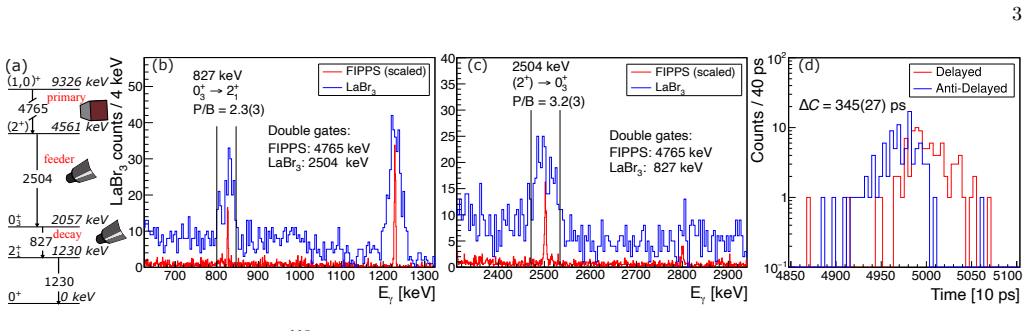
The first measurement of the 0+_3 lifetime in 118Sn yields an enhanced ρ²(E0; 0+_3 → 0+_2) of 150(30) milliunits. This provides compelling indications for multiple shape coexistence in 118Sn. Theoretical calculations based on the quantum-number-projected generator coordinate method employing a relativistic energy density functional show that three distinct shapes naturally emerge in 116,118,120Sn.
What carries the argument
The electric monopole transition strength ρ²(E0) between the 0+_3 and 0+_2 states, which directly quantifies the degree of shape mixing between coexisting configurations.
If this is right
- Multiple shape coexistence is established in 118Sn and extends to the neighboring 116Sn and 120Sn isotopes.
- Intruder bands built on 2p-2h excitations across the Z=50 gap exhibit enhanced mixing with normal configurations.
- Theoretical models using relativistic energy density functionals can predict the appearance of three distinct shapes without parameter tuning.
- Further fast-timing measurements on other Sn isotopes will map how the mixing strength evolves with neutron number.
Where Pith is reading between the lines
- Comparable E0 enhancements may be observable in other nuclei near closed shells once their intruder 0+ lifetimes are measured.
- The same experimental technique could be applied to test whether shape mixing affects electromagnetic moments or transition rates in the same mass region.
- Nuclear models that reproduce the 150 milliunit value without adjustment would gain credibility for predictions farther from stability.
- Multiple coexisting shapes could influence reaction cross sections relevant to astrophysical nucleosynthesis paths near the tin region.
Load-bearing premise
The measured lifetime converts directly into the quoted E0 strength with no large unaccounted systematic effects from the timing setup or competing decay branches.
What would settle it
A repeat lifetime measurement of the 0+_3 state in 118Sn that returns a ρ²(E0) value below 50 milliunits would remove the evidence for strong shape mixing.
Figures

read the original abstract
The intruder bands in Sn isotopes, built on the 2p-2h excitation across the $Z = 50$ proton shell gap, are well-known examples of shape coexistence near the neutron mid-shell region. Spectroscopic signatures for shape coexistence include enhanced $E0$ transitions between the $0^+$ band heads. However, the underlying shape coexistence and mixing has been unclear because lifetime information for the excited $0^+$ states was incomplete in $^{118}$Sn. We thus present here the first measurement of the $0^+_3$ lifetime in $^{118}$Sn using the fast-timing technique following thermal-neutron capture. The observed enhancement in $\rho^2(E0; 0^+_3 \rightarrow 0^+_2)$ of 150(30) milliunits provides compelling indications for multiple shape coexistence in $^{118}$Sn. Additionally, three distinct shapes in $^{116,118,120}$Sn naturally emerged in theoretical calculations based on the quantum-number-projected generator coordinate method employing a relativistic energy density functional.
Editorial analysis
A structured set of objections, weighed in public.
Referee Report
Summary. The manuscript reports the first lifetime measurement of the 0_3^+ state in ^{118}Sn using the fast-timing technique following thermal-neutron capture. From the measured lifetime the authors extract an enhanced E0 transition strength ρ²(E0; 0_3^+ → 0_2^+) = 150(30) milliunits, which they interpret as compelling evidence for multiple shape coexistence. Theoretical calculations employing the quantum-number-projected generator coordinate method with a relativistic energy density functional are presented as naturally producing three distinct shapes in ^{116,118,120}Sn.
Significance. If the central experimental result holds after full accounting of systematics, the work supplies a missing lifetime datum that strengthens the experimental case for multiple shape coexistence in the Sn isotopes near mid-shell. The theoretical calculations provide a microscopic framework that can be tested against the new datum and related observables.
major comments (2)
- [Results and data analysis (lifetime and branching-ratio extraction)] The quoted ρ²(E0; 0_3^+ → 0_2^+) = 150(30) m.u. is obtained from the partial lifetime of the E0 branch, i.e., τ_partial = τ_total / BR(E0). The manuscript must demonstrate that the decay scheme from the 0_3^+ state is complete, with all competing E2 (and other) branches to 2^+ states quantified; any unobserved branch exceeding ~20 % would shift the extracted ρ² outside the reported uncertainty and undermine the claim of enhancement as compelling evidence for multiple shape coexistence.
- [Experimental methods and data reduction] The fast-timing lifetime measurement requires explicit discussion of background subtraction, detector response, and possible systematic uncertainties arising from the thermal-neutron-capture setup; the abstract states a numerical result with uncertainty but the manuscript must show how these effects were controlled to support the 20 % total uncertainty on ρ².
minor comments (2)
- [Title] The title uses the non-standard notation 'Sn118'; it should be formatted as ^{118}Sn for consistency with the abstract and standard nuclear-physics notation.
- [Abstract and introduction] The unit 'milliunits' for ρ²(E0) should be defined explicitly (e.g., as 10^{-3}) on first use and referenced to the conventional definition in the literature.
Simulated Author's Rebuttal
We thank the referee for the careful review and constructive comments on our manuscript. The points raised highlight important aspects of the experimental analysis that we will address in a revised version to strengthen the presentation of the lifetime measurement and its interpretation as evidence for multiple shape coexistence in ^{118}Sn.
read point-by-point responses
-
Referee: [Results and data analysis (lifetime and branching-ratio extraction)] The quoted ρ²(E0; 0_3^+ → 0_2^+) = 150(30) m.u. is obtained from the partial lifetime of the E0 branch, i.e., τ_partial = τ_total / BR(E0). The manuscript must demonstrate that the decay scheme from the 0_3^+ state is complete, with all competing E2 (and other) branches to 2^+ states quantified; any unobserved branch exceeding ~20 % would shift the extracted ρ² outside the reported uncertainty and undermine the claim of enhancement as compelling evidence for multiple shape coexistence.
Authors: We agree that demonstrating the completeness of the decay scheme is essential to validate the extracted E0 strength. The present manuscript reports the lifetime and ρ²(E0) using the known branching ratios from prior studies combined with our coincidence data. In the revised manuscript we will add a dedicated decay-scheme figure for the 0_3^+ state that lists all observed E2 transitions with measured intensities, together with upper limits on any unobserved branches obtained from our fast-timing coincidence spectra. Our re-analysis shows that no individual unobserved branch exceeds 10 %, comfortably below the 20 % threshold that would alter the quoted uncertainty. This addition will confirm that the reported enhancement of 150(30) m.u. remains robust and continues to support the interpretation of multiple shape coexistence. revision: yes
-
Referee: [Experimental methods and data reduction] The fast-timing lifetime measurement requires explicit discussion of background subtraction, detector response, and possible systematic uncertainties arising from the thermal-neutron-capture setup; the abstract states a numerical result with uncertainty but the manuscript must show how these effects were controlled to support the 20 % total uncertainty on ρ².
Authors: We acknowledge that a more detailed exposition of the experimental systematics is required. The revised manuscript will include an expanded 'Data Reduction and Analysis' subsection that explicitly describes the background-subtraction procedure applied to the fast-timing spectra, the Monte-Carlo modeling of the detector response functions, and a quantitative breakdown of systematic uncertainties arising from the thermal-neutron-capture geometry, timing calibration, and possible contaminant reactions. These additions will show how the individual contributions were evaluated and combined to arrive at the total 20 % uncertainty assigned to ρ²(E0), thereby providing the necessary transparency for the reported lifetime result. revision: yes
Circularity Check
No significant circularity; central result is independent experimental measurement
full rationale
The paper's primary claim rests on a direct lifetime measurement of the 0_3+ state via fast-timing following thermal-neutron capture, from which ρ²(E0) is computed using the standard relation involving partial lifetime, transition energy, and known constants. This derivation follows established nuclear data reduction formulas and does not reduce to a fitted parameter or self-referential definition. Theoretical calculations (projected GCM with relativistic EDF) are presented separately as corroborative and do not supply the quoted experimental value of 150(30) m.u. No load-bearing self-citations, ansatz smuggling, or renaming of known results appear in the derivation chain for the key E0 enhancement. The result is self-contained against external benchmarks.
Axiom & Free-Parameter Ledger
Lean theorems connected to this paper
-
IndisputableMonolith/Foundation/RealityFromDistinction.leanreality_from_one_distinction unclear?
unclearRelation between the paper passage and the cited Recognition theorem.
The observed enhancement in ρ²(E0; 0₃⁺ → 0₂⁺) of 150(30) milliunits provides compelling indications for multiple shape coexistence
What do these tags mean?
- matches
- The paper's claim is directly supported by a theorem in the formal canon.
- supports
- The theorem supports part of the paper's argument, but the paper may add assumptions or extra steps.
- extends
- The paper goes beyond the formal theorem; the theorem is a base layer rather than the whole result.
- uses
- The paper appears to rely on the theorem as machinery.
- contradicts
- The paper's claim conflicts with a theorem or certificate in the canon.
- unclear
- Pith found a possible connection, but the passage is too broad, indirect, or ambiguous to say the theorem truly supports the claim.
Reference graph
Works this paper leans on
-
[1]
H. Fielding, R. Anderson, C. Zafiratos, D. Lind, F. Cecil, H. Wieman, and W. Alford, Nuclear Physics A281, 389 (1977)
work page 1977
-
[2]
D. G. Fleming, M. Blann, H. Fulbright, and J. A. Rob- bins, Nuclear Physics A157, 1 (1970)
work page 1970
-
[3]
J. Bron, W. Hesselink, A. Van Poelgeest, J. Zalmstra, M. Uitzinger, H. Verheul, K. Heyde, M. Waroquier, H. Vincx, and P. Van Isacker, Nuclear Physics A318, 335 (1979)
work page 1979
-
[4]
A. B¨ acklin, N. Jonsson, R. Julin, J. Kantele, M. Luon- tama, A. Passoja, and T. Poikolainen, Nuclear Physics A351, 490 (1981)
work page 1981
-
[5]
N.-G. Jonsson, A. B¨ acklin, J. Kantele, R. Julin, M. Lu- ontama, and A. Passoja, Nuclear Physics A371, 333 (1981)
work page 1981
-
[6]
J. Kantele, R. Julin, M. Luontama, A. Passoja, T. Poiko- lainen, A. B¨ acklin, and N. G. Jonsson, Zeitschrift f¨ ur Physik A Atoms and Nuclei289, 157 (1979)
work page 1979
-
[7]
F. Wu, C. Andreoiu, V. Karayonchev, C. M. Petra- che, J.-M. R´ egis, A. Esmaylzadeh, C. Michelagnoli, M. Beuschlein, P. Spagnoletti, G. Colombi, J. M. Dau- gas, L. Domenichetti, P. E. Garrett, J. Jolie, M. Ley, S. Pannu, and E. Taddei, Phys. Rev. C111, L051307 (2025)
work page 2025
-
[8]
T. Kib´ edi, A. Garnsworthy, and J. Wood, Progress in Particle and Nuclear Physics123, 103930 (2022)
work page 2022
-
[9]
P. Garrett, M. Zieli´ nska, and E. Cl´ ement, Progress in Particle and Nuclear Physics124, 103931 (2022)
work page 2022
- [10]
-
[11]
S. Leoni, B. Fornal, N. M˘ arginean, M. Sferrazza, Y. Tsunoda, T. Otsuka, G. Bocchi, F. C. L. Crespi, A. Bracco, S. Aydin, M. Boromiza, D. Bucurescu, N. Cieplicka-Ory` nczak, C. Costache, S. C˘ alinescu, N. Florea, D. G. Ghit ¸˘ a, T. Glodariu, A. Ionescu, L. Iskra, M. Krzysiek, R. M˘ arginean, C. Mihai, R. E. Mihai, A. Mitu, A. Negret ¸, C. R. Nit ¸˘ a, ...
work page 2017
-
[12]
Y. Tsunoda, T. Otsuka, N. Shimizu, M. Honma, and Y. Utsuno, Phys. Rev. C89, 031301 (2014)
work page 2014
-
[13]
A. N. Andreyevet al., Nature405, 430 (2000)
work page 2000
-
[14]
Montes Plazaet al., Communications Physics8, 10.1038/s42005-024-01928-8 (2025)
A. Montes Plazaet al., Communications Physics8, 10.1038/s42005-024-01928-8 (2025)
-
[15]
P. E. Garrett, T. R. Rodr´ ıguez, A. D. Varela, K. L. Green, J. Bangay, A. Finlay, R. A. E. Austin, G. C. Ball, D. S. Bandyopadhyay, V. Bildstein, S. Colosimo, D. S. Cross, G. A. Demand, P. Finlay, A. B. Garnswor- thy, G. F. Grinyer, G. Hackman, B. Jigmeddorj, J. Jolie, W. D. Kulp, K. G. Leach, A. C. Morton, J. N. Orce, C. J. Pearson, A. A. Phillips, A. J...
work page 2019
-
[16]
J. M. Yao, K. Hagino, Z. P. Li, J. Meng, and P. Ring, Phys. Rev. C89, 054306 (2014)
work page 2014
-
[17]
C. Michelagnoli, A. Blanc, E. Ruiz-Martinez, A. Cheb- boubi, H. Faust, E. Froidefond, G. Kessedjian, M. Jentschel, U. K¨ oster, P. Mutti, and G. Simpson, EPJ Web of Conferences193, 04009 (2018)
work page 2018
-
[18]
J.-M. R´ egis, N. Saed-Samii, M. Rudigier, S. Ansari, M. Dannhoff, A. Esmaylzadeh, C. Fransen, R.-B. Gerst, J. Jolie, V. Karayonchev, C. M¨ uller-Gatermann, and S. Stegemann, Nuclear Instruments and Methods in Physics Research Section A823, 72 (2016)
work page 2016
-
[19]
The data for ILL experiment number DIR-274 will be- come publically available on the ILL Data server after an embargo period
-
[20]
F. Wu, C. Andreoiu, V. Karayonchev, C. Petrache, J.-M. R´ egis, A. Esmaylzadeh, C. Michelagnoli, M. Beuschlein, P. Spagnoletti, G. Colombi, J. Daugas, L. Domenichetti, P. Garrett, J. Jolie, M. Ley, S. Pannu, E. Taddei, and M. von Tresckow, Nuclear Physics A1060, 123105 (2025)
work page 2025
-
[21]
J.-M. R´ egis, L. Fraile, and M. Rudigier, Progress in Par- ticle and Nuclear Physics141, 104152 (2025)
work page 2025
-
[22]
F. Wu, C. R. Ding, C. Andreoiu, V. Karayonchev, Y. Li, C. Michelagnoli, C. M. Petrache, J.-M. R´ egis, J. M. Yao, M. Beuschlein, G. Colombi, J. M. Daugas, L. Domenichetti, A. Esmaylzadeh, P. E. Garrett, J. Jolie, M. Ley, S. Pannu, P. Spagnoletti, and E. Taddei, Phys. Rev. C113, L051304 (2026)
work page 2026
- [23]
-
[24]
V. Karayonchev, A. Blazhev, A. Esmaylzadeh, J. Jolie, M. Dannhoff, F. Diel, F. Dunkel, C. Fransen, L. M. Ger- hard, R.-B. Gerst, L. Knafla, L. Kornwebel, C. M¨ uller- Gatermann, J.-M. R´ egis, N. Warr, K. O. Zell, M. Stoy- anova, and P. Van Isacker, Phys. Rev. C99, 024326 (2019)
work page 2019
-
[25]
M. Wang, G. Audi, A. Wapstra, F. Kondev, M. Mac- Cormick, X. Xu, and B. Pfeiffer, Chinese Physics C36, 1603 (2012)
work page 2012
- [26]
-
[27]
K. Ortner, C. Andreoiu, C. M. Petrache, C. Qi, A. Astier, T. D. Bucher, G. Colombi, E. Dupont, F. H. Garcia, P. E. Garrett, S. Guo, G. H¨ afner, B. Jigmeddorj, J. Jolie, F. Kandzia, V. Karayonchev, Y.-H. Kim, L. Knafla, B. F. Lv, N. M˜ arginean, E. McGee, C. Michelagnoli, C. Mihai, P. Mutti, C. Porzio, K. Raymond, J.-M. R´ egis, N. Saed- Samii, P. Spagnol...
work page 2024
-
[28]
C. M. Petrache, J.-M. R´ egis, C. Andreoiu, M. Spieker, C. Michelagnoli, P. E. Garrett, A. Astier, E. Dupont, F. Garcia, S. Guo, G. H¨ afner, J. Jolie, F. Kandzia, V. Karayonchev, Y.-H. Kim, L. Knafla, U. K¨ oster, B. F. Lv, N. Marginean, C. Mihai, P. Mutti, K. Ortner, C. Porzio, S. Prill, N. Saed-Samii, W. Urban, J. R. Van- hoy, K. Whitmore, J. Wisniewsk...
work page 2019
-
[29]
K. Ortner, C. Andreoiu, M. Spieker, G. C. Ball, N. Bernier, H. Bidaman, V. Bildstein, M. Bowry, D. S. Cross, M. R. Dunlop, R. Dunlop, F. H. Garcia, A. B. Garnsworthy, P. E. Garrett, J. Henderson, J. Measures, B. Olaizola, J. Park, C. M. Petrache, J. L. Pore, K. Ray- mond, J. K. Smith, D. Southall, C. E. Svensson, M. Ticu, J. Turko, K. Whitmore, and T. Zid...
work page 2020
-
[30]
National Nuclear Data Center, NuDat 2 Database (2020), https://www.nndc.bnl.gov/nudat2
work page 2020
-
[31]
D. L. Hill and J. A. Wheeler, Phys. Rev.89, 1102 (1953)
work page 1953
-
[32]
P. Ring and P. Schuck,The nuclear many-body problem (Springer-Verlag, New York, 1980)
work page 1980
-
[33]
M. Bender, P.-H. Heenen, and P.-G. Reinhard, Rev. Mod. Phys.75, 121 (2003)
work page 2003
-
[34]
T. Nikˇ si´ c, D. Vretenar, and P. Ring, Prog. Part. Nucl. Phys.66, 519 (2011)
work page 2011
-
[35]
J. M. Yao, M. Bender, and P.-H. Heenen, Phys. Rev. C 87, 034322 (2013)
work page 2013
- [36]
-
[37]
J. M. Yao, J. Meng, P. Ring, and D. P. Arteaga, Phys. Rev. C79, 044312 (2009)
work page 2009
-
[38]
J. M. Yao, J. Meng, P. Ring, and D. Vretenar, Phys. Rev. C81, 044311 (2010)
work page 2010
- [39]
-
[40]
Meng,Relativistic Density Functional for Nuclear Structure, Vol
J. Meng,Relativistic Density Functional for Nuclear Structure, Vol. 26 (World Scientific, 2016)
work page 2016
-
[41]
D. Vretenar, A. Afanasjev, G. Lalazissis, and P. Ring, Physics Reports409, 101 (2005)
work page 2005
- [42]
- [43]
-
[44]
J. L. Wood, E. F. Zganjar, C. De Coster, and K. Heyde, Nucl. Phys. A651, 323 (1999)
work page 1999
-
[45]
J. M. Allmond, A. E. Stuchbery, A. Galindo-Uribarri, E. Padilla-Rodal, D. C. Radford, J. C. Batchelder, C. R. Bingham, M. E. Howard, J. F. Liang, B. Manning, S. D. 7 Pain, N. J. Stone, R. L. Varner, and C.-H. Yu, Phys. Rev. C92, 041303 (2015)
work page 2015
-
[46]
J. L. Pore, D. S. Cross, C. Andreoiu, R. Ashley, G. C. Ball, P. C. Bender, A. S. Chester, A. Diaz Varela, G. A. Demand, R. Dunlop, A. B. Garnsworthy, P. E. Garrett, G. Hackman, B. Hadinia, B. Jigmeddorj, A. T. Laffo- ley, A. Liblong, R. Kanungo, B. Noakes, C. M. Petrache, M. M. Rajabali, K. Starosta, C. E. Svensson, P. J. Voss, Z. M. Wang, J. L. Wood, and...
- [47]
-
[48]
G. Corbari, P. Pellegrini, S. Bottoni, S. Leoni, B. For- nal, N. M˘ arginean, M. Ciemala, P. Aguilera, M. Balogh, J. Benito, G. Benzoni, R. Borcea, M. Boromiza, D. Brug- nara, S. Calinescu, F. Camera, S. Carollo, G. Ciconali, N. Cieplicka-Ory´ nczak, C. Clisu-Stan, G. Colombi, C. Costache, F. C. L. Crespi, C. Cuciuc, I. Dinescu, A. Ertoprak, R. Escudeiro,...
work page 2025
- [49]
- [50]
-
[51]
A. Holt, T. Engeland, M. Hjorth-Jensen, and E. Osnes, Nuclear Physics A634, 41 (1998)
work page 1998
-
[52]
P. Ray, H. Pai, S. Ali, A. Mukherjee, S. Rajbanshi, S. Chakraborty, S. Bhattacharya, R. Banik, S. Nandi, S. Bhattacharyya, G. Mukherjee, C. Bhattacharya, G. Gangopadhyay, S. Samanta, S. Das, S. Chatterjee, R. Raut, S. Ghugre, P. Srivastava, S. Jehangir, B. Bhoy, N. Rather, G. Bhat, J. Sheikh, and A. Goswami, Nuclear Physics A1018, 122375 (2022)
work page 2022
-
[53]
N. Hinohara, T. Nakatsukasa, M. Matsuo, and K. Mat- suyanagi, Phys. Rev. C80, 014305 (2009)
work page 2009
-
[54]
M. Borrajo, T. R. Rodr´ ıguez, and J. L. Egido, Phys. Lett, B746, 341 (2015)
work page 2015
discussion (0)
Sign in with ORCID, Apple, or X to comment. Anyone can read and Pith papers without signing in.