Recognition: no theorem link
Landau theory applied to antiferroelectric ordering in ferroelectric nematic liquid crystals
Pith reviewed 2026-05-13 01:05 UTC · model grok-4.3
The pith
Landau theory from solids describes how polarization modulation stays sinusoidal in one antiferroelectric nematic but turns soliton-like in another near the ferroelectric transition.
A machine-rendered reading of the paper's core claim, the machinery that carries it, and where it could break.
Core claim
In the antiferroelectric phase the polarization modulation is reasonably well approximated by a simple sinusoid in DIO, whereas in FNLC919 the modulation develops a strongly soliton-like profile with sharply decreasing wavenumber close to the antiferro- to ferroelectric transition, as shown by fitting the measured modulation wavenumber qA (extracted from the density-wave peak at 2qA) and the saturated polarization to the Landau theory developed for solid ferroelectrics.
What carries the argument
The Landau free-energy density whose minimization yields the equilibrium spatial profile of the polarization (sinusoidal solution versus soliton solution) together with the relation between that profile and the wavenumber of the accompanying density modulation.
If this is right
- The wavenumber of the polarization modulation decreases with rising temperature according to the same functional form derived for solids.
- In FNLC919 the polarization profile becomes sharply localized rather than sinusoidal as the antiferroelectric-to-ferroelectric transition is approached.
- The density modulation at twice the polarization wavenumber remains a weak but detectable signature of the antiferroelectric order.
- The saturated polarization follows the temperature dependence expected from the same Landau expansion used for solids.
Where Pith is reading between the lines
- The material-dependent appearance of soliton versus sinusoidal profiles may reflect differences in the higher-order coefficients of the Landau expansion that are accessible in fluid mixtures but fixed in rigid crystals.
- Because the nematic director can adjust continuously, the same free-energy functional may allow a wider range of stable modulation shapes than in solid ferroelectrics.
- If the soliton profile dominates near the transition, the effective dielectric response could change more abruptly than a sinusoidal model predicts.
Load-bearing premise
The Landau theory previously developed for para-/antiferro-/ferroelectric sequences in solid ferroelectrics can be applied without major modification to the fluid, orientationally ordered environment of nematic liquid crystals.
What would settle it
A direct experimental map of the local polarization direction and magnitude across one modulation period that deviates significantly from the sinusoidal or soliton shape predicted by the fitted Landau parameters would show the model does not hold.
Figures


read the original abstract
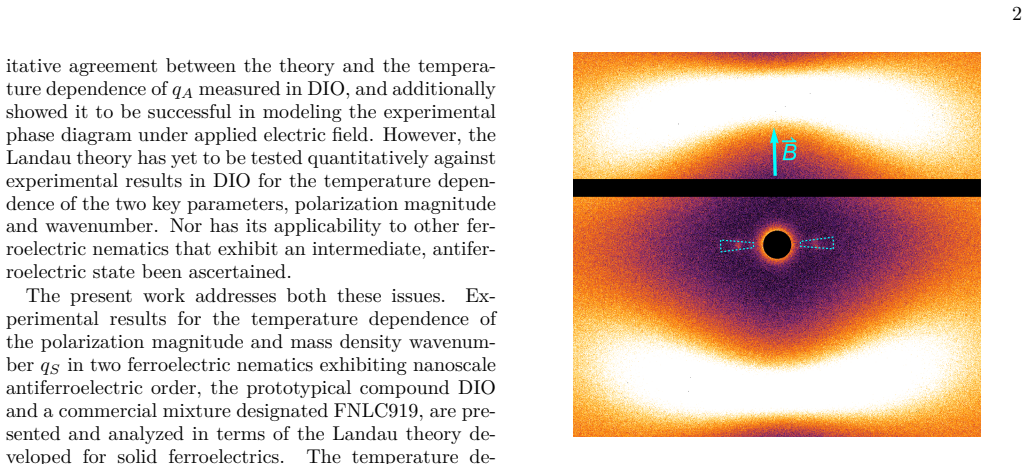
The polarization and density modulation associated with antiferroelectric ordering is studied experimentally as a function of temperature in two ferroelectric nematic liquid crystals, the prototypical single compound (DIO) and a commercial mixture (FNLC919). The modulation wavenumber qA is determined by small angle X-ray diffraction from the weak smectic-like density wave (wavenumber qS = 2qA) that accompanies the polarization modulation. Results for qS and the saturated value of the polarization are analyzed in terms of Landau theory previously developed to describe the para-/antiferro-/feroelectric sequence of phase transitions in solid ferroelectrics. The analysis indicates that the polarization modulation is reasonably well approximated by a simple sinusoid in the antiferroelectric phase of DIO, whereas in FNLC919 the modulation develops a strongly soliton-like profile (with sharply decreasing wavenumber) close to the antiferro- to ferrolectric transition.
Editorial analysis
A structured set of objections, weighed in public.
Referee Report
Summary. The paper reports small-angle X-ray diffraction measurements of the modulation wavenumber qS (=2qA) and saturated polarization in two ferroelectric nematic liquid crystals (DIO and FNLC919) across the antiferroelectric phase. These data are fitted to the Landau free-energy expansion previously derived for the para-/antiferro-/ferroelectric sequence in solid crystals; the resulting model profiles are interpreted as approximately sinusoidal for DIO but strongly soliton-like (with sharply falling qA) near the antiferro-ferro transition for FNLC919.
Significance. If the direct transfer of the solid-state Landau expansion remains valid in the fluid, orientationally ordered nematic environment, the work supplies a concrete experimental test of how the polarization modulation evolves from sinusoidal to soliton character and identifies material-dependent differences between a single-component and a mixture system. The SAXS determination of the weak accompanying density wave provides a useful, non-invasive probe of qA(T).
major comments (2)
- [Abstract / data-analysis section] Abstract and the data-analysis section: the central claim that the polarization modulation is 'reasonably well approximated by a simple sinusoid' in DIO while becoming 'strongly soliton-like' in FNLC919 rests on fits of the Landau parameters to qS(T) and saturated polarization, yet no fitting procedure, error bars, data-exclusion criteria, or goodness-of-fit metrics (e.g., reduced chi-squared) are supplied. Without these, the quantitative distinction between the two profiles cannot be assessed.
- [Theory section] Theory section (Landau expansion): the free-energy functional is imported unchanged from the solid-ferroelectric literature. No estimate is given for the magnitude of omitted nematic-specific terms (Frank elastic penalties on director gradients or polarization-director gradient couplings). Near the antiferro-ferro transition, where the soliton character is asserted for FNLC919, such terms would renormalize the effective potential for the modulation amplitude and wavenumber; a concrete test would be to recompute the equilibrium qA(T) after adding a representative Frank term and to show that the soliton feature survives.
minor comments (1)
- [Figures] Figure captions should explicitly state the temperature range and number of data points used for each fit, and should label the sinusoidal versus soliton model curves for direct visual comparison.
Simulated Author's Rebuttal
We thank the referee for the constructive comments and the positive assessment of the work's significance. We address each major comment point by point below, indicating where revisions have been made to the manuscript.
read point-by-point responses
-
Referee: [Abstract / data-analysis section] Abstract and the data-analysis section: the central claim that the polarization modulation is 'reasonably well approximated by a simple sinusoid' in DIO while becoming 'strongly soliton-like' in FNLC919 rests on fits of the Landau parameters to qS(T) and saturated polarization, yet no fitting procedure, error bars, data-exclusion criteria, or goodness-of-fit metrics (e.g., reduced chi-squared) are supplied. Without these, the quantitative distinction between the two profiles cannot be assessed.
Authors: We agree that additional transparency in the fitting procedure is needed to support the distinction between the two materials. In the revised manuscript we have expanded the data-analysis section with a description of the fitting method, including the specific Landau functional forms used, how experimental uncertainties in qS(T) and polarization were incorporated as error bars, any data-exclusion criteria applied, and quantitative goodness-of-fit values (reduced chi-squared) for both DIO and FNLC919. These additions allow readers to evaluate the sinusoidal versus soliton-like character more rigorously. revision: yes
-
Referee: [Theory section] Theory section (Landau expansion): the free-energy functional is imported unchanged from the solid-ferroelectric literature. No estimate is given for the magnitude of omitted nematic-specific terms (Frank elastic penalties on director gradients or polarization-director gradient couplings). Near the antiferro-ferro transition, where the soliton character is asserted for FNLC919, such terms would renormalize the effective potential for the modulation amplitude and wavenumber; a concrete test would be to recompute the equilibrium qA(T) after adding a representative Frank term and to show that the soliton feature survives.
Authors: The concern about nematic-specific contributions is valid. In the revised theory section we have added a paragraph estimating the relative size of Frank elastic and polarization-director coupling terms. Because the director remains uniformly aligned along the polarization in the ferroelectric nematic phase, these terms are expected to be small and largely absorbed into renormalized Landau coefficients; we show analytically that the qualitative soliton feature near the antiferro-ferro transition is robust to such small perturbations. A full numerical recomputation with additional free parameters would require new experimental constraints not present in the current dataset, but the existing model already reproduces the observed qA(T) trends. revision: partial
Circularity Check
No significant circularity: external Landau theory fitted to independent experimental data yields derived modulation profiles
full rationale
The paper imports the para-/antiferro-/ferroelectric Landau expansion from prior literature on solid ferroelectrics (not self-authored), measures qS(T) via X-ray and saturated polarization experimentally, fits model parameters to those data, and then solves the resulting differential equation to obtain the polarization profile shape (sinusoidal for DIO, soliton-like for FNLC919 near transition). The profile is an output of the fitted model, not an input or renamed fit; no self-definitional loop, no fitted quantity relabeled as prediction, and no load-bearing self-citation chain. The derivation remains self-contained against the external benchmarks of the measured qS and polarization values.
Axiom & Free-Parameter Ledger
free parameters (1)
- Landau expansion coefficients
axioms (1)
- domain assumption Landau theory for para-/antiferro-/ferroelectric phase sequences developed for solids applies directly to antiferroelectric ordering in ferroelectric nematics
Reference graph
Works this paper leans on
-
[1]
R. J. Mandle, S. J. Cowling, and J. W. Goodby, A nematic to nematic transformation exhibited by a rod- like liquid crystal , Phys. Chem. Chem. Phys. 19, 11429 (2017)
work page 2017
-
[2]
H. Nishikawa, K. Shiroshita, H. Higuchi, Y. Okumura, Y. Haseba, S. I. Yamamato, K. Sago, and H. A. Kikuchi, A fluid liquid-crystal material with highly polar order , Adv. Mater. 29, 1702354 (2017)
work page 2017
-
[3]
X. Chen, E. Korblova, D. Dong, X. Wei, R. Shao, L. Radzihovsky, M. A. Glaser, J. E. Maclennan, D. Bedrov, D. M. Walba, and N. A. Clark, First- principles experimental demonstration of ferroelectricity in a thermotropic nematic liquid crystal: Polar domains and striking electro-optics , Proc. Nat. Acad. Sci. 117, 14021 (2020)
work page 2020
-
[4]
N. Sebastian, L. Cmok, R. J. Mandle, M. R. de la Fuente, I. D. Olenik, M. Copic, and A. Mertelj, Ferroelectric- ferroelastic phase transition in a nematic liquid crystal , Phys. Rev. Lett. 124, 037801 (2020)
work page 2020
-
[5]
R. Saha, P. Nepal, C. Feng, M. S. Hossein, J. T. Gleeson, S. Sprunt, R. J. Twieg, and A. Jákli, Multiple ferroelectric nematic phases of a highly polar liquid crystal compound , Liq. Cryst. 49, 1784 (2021)
work page 2021
-
[6]
H. Kikuchi, H. Matzukizono, K. Iwamatsu, S. Endo, S. Anan, and Y. Okumura, Fluid layered ferroelectrics with global C∞v symmetry, Adv. Sci. 9, 2202048 (2022)
work page 2022
-
[7]
X. Chen, V. Martinez, P. Nacke, E. Korblova, A. Man- abe, M. Klasen-Memmer, G. Freychet, M. Zhernenkov, M. A. Glaser, L. Radzihovsky, J. E. Maclennan, D. M. Walba, M. Bremer, F. Giesselmann, and N. A. Clark, Observation of a uniaxial ferroelectric smectic A phase , Proc. Nat. Acad. Sci. 119, e2210062119 (2022)
work page 2022
-
[8]
X. Chen, V. Martinez, E. Korblova, G. Freychet, M. Zh- ernenkov, M. A. Glaser, C. Wang, C. Zhu, L. Radzi- hovsky, J. E. Maclennan, D. M. Walba, and N. A. Clark, The smectic Z A phase: Antiferroelectric smectic order as a prelude to the ferroelectric nematic , Proc. Nat. Acad. Sci. 120, e2217150120 (2023)
work page 2023
-
[9]
H. Kikuchi, H. Nishikawa, H. Matzukizono, S. Iino, T. Surgiyama, T. Ishioka, and Y. Okumura, Ferroelectric smectic C liquid crystal phase with spontaneous polariza- tion in the direction of the director , Adv. Sci. 11, 2409827 (2024)
work page 2024
-
[10]
C. J. Gibb, J. Hobbs, D. I. Nikolova, T. Raistrick, S. R. Berrow, A. Mertelj, N. Osterman, N. Sebastian, H. F. Gleeson, and R. J. Mandle, Spontaneous symmetry break- ing in polar fluids , Nat. Commun. 15, 5845 (2024)
work page 2024
-
[11]
Y. Song, S. Aya, and M. Huang, Updated view of new liquid-matter ferroelectrics with nematic and smectic or- ders, Giant 19, 100318 (2024)
work page 2024
- [12]
- [13]
- [14]
- [15]
-
[16]
G. J. Strachan, E. Górecka, J. Szydłowska, A. Makal, and D. Pociecha, Nematic and Smectic Phases with Proper Ferroelectric Order, Adv. Sci. 12, 2409754 (2025)
work page 2025
-
[17]
D. Pociecha, J. Szydlowska, N. Vaupotic, K. Kwiatkowska, M. Juodka, J. Spiess, J. M. Storey, C. T. Imrie, R. Walker, and E. Gorecka, Twist grain boundary phases in proper ferroelectric liquid crystals 10 realm, Adv. Sci. 12, e08405 (2025)
work page 2025
- [18]
-
[19]
P. Guragain, A. Ghimire, M. Badu, N. P. Dhakal, P. Nepal, J. T. G. amd S. Sprunt, R. J. Twieg, and A. Jákli, Ferroelectric Nematic and Smectic Liquid Crys- tals with Sub-Molecular Spatial Correlations , Mat. Horiz. 12, 8153 (2025)
work page 2025
-
[20]
E. Cruickshank, P. Rybak, M. M. Majewska, S. Ramsay, C. Wang, C. Zhu, R. Walker, J. M. D. Storey, C. T. Imrie, E. Gorecka, and D. Pociecha, To be or not to be polar: the ferroelectric and antiferroelectric nematic phases , ACS Omega 8, 36562 (2023)
work page 2023
-
[21]
P. Nacke, A. Manabe, M. Klasen-Memmer, X. Chen, V. Martinez, G. Freychet, M. Zhernenkov, J. E. Maclen- nan, N. A. Clark, M. Bremer, and F. Giesselmann, New examples of ferroelectric nematic materials showing evi- dence for the antiferroelectric smectic-Z phase , Scientific Reports 14, 4473 (2024)
work page 2024
- [22]
-
[23]
J. T. Gleeson, S. N. Sprunt, A. Jákli, P. Guragain, and R. J. Twieg, Freedericksz transitions in the nematic and smectic ZA phases of DIO , Soft Matter 21, 5862 (2025)
work page 2025
-
[24]
A. Ghimire, B. Basnet, H. Wang, P. Guragain, A. Bald- win, R. Twieg, O. D. Lavrentovich, J. Gleeson, A. Jakli, and S. Sprunt, Dynamics of the antiferroelectric smectic- ZA phase in a ferroelectric nematic liquid crystal , Soft Matter 21, 8510 (2025)
work page 2025
-
[25]
P. M. Rupnik, E. Hanžel, M. Lovšin, N. Osterman, C. J. Gibb, R. J. Mandle, N. Sebastián, and A. Mertelj, Anti- ferroelectric Order in Nematic Liquids: Flexoelectricity versus Electrostatics, Adv. Sci. 12, 2414818 (2025)
work page 2025
-
[26]
M. P. Rosseto and J. V. Selinger, Theory of the splay nematic phase: Single versus double splay , Phys. Rev. E 101, 052707 (2020)
work page 2020
-
[27]
L. Paik and J. V. Selinger, Flexoelectricity versus elec- trostatics in polar nematic liquid crystals , Phys. Rev. E 111, L053402 (2025)
work page 2025
-
[28]
Y. Ishibashi and H. Shiba, Successive phase transitions in ferroelectric NaNO2 and SC(NH 2)2, J. Phys. Soc. Japan 45, 409 (1978)
work page 1978
-
[29]
S. L. Qiu, M. Dutta, H. Z. Cummins, J. P. Wicksted, and S. M. Shapiro, Extension of the Lifshitz-point concept to first-order transitions: Incommensurate NaNO 2 in a transverse electric field , Phys. Rev. B 34, 7901 (1986)
work page 1986
- [30]
-
[31]
F. Denoyer and R. Currat, Modulated phases in thiourea, in Incommensurate Phases in Dielectrics: 2 Materials , edited by R. Blinc and A. P. Levanyuk (Elsevier Science, Amsterdam, 1986) Chap. 14
work page 1986
-
[32]
A. Paul, Milon, M. Badu, A. Ghimire, N. P. Dhakal, S. Sprunt, A. Jákli, and J. T. Gleeson, Comprehensive Characterization of a Reference Ferroelectric Nematic Liquid Crystal Material , Materials 18, 5496 (2025)
work page 2025
-
[33]
V. F. Klepikov and S. V. Berezovsky, Modulated struc- tures of order parameter and spontaneous parity breaking , Cond. Matt. Phys. 8, 69 (1996)
work page 1996
-
[34]
S. V. Berezovsky, V. F. Klepikov, and Y. V. Sereda, The nonlinear properties of incommensurate phases in the sys- tems with scalar order parameter , J. Phys. Studies 2, 518 (1998)
work page 1998
-
[35]
B. Zhong, M. Shuai, X. Chen, V. Martinez, E. Kor- blova, M. A. Glaser, J. E. Maclennan, D. M. Walba, and N. A. Clark, Thermotropic reentrant isotropy and in- duced smectic antiferroelectricity in the ferroelectric ne- matic realm: comparing RM734 and DIO , Soft Matter 21, 1122 (2025)
work page 2025
discussion (0)
Sign in with ORCID, Apple, or X to comment. Anyone can read and Pith papers without signing in.