Recognition: 2 theorem links
· Lean TheoremXFreq-GS: Cross-Frequency Wireless Radiation Field Reconstruction with 3D Gaussian Splatting
Pith reviewed 2026-05-13 02:06 UTC · model grok-4.3
The pith
XFreq-GS reconstructs wireless radiation fields across frequencies using 3D Gaussian primitives with shared geometry and frequency-adaptive RF attributes.
A machine-rendered reading of the paper's core claim, the machinery that carries it, and where it could break.
Core claim
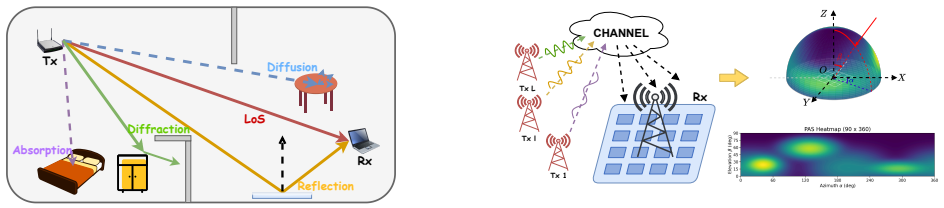
XFreq-GS employs 3D Gaussian primitives with shared geometry and frequency-adaptive radio frequency (RF) attributes to reconstruct cross-frequency WRF, and synthesizes power angular spectrum (PAS) maps for wireless channel modeling.
What carries the argument
3D Gaussian primitives with shared geometry and frequency-adaptive RF attributes
Load-bearing premise
Frequency-adaptive RF attributes attached to one shared 3D geometry can capture real cross-frequency variations in wireless environments without per-frequency retraining or extra environmental data.
What would settle it
Demonstrate that the method produces PAS maps with higher error than single-frequency baselines when tested on frequencies outside the training set, or that it requires separate retraining to match single-frequency accuracy.
Figures


read the original abstract
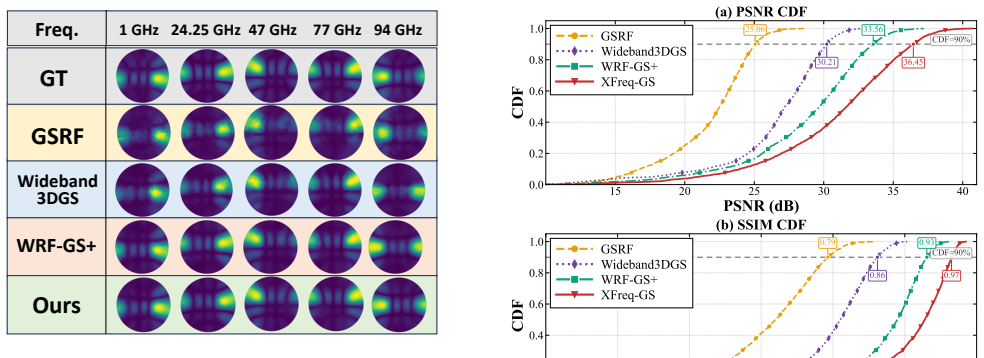
Channel modeling is fundamental to the analysis, design, and optimization of wireless communication systems, which, however, accurate wireless channel modeling remains challenging, especially given the increasingly complex wireless environments. As an emerging paradigm, 3D Gaussian Splatting (3DGS)-based channel modeling methods achieve accurate wireless radiation field (WRF) reconstruction and high-fidelity spatial spectrum synthesis. However, existing works only consider a single carrier frequency and fail to adapt to wide-range cross-frequency channels. To address this challenge, we propose XFreq-GS, a cross-frequency Gaussian splatting framework for WRF reconstruction. It employs 3D Gaussian primitives with shared geometry and frequency-adaptive radio frequency (RF) attributes to reconstruct cross-frequency WRF, and synthesizes power angular spectrum (PAS) maps for wireless channel modeling. Experiments show that XFreq-GS outperforms state-of-the-art 3DGS-based methods in PAS synthesis and achieves superior cross-frequency generalization. Code is available at https://github.com/KINGAZ1019/XFreq-GS.
Editorial analysis
A structured set of objections, weighed in public.
Referee Report
Summary. The manuscript proposes XFreq-GS, a cross-frequency extension of 3D Gaussian Splatting for wireless radiation field (WRF) reconstruction. It employs a single set of 3D Gaussian primitives whose geometry (positions, covariances, opacities) is shared across frequencies while attaching frequency-adaptive RF attributes (amplitude and phase) to enable reconstruction of cross-frequency WRFs and synthesis of power angular spectrum (PAS) maps. Experiments are reported to show outperformance versus prior 3DGS-based methods in PAS synthesis quality and superior generalization across carrier frequencies, with public code release.
Significance. If the central modeling choice and reported gains hold under rigorous validation, the work would be significant for wireless channel modeling in wideband and multi-frequency systems. Extending 3DGS to cross-frequency settings via shared geometry plus adaptive attributes offers a potentially efficient alternative to independent per-frequency reconstructions, which is relevant for 5G/6G analysis in complex environments. Code availability supports reproducibility.
major comments (2)
- [§3] §3 (XFreq-GS framework description): The core construction fixes all geometric parameters of the 3D Gaussians across frequencies and modulates only per-primitive amplitude/phase attributes. This is load-bearing for the cross-frequency generalization claim, yet the text provides no mechanism or ablation for wavelength-dependent effects (e.g., diffraction angle shifts or material penetration changes) that would require geometry updates. A direct test on a dataset exhibiting strong frequency-selective scattering is needed to substantiate that the adaptive attributes suffice.
- [§4] §4 (Experiments and results): The abstract asserts outperformance and superior generalization, but the quantitative tables lack explicit reporting of data splits, exact baseline implementations, per-frequency error metrics, and an ablation isolating the frequency-adaptive attributes. Without these, it is impossible to confirm that gains are attributable to the proposed shared-geometry design rather than implementation details or post-hoc tuning.
minor comments (2)
- [§3] Notation for the frequency-adaptive attributes (e.g., how amplitude/phase are parameterized per Gaussian) should be introduced with explicit equations in §3 to improve clarity.
- [Figures] Figure captions for PAS map visualizations could include the specific carrier frequencies and quantitative error values for each compared method.
Simulated Author's Rebuttal
We thank the referee for the constructive and detailed comments. We address each major comment below with clarifications and indicate the changes we will incorporate in the revised manuscript.
read point-by-point responses
-
Referee: [§3] §3 (XFreq-GS framework description): The core construction fixes all geometric parameters of the 3D Gaussians across frequencies and modulates only per-primitive amplitude/phase attributes. This is load-bearing for the cross-frequency generalization claim, yet the text provides no mechanism or ablation for wavelength-dependent effects (e.g., diffraction angle shifts or material penetration changes) that would require geometry updates. A direct test on a dataset exhibiting strong frequency-selective scattering is needed to substantiate that the adaptive attributes suffice.
Authors: We thank the referee for this observation. The shared-geometry design rests on the physical approximation that dominant scattering paths exhibit largely frequency-independent geometry within the evaluated carrier-frequency ranges, with adaptive amplitude and phase attributes capturing the primary frequency-dependent variations. We acknowledge that this may not hold in environments with pronounced wavelength-dependent phenomena such as strong diffraction shifts or material penetration changes. In the revision we will expand the discussion in §3 to explicitly state these modeling assumptions and their limitations. We will also add an ablation that varies the degree of frequency selectivity within our existing cross-frequency datasets and report the resulting performance trends. A dedicated new dataset focused exclusively on strong frequency-selective scattering is not available to us at present and would require substantial new simulation or measurement effort; we will note this as a valuable direction for future validation. revision: partial
-
Referee: [§4] §4 (Experiments and results): The abstract asserts outperformance and superior generalization, but the quantitative tables lack explicit reporting of data splits, exact baseline implementations, per-frequency error metrics, and an ablation isolating the frequency-adaptive attributes. Without these, it is impossible to confirm that gains are attributable to the proposed shared-geometry design rather than implementation details or post-hoc tuning.
Authors: We agree that these omissions hinder full assessment of the contribution. In the revised manuscript we will: (i) explicitly document the data splits, including how cross-frequency samples are partitioned for training and testing; (ii) provide precise descriptions of baseline implementations, including any adaptations required to handle multiple frequencies; (iii) augment the tables with per-frequency error metrics; and (iv) insert a dedicated ablation that compares the full model against a variant in which the RF attributes are held fixed across frequencies. These additions will allow readers to isolate the benefit of the frequency-adaptive attributes and the shared-geometry design. revision: yes
Circularity Check
No significant circularity; framework introduces explicit modeling choice evaluated empirically
full rationale
The paper defines XFreq-GS as a new architecture attaching frequency-adaptive RF attributes to fixed 3D Gaussian geometry, then reports empirical PAS synthesis results against prior 3DGS baselines. No equation or claim reduces the output to the input by construction, no fitted parameter is relabeled as a prediction, and no load-bearing premise rests on a self-citation chain. The shared-geometry assumption is stated as a design decision rather than derived from prior results of the same authors. The derivation chain therefore remains self-contained against external benchmarks.
Axiom & Free-Parameter Ledger
Lean theorems connected to this paper
-
IndisputableMonolith/Cost/FunctionalEquation.leanwashburn_uniqueness_aczel unclearIt employs 3D Gaussian primitives with shared geometry and frequency-adaptive radio frequency (RF) attributes to reconstruct cross-frequency WRF
-
IndisputableMonolith/Foundation/AbsoluteFloorClosure.leanabsolute_floor_iff_bare_distinguishability unclearWideFreqNetwork ... outputs the attenuation, signal response, latent code, and angular spread factor
Reference graph
Works this paper leans on
-
[1]
Survey on 6G frontiers: Trends, applications, require- ments, technologies and future research,
C. De Alwis, A. Kalla, Q.-V . Pham, P. Kumar, K. Dev, W.-J. Hwang, and M. Liyanage, “Survey on 6G frontiers: Trends, applications, require- ments, technologies and future research,”IEEE Open J. Commun. Soc., vol. 2, pp. 836–886, 2021
work page 2021
-
[2]
Study on channel model for frequencies from 0.5 to 100 GHz,
3GPP, “Study on channel model for frequencies from 0.5 to 100 GHz,” 3GPP, Technical Report TR 38.901 V19.3.0, Mar. 2026
work page 2026
-
[3]
Survey of Channel and Radio Propagation Models for Wireless MIMO Systems,
P. Almers, E. Bonek, A. Burr, N. Czink, M. Debbah, V . Degli-Esposti, H. Hofstetter, P. Ky¨osti, D. Laurenson, G. Matz, A. Molisch, C. Oestges, and H. ¨Ozcelik, “Survey of Channel and Radio Propagation Models for Wireless MIMO Systems,”EURASIP J. Wireless Commun. Netw., vol. 2007, no. 1, p. 019070, Dec. 2007
work page 2007
-
[4]
J. Meinil ¨a, P. Ky ¨osti, T. J ¨ams¨a, and L. Hentil ¨a, “WINNER II channel models,” inRadio Technologies and Concepts for IMT-Advanced. Wi- ley, 2009, pp. 39–92
work page 2009
-
[5]
Site-specific propagation prediction for wireless in-building personal communication system design,
S. Y . Seidel and T. S. Rappaport, “Site-specific propagation prediction for wireless in-building personal communication system design,”IEEE Trans. V eh. Technol., vol. 43, no. 4, pp. 879–891, 1994
work page 1994
-
[6]
Ray tracing for radio propagation modeling: Principles and applications,
Z. Yun and M. F. Iskander, “Ray tracing for radio propagation modeling: Principles and applications,”IEEE Access, vol. 3, pp. 1089–1100, 2015
work page 2015
-
[7]
NeRF: Representing scenes as neural radiance fields for view synthesis,
B. Mildenhall, P. P. Srinivasan, M. Tancik, J. T. Barron, R. Ramamoorthi, and R. Ng, “NeRF: Representing scenes as neural radiance fields for view synthesis,” inProc. Eur . Conf. Comput. Vis. (ECCV), 2020, pp. 405–421
work page 2020
-
[8]
NeRF2: Neural radio-frequency radiance fields,
X. Zhao, Z. An, Q. Pan, and L. Yang, “NeRF2: Neural radio-frequency radiance fields,” inProc. ACM Annu. Int. Conf. Mobile Comput. Netw. (MobiCom), 2023, pp. 393–407
work page 2023
-
[9]
NeWRF: A deep learning framework for wireless radiation field reconstruction and channel prediction,
H. Lu, C. Vattheuer, B. Mirzasoleiman, and O. Abari, “NeWRF: A deep learning framework for wireless radiation field reconstruction and channel prediction,” inProc. Int. Conf. Mach. Learn. (ICML), 2024, pp. 33 147–33 159
work page 2024
-
[10]
3D Gaussian splatting for real-time radiance field rendering,
B. Kerbl, G. Kopanas, T. Leimk ¨uhler, and G. Drettakis, “3D Gaussian splatting for real-time radiance field rendering,”ACM Trans. Graph., vol. 42, no. 4, pp. 1–14, 2023
work page 2023
-
[11]
WRF-GS: Wireless radiation field reconstruction with 3D gaussian splatting,
C. Wen, J. Tong, Y . Hu, Z. Lin, and J. Zhang, “WRF-GS: Wireless radiation field reconstruction with 3D gaussian splatting,” inProc. IEEE Conf. Comput. Commun. (INFOCOM), 2025, pp. 1–10
work page 2025
-
[12]
Neural representation for wireless radiation field reconstruction: A 3D gaussian splatting approach,
C. Wen, J. Tong, Y . Hu, Z. Lin, and J. Zhang, “Neural representation for wireless radiation field reconstruction: A 3D gaussian splatting approach,”IEEE Trans. Wireless Commun., vol. 25, pp. 7490–7504, Dec. 2025
work page 2025
-
[13]
GSRF: Complex- valued 3D gaussian splatting for efficient radio-frequency data synthe- sis,
K. Yang, G. Dong, S. Ji, W. Du, and M. Srivastava, “GSRF: Complex- valued 3D gaussian splatting for efficient radio-frequency data synthe- sis,” inProc. Neural Inf. Process. Syst. (NeurIPS), 2025
work page 2025
-
[14]
RF-3DGS: Wireless channel modeling with radio radiance field and 3D gaussian splatting,
L. Zhang, H. Sun, S. Berweger, C. Gentile, and R. Q. Hu, “RF-3DGS: Wireless channel modeling with radio radiance field and 3D gaussian splatting,”IEEE Trans. Wireless Commun., vol. 25, pp. 10 419–10 433, 2026
work page 2026
-
[15]
ITU-R, “Effects of building materials and structures on radiowave propagation in the range of 1 MHz to 450 GHz,” International Telecommunication Union, Tech. Rep. Recommendation ITU-R P.2040- 4, Sep. 2025. [Online]. Available: https://www.itu.int/rec/R-REC-P. 2040-4-202509-I/en
work page 2040
-
[16]
Image quality assessment: from error visibility to structural similarity,
Z. Wang, A. C. Bovik, H. R. Sheikh, and E. P. Simoncelli, “Image quality assessment: from error visibility to structural similarity,”IEEE Transactions on Image Processing, vol. 13, no. 4, pp. 600–612, Apr. 2004
work page 2004
-
[17]
Wideband RF radiance field modeling using frequency- embedded 3D gaussian splatting,
Z. Li, L. Yang, Y . Bian, H. Pan, Y . Fu, Y . Wang, Z. Chen, Y .-C. Chen, and G. Xue, “Wideband RF radiance field modeling using frequency- embedded 3D gaussian splatting,”arXiv preprint arXiv:2505.20714, May 2025
discussion (0)
Sign in with ORCID, Apple, or X to comment. Anyone can read and Pith papers without signing in.