Recognition: 2 theorem links
· Lean TheoremNeural Refractive Index Primitives for Flame Field Reconstruction Using Background-Oriented Schlieren
Pith reviewed 2026-05-13 02:14 UTC · model grok-4.3
The pith
Compact neural networks reconstruct continuous three-dimensional refractive index fields in flames from schlieren images.
A machine-rendered reading of the paper's core claim, the machinery that carries it, and where it could break.
Core claim
By treating the refractive index field as the sole neural primitive inside a compact multilayer perceptron and integrating multiresolution hash encoding, automatic-discrete gradient losses, and a three-dimensional mask, the method produces fast-converging, high-resolution, spatially coherent reconstructions of flame fields from background-oriented schlieren measurements.
What carries the argument
Refractive index field modeled as the sole neural primitive in a compact multilayer perceptron equipped with multiresolution hash encoding
If this is right
- Accurate recovery of both large-scale flame structures and fine-scale turbulence on numerical phantoms and real data
- Strong robustness to noise in the captured schlieren images
- Clear accuracy and coherence gains over frequency-encoding-based and voxel-based methods
- Fast convergence to high-resolution solutions during optimization
Where Pith is reading between the lines
- Continuous neural field representations could reduce staircasing artifacts when the same tomography setup is applied to other transparent fluid flows.
- If paired with high-speed cameras, the approach might support time-resolved reconstruction of unsteady flames without additional regularization.
Load-bearing premise
The refractive index distribution inside a flame can be faithfully captured by the output of a compact multilayer perceptron without introducing non-physical artifacts or losing accuracy in the inverse tomography problem.
What would settle it
Apply the method to a new numerical phantom whose exact refractive index volume is known, then measure whether the recovered field matches the ground truth at fine turbulence scales within the error bounds reported for the original tests.
Figures








read the original abstract
An improved neural refractive-index-primitive method for background-oriented schlieren tomography is presented, enabling continuous three-dimensional reconstruction of refractive-index fields using a compact multilayer perceptron. The method adopts the refractive-index field as the sole neural primitive and integrates multiresolution hash encoding, automatic-discrete gradient losses, and a three-dimensional mask to enable fast convergence and high-resolution, spatially coherent reconstructions. Tests on numerical combustion phantoms and real flame data demonstrate accurate recovery of both large-scale structures and fine-scale turbulence, strong robustness to noise, and clear advantages over frequency-encoding-based and voxel-based reconstruction methods.
Editorial analysis
A structured set of objections, weighed in public.
Referee Report
Summary. The paper presents an improved neural refractive-index-primitive method for background-oriented schlieren (BOS) tomography. It uses a compact multilayer perceptron as the sole neural primitive for the refractive index field, combined with multiresolution hash encoding, automatic-discrete gradient losses, and a 3D mask. This enables continuous 3D reconstruction of flame refractive-index fields. Validation is performed on numerical combustion phantoms (with ground truth) and real flame data, claiming accurate recovery of large-scale structures and fine-scale turbulence, noise robustness, and advantages over frequency-encoding-based and voxel-based methods.
Significance. If the central claims hold with quantitative support, the work could meaningfully advance non-intrusive 3D diagnostics in combustion and fluid dynamics by providing a continuous, high-resolution representation that avoids discretization artifacts common in traditional tomography. The integration of hash encoding and gradient losses for physical inverse problems is a timely contribution, but its impact depends on rigorous error metrics and ablation studies that are currently absent from the presented material.
major comments (2)
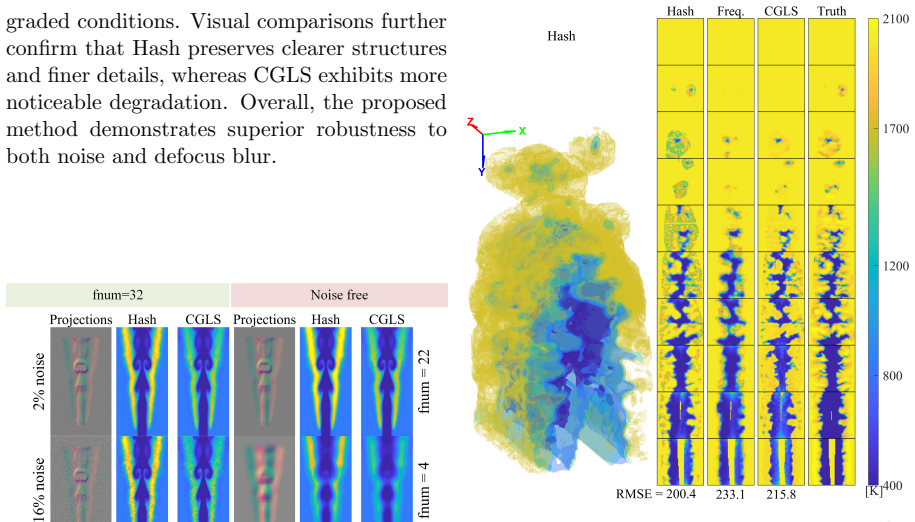
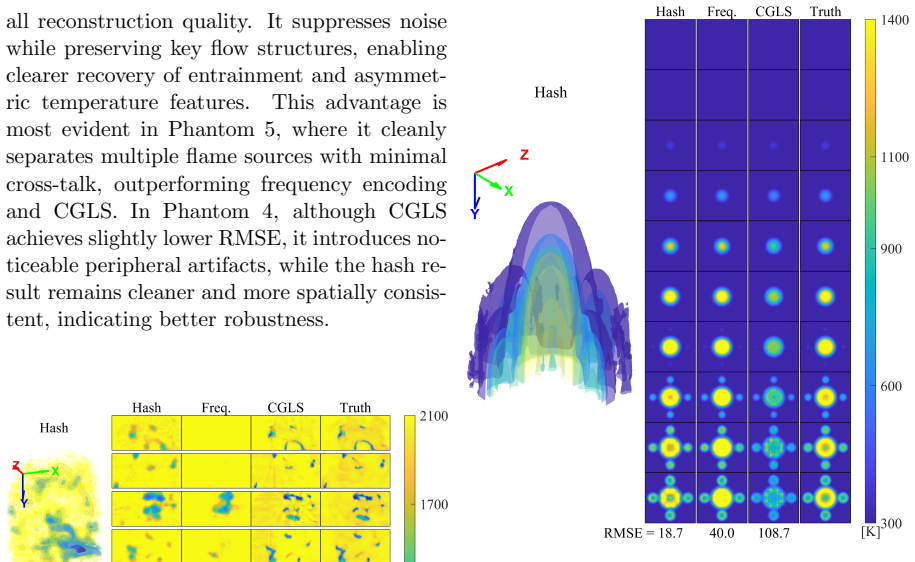
- [Abstract and Results] Abstract and Results section: The central claims of 'accurate recovery' and 'clear advantages' over baselines are stated without any quantitative error metrics (e.g., RMSE, PSNR, or L2 norms against ground truth on phantoms), ablation tables, or statistical comparisons. This leaves the superiority and robustness assertions unverified and load-bearing for the paper's contribution.
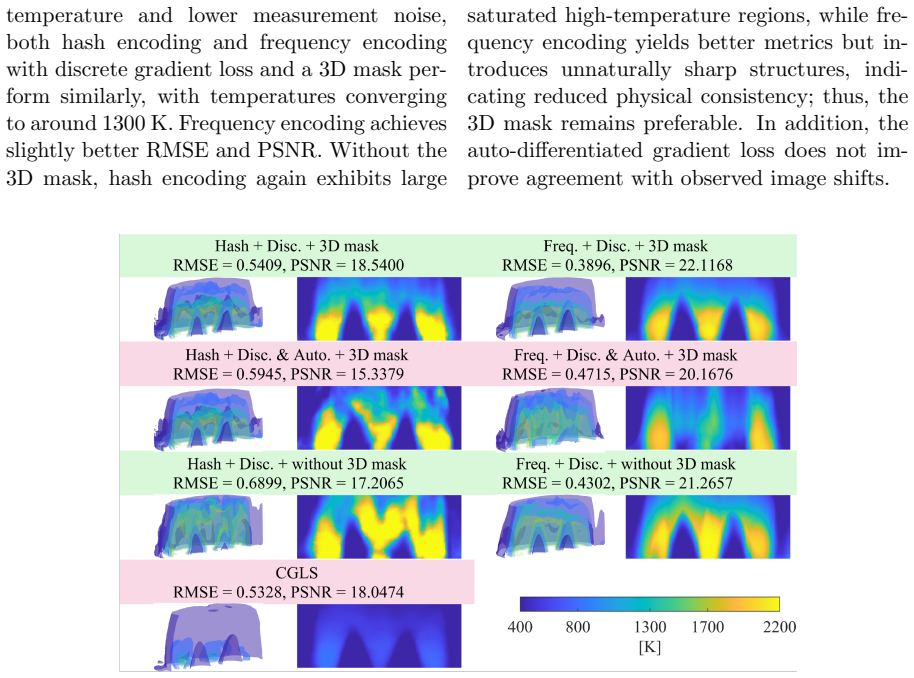
- [Method] Method description (around the neural primitive and losses): The automatic-discrete gradient losses and 3D mask are presented as enabling physical consistency and fast convergence, but no derivation, hyperparameter sensitivity analysis, or proof of non-introduction of non-physical artifacts is provided. This directly affects the weakest assumption that the MLP faithfully represents flame RI fields for the inverse problem.
minor comments (2)
- Notation for the refractive index field and encoding should be standardized across equations and figures for clarity.
- Figure captions for phantom and real-data reconstructions would benefit from explicit scale bars and error maps to aid visual assessment.
Simulated Author's Rebuttal
We thank the referee for the constructive feedback on our manuscript. The comments highlight opportunities to strengthen the quantitative support for our claims and to provide more explicit details on the method components. We address each major comment below and will revise the manuscript to incorporate the suggested improvements, including additional metrics, derivations, and analyses.
read point-by-point responses
-
Referee: [Abstract and Results] Abstract and Results section: The central claims of 'accurate recovery' and 'clear advantages' over baselines are stated without any quantitative error metrics (e.g., RMSE, PSNR, or L2 norms against ground truth on phantoms), ablation tables, or statistical comparisons. This leaves the superiority and robustness assertions unverified and load-bearing for the paper's contribution.
Authors: We agree that the current presentation relies primarily on qualitative visual comparisons between our method, frequency-encoding baselines, and voxel-based approaches. While these figures demonstrate clearer recovery of large-scale structures and fine-scale turbulence on both phantoms and real flames, we acknowledge the absence of explicit numerical error metrics and ablation tables. In the revised manuscript, we will add a quantitative comparison table reporting RMSE, PSNR, and L2 norms on the numerical combustion phantoms (with ground truth available), as well as ablation studies isolating the contributions of multiresolution hash encoding and the automatic-discrete gradient losses. This will provide the statistical verification needed to support the claims of accuracy and advantages. revision: yes
-
Referee: [Method] Method description (around the neural primitive and losses): The automatic-discrete gradient losses and 3D mask are presented as enabling physical consistency and fast convergence, but no derivation, hyperparameter sensitivity analysis, or proof of non-introduction of non-physical artifacts is provided. This directly affects the weakest assumption that the MLP faithfully represents flame RI fields for the inverse problem.
Authors: The automatic-discrete gradient losses are constructed by applying a discrete finite-difference approximation to the refractive-index field sampled from the hash-encoded MLP, with the resulting gradient term incorporated into the BOS forward model loss to promote physical consistency and smoothness. The 3D mask is a simple spatial bounding volume derived from the experimental setup to restrict optimization to the flame region. We recognize that the manuscript would benefit from a more explicit step-by-step derivation of these terms and supporting analyses. In the revision, we will expand Section 3 with a detailed derivation of the gradient loss, include hyperparameter sensitivity results (e.g., varying the gradient-loss weight and its effect on convergence and reconstruction quality), and add discussion plus phantom evidence showing that the approach avoids non-physical artifacts, as the recovered fields align with expected combustion structures without introducing spurious oscillations or discontinuities. revision: yes
Circularity Check
No significant circularity in derivation chain
full rationale
The paper proposes a neural representation for refractive-index fields in BOS tomography using a compact MLP with multiresolution hash encoding, automatic-discrete gradient losses, and a 3D mask. This is an empirical modeling choice tested on numerical phantoms (with ground truth) and real flame data, with quantitative comparisons to frequency-encoding and voxel baselines. No load-bearing step reduces by construction to self-definition, fitted inputs renamed as predictions, or self-citation chains; the representational power is validated externally rather than assumed tautologically. The derivation remains self-contained as a proposed architecture whose accuracy is assessed against independent benchmarks.
Axiom & Free-Parameter Ledger
axioms (1)
- domain assumption A compact multilayer perceptron with multiresolution hash encoding can represent the continuous 3D refractive index field of a flame with sufficient fidelity for tomography reconstruction.
Lean theorems connected to this paper
-
IndisputableMonolith/Cost/FunctionalEquation.leanwashburn_uniqueness_aczel unclearThe method adopts the refractive-index field as the sole neural primitive and integrates multiresolution hash encoding, automatic-discrete gradient losses, and a three-dimensional mask to enable fast convergence and high-resolution, spatially coherent reconstructions.
-
IndisputableMonolith/Foundation/AbsoluteFloorClosure.leanreality_from_one_distinction unclearTests on numerical combustion phantoms and real flame data demonstrate accurate recovery of both large-scale structures and fine-scale turbulence
Reference graph
Works this paper leans on
-
[1]
Raffel, Background-oriented schlieren techniques, Experiments in Fluids 56 (2015) 60
M. Raffel, Background-oriented schlieren techniques, Experiments in Fluids 56 (2015) 60
work page 2015
-
[2]
B. E. Schmidt, B. F. Bathel, S. J. Grauer, M. J. Hargather, J. T. Heineck, M. Raffel, Twenty-five years of background-oriented schlieren: Advances and novel applica- tions, in: AIAA SciTech Forum, 2025, p. 1627
work page 2025
-
[3]
S. J. Grauer, A. Unterberger, A. Rit- tler, K. J. Daun, A. M. Kempf, K. Mohri, Instantaneous 3d flame imaging by background-oriented schlieren tomog- raphy, Combustion and Flame 196 (2018) 394–405
work page 2018
-
[4]
F. J. W. A. Martins, C. T. Foo, A. Un- terberger, et al., Analyzing 3d fields of re- fractive index, emission and temperature in spray-flame nanoparticle synthesis via tomographic imaging, Applications in En- ergy and Combustion Science 16 (2023) 100213
work page 2023
- [5]
-
[6]
H. Cai, Y. Song, Y. Ji, Z. Li, A. He, Di- rect background-oriented schlieren tomog- raphy using radial basis functions, Optics Express 30 (2022) 19100–19120
work page 2022
-
[7]
H. C. Liu, J. Q. Huang, L. Li, W. W. Cai, Volumetric imaging of flame refractive in- dex, density, and temperature using bos tomography, Science China Technological Sciences 64 (2021) 1–12
work page 2021
- [8]
-
[9]
B. Atcheson, I. Ihrke, W. Heidrich, et al., Time-resolved 3d capture of non- stationary gas flows, ACM Transactions on Graphics 27 (2008)
work page 2008
-
[10]
F. Nicolas, V. Todoroff, A. Plyer, et al., A direct approach for instantaneous 3d den- sity field reconstruction from bos, Exper- iments in Fluids 57 (2016)
work page 2016
-
[11]
J. P. Molnar, S. J. Grauer, Algorithm for time-resolved bos tomography, in: AIAA SciTech Forum, 2025
work page 2025
-
[12]
S. Cai, Z. Wang, F. Fuest, Y. J. Jeon, C. Gray, G. E. Karniadakis, Inferring 3d velocity and pressure fields from bos via pinns, Journal of Fluid Mechanics 915 (2021) A102
work page 2021
-
[13]
J. P. Molnar, S. J. Grauer, O. Leon, et al., Physics-informed bos of turbulent jets, in: AIAA SciTech Forum, 2023
work page 2023
-
[14]
Y. He, Y. Zheng, S. Xu, C. Liu, D. Peng, Y. Liu, W. Cai, Neural refractive index field for bos tomography, Physics of Flu- ids 37 (2025) 017143
work page 2025
-
[15]
B. Mildenhall, P. P. Srinivasan, M. Tan- cik, J. T. Barron, R. Ramamoorthi, R. Ng, Nerf: Representing scenes as neural radi- ance fields, Communications of the ACM 65 (2022) 99–106
work page 2022
- [16]
-
[17]
J. Li, X. Meng, Y. Xiong, et al., Neural de- flection field for sparse-view bos, Physics of Fluids 36 (2024) 121701
work page 2024
-
[18]
D. Brouzet, M. Talei, M. J. Brear, B. Cuenot, Impact of chemical modelling on flame acoustics, Journal of Fluid Me- chanics 915 (2021) A3
work page 2021
- [19]
-
[20]
X. Qin, X. Xiao, I. K. Puri, S. K. Ag- garwal, Effect of composition on tempera- ture reconstruction from refractive index, Combustion and Flame 128 (2002) 1–12
work page 2002
- [21]
-
[22]
J. Tang, X. Chen, J. Wang, et al., Compressible-composable nerf, NeurIPS 35 (2022) 14798–14809. 18
work page 2022
discussion (0)
Sign in with ORCID, Apple, or X to comment. Anyone can read and Pith papers without signing in.