Recognition: no theorem link
Thermoviscoelasticity of polydomain liquid crystal elastomers regulated by soft elasticity
Pith reviewed 2026-05-13 00:45 UTC · model grok-4.3
The pith
A constitutive model superposes rate-independent soft elasticity from mesogen reorientation with time-dependent viscoelasticity to predict polydomain LCE thermomechanical response.
A machine-rendered reading of the paper's core claim, the machinery that carries it, and where it could break.
Core claim
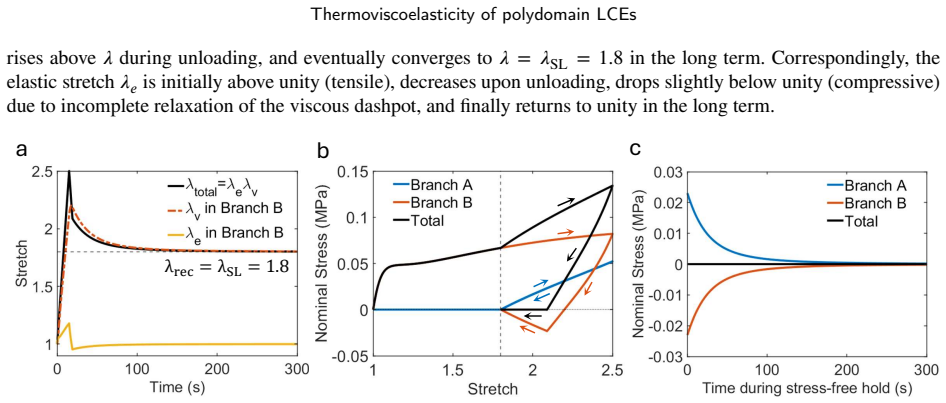
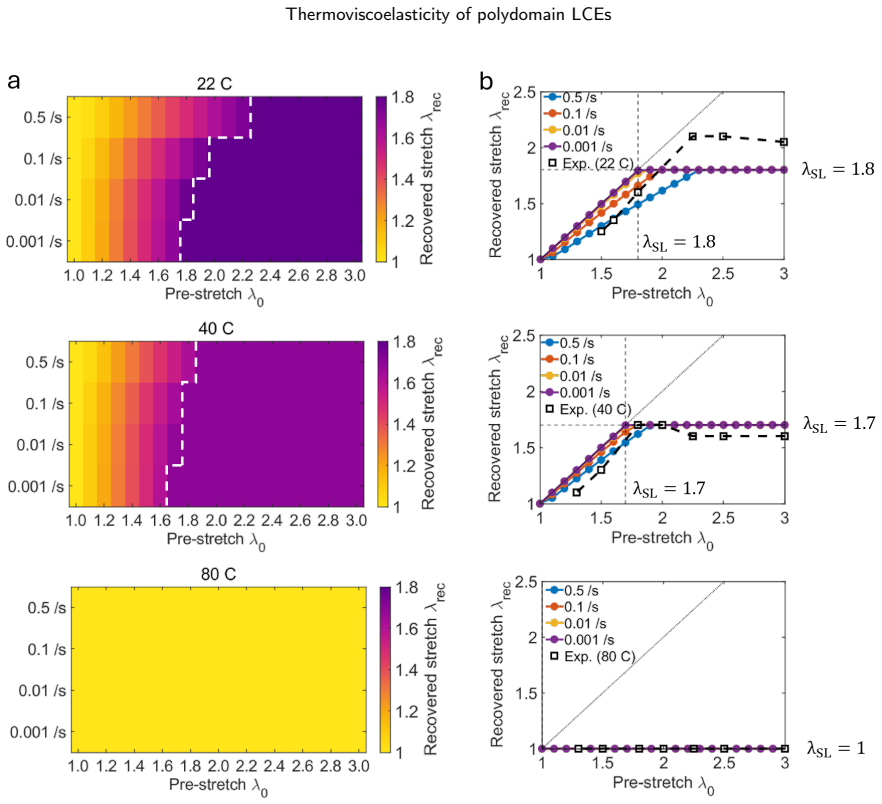
The authors establish that the thermoviscoelastic response of polydomain LCEs arises from two parallel mechanisms whose effects add in the constitutive equations: a rate-independent, temperature-dependent soft-elastic plateau produced by mesogen reorientation and a time- and temperature-dependent viscoelastic response of the polymer network. Their finite-deformation model reproduces all three uniaxial protocols with a single parameter set, separating the mechanisms so the soft-elastic limit controls the low-rate response and long-time recovered stretch while viscoelasticity accounts for rate-dependent deviations and cycle-wise residual stretch accumulation. Thermal recovery above the nematic
What carries the argument
Finite-deformation constitutive model that adds the contributions of rate-independent soft elasticity from mesogen reorientation and time-temperature-dependent viscoelasticity from the polymer network.
If this is right
- The soft-elastic limit sets the long-time recovered stretch and low-rate response across all tested protocols.
- Viscoelasticity produces the observed rate-dependent deviations and the progressive accumulation of residual stretch over cycles.
- All hysteresis and residual deformation are fully reversible upon heating above the nematic-isotropic transition.
- A single parameter set describes the complete set of loading-unloading, recovery, and multi-cycle behaviors.
- The framework supplies a predictive basis for designing polydomain LCE components under complex thermomechanical histories.
Where Pith is reading between the lines
- The additive structure suggests that mesogen alignment and network relaxation times could be tuned independently to target specific damping or recovery performance.
- If the mechanisms remain additive under multiaxial or shear loading, the same model could guide design of LCE parts in realistic three-dimensional use.
- The demonstrated reversibility implies that accumulated residual stretch in service can be reset by a simple thermal cycle without permanent material change.
Load-bearing premise
The soft-elastic and viscoelastic mechanisms act as independent parallel processes whose contributions add directly in the constitutive equations, with the soft-elastic response being strictly rate-independent at fixed temperature.
What would settle it
Applying the same pre-stretch at several different constant rates and then measuring the long-time recovered stretch at fixed temperature; systematic dependence of the recovered stretch on prior rate would falsify the rate-independence of the soft-elastic limit.
Figures






read the original abstract
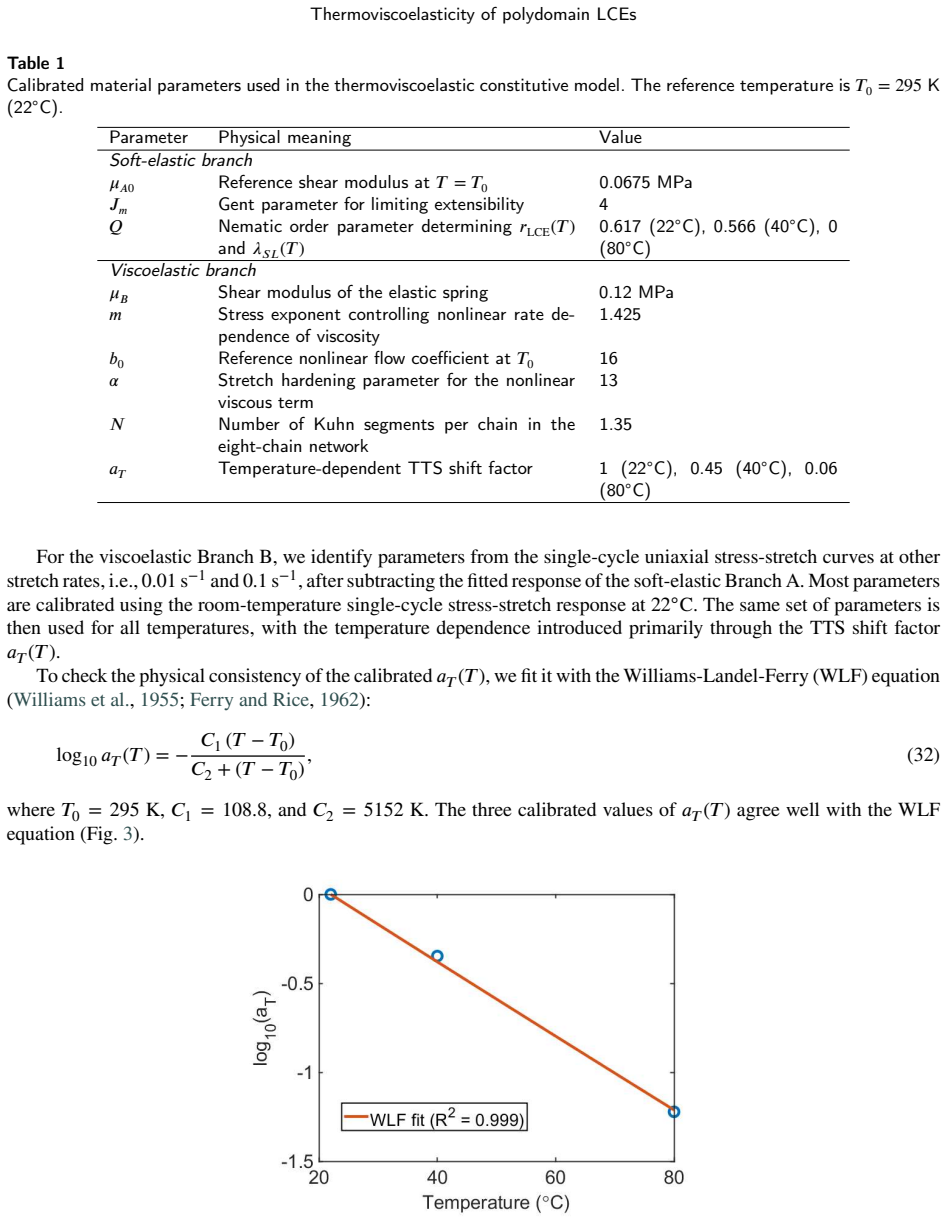
Liquid crystal elastomers (LCEs) are elastomeric networks with rod-like mesogens that reorient under load. In polydomain LCEs, this reorientation drives a polydomain-to-monodomain transition that produces a soft-elastic plateau. Coupling between this soft elasticity and polymer-network viscoelasticity yields a path-dependent thermoviscoelastic response, central to applications in damping, impact protection, and tough adhesives. However, the physics governing this response under complex thermomechanical histories remains insufficiently studied. We present a combined experimental and theoretical study of polydomain LCEs under three uniaxial protocols: single-cycle loading-unloading, stress-free recovery from various pre-stretches, and multi-cycle loading with progressively increasing amplitude. We develop a finite-deformation constitutive model combining two parallel mechanisms: rate-independent, temperature-dependent soft elasticity from mesogen reorientation, and time- and temperature-dependent viscoelasticity. With a single parameter set, the model quantitatively reproduces all three protocols and resolves each mechanism's contribution. A temperature-dependent soft-elastic limit governs the low-rate response and the long-time recovered stretch, while viscoelasticity controls the rate-dependent deviation and the cycle-wise accumulation of residual stretch away from this limit. A thermal recovery test above the nematic-isotropic transition confirms that all hysteresis and residual deformation are reversible, ruling out irreversible damage. The framework provides mechanistic understanding and a predictive basis for designing polydomain LCE components under complex thermomechanical histories.
Editorial analysis
A structured set of objections, weighed in public.
Referee Report
Summary. The manuscript develops a finite-deformation constitutive model for polydomain liquid crystal elastomers that superposes rate-independent, temperature-dependent soft elasticity arising from mesogen reorientation with time- and temperature-dependent viscoelasticity. Using a single parameter set, the model is reported to quantitatively reproduce uniaxial data from three protocols (single-cycle loading-unloading, stress-free recovery after various pre-stretches, and multi-cycle loading with increasing amplitude), to separate the contribution of each mechanism, and to be consistent with a thermal recovery test above the nematic-isotropic transition that demonstrates full reversibility of hysteresis and residual strain.
Significance. If the central claim of a single-parameter-set decomposition holds with independent validation, the work supplies a practical constitutive framework for thermoviscoelastic design of polydomain LCEs in damping and adhesive applications. The explicit separation of a temperature-dependent soft-elastic limit from viscoelastic accumulation, together with the confirming thermal-recovery experiment, would be a useful advance over purely phenomenological fits.
major comments (3)
- [Abstract and §4] Abstract and §4 (model calibration): the claim that a single parameter set 'quantitatively reproduces all three protocols' is load-bearing for the central result, yet the manuscript provides neither the explicit optimization procedure (joint vs. sequential fitting), nor quantitative error metrics (e.g., normalized RMS error or R² per protocol), nor a statement of which data points were excluded. Without these, the reproduction cannot be distinguished from a descriptive fit.
- [§3] §3 (constitutive equations): the model treats soft elasticity and viscoelasticity as strictly additive parallel mechanisms with the soft-elastic limit strictly rate-independent. No cross-protocol test is described that extracts the soft-elastic parameters from one protocol and uses them to predict the long-time recovered stretch or cycle-wise accumulation in the remaining protocols; such a test is required to establish that the decomposition is identifiable rather than merely consistent with the joint data.
- [§5] §5 (multi-cycle results): the attribution of residual-stretch accumulation to viscoelasticity (away from the soft-elastic limit) is central to the mechanistic resolution, but the manuscript does not report whether the same viscoelastic parameters, when held fixed, correctly predict the stress-free recovery curves of §4.2 without re-fitting.
minor comments (2)
- [§3] Notation for the soft-elastic limit stretch should be defined once and used consistently; the abstract refers to it as 'temperature-dependent soft-elastic limit' while the model section appears to introduce it via an auxiliary variable whose temperature dependence is not shown explicitly.
- [Figures 3-5] Figure captions for the three protocols should state the strain rate(s) and temperature(s) used in each experiment so that readers can immediately compare the model curves to the stated rate- and temperature-dependence.
Simulated Author's Rebuttal
We thank the referee for the careful reading and constructive comments on our manuscript. We address each major comment below and describe the revisions we will implement to strengthen the presentation of the model calibration and validation.
read point-by-point responses
-
Referee: [Abstract and §4] Abstract and §4 (model calibration): the claim that a single parameter set 'quantitatively reproduces all three protocols' is load-bearing for the central result, yet the manuscript provides neither the explicit optimization procedure (joint vs. sequential fitting), nor quantitative error metrics (e.g., normalized RMS error or R² per protocol), nor a statement of which data points were excluded. Without these, the reproduction cannot be distinguished from a descriptive fit.
Authors: We agree that the calibration procedure and quantitative metrics must be reported explicitly. In the revised manuscript we will add a dedicated subsection in §4 describing the joint optimization procedure used to determine the single parameter set from all three protocols simultaneously. We will also report normalized RMS errors (and R² where appropriate) for stress and stretch in each protocol and state that all experimental data points were included in the fit. These additions will substantiate the claim and distinguish the result from a purely descriptive fit. revision: yes
-
Referee: [§3] §3 (constitutive equations): the model treats soft elasticity and viscoelasticity as strictly additive parallel mechanisms with the soft-elastic limit strictly rate-independent. No cross-protocol test is described that extracts the soft-elastic parameters from one protocol and uses them to predict the long-time recovered stretch or cycle-wise accumulation in the remaining protocols; such a test is required to establish that the decomposition is identifiable rather than merely consistent with the joint data.
Authors: The referee correctly identifies that an explicit cross-protocol test would strengthen the demonstration of identifiability. While the joint fit already shows consistency across protocols, we will add a new validation subsection that extracts the soft-elastic parameters from the single-cycle and recovery data (low-rate limits) and, with viscoelastic parameters held fixed, predicts the long-time recovered stretch and cycle-wise accumulation observed in the multi-cycle protocol. The results of this test will be presented to confirm the decomposition. revision: yes
-
Referee: [§5] §5 (multi-cycle results): the attribution of residual-stretch accumulation to viscoelasticity (away from the soft-elastic limit) is central to the mechanistic resolution, but the manuscript does not report whether the same viscoelastic parameters, when held fixed, correctly predict the stress-free recovery curves of §4.2 without re-fitting.
Authors: We agree that an explicit parameter-transfer test is required. In the revised manuscript we will add the requested check: viscoelastic parameters obtained from the multi-cycle protocol will be held fixed and used to predict the stress-free recovery curves of §4.2. The predicted versus measured recovered stretches will be shown, confirming that the attribution of residual-stretch accumulation to viscoelasticity is consistent without re-fitting. revision: yes
Circularity Check
Joint fitting of single parameter set to all three protocols reduces claimed reproduction to a descriptive fit rather than independent prediction
specific steps
-
fitted input called prediction
[Abstract]
"We develop a finite-deformation constitutive model combining two parallel mechanisms: rate-independent, temperature-dependent soft elasticity from mesogen reorientation, and time- and temperature-dependent viscoelasticity. With a single parameter set, the model quantitatively reproduces all three protocols and resolves each mechanism's contribution."
The single parameter set is obtained by fitting to the experimental data from the same three protocols (single-cycle loading-unloading, stress-free recovery, multi-cycle loading). The quantitative reproduction and resolution of contributions are therefore achieved by construction through this joint calibration, rather than serving as an independent test of the model's ability to separate and predict the mechanisms across protocols.
full rationale
The paper's central claim is that a two-mechanism constitutive model (rate-independent soft elasticity + viscoelasticity) with one parameter set quantitatively reproduces the three uniaxial protocols while resolving each mechanism's contribution. This is presented as evidence of mechanistic understanding and a predictive basis. However, the parameters are calibrated directly to the combined experimental dataset from these protocols, so the reproduction follows by construction from the optimization and does not constitute out-of-sample validation or a test of the decomposition's identifiability. The constitutive equations themselves are not shown to reduce to inputs, but the empirical support for the headline claim does.
Axiom & Free-Parameter Ledger
free parameters (1)
- Soft-elastic and viscoelastic parameters
axioms (2)
- domain assumption Soft elasticity is rate-independent and temperature-dependent only
- domain assumption Viscoelasticity is time- and temperature-dependent and acts independently of soft elasticity
Reference graph
Works this paper leans on
-
[1]
Viscoelasticity of the polydomain-monodomain transition in main-chain liquid crystal elastomers. Polymer 98, 165–171. Bai,R.,Bhattacharya,K.,2020. Photomechanicalcouplinginphotoactivenematicelastomers. JournaloftheMechanicsandPhysicsofSolids144. Bergström,J.S.,Boyce,M.C.,1998. Constitutivemodelingofthelargestraintime-dependentbehaviorofelastomers. Journal...
work page 2020
-
[2]
Physical Review Letters 103, 037802
Supersoft elasticity in polydomain nematic elastomers. Physical Review Letters 103, 037802. Biggins,J.,Warner,M.,Bhattacharya,K.,2012. Elasticityofpolydomainliquidcrystalelastomers. JournaloftheMechanicsandPhysicsofSolids 60, 573–590. Bladon, P., Terentjev, E.M., Warner, M.,
work page 2012
-
[3]
International Journal for Numerical Methods in Engineering 125, e7510
Finite element modeling of viscoelastic liquid crystal elastomers. International Journal for Numerical Methods in Engineering 125, e7510. Chen, B., Liu, C., Xu, Z., Wang, Z., Xiao, R., 2024a. Modeling the thermo-responsive behaviors of polydomain and monodomain nematic liquid crystal elastomers. Mechanics of Materials 188, 104838. Chen,B.,Yang,H.,Xiao,R.,...
work page 2025
-
[4]
Advanced Functional Materials 35, 2413824
Harnessing extreme internal damping in polyrotaxane-incorporated liquid crystal elastomers for pressure-sensitive adhesives. Advanced Functional Materials 35, 2413824. Chung,C.,Luo,C.,Yakacki,C.M.,Song,B.,Long,K.,Yu,K.,2024. Revealingtheunusualrate-dependentmechanicalbehaviorsofnematicliquid crystal elastomers. International Journal of Solids and Structur...
work page 2024
-
[5]
Viscoelastic Properties of Polymers. American Institute of Physics. Fu,K.,Zhao,Z.,Jin,L.,2019. Programmablegranularmetamaterialsforreusableenergyabsorption. AdvancedFunctionalMaterials29,1901258. Guin, T., Settle, M., Kowalski, B., Auguste, A., Beblo, R., Reich, G., White, T.,
work page 2019
-
[6]
Computational analysis of buckling-based stiffness programming of liquid crystal elastomer beams, in: Proceedings of the ASME 2023 International Design Engineering Technical Conferences and Computers and Information in Engineering Conference, ASME. p. V008T08A040. Hotta, A., Terentjev, E.,
work page 2023
-
[7]
The European Physical Journal E 10, 291–301
Dynamic soft elasticity in monodomain nematic elastomers. The European Physical Journal E 10, 291–301. Wei et al.:Preprint submitted to ElsevierPage 21 of 23 Thermoviscoelasticity of polydomain LCEs Jeon,S.Y.,Shen,B.,Traugutt,N.A.,Zhu,Z.,Fang,L.,Yakacki,C.M.,Nguyen,T.D.,Kang,S.H.,2022. Synergisticenergyabsorptionmechanisms of architected liquid crystal el...
work page 2022
-
[8]
Macromolecules 58, 12191–12200
Switchable pressure-sensitive adhesion in nematic side-chain liquid crystal elastomers. Macromolecules 58, 12191–12200. Kularatne,R.,Kim,H.,Boothby,J.,Ware,T.,2017. Liquidcrystalelastomeractuators:Synthesis,alignment,andapplications. JournalofPolymer Science Part B: Polymer Physics 55, 395–411. Kutsyy, A., Wihardja, A., Lee, V., Bhattacharya, K.,
work page 2017
-
[9]
arXiv preprint arXiv:2512.05146
Characterization of the soft behavior of nematic elastomers over a range of temperature and strain rates. arXiv preprint arXiv:2512.05146 . Lee, V., Wihardja, A., Bhattacharya, K.,
-
[10]
ACS Applied Materials & Interfaces 13, 8929–8939
Remotely controlled, reversible, on-demand assembly and reconfiguration of 3D mesostructures via liquid crystal elastomer platforms. ACS Applied Materials & Interfaces 13, 8929–8939. Li,Y.,Teixeira,Y.,Parlato,G.,Grace,J.,Wang,F.,Huey,B.,Wang,X.,2022. Three-dimensionalthermochromicliquidcrystalelastomerstructures with reversible shape-morphing and color-ch...
work page 2022
-
[11]
The effect of alignment on the rate-dependent behavior of a main-chain liquid crystal elastomer. Soft Matter 16, 8782–8798. Liu,K.,Hacker,F.,Daraio,C.,2021. Roboticsurfaceswithreversible,spatiotemporalcontrolforshapemorphingandobjectmanipulation. Science Robotics 6, eabf5116. Luo,C.,Chung,C.,Yakacki,C.,Long,K.,Yu,K.,2021. Real-timealignmentandreorientatio...
work page 2021
-
[12]
Viscoelastic Behavior and Energy Absorption of Main-Chain Liquid Crystal Elastomers-Based Architected Materials. Ph.D. Dissertation. Johns Hopkins University. Baltimore, MD, USA. Shen,B.,Jiang,Y.,Yakacki,C.M.,Kang,S.H.,Nguyen,T.D.,2026. Combiningstretching-dominatedandbending-dominateddissipationbehavior to optimize energy absorption in liquid crystal ela...
work page 2026
-
[13]
Probing the in-plane liquid-like behavior of liquid crystal elastomers. Science Advances 7, eabe9495. Traugutt,N.,Mistry,D.,Luo,C.,Yu,K.,Ge,Q.,Yakacki,C.,2020. Liquid-crystal-elastomer-baseddissipativestructuresbydigitallightprocessing 3D printing. Advanced Materials 32, 2000797. Traugutt, N., Volpe, R., Bollinger, M., Saed, M., Torbati, A., Yu, K., Dadiv...
work page 2020
-
[14]
Liquid-crystal order during synthesis affects main-chain liquid-crystal elastomer behavior. Soft Matter 13, 7013–7025. Ula,S.,Traugutt,N.,Volpe,R.,Patel,R.,Yu,K.,Yakacki,C.,2018. Liquidcrystalelastomers:anintroductionandreviewofemergingtechnologies. Liquid Crystals Reviews 6, 78–107. Urayama, K., Kohmon, E., Kojima, M., Takigawa, T.,
work page 2018
-
[15]
Polydomain–monodomain transition of randomly disordered nematic elastomers with different cross-linking histories. Macromolecules 42, 4084–4089. Usmanova,Z.,Bai,R.,2026. Anomalousthermomechanicalactuationofliquidcrystalelastomerballoons. ExtremeMechanicsLetters83,102448. Verwey, G., Warner, M.,
work page 2026
-
[16]
Liquid Crystal Elastomers. Oxford University Press. Wei, C., Cao, S., Zhou, Y., Lin, D., Jin, L., 2023a. Rate-dependent stress-order coupling in main-chain liquid crystal elastomers. Soft Matter 19, 7923–7936. Wei,C.,Zhou,Y.,Hsu,B.,Jin,L.,2024. Exceptionalstress-directorcouplingatthecracktipofaliquidcrystalelastomer. JournaloftheMechanics and Physics of S...
work page 2024
-
[17]
Nature Materials 14, 1087–1098
Programmable and adaptive mechanics with liquid crystal polymer networks and elastomers. Nature Materials 14, 1087–1098. Wei et al.:Preprint submitted to ElsevierPage 22 of 23 Thermoviscoelasticity of polydomain LCEs Wihardja,A.,Nieto-Fuentes,J.C.,Rittel,D.,Bhattacharya,K.,2026. Highstrainratebehaviorofliquidcrystalelastomers. JournaloftheMechanics and Ph...
work page 2026
-
[18]
Advanced Materials 33, 2106175
Liquid crystal elastomer metamaterials with giant biaxial thermal shrinkage for enhancing skin regeneration. Advanced Materials 33, 2106175. Yakacki,C.,Saed,M.,Nair,D.,Gong,T.,Reed,S.,Bowman,C.,2015. Tailorableandprogrammableliquid-crystallineelastomersusingatwo-stage thiol–acrylate reaction. RSC Advances 5, 18997–19001. Zhou,Y.,Wei,C.,Jin,L.,2025. Amodif...
work page 2015
discussion (0)
Sign in with ORCID, Apple, or X to comment. Anyone can read and Pith papers without signing in.