Recognition: no theorem link
Loss-induced quantum nonreciprocity and entanglement in superconducting qubits
Pith reviewed 2026-05-13 02:17 UTC · model grok-4.3
The pith
Loss in auxiliary cavities can induce nonreciprocal coupling and entanglement between two remote superconducting qubits through direction-dependent interference.
A machine-rendered reading of the paper's core claim, the machinery that carries it, and where it could break.
Core claim
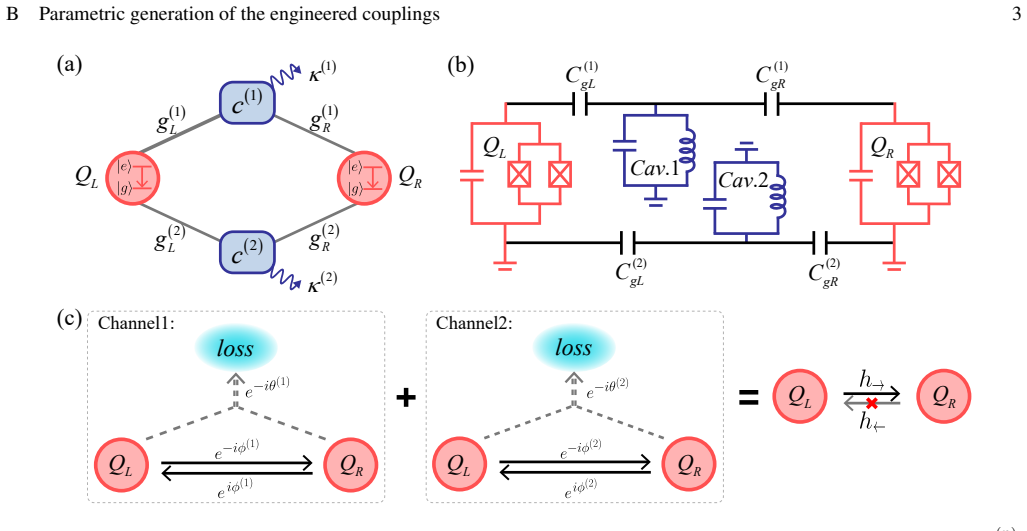
We show that loss can be used as a resource to generate nonreciprocity and nonreciprocal entanglement in a superconducting platform consisting of two remote transmon qubits linked by two lossy auxiliary cavities. The nonreciprocity arises from interference among multiple lossy coupling paths: coherent phases associated with the qubit-resonator couplings reverse sign under propagation reversal, while loss-induced phases remain direction-independent. Their combined effect produces different interference conditions in the two directions, resulting in unequal effective couplings. The resulting nonreciprocal entanglement is tunable by the relative phase induced by loss, allowing both reciprocal (
What carries the argument
Interference between multiple lossy coupling paths in which coherent qubit-resonator phases reverse sign under direction reversal while loss phases remain direction-independent.
If this is right
- Nonreciprocal entanglement becomes possible without external magnetic fields or active modulation.
- The loss phase provides a tunable knob that can switch the system between reciprocal and nonreciprocal regimes.
- The scheme supplies a concrete mechanism for realizing nonreciprocal quantum gates or channels in circuit-QED networks.
- Engineered loss can be repurposed as a design element rather than a defect to be minimized.
Where Pith is reading between the lines
- The same interference principle could be tested in other bosonic platforms such as optomechanical or magnonic systems where loss is similarly unavoidable.
- Scaling to many qubits might allow construction of nonreciprocal quantum routers or directed entanglement distribution without additional hardware.
- The method suggests a general design rule: pair coherent couplings with direction-independent dissipative paths to break reciprocity at the quantum level.
Load-bearing premise
Coherent phases from the qubit-resonator couplings change sign when propagation direction reverses, whereas phases arising from loss stay the same in both directions.
What would settle it
Measuring equal transmission amplitudes or identical entanglement measures when the two qubits exchange roles would falsify the claim; observing direction-dependent differences in coupling strength or entanglement would support it.
Figures


read the original abstract
Losses are ubiquitous in physics and are usually regarded as harmful in quantum information processing. Here, we propose a loss-induced scheme to achieve nonreciprocity and nonreciprocal entanglement in a superconducting platform, where two remote superconducting transmon qubits are connected via two lossy auxiliary cavities. The nonreciprocity in our scheme originates from interference between multiple lossy coupling paths. The coherent phases associated with the qubit-resonator couplings reverse sign under propagation reversal, while the loss-induced phases remain direction independent. Their combined effect leads to different interference conditions in the opposite directions, resulting in unequal effective couplings. We show that this loss-induced scheme can generate nonreciprocal quantum entanglement, indicating that loss can be utilized as a resource. Moreover, the tunability of nonreciprocity and nonreciprocal entanglement in our scheme can be manipulated by the relative phase induced by loss, allowing to tailor both reciprocal and nonreciprocal behaviors. Our results establish a direct link between engineered loss and nonreciprocal entanglement in quantum information processing and offer potential applications in scalable quantum networks.
Editorial analysis
A structured set of objections, weighed in public.
Referee Report
Summary. The paper proposes a scheme in which two remote transmon qubits are coupled through two lossy auxiliary cavities to realize loss-induced nonreciprocity and nonreciprocal entanglement. Nonreciprocity is attributed to interference among multiple lossy paths: coherent qubit-resonator phases reverse sign upon propagation reversal while loss-induced phases remain direction-independent, producing unequal effective couplings in opposite directions. The relative phase induced by loss is claimed to tune both the degree of nonreciprocity and the generation of nonreciprocal entanglement, positioning loss as a controllable resource for quantum networks.
Significance. If the phase-separation mechanism and resulting effective couplings can be rigorously derived and verified, the work would establish a concrete route to harness engineered loss for tunable nonreciprocity and entanglement in superconducting circuits, with potential utility for directional quantum communication and scalable networks.
major comments (1)
- [Main text (interference mechanism)] The central interference argument (main text following the abstract) asserts that loss-induced phases are direction-independent while coherent phases reverse, yet supplies no explicit Hamiltonian, master equation, or adiabatic-elimination formula for the effective qubit-qubit coupling. Without this derivation it is impossible to confirm that the claimed phase distinction survives standard treatments of cavity loss (Lindblad operators or complex detunings) and does not acquire additional direction-dependent contributions from input-output boundary conditions or cavity susceptibility.
minor comments (1)
- [Abstract] The abstract and introduction would benefit from a brief statement of the parameter regime (e.g., strong-coupling vs. bad-cavity limits, specific values of loss rates relative to couplings) in which the scheme is intended to operate.
Simulated Author's Rebuttal
We thank the referee for their careful reading and constructive criticism. We have revised the manuscript to provide the requested explicit derivation of the effective qubit-qubit coupling while preserving the original claims.
read point-by-point responses
-
Referee: [Main text (interference mechanism)] The central interference argument (main text following the abstract) asserts that loss-induced phases are direction-independent while coherent phases reverse, yet supplies no explicit Hamiltonian, master equation, or adiabatic-elimination formula for the effective qubit-qubit coupling. Without this derivation it is impossible to confirm that the claimed phase distinction survives standard treatments of cavity loss (Lindblad operators or complex detunings) and does not acquire additional direction-dependent contributions from input-output boundary conditions or cavity susceptibility.
Authors: We agree that an explicit derivation is necessary for rigor and that its absence from the main text was a shortcoming. In the revised manuscript we have added a dedicated subsection (new Sec. II) containing: (i) the full system Hamiltonian with coherent qubit-cavity couplings g_j and cavity frequencies; (ii) the Lindblad master equation with cavity-loss operators sqrt(kappa) a_j; and (iii) the adiabatic-elimination procedure that yields the effective qubit-qubit coupling J_eff. Under the standard treatment (complex detunings Delta - i kappa/2 for lossy cavities), the loss-induced contribution to the phase is carried by the imaginary part of the cavity susceptibility and remains invariant under propagation reversal, while the coherent phase factor e^{i phi} reverses sign. Input-output boundary conditions are accounted for via the standard scattering formalism; they contribute only to the overall normalization of the effective coupling and introduce no additional direction-dependent phase in the regime kappa >> g, |Delta|. We have verified this both analytically and by direct numerical integration of the full master equation against the effective model. The revised text now makes the interference mechanism fully traceable. revision: yes
Circularity Check
No significant circularity; derivation self-contained via standard interference assumptions
full rationale
The paper derives nonreciprocity from interference between coherent phases (reversing under propagation) and loss-induced phases (direction-independent), leading to unequal effective couplings. This follows directly from the stated model without any quoted reduction of the target result to a fitted parameter, self-defined quantity, or load-bearing self-citation chain. No equations rename inputs as predictions or smuggle ansatze via prior self-work. The central claim rests on explicit phase properties and adiabatic elimination, which are independent of the final nonreciprocity outcome. This is the expected non-circular case for a proposal paper.
Axiom & Free-Parameter Ledger
free parameters (1)
- relative phase induced by loss
axioms (1)
- domain assumption Coherent phases reverse sign under propagation reversal while loss-induced phases remain direction-independent
Reference graph
Works this paper leans on
-
[1]
The setup in the laboratory frame In the laboratory frame, the Hamiltonian of the system can be written as(ℏ= 1): ˆHlab = ˆHq(t) + ˆHc + ˆHint(t).(A1) Here, the qubit Hamiltonian is ˆHq(t) = 1 2 ωm(t)ˆσz, where ωm(t)is time-dependent due to flux modulation. The con- necting modes are described by: ˆHc = P2 n=1 ω(n) c ˆc(n)†ˆc(n) withω (n) c the frequencie...
-
[2]
Rotating frame atω 0 We now move to the same global rotating frame used in the main text, defined by the average qubit frequencyω 0 via the unitary operator: ˆUrot(t) = exp " −iω0 1 2 ˆσz + 2X n=1 ˆc(n)†ˆc(n) ! t # .(A4) The laboratory Hamiltonian transforms as ˆHrot(t) = ˆU † rot(t) ˆHlab(t) ˆUrot(t)−i ˆU † rot(t) ˙ˆUrot, takes the form: ˆHrot(t) =1 2 δω...
-
[3]
The trans- formation is given by the unitary operator ˆUm(t) = Texp h −i R t 0 δω(τ)dτ i
Removal of the qubit modulation term To expose the sideband structure induced by the qubit- frequency modulation, we remove the local qubit term with respect to the Hamiltonian 1 2 δω(t)ˆσz. The trans- formation is given by the unitary operator ˆUm(t) = Texp h −i R t 0 δω(τ)dτ i . Since[δω(t 1)ˆσz, δω(t2)ˆσz] = 0for ∀t1, t2, the time-ordering operatorTcan...
-
[4]
Interaction picture with respect to the bare detuning Then we introduce an interaction picture associate with the bare connecting mode detuning: ˆU∆0(t) = exp " i 2X n=1 ∆(n) 0 ˆc(n)†ˆc(n)t # .(A8) And the corresponding Hamiltonian is transformed as: ˆHI(t) = 2X n=1 λ(n) h ˆσ+ˆc(n)eiΦ(t)ei∆(n) 0 t +H.c. i (A9) 6 Sideband selection with residual engineered...
-
[5]
∞X k=−∞ Jk A1 ωd1 eik(ωd1t+ψ1) # ·
Jacobi-Anger expansion Integrating the modulation phase and substituting it into α(n)(t), we obtain: α(n)(t) =∆(n) 0 t+ A1 ωd1 sin(ωd1t+ψ 1) + A2 ωd2 sin(ωd2t+ψ 2) + const., (A10) where the constant term only contributes a global phase and can be omitted. To proceed, we apply the Jacobi-Anger expansion eizsin Θ = P k Jk(z)eikΘ, whereJ k(z)is thek-th order...
-
[6]
Sideband selection with residual engineered detunings To activate the desired couplings to the two connecting modes while retaining residual engineered detunings, the drive frequencies are chosen to compensate the bare detunings up to residual detunings. Specifically, for each connecting mode we impose the sideband condition∆(n) 0 +kωd1+lωd2 = ∆(n) with∆ ...
-
[7]
Transformation to the residual engineered detuning frame Next, we absorb the phase factorse i∆(n)t in Eq. (A13) by introducing the residual engineered detuning frame: ˆUres(t) = exp " −i 2X n=1 ∆(n)ˆc(n)†ˆc(n)t # .(A15) Using ˆU † resˆc(n) ˆUres = ˆc(n)e−i∆(n)t, the slow Hamiltonian ˆHslow is transformed as ˆHeng = ˆU † res ˆHslow ˆUres −i ˆU † res ˙ˆUres...
-
[8]
Generalization to two qubits Finally, we extend the above derivation to the two qubits case. When each qubitQ m (m=L, R) is independently modulated by its own set of drive parameters, the slow dynam- ics is governed by the generalized Hamiltonian in Eq. (A16): ˆHeng =− 2X n=1 ∆(n)ˆc(n)†ˆc(n) + 2X n=1 h g(n) L ˆσ+ L +g (n) R ˆσ+ R ˆc(n) +H.c. i , (A17) TAB...
-
[9]
J. Yao, C. Lu, X. Fan, D. Xue, G. E. Bridges, and C.-M. Hu, Nonreciprocal control of the speed of light using cavity magnonics, Phys. Rev. Lett.134, 196904 (2025)
work page 2025
-
[10]
Y . Avni, M. Fruchart, D. Martin, D. Seara, and V . Vitelli, Non- reciprocal Ising model, Phys. Rev. Lett.134, 117103 (2025)
work page 2025
-
[11]
F. Brauns and M. C. Marchetti, Nonreciprocal pattern forma- tion of conserved fields, Phys. Rev. X14, 021014 (2024)
work page 2024
-
[12]
M. Cotrufo, A. Cordaro, D. L. Sounas, A. Polman, and A. Al`u, Passive bias-free non-reciprocal metasurfaces based on ther- mally nonlinear quasi-bound states in the continuum, Nat. Photonics18, 81 (2024)
work page 2024
-
[13]
J. King, C. Wan, T. J. Park, S. Deshpande, Z. Zhang, S. Ra- manathan, and M. A. Kats, Electrically tunable VO2-metal metasurface for mid-infrared switching, limiting and nonlin- ear isolation, Nat. Photonics18, 74 (2024)
work page 2024
- [14]
- [15]
-
[16]
Z. Wang, Y . Chong, J. D. Joannopoulos, and M. Soljaˇci´c, Ob- servation of unidirectional backscattering-immune topological electromagnetic states, Nature461, 772 (2009)
work page 2009
-
[17]
D. Malz, L. D. T ´oth, N. R. Bernier, A. K. Feofanov, T. J. Kip- penberg, and A. Nunnenkamp, Quantum-limited directional amplifiers with optomechanics, Phys. Rev. Lett.120, 023601 (2018)
work page 2018
-
[18]
Y . Shoji and T. Mizumoto, Waveguide magneto-optical de- vices for photonics integrated circuits [invited], Opt. Mater. Express8, 2387 (2018)
work page 2018
-
[19]
S.-Y . Ren, W. Yan, L.-T. Feng, Y . Chen, Y .-K. Wu, X.-Z. Qi, X.-J. Liu, Y .-J. Cheng, B.-Y . Xu, L.-J. Deng,et al., Single- photon nonreciprocity with an integrated magneto-optical iso- lator, Laser & Photonics Reviews16, 2100595 (2022)
work page 2022
-
[20]
M. Scheucher, A. Hilico, E. Will, J. V olz, and A. Rauschen- beutel, Quantum optical circulator controlled by a single chi- rally coupled atom, Science354, 1577 (2016)
work page 2016
- [21]
-
[22]
D. L. Sounas and A. Al `u, Non-reciprocal photonics based on time modulation, Nat. Photonics11, 774 (2017)
work page 2017
-
[23]
Z. Shen, Y .-L. Zhang, Y . Chen, Y .-F. Xiao, C.-L. Zou, G.- C. Guo, and C.-H. Dong, Nonreciprocal frequency conversion and mode routing in a microresonator, Phys. Rev. Lett.130, 013601 (2023). 14
work page 2023
-
[24]
F. Ruesink, M.-A. Miri, A. Al `u, and E. Verhagen, Nonre- ciprocity and magnetic-free isolation based on optomechan- ical interactions, Nat. Commun.7, 13662 (2016)
work page 2016
-
[25]
G. A. Peterson, F. Lecocq, K. Cicak, R. W. Simmonds, J. Au- mentado, and J. D. Teufel, Demonstration of efficient nonre- ciprocity in a microwave optomechanical circuit, Phys. Rev. X 7, 031001 (2017)
work page 2017
-
[26]
N. R. Bernier, L. D. T ´oth, A. Koottandavida, M. A. Ioannou, D. Malz, A. Nunnenkamp, A. K. Feofanov, and T. J. Kippen- berg, Nonreciprocal reconfigurable microwave optomechani- cal circuit, Nat. Commun.8, 604 (2017)
work page 2017
-
[27]
K. Fang, J. Luo, A. Metelmann, M. H. Matheny, F. Marquardt, A. A. Clerk, and O. Painter, Generalized non-reciprocity in an optomechanical circuit via synthetic magnetism and reservoir engineering, Nat. Phys.13, 465 (2017)
work page 2017
-
[28]
H. Xu, L. Jiang, A. A. Clerk, and J. G. E. Harris, Nonrecipro- cal control and cooling of phonon modes in an optomechanical system, Nature568, 65 (2019)
work page 2019
-
[29]
A. Rosario Hamann, C. M ¨uller, M. Jerger, M. Zanner, J. Combes, M. Pletyukhov, M. Weides, T. M. Stace, and A. Fedorov, Nonreciprocity realized with quantum nonlinear- ity, Phys. Rev. Lett.121, 123601 (2018)
work page 2018
-
[30]
K. Y . Yang, J. Skarda, M. Cotrufo, A. Dutt, G. H. Ahn, M. Sawaby, D. Vercruysse, A. Arbabian, S. Fan, A. Al`u,et al., Inverse-designed non-reciprocal pulse router for chip-based LiDAR, Nat. Photonics14, 369 (2020)
work page 2020
-
[31]
L. Tang, J. Tang, M. Chen, F. Nori, M. Xiao, and K. Xia, Quan- tum squeezing induced optical nonreciprocity, Phys. Rev. Lett. 128, 083604 (2022)
work page 2022
-
[32]
Y . Xie, Z. Liu, F. Zhou, X. Luo, Y . Gong, Z. Cheng, and Y . You, Tunable nonreciprocal metasurfaces based on a non- linear quasi-bound state in the continuum, Opt. Lett.49, 3520 (2024)
work page 2024
-
[33]
Y .-R. Zhou, Q.-F. Zhang, F.-F. Liu, Y .-H. Han, Y .-P. Gao, L. Fan, R. Zhang, and C. Cao, Controllable nonreciprocal phonon laser in a hybrid photonic molecule based on direc- tional quantum squeezing, Opt. Express32, 2786 (2024)
work page 2024
- [34]
-
[35]
C. Li, J. Yuan, R. He, J. Yu, Y . Zhang, M. Xiao, K. Xia, and Z. Zhang, Nonreciprocal spontaneous parametric process, Light: Science & Applications14, 200 (2025)
work page 2025
-
[36]
Z.-B. Wang, Y .-L. Zhang, X.-X. Hu, G.-J. Chen, M. Li, P.- F. Yang, X.-B. Zou, P.-F. Zhang, C.-H. Dong, G. Li,et al., Self-induced optical non-reciprocity, Light: Science & Appli- cations14, 23 (2025)
work page 2025
-
[37]
A. Metelmann and A. A. Clerk, Nonreciprocal photon trans- mission and amplification via reservoir engineering, Phys. Rev. X5, 021025 (2015)
work page 2015
-
[38]
Y .-P. Wang, J. W. Rao, Y . Yang, P.-C. Xu, Y . S. Gui, B. M. Yao, J. Q. You, and C.-M. Hu, Nonreciprocity and unidirectional invisibility in cavity magnonics, Phys. Rev. Lett.123, 127202 (2019)
work page 2019
- [39]
- [40]
-
[41]
X. Xu, Y . Zhao, H. Wang, H. Jing, and A. Chen, Quantum nonreciprocality in quadratic optomechanics, Photon. Res.8, 143 (2020)
work page 2020
-
[42]
X.-Y . Yao, H. Ali, F.-L. Li, and P.-B. Li, Nonreciprocal phonon blockade in a spinning acoustic ring cavity coupled to a two- level system, Phys. Rev. Appl.17, 054004 (2022)
work page 2022
- [43]
-
[44]
A. Graf, S. D. Rogers, J. Staffa, U. A. Javid, D. H. Griffith, and Q. Lin, Nonreciprocity in photon pair correlations of classi- cally reciprocal systems, Phys. Rev. Lett.128, 213605 (2022)
work page 2022
-
[45]
S. E. Begg and R. Hanai, Quantum criticality in open quantum spin chains with nonreciprocity, Phys. Rev. Lett.132, 120401 (2024)
work page 2024
-
[46]
Y .-F. Jiao, S.-D. Zhang, Y .-L. Zhang, A. Miranowicz, L.- M. Kuang, and H. Jing, Nonreciprocal optomechanical entan- glement against backscattering losses, Phys. Rev. Lett.125, 143605 (2020)
work page 2020
-
[47]
long Ren, Nonreciprocal optical–microwave entanglement in a spinning magnetic resonator, Opt
Y . long Ren, Nonreciprocal optical–microwave entanglement in a spinning magnetic resonator, Opt. Lett.47, 1125 (2022)
work page 2022
-
[48]
S.-Y . Guan, H.-F. Wang, and X. Yi, Manipulation of tunable nonreciprocal entanglement and one-way steering induced by two-photon driving, Phys. Rev. A109, 062423 (2024)
work page 2024
-
[49]
M.-A. Miri and A. Al `u, Exceptional points in optics and pho- tonics, Science363, eaar7709 (2019)
work page 2019
-
[50]
K. Tschernig, K. Busch, D. N. Christodoulides, and A. Perez- Leija, Branching high-order exceptional points in non- Hermitian optical systems, Laser & Photonics Reviews16, 2100707 (2022)
work page 2022
-
[51]
A. Li, H. Wei, M. Cotrufo, W. Chen, S. Mann, X. Ni, B. Xu, J. Chen, J. Wang, S. Fan,et al., Exceptional points and non- Hermitian photonics at the nanoscale, Nat. Nanotechnol.18, 706 (2023)
work page 2023
-
[52]
A. Guo, G. J. Salamo, D. Duchesne, R. Morandotti, M. V olatier-Ravat, V . Aimez, G. A. Siviloglou, and D. N. Christodoulides, Observation ofPT-symmetry breaking in complex optical potentials, Phys. Rev. Lett.103, 093902 (2009)
work page 2009
- [53]
-
[54]
I. Beder and P. A. Brand ˜ao, Quantum theory of loss-induced transparency in coupled waveguides, Phys. Rev. A110, 033503 (2024)
work page 2024
-
[55]
A. Regensburger, C. Bersch, M.-A. Miri, G. Onishchukov, D. N. Christodoulides, and U. Peschel, Parity-time synthetic photonic lattices, Nature488, 167 (2012)
work page 2012
- [56]
-
[57]
W. He, S. Wan, Y . Zuo, S. Hu, Z. Ren, Z. Yu, D. Yang, X. Cheng, K. Xia, Y . Hu, H. Jing, and T. Jiang, Loss-enabled chirality inversion in terahertz metasurfaces, Phys. Rev. Lett. 134, 106901 (2025)
work page 2025
-
[58]
L. Li, C. H. Lee, and J. Gong, Topological switch for non- Hermitian skin effect in cold-atom systems with loss, Phys. Rev. Lett.124, 250402 (2020)
work page 2020
-
[59]
J. Wu, Y . Hu, Z. He, K. Deng, X. Huang, M. Ke, W. Deng, J. Lu, and Z. Liu, Hybrid-order skin effect from loss-induced nonreciprocity, Phys. Rev. Lett.134, 176601 (2025)
work page 2025
-
[60]
M. Liu, C. Zhao, Y . Zeng, Y . Chen, C. Zhao, and C.-W. Qiu, Evolution and nonreciprocity of loss-induced topological phase singularity pairs, Phys. Rev. Lett.127, 266101 (2021)
work page 2021
- [61]
-
[62]
X. Huang and Y .-C. Liu, Perfect nonreciprocity by loss engi- 15 neering, Phys. Rev. A107, 023703 (2023)
work page 2023
-
[63]
B. Li, Y . Zuo, L.-M. Kuang, H. Jing, and C. Lee, Loss-induced quantum nonreciprocity, npj Quantum Inf.10, 75 (2024)
work page 2024
-
[64]
M. H. Devoret and R. J. Schoelkopf, Superconducting cir- cuits for quantum information: An outlook, Science339, 1169 (2013)
work page 2013
-
[65]
J. Q. You and F. Nori, Atomic physics and quantum optics using superconducting circuits, Nature474, 589 (2011)
work page 2011
-
[66]
M. Kjaergaard, M. E. Schwartz, J. Braum ¨uller, P. Krantz, J. I.- J. Wang, S. Gustavsson, and W. D. Oliver, Superconducting qubits: Current state of play, Annu. Rev. Condens. Matter Phys.11, 369 (2020)
work page 2020
- [67]
- [68]
-
[69]
A. Somoroff, Q. Ficheux, R. A. Mencia, H. Xiong, R. Kuzmin, and V . E. Manucharyan, Millisecond coherence in a supercon- ducting qubit, Phys. Rev. Lett.130, 267001 (2023)
work page 2023
- [70]
- [71]
-
[72]
F. Yan, P. Krantz, Y . Sung, M. Kjaergaard, D. L. Campbell, T. P. Orlando, S. Gustavsson, and W. D. Oliver, Tunable cou- pling scheme for implementing high-fidelity two-qubit gates, Phys. Rev. Appl.10, 054062 (2018)
work page 2018
-
[73]
M. Kounalakis, C. Dickel, A. Bruno, N. K. Langford, and G. A. Steele, Tuneable hopping and nonlinear cross-Kerr in- teractions in a high-coherence superconducting circuit, npj Quantum Inf.4, 38 (2018)
work page 2018
-
[74]
X. Li, T. Cai, H. Yan, Z. Wang, X. Pan, Y . Ma, W. Cai, J. Han, Z. Hua, X. Han,et al., Tunable coupler for realizing a controlled-phase gate with dynamically decoupled regime in a superconducting circuit, Phys. Rev. Appl.14, 024070 (2020)
work page 2020
-
[75]
Y . Xu, J. Chu, J. Yuan, J. Qiu, Y . Zhou, L. Zhang, X. Tan, Y . Yu, S. Liu, J. Li, F. Yan, and D. Yu, High-fidelity, high- scalability two-qubit gate scheme for superconducting qubits, Phys. Rev. Lett.125, 240503 (2020)
work page 2020
- [76]
- [77]
-
[78]
P. Jurcevic, A. Javadi-Abhari, L. S. Bishop, I. Lauer, D. F. Bogorin, M. Brink, L. Capelluto, O. G ¨unl¨uk, T. Itoko, N. Kanazawa,et al., Demonstration of quantum volume 64 on a superconducting quantum computing system, Quantum Sci. Technol.6, 025020 (2021)
work page 2021
- [79]
-
[80]
S. Krinner, N. Lacroix, A. Remm, A. Di Paolo, E. Genois, C. Leroux, C. Hellings, S. Lazar, F. Swiadek, J. Herrmann, et al., Realizing repeated quantum error correction in a distance-three surface code, Nature605, 669 (2022)
work page 2022
discussion (0)
Sign in with ORCID, Apple, or X to comment. Anyone can read and Pith papers without signing in.