Study of φto Kbar{K} in the amplitude analysis of D⁺to K_{S}⁰K_{L}⁰π⁺
A. Amoroso, A. A. Zafar, A. Bortone, A. Brueggemann, A. Calcaterra, A. Dbeyssi, A. Denig, A. Gilman, A. Guskov, A. Khoukaz, A. Kupsc, A. Limphirat, A. Marshall, A. N. Zhu, A. Pathak, A. Q. Guo, A. Rivetti, A. Sarantsev, A. Zhemchugov, B. A. Shi, B. C. Ke, BESIII Collaboration: M. Ablikim, B. H. Xiang, Bin Wang, B. J. Liu, B. Kopf, B. L. Zhang, B. Moses, B. M. Zheng, Bo Wang, B. Wang, B. X. Liu, B. X. Yu, B. X. Zhang, B. Zheng, B. Zhong, C. C. Lin, C. D. Fu, C. F. Qiao, C. F. Redmer, C. Geng, Chao Chen, Chao Wang, C. H. Chen, C. Herold, C. H. Heinz, C. H. Li, Ch. Rosner, Chunkai Li, Ch. Y. Shi, C. J. Tang, C. K. Li, C. Li, C. Liang, C. Liu, C. L. Luo, C. Normand, Cong Li, Cong Wang, C. P. Shen, C. Q. Deng, C. Q. Feng, C. S. Akondi, C. Wang, C. Xie, C. X. Lin, C. X. Liu, C. X. Yu, C. X. Yue, C. Y. Guan, C. Z. He, C. Zhong, C. Z. Yuan, D. Bettoni, D. B. Xiong, D. Cabiati, D. Dedovich, D. H. Wei, D. H. Zhang, D. Jiang, D. J. Wei, D. M. Li, D. Wei, D. Xiao, D. X. Lin, D. Y. Wang, E. Bianco, E. Di Fiore, E. M. Gersabeck, E. van der Smagt, F. A. Harris, F. Bianchi, F. C. Ma, F. Cossio, F. De Mori, F. E. Maas, Feng Liu, F. Feldbauer, F. Hanisch, F. H. Heinsius, F. H. Liu, F. K. Wang, F. Li, F. Liu, F. M. Melendi, F. Nerling, F. Rosini, F. R. Zeng, F. Stieler, F. Weidner, F. Yan, F. Z. Qi, G. B. Sun, G. Chen, G. Cibinetto, Gengyuan Zhang, G. F. Cao, G. Felici, G. F. Fan, G. F. Xu, G. Li, G. L. Peng, G. Mezzadri, G. M. Liu, G. R. Che, G. R. Liao, G. Rong, G. S. Huang, G. Wilkinson, G. X. Sun, G. Y. Hou, G. Y. Tang, G. Yu, G. Y. Xiao, G. Y. Zhang, G. Zhao, Han Zhang, H. B. Jiang, H. B. Li, H. B. Liu, H. Cai, H. C. Zhang, Heng Ma, H. F. Shen, H. Gao, H. Guo, H. H. Zhang, H. J. Li, H. J. Lu, H. J. Wang, H. J. Yang, H. K. Sun, H. L. Dai, H. Liang, H. Liu, H. L. Li, H. L. Ma, H. L. Song, H. L. Xia, H. L. Yang, H. M. Hu, H. Miao, H. M. Liu, H. Neuwirth, H. N. Li, H. P. Li, H. P. Peng, H. Q. Zhang, H. R. Bao, H. R. Qi, H. R. Wang, H. R. Wei, H. R. Wen, H. R. Zhang, H. S. Chen, H. Shi, H. Sun, H. Tabaharizato, Huihui Liu, Hui Li, H. Xiao, H. X. Mao, H. X. Yang, H. Y. Chen, H. Yuan, H. Y. Xu, H. Y. Zhang, H. Zhang, H. Zhou, I. Boyko, I. Denisenko, I. Garzia, I. Mackay, I. Uman, I. V. Ovtin, J. B. Gong, J. B. Jiao, J. B. Liu, J. Cheng, J. Cottee-Meldrum, J. D. Gong, J. Dong, J. Fang, J. F. Chang, J. F. Hu, J. F. Qiu, J. F. Shangguan, J. F. Sun, J. F. Wu, J. G. Lu, J. Gollub, J. Gutierrez, J. H. Feng, J. H. Qiao, J. H. Yang, J. H. Zou, Jianyu Zhang, Jie Yuan, Jin Fang, Jin Zhang, Jiyuan Zhang, J. Jackson, J. J. Fan, J. J. Liu, J. J. Qin, J. J. Song, J. J. Tang, J. J. Wang, J. J. Zhang, J. K. Jiao, J. L. Fu, J. Libby, J. L. Ma, J. L. Ping, J. L. Qin, J. L. Shi, J. L. Zhang, J. Muskalla, J. N. Guo, J. N. Li, J. P. Dai, J. P. Wang, J.-P. Zhao, J. P. Zheng, J. Q. Zhang, J. Q. Zhou, J. Rademacker, J. R. Luo, J. S. Li, J. S. Luo, J. S. Yu, J. S. Zhang, J. Tang, Junhao Yin, J. Wang, J. W. Li, J. W. Zhang, J. X. Teng, J. X. Zhang, J. Y. Han, J. Y. Shi, J. Y. Tian, J. Yuan, J. Y. Zhang, J. Y. Zhao, J. Zhang, J. Zhu, J. Zu, J. Z. Zhang, J. Z. Zhao, K. Begzsuren, K. D. Hao, Ke Liu, K. Goetzen, K. J. Xie, K. J. Zhu, K. K. He, K. L. He, K. Li, K. Liu, K. L. Li, K. Peters, K. Petridis, K. Ravindran, K. Schoenning, K. Sun, K. S. Zhu, Kun Liu, K. Wang, K. X. Huang, K. Yi, K. Y. Liu, K. Yu. Todyshev, K. Zhu, L. B. Guo, L. B. Liao, L. C. Liu, L. C. L. Jin, Lei Li, Lei Zhang, Lei Zhao, L. Fava, L. Feng, L. F. Tang, L. Ge, L. Gong, L. G. Shao, L. H. Wu, Lianjie Wu, Lin Zhu, L. J. Li, L. J. Wu, L. K. Jia, L. K. Li, L. Kr\"oger, L. Kr\"ummel, L. Liu, L. L. Ma, L. L. Wang, L. M. Zhang, L. N. Cheng, L. P\"opping, L. Q. Huang, L. Q. Qin, L. R. Ma, L. Sun, Lu Liu, L. W. Wang, L. W. Yu, L. Xia, L. X. Zhu, L. Yan, L. Y. Dong, L. Y. Qin, L. Y. Tao, L. Yuan, L. Zhao, M. Barbagiovanni, M. B. Bertani, M. Berlowski, M. C. Du, M. Destefanis, M. D. Gu, M. Fritsch, M. Greco, M. G. Zhao, M. H. Cai, M. H. Gu, M. H. Li, M. H. Liao, M. H. Liu, M. H. Shi, M. H. Song, M. H. Ye, Mi Wang, M. J. Guo, M. Kuessner, M. K. Yuan, M. L. Chen, M. Lellmann, M. Maggiora, M. N. Achasov, M. Pelizaeus, M. Qi, M. Q. Jing, M. Q. Ruan, M. R. Li, M. Rolo, M. Schernau, M. Scodeggio, M. Shao, M. Stolte, M. Tat, M. T. Li, M. Wang, M. Wolke, M. X. Luo, M. Y. Dong, M. Ye, M. Zhuge, N. Berger, N. Cao, N. H\"usken, N. in der Wiesche, N. Kumar, N. Salone, N. Yu. Muchnoi, N. Y. Wang, N. Zhang, O. Bakina, O. B. Kolcu, P. Adlarson, P. B. Qin, P. C. Hong, P. Egorov, P. Huang, P. L. Li, P. L. Liu, P. R. Li, P. T. Ge, P. Wang, P. Zhang, Q. A. Malik, Q. An, Q. Ji, Q. J. Xu, Q. Lan, Q. Liu, Q. L. Niu, Q. M. Li, Q. M. Ma, Q. N. Xu, Q. Ouyang, Q. P. Hu, Q. P. Ji, Q. X. Feng, Q. X. Li, Q. Y. Zhang, Q. Zhang, Q. Z. Zhang, R. A. Briere, R. Aliberti, R. E. de Boer, R. E. Mitchell, R. G. Ping, R. J. Yang, R. Li, R. P. Guo, R. P. Zhao, R. Q. Ma, R. Sun, R. Y. Ma, R. Y. Zhang, S. A. Cetin, S. B. Liu, S. Garbolino, S. Gramigna, S. G. Wu, Shanshan Li, Shaoxu Du, Shulei Zhang, Shun Wang, S. H. Yuan, S. H. Zeng, S. H. Zhang, S. H. Zhu, S. J. Chen, S. Jin, S. J. Jiang, S. J. Zhao, S. Kabana, S. K. Choi, S. L. Hu, S. Li, S. L. Olsen, S. Maity, S. Malde, S. Marcello, S. M. Chen, S. M. Wu, S. Nisar, S. N. Zhang, S. Pacetti, S. Plura, S. P. Wen, S. Qian, S. S. Fang, S. Sosio, S. Spataro, S. S. Rong, S. S Su, S. S. Sun, S. Stansilaus, S. Wang, S. X. Du, S. X. Li, S. Y. Li, S. Y. Shi, S. Zhou, T. Chen, T. D. Xu, T. Hu, T. Hussain, T. J. Min, T. Johansson, T. J. Zhu, T. Lenz, T. Li, T. Lin, T. Liu, T. Luo, T. Ma, T. Sun, T. T. Chang, T. T. Han, T. T. Lei, T. Wang, T. Y. Li, T. Yu, T. Y. Xing, T. Z. Song, U. Wiedner, V. Batozskaya, V. Khachatryan, V. Prasad, W. B. Qian, W. B. Yan, W. Chen, W. C. Yan, W. D. Li, W. D. Niu, W. D. Zhu, W. G. Li, W. Gradl, W. H. Shen, W. H. Tian, W. H. Yan, W. Ji, W. J. Yao, W. J. Zheng, W. J. Zhu, W. K\"uhn, W. M. Liu, W. M. Song, W. N. Lan, W. P. Wang, W. P. Yan, W. Q. Zheng, W. Shan, W. T. Liu, W. Wang, W. X. Fang, W. X. Gong, W. Y. Sun, W. Z. Zhu, X. B. Ji, X. Cai, X. C. Ai, X. C. Dai, X. Chu, X. C. Lou, X. Dong, X. D. Yu, X. F. Wang, X. Guo, X. Han, X. H. Li, X. H. Mo, Xin Wang, X. J. Peng, X. K. Li, X. K. Liu, X. Kui, X. K. Zhou, X. L. Bao, X. L. Du, X. Li, X. Liu, X. L. Ji, X. L. Kang, X. L. Li, X. L. Liu, X. L. Lu, X. L. Luo, X. L. Wang, X. M. Jing, X. M. Zhang, X. N. Wang, X. P. Liu, X. P. Qin, X. P. Xu, X. Q. Hao, X. Q. Jia, X. Q. Yan, X. R. Chen, X. R. Lyu, X. R. Zheng, X. R. Zhou, X. Shi, X. S. Jiang, X. S. Kang, X. S. Qin, X. T. Chen, X. T. Hou, X. T. Huang, X. T. Liu, X. T. Ma, Xu Gao, X. W. Wu, X. X. Ding, X. Y. Chai, X. Y. Chen, X. Y. Li, X. Y. Liu, X. Y. Ma, X. Y. Shan, X. Y. Shen, X. Y. Yang, X. Y. Zhang, X. Y. Zhou, X. Y. Zhuang, X. Zeng, X. Zhong, X. Zhou, X. Z. Li, Yanning Wang, Yao Zhang, Yaqian Wang, Y. A. Tang, Y. Bai, Y. B. Chen, Y. B. Li, Y. B. Liu, Y. B. Zhao, Y. C. Li, Y. C. Sun, Y. C. Xu, Y. C. Yu, Y. C. Zhai, Y. C. Zhu, Y. Ding, Y. D. Wang, Y. F. Liang, Y. F. Lyu, Y. F. Wang, Y. Gao, Y. G. Li, Y. G. Xie, Y. G. Yang, Y. H. An, Y. H. Fan, Y. H. Li, Y. H. Lu, Y. H. Lyu, Y. H. Meng, Y. H. Sun, Y. Hu, Y. H. Wang, Y. H. Xie, Y. H. Yang, Y. H. Zhan, Y. H. Zhang, Y. H. Zheng, Yi. Ding, Yi Liu, Ying Yue, Yi Wang, Y. Jiang, Y. Jin, Y. J. Mao, Y. J. Sun, Y. J. Wang, Y. J. Zeng, Y. K. Heng, Y. Li, Y. Liu, Y. Lu, Y. L. Wang, Y. L. Xiao, Y. L. Zhao, Y. M. Ma, Y. M. Yang, Y. Nefedov, Y. N. Gao, Y. Niu, Y. N. Wang, Yongchao Yu, Youhua Yang, Y. Pan, Y. P. Guo, Y. P. Huang, Y. P. Li, Y. P. Liao, Y. P. Lu, Y. P. Pei, Y. P. Zhang, Y. P. Zhao, Y. Q. Chen, Y. Q. Du, Y. Q. Fang, Y. Q. Yang, Y. R. Hou, Y. Schelhaas, Y. S. Huang, Y. T. Feng, Y. Tian, Y. T. Liang, Y. T. Zhang, Yuan Wang, Yujie Zeng, Yunong Gao, Yu Zhang, Y. Wang, Y. W. Fu, Y. X. Ding, Y. X. Hu, Y. Xie, Y. X. Song, Y. Xu, Y. X. Zhao, Y. X. Zhou, Y. Yang, Y. Y. Duan, Y. Y. Gao, Y. Y. Ji, Y. Y. Kuang, Y. Y. Peng, Y. Yuan, Y. Y. Yan, Y. Z. Che, Y. Z. Sun, Y. Z. Yang, Y. Z. Zhou, Z. A. Liu, Z. A. Zhu, Z. D. Liu, Z. D. Zhang, Z. F. Tian, Z. Gao, Z. Guo, Z. G. Zhao, Z. H. Duan, Zhilong Zhang, Zhi Wang, Z. H. Li, Z. H. Lu, Z. H. Qin, Z. H. Qu, Z. H. Tang, Z. H. Zhang, Zh. Zh. Zhang, Zirong Song, Ziyang Zhang, Ziyi Wang, Ziyu Zhang, Z. J. Dong, Z. Jiao, Z. J. Li, Z. J. Shang, Z. J. Xiao, Z. J. Ye, Z. K. Chen, Z. L. Hou, Z. L. Li, Z. L. Liu, Z. L. Wang, Z. L. Zhang, Z. M. Hu, Z. Ning, Z. P. Mao, Z. P. Xie, Z. P. Yao, Z. Q. Liu, Z. Q. Sun, Z. Q. Wang, Z. S. Xu, Z. T. Sun, Z. Wang, Z. W. Ge, Z. Wu, Z. X. Li, Z. X. Liu, Z. X. Meng, Z. X. Zhang, Z. Y. Deng, Z. Y. Li, Z. Y. Liu, Z. Y. Lv, Z. Y. Wang, Z. Y. Yang, Z. Y. You, Z. Y. Zhang, Z. Zhang, Z. Z. Liang
Pith reviewed 2026-05-13 02:30 UTC · model grok-4.3
The relative branching fraction of phi to neutral versus charged kaon pairs is measured at 0.628, lower than the prior world average but matching isospin expectations.
A machine-rendered reading of the paper's core claim, the
machinery that carries it, and where it could break.
The paper performs the first amplitude analysis of the three-body decay D+ to KS0 KL0 pi+ and measures its branching fraction as 5.78 times 10 to the minus 3. It then isolates the intermediate phi resonance to extract the ratio of phi decaying to neutral kaon pairs over charged kaon pairs. The resulting value of 0.628 with combined uncertainties around 0.03 is significantly below the previous world average. A sympathetic reader would care because this ratio tests whether the phi, composed of strange and antistrange quarks, couples to kaons in the manner predicted by isospin symmetry. The result supplies a cleaner input for any calculation that relies on phi decays to kaons.
Core claim
Using an amplitude analysis of D+ → KS0 KL0 π+ with 20.3 fb^{-1} of data, the branching fraction B(D+ → KS0 KL0 π+) is measured to be (5.780 ± 0.085 ± 0.052) × 10^{-3}. From this the relative branching fraction B(D+ → φπ+, φ → KS0 KL0) / B(D+ → φπ+, φ → K+ K-) is determined to be 0.628 ± 0.022 ± 0.015 ± 0.017, which is lower than the previous world average and consistent with the isospin expectation for the φ meson's coupling to charged and neutral kaon pairs.
What carries the argument
The amplitude analysis of the Dalitz plot for the three-body D+ decay, which models all resonant and non-resonant contributions to isolate the φ → KS0 KL0 signal.
If this is right
The phi meson decay to neutral and charged kaon pairs follows the ratio expected from isospin symmetry.
Previous world-average values for this ratio require downward revision.
The branching fraction of D+ → KS0 KL0 π+ is now known with roughly 1.5 percent total uncertainty.
Analyses that use phi as an intermediate state in other decays can adopt this updated ratio for improved accuracy.
Where Pith is reading between the lines
These are editorial extensions of the paper, not claims the
author makes directly.
Global fits of vector-meson decay parameters will likely shift once this measurement is incorporated.
The same amplitude-analysis approach could be applied to other three-body D decays to check consistency of resonance couplings.
If the lower ratio holds, it may reduce theoretical uncertainties in predictions of phi production rates at colliders.
Load-bearing premise
The amplitude model correctly accounts for all relevant resonances and interference effects so that the extracted phi contribution is not biased by unmodeled amplitudes.
What would settle it
An independent determination of B(φ → KS0 KL0) / B(φ → K+ K-) from direct φ production in e+e- collisions that yields a value significantly different from 0.628.
Figures
Figures reproduced from
arXiv: 2605.11464
by A. Amoroso, A. A. Zafar, A. Bortone, A. Brueggemann, A. Calcaterra, A. Dbeyssi, A. Denig, A. Gilman, A. Guskov, A. Khoukaz, A. Kupsc, A. Limphirat, A. Marshall, A. N. Zhu, A. Pathak, A. Q. Guo, A. Rivetti, A. Sarantsev, A. Zhemchugov, B. A. Shi, B. C. Ke, BESIII Collaboration: M. Ablikim, B. H. Xiang, Bin Wang, B. J. Liu, B. Kopf, B. L. Zhang, B. Moses, B. M. Zheng, Bo Wang, B. Wang, B. X. Liu, B. X. Yu, B. X. Zhang, B. Zheng, B. Zhong, C. C. Lin, C. D. Fu, C. F. Qiao, C. F. Redmer, C. Geng, Chao Chen, Chao Wang, C. H. Chen, C. Herold, C. H. Heinz, C. H. Li, Ch. Rosner, Chunkai Li, Ch. Y. Shi, C. J. Tang, C. K. Li, C. Li, C. Liang, C. Liu, C. L. Luo, C. Normand, Cong Li, Cong Wang, C. P. Shen, C. Q. Deng, C. Q. Feng, C. S. Akondi, C. Wang, C. Xie, C. X. Lin, C. X. Liu, C. X. Yu, C. X. Yue, C. Y. Guan, C. Z. He, C. Zhong, C. Z. Yuan, D. Bettoni, D. B. Xiong, D. Cabiati, D. Dedovich, D. H. Wei, D. H. Zhang, D. Jiang, D. J. Wei, D. M. Li, D. Wei, D. Xiao, D. X. Lin, D. Y. Wang, E. Bianco, E. Di Fiore, E. M. Gersabeck, E. van der Smagt, F. A. Harris, F. Bianchi, F. C. Ma, F. Cossio, F. De Mori, F. E. Maas, Feng Liu, F. Feldbauer, F. Hanisch, F. H. Heinsius, F. H. Liu, F. K. Wang, F. Li, F. Liu, F. M. Melendi, F. Nerling, F. Rosini, F. R. Zeng, F. Stieler, F. Weidner, F. Yan, F. Z. Qi, G. B. Sun, G. Chen, G. Cibinetto, Gengyuan Zhang, G. F. Cao, G. Felici, G. F. Fan, G. F. Xu, G. Li, G. L. Peng, G. Mezzadri, G. M. Liu, G. R. Che, G. R. Liao, G. Rong, G. S. Huang, G. Wilkinson, G. X. Sun, G. Y. Hou, G. Y. Tang, G. Yu, G. Y. Xiao, G. Y. Zhang, G. Zhao, Han Zhang, H. B. Jiang, H. B. Li, H. B. Liu, H. Cai, H. C. Zhang, Heng Ma, H. F. Shen, H. Gao, H. Guo, H. H. Zhang, H. J. Li, H. J. Lu, H. J. Wang, H. J. Yang, H. K. Sun, H. L. Dai, H. Liang, H. Liu, H. L. Li, H. L. Ma, H. L. Song, H. L. Xia, H. L. Yang, H. M. Hu, H. Miao, H. M. Liu, H. Neuwirth, H. N. Li, H. P. Li, H. P. Peng, H. Q. Zhang, H. R. Bao, H. R. Qi, H. R. Wang, H. R. Wei, H. R. Wen, H. R. Zhang, H. S. Chen, H. Shi, H. Sun, H. Tabaharizato, Huihui Liu, Hui Li, H. Xiao, H. X. Mao, H. X. Yang, H. Y. Chen, H. Yuan, H. Y. Xu, H. Y. Zhang, H. Zhang, H. Zhou, I. Boyko, I. Denisenko, I. Garzia, I. Mackay, I. Uman, I. V. Ovtin, J. B. Gong, J. B. Jiao, J. B. Liu, J. Cheng, J. Cottee-Meldrum, J. D. Gong, J. Dong, J. Fang, J. F. Chang, J. F. Hu, J. F. Qiu, J. F. Shangguan, J. F. Sun, J. F. Wu, J. G. Lu, J. Gollub, J. Gutierrez, J. H. Feng, J. H. Qiao, J. H. Yang, J. H. Zou, Jianyu Zhang, Jie Yuan, Jin Fang, Jin Zhang, Jiyuan Zhang, J. Jackson, J. J. Fan, J. J. Liu, J. J. Qin, J. J. Song, J. J. Tang, J. J. Wang, J. J. Zhang, J. K. Jiao, J. L. Fu, J. Libby, J. L. Ma, J. L. Ping, J. L. Qin, J. L. Shi, J. L. Zhang, J. Muskalla, J. N. Guo, J. N. Li, J. P. Dai, J. P. Wang, J.-P. Zhao, J. P. Zheng, J. Q. Zhang, J. Q. Zhou, J. Rademacker, J. R. Luo, J. S. Li, J. S. Luo, J. S. Yu, J. S. Zhang, J. Tang, Junhao Yin, J. Wang, J. W. Li, J. W. Zhang, J. X. Teng, J. X. Zhang, J. Y. Han, J. Y. Shi, J. Y. Tian, J. Yuan, J. Y. Zhang, J. Y. Zhao, J. Zhang, J. Zhu, J. Zu, J. Z. Zhang, J. Z. Zhao, K. Begzsuren, K. D. Hao, Ke Liu, K. Goetzen, K. J. Xie, K. J. Zhu, K. K. He, K. L. He, K. Li, K. Liu, K. L. Li, K. Peters, K. Petridis, K. Ravindran, K. Schoenning, K. Sun, K. S. Zhu, Kun Liu, K. Wang, K. X. Huang, K. Yi, K. Y. Liu, K. Yu. Todyshev, K. Zhu, L. B. Guo, L. B. Liao, L. C. Liu, L. C. L. Jin, Lei Li, Lei Zhang, Lei Zhao, L. Fava, L. Feng, L. F. Tang, L. Ge, L. Gong, L. G. Shao, L. H. Wu, Lianjie Wu, Lin Zhu, L. J. Li, L. J. Wu, L. K. Jia, L. K. Li, L. Kr\"oger, L. Kr\"ummel, L. Liu, L. L. Ma, L. L. Wang, L. M. Zhang, L. N. Cheng, L. P\"opping, L. Q. Huang, L. Q. Qin, L. R. Ma, L. Sun, Lu Liu, L. W. Wang, L. W. Yu, L. Xia, L. X. Zhu, L. Yan, L. Y. Dong, L. Y. Qin, L. Y. Tao, L. Yuan, L. Zhao, M. Barbagiovanni, M. B. Bertani, M. Berlowski, M. C. Du, M. Destefanis, M. D. Gu, M. Fritsch, M. Greco, M. G. Zhao, M. H. Cai, M. H. Gu, M. H. Li, M. H. Liao, M. H. Liu, M. H. Shi, M. H. Song, M. H. Ye, Mi Wang, M. J. Guo, M. Kuessner, M. K. Yuan, M. L. Chen, M. Lellmann, M. Maggiora, M. N. Achasov, M. Pelizaeus, M. Qi, M. Q. Jing, M. Q. Ruan, M. R. Li, M. Rolo, M. Schernau, M. Scodeggio, M. Shao, M. Stolte, M. Tat, M. T. Li, M. Wang, M. Wolke, M. X. Luo, M. Y. Dong, M. Ye, M. Zhuge, N. Berger, N. Cao, N. H\"usken, N. in der Wiesche, N. Kumar, N. Salone, N. Yu. Muchnoi, N. Y. Wang, N. Zhang, O. Bakina, O. B. Kolcu, P. Adlarson, P. B. Qin, P. C. Hong, P. Egorov, P. Huang, P. L. Li, P. L. Liu, P. R. Li, P. T. Ge, P. Wang, P. Zhang, Q. A. Malik, Q. An, Q. Ji, Q. J. Xu, Q. Lan, Q. Liu, Q. L. Niu, Q. M. Li, Q. M. Ma, Q. N. Xu, Q. Ouyang, Q. P. Hu, Q. P. Ji, Q. X. Feng, Q. X. Li, Q. Y. Zhang, Q. Zhang, Q. Z. Zhang, R. A. Briere, R. Aliberti, R. E. de Boer, R. E. Mitchell, R. G. Ping, R. J. Yang, R. Li, R. P. Guo, R. P. Zhao, R. Q. Ma, R. Sun, R. Y. Ma, R. Y. Zhang, S. A. Cetin, S. B. Liu, S. Garbolino, S. Gramigna, S. G. Wu, Shanshan Li, Shaoxu Du, Shulei Zhang, Shun Wang, S. H. Yuan, S. H. Zeng, S. H. Zhang, S. H. Zhu, S. J. Chen, S. Jin, S. J. Jiang, S. J. Zhao, S. Kabana, S. K. Choi, S. L. Hu, S. Li, S. L. Olsen, S. Maity, S. Malde, S. Marcello, S. M. Chen, S. M. Wu, S. Nisar, S. N. Zhang, S. Pacetti, S. Plura, S. P. Wen, S. Qian, S. S. Fang, S. Sosio, S. Spataro, S. S. Rong, S. S Su, S. S. Sun, S. Stansilaus, S. Wang, S. X. Du, S. X. Li, S. Y. Li, S. Y. Shi, S. Zhou, T. Chen, T. D. Xu, T. Hu, T. Hussain, T. J. Min, T. Johansson, T. J. Zhu, T. Lenz, T. Li, T. Lin, T. Liu, T. Luo, T. Ma, T. Sun, T. T. Chang, T. T. Han, T. T. Lei, T. Wang, T. Y. Li, T. Yu, T. Y. Xing, T. Z. Song, U. Wiedner, V. Batozskaya, V. Khachatryan, V. Prasad, W. B. Qian, W. B. Yan, W. Chen, W. C. Yan, W. D. Li, W. D. Niu, W. D. Zhu, W. G. Li, W. Gradl, W. H. Shen, W. H. Tian, W. H. Yan, W. Ji, W. J. Yao, W. J. Zheng, W. J. Zhu, W. K\"uhn, W. M. Liu, W. M. Song, W. N. Lan, W. P. Wang, W. P. Yan, W. Q. Zheng, W. Shan, W. T. Liu, W. Wang, W. X. Fang, W. X. Gong, W. Y. Sun, W. Z. Zhu, X. B. Ji, X. Cai, X. C. Ai, X. C. Dai, X. Chu, X. C. Lou, X. Dong, X. D. Yu, X. F. Wang, X. Guo, X. Han, X. H. Li, X. H. Mo, Xin Wang, X. J. Peng, X. K. Li, X. K. Liu, X. Kui, X. K. Zhou, X. L. Bao, X. L. Du, X. Li, X. Liu, X. L. Ji, X. L. Kang, X. L. Li, X. L. Liu, X. L. Lu, X. L. Luo, X. L. Wang, X. M. Jing, X. M. Zhang, X. N. Wang, X. P. Liu, X. P. Qin, X. P. Xu, X. Q. Hao, X. Q. Jia, X. Q. Yan, X. R. Chen, X. R. Lyu, X. R. Zheng, X. R. Zhou, X. Shi, X. S. Jiang, X. S. Kang, X. S. Qin, X. T. Chen, X. T. Hou, X. T. Huang, X. T. Liu, X. T. Ma, Xu Gao, X. W. Wu, X. X. Ding, X. Y. Chai, X. Y. Chen, X. Y. Li, X. Y. Liu, X. Y. Ma, X. Y. Shan, X. Y. Shen, X. Y. Yang, X. Y. Zhang, X. Y. Zhou, X. Y. Zhuang, X. Zeng, X. Zhong, X. Zhou, X. Z. Li, Yanning Wang, Yao Zhang, Yaqian Wang, Y. A. Tang, Y. Bai, Y. B. Chen, Y. B. Li, Y. B. Liu, Y. B. Zhao, Y. C. Li, Y. C. Sun, Y. C. Xu, Y. C. Yu, Y. C. Zhai, Y. C. Zhu, Y. Ding, Y. D. Wang, Y. F. Liang, Y. F. Lyu, Y. F. Wang, Y. Gao, Y. G. Li, Y. G. Xie, Y. G. Yang, Y. H. An, Y. H. Fan, Y. H. Li, Y. H. Lu, Y. H. Lyu, Y. H. Meng, Y. H. Sun, Y. Hu, Y. H. Wang, Y. H. Xie, Y. H. Yang, Y. H. Zhan, Y. H. Zhang, Y. H. Zheng, Yi. Ding, Yi Liu, Ying Yue, Yi Wang, Y. Jiang, Y. Jin, Y. J. Mao, Y. J. Sun, Y. J. Wang, Y. J. Zeng, Y. K. Heng, Y. Li, Y. Liu, Y. Lu, Y. L. Wang, Y. L. Xiao, Y. L. Zhao, Y. M. Ma, Y. M. Yang, Y. Nefedov, Y. N. Gao, Y. Niu, Y. N. Wang, Yongchao Yu, Youhua Yang, Y. Pan, Y. P. Guo, Y. P. Huang, Y. P. Li, Y. P. Liao, Y. P. Lu, Y. P. Pei, Y. P. Zhang, Y. P. Zhao, Y. Q. Chen, Y. Q. Du, Y. Q. Fang, Y. Q. Yang, Y. R. Hou, Y. Schelhaas, Y. S. Huang, Y. T. Feng, Y. Tian, Y. T. Liang, Y. T. Zhang, Yuan Wang, Yujie Zeng, Yunong Gao, Yu Zhang, Y. Wang, Y. W. Fu, Y. X. Ding, Y. X. Hu, Y. Xie, Y. X. Song, Y. Xu, Y. X. Zhao, Y. X. Zhou, Y. Yang, Y. Y. Duan, Y. Y. Gao, Y. Y. Ji, Y. Y. Kuang, Y. Y. Peng, Y. Yuan, Y. Y. Yan, Y. Z. Che, Y. Z. Sun, Y. Z. Yang, Y. Z. Zhou, Z. A. Liu, Z. A. Zhu, Z. D. Liu, Z. D. Zhang, Z. F. Tian, Z. Gao, Z. Guo, Z. G. Zhao, Z. H. Duan, Zhilong Zhang, Zhi Wang, Z. H. Li, Z. H. Lu, Z. H. Qin, Z. H. Qu, Z. H. Tang, Z. H. Zhang, Zh. Zh. Zhang, Zirong Song, Ziyang Zhang, Ziyi Wang, Ziyu Zhang, Z. J. Dong, Z. Jiao, Z. J. Li, Z. J. Shang, Z. J. Xiao, Z. J. Ye, Z. K. Chen, Z. L. Hou, Z. L. Li, Z. L. Liu, Z. L. Wang, Z. L. Zhang, Z. M. Hu, Z. Ning, Z. P. Mao, Z. P. Xie, Z. P. Yao, Z. Q. Liu, Z. Q. Sun, Z. Q. Wang, Z. S. Xu, Z. T. Sun, Z. Wang, Z. W. Ge, Z. Wu, Z. X. Li, Z. X. Liu, Z. X. Meng, Z. X. Zhang, Z. Y. Deng, Z. Y. Li, Z. Y. Liu, Z. Y. Lv, Z. Y. Wang, Z. Y. Yang, Z. Y. You, Z. Y. Zhang, Z. Zhang, Z. Z. Liang.
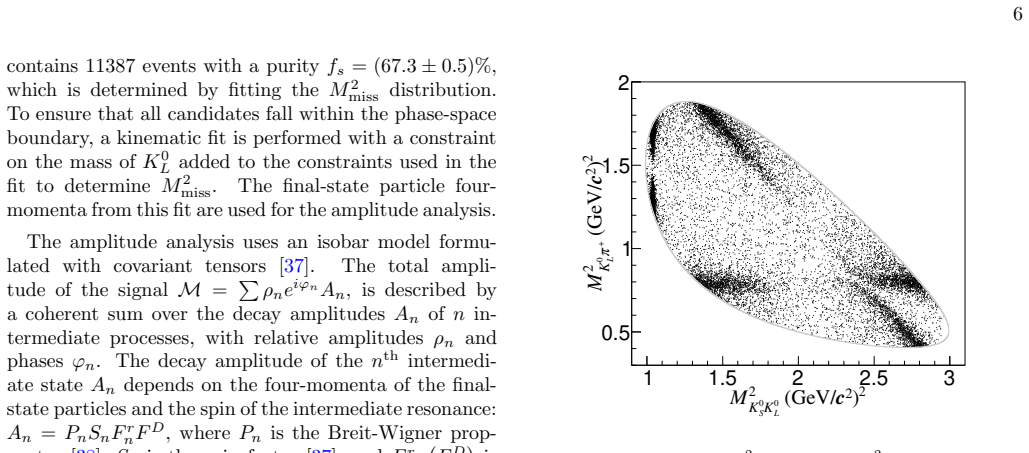
Figure 1.Figure 1: FIG. 1. Dalitz plot of
[PITH_FULL_IMAGE:figures/full_fig_p006_1.png]view at source ↗Figure 2.Figure 2: FIG. 2. Distributions of (a)
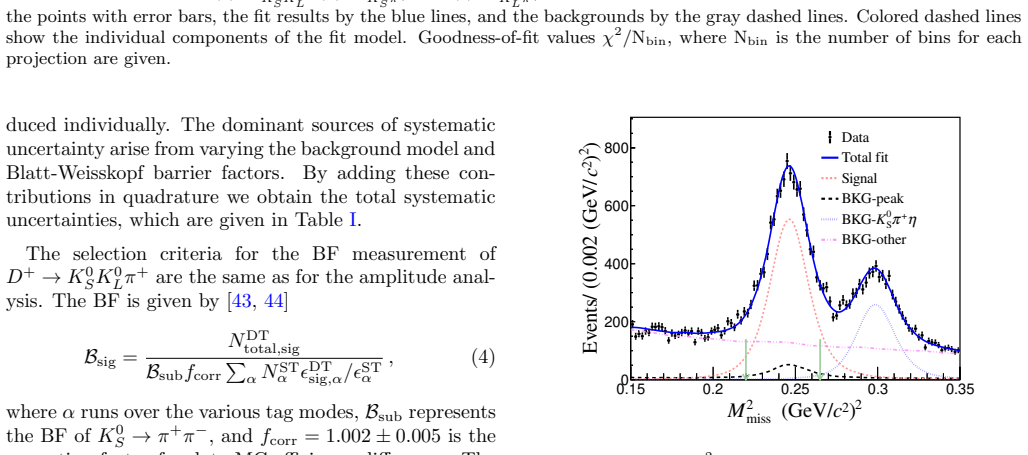
[PITH_FULL_IMAGE:figures/full_fig_p007_2.png]view at source ↗Figure 3.Figure 3: FIG. 3. Fit to the
[PITH_FULL_IMAGE:figures/full_fig_p007_3.png]view at source ↗Figure 4.Figure 4: FIG. 4. Comparison of the results for
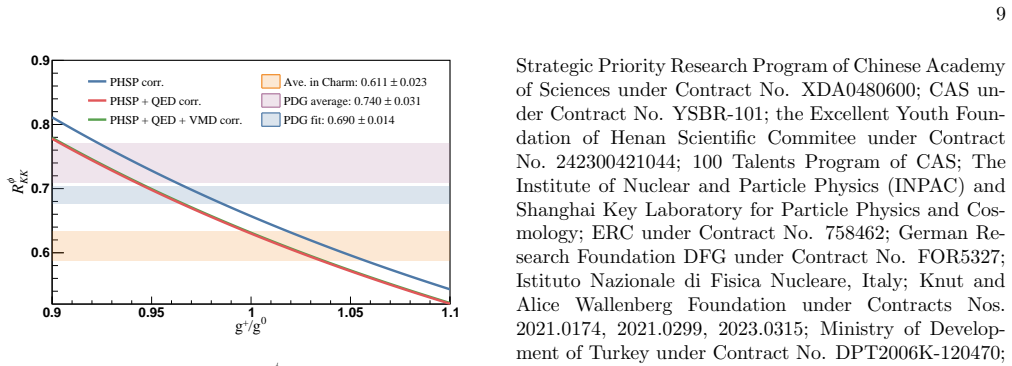
[PITH_FULL_IMAGE:figures/full_fig_p008_4.png]view at source ↗Figure 5.Figure 5: FIG. 5. Comparison of measured
[PITH_FULL_IMAGE:figures/full_fig_p009_5.png]view at source ↗
read the original abstract
We present the first amplitude analysis and branching fraction measurement of $D^{+} \rightarrow K_{S}^{0}K_{L}^{0}\pi^{+}$ decay. The analysis uses a dataset corresponding to an integrated luminosity of 20.3~$\rm fb^{-1}$, which was recorded at a center-of-mass energy 3.773~GeV by the BESIII detector. The measured branching fraction is $\mathcal{B}(D^{+} \rightarrow K_{S}^{0}K_{L}^{0}\pi^{+})=(5.780\pm0.085\pm 0.052)\times10^{-3}$, where the first uncertainty is statistical and the second is systematic. Using the known value of ${\cal B}(D^+ \to \phi \pi^+,\,\phi \to K^+K^-)$, we determine the relative branching fraction between $\phi \to K_{S}^0K_{L}^0$ and $\phi \to K^+K^-$ to be $\mathcal{B}(D^{+} \to \phi \pi^{+}, \phi \to K_{S}^0K_{L}^0)/\mathcal{B}(D^{+} \to \phi \pi^{+}, \phi \to K^+K^-)= 0.628\pm0.022\pm 0.015\pm0.017$, where the third uncertainty is related to $\mathcal{B}(D^{+} \to \phi \pi^{+}, \phi \to K^+K^-)$. This result is significantly lower than the previous world average and is consistent with the isospin expectation for the $\phi$ meson's coupling to charged and neutral kaon pairs.
Editorial analysis
A structured set of objections, weighed in public.
Desk editor's note, referee report, simulated authors' rebuttal, and a
circularity audit. Tearing a paper down is the easy half of reading it; the
pith above is the substance, this is the friction.
Referee Report
1 major / 2 minor
Summary. The paper reports the first amplitude analysis of the decay D⁺ → K_S⁰ K_L⁰ π⁺ using 20.3 fb⁻¹ of e⁺e⁻ collision data at √s = 3.773 GeV collected with the BESIII detector. It measures the absolute branching fraction B(D⁺ → K_S⁰ K_L⁰ π⁺) = (5.780 ± 0.085 ± 0.052) × 10^{-3}. Combining this with the external reference B(D⁺ → φ π⁺, φ → K⁺K⁻), the authors extract the relative branching fraction B(φ → K_S⁰ K_L⁰)/B(φ → K⁺K⁻) = 0.628 ± 0.022 ± 0.015 ± 0.017. The result is stated to be significantly lower than the previous world average and consistent with isospin expectations for φ → KK̄ couplings.
Significance. If the amplitude analysis reliably isolates the narrow φ contribution, the measurement supplies an independent test of isospin symmetry in vector-meson decays and resolves a long-standing discrepancy with earlier world-average values. The use of a full Dalitz-plot amplitude fit rather than a simple mass-window selection is a methodological improvement for a three-body final state containing both narrow and broad structures. The result, if robust, would tighten constraints on φ–KK̄ couplings and serve as input for future precision studies of light-meson spectroscopy.
major comments (1)
The central relative branching fraction (0.628) is obtained by attributing a fraction of the three-body intensity to the narrow φ → K_S⁰ K_L⁰ component inside a global amplitude fit. The manuscript does not demonstrate that this fraction remains stable (within the quoted uncertainties) when the model is varied by adding or removing resonances (e.g., K*(892), a₀(980), or additional scalar terms) or by altering the parametrization of non-resonant contributions and their interference phases. Because cross terms in the intensity can shift the fitted φ normalization, the absence of such stability tests leaves the quoted total uncertainty potentially underestimated and directly affects the claim that the result is significantly lower than the prior average.
minor comments (2)
The abstract states that the result is “significantly lower than the previous world average” but does not quote the numerical value or reference of that average; a direct comparison would improve clarity.
The third uncertainty on the relative branching fraction is attributed to the external B(D⁺ → φ π⁺, φ → K⁺K⁻); the manuscript should explicitly state how this external uncertainty is propagated and whether it is treated as fully correlated or uncorrelated with the present data.
Simulated Author's Rebuttal
1 responses · 0
unresolved
We thank the referee for the thorough review and valuable feedback on our manuscript. The concern regarding the stability of the extracted φ fraction under amplitude model variations is well taken, and we have addressed it by performing the requested checks. Our responses to the major comment are provided below, and the revised manuscript incorporates the additional material.
read point-by-point responses
Referee: The central relative branching fraction (0.628) is obtained by attributing a fraction of the three-body intensity to the narrow φ → K_S⁰ K_L⁰ component inside a global amplitude fit. The manuscript does not demonstrate that this fraction remains stable (within the quoted uncertainties) when the model is varied by adding or removing resonances (e.g., K*(892), a₀(980), or additional scalar terms) or by altering the parametrization of non-resonant contributions and their interference phases. Because cross terms in the intensity can shift the fitted φ normalization, the absence of such stability tests leaves the quoted total uncertainty potentially underestimated and directly affects the claim that the result is significantly lower than the prior average.
Authors: We agree that explicit tests of model stability are essential for amplitude analyses of three-body decays to ensure that interference effects do not bias the narrow resonance normalization. The baseline model in our analysis includes the φ(1020), K*(892), a₀(980), and a non-resonant component with floating magnitudes and phases, chosen to describe the observed Dalitz-plot structures. The φ contribution is localized due to its narrow width, and the fit accounts for all interference terms in the intensity. To directly address the referee's point, we have now performed a series of alternative fits: (i) removing the a₀(980) or K*(892) one at a time, (ii) adding an additional scalar resonance, and (iii) varying the non-resonant parametrization (e.g., different polynomial orders or constant vs. linear terms). In all cases the extracted relative branching fraction B(φ → K_S⁰ K_L⁰)/B(φ → K⁺ K⁻) remains consistent with 0.628 within the quoted total uncertainty. These results, together with a new table summarizing the variations, will be added to the revised manuscript (new Section 5.3 and Appendix). We therefore maintain that the total uncertainty is not underestimated and that the comparison to the previous world average remains valid.
revision: yes
Circularity Check
0 steps flagged
No significant circularity in the derivation chain
full rationale
The paper reports a data-driven amplitude analysis of D+ → KS0 KL0 π+ decays using BESIII collision data. The total branching fraction is extracted directly from the fit to the Dalitz plot. The relative branching fraction for the φ modes is obtained by dividing the fitted φ → KS0 KL0 yield by an external, previously published branching fraction for φ → K+K−; this external input is independent of the present dataset and equations. The comparison to the world average and to isospin expectations is a post-hoc consistency check, not part of the derivation. No self-definitional relations, fitted inputs renamed as predictions, load-bearing self-citations, or ansatz smuggling appear in the reported chain. The result remains falsifiable against external data and is self-contained against benchmarks.
The central claim rests on experimental data fitting and one external branching-fraction input; no new particles or forces are postulated.
free parameters (1)
amplitude fit parameters Complex amplitudes and phases for contributing resonances are determined by fitting the observed phase-space distribution.
axioms (1)
domain assumptionIsospin symmetry holds for phi → KK decays up to small electromagnetic and mass-difference corrections Invoked when stating that the measured ratio is consistent with isospin expectation.
pith-pipeline@v0.9.0 ·
9818 in / 1325 out tokens ·
81871 ms ·
2026-05-13T02:30:56.133849+00:00
· methodology
The amplitude analysis uses an isobar model formulated with covariant tensors... total amplitude M = Σ ρ_n e^{i φ_n} A_n ... Breit-Wigner propagator, spin factor, Blatt-Weisskopf barrier factor.
J. C. Chen, G. S. Huang, X. R. Qi, D. H. Zhanget al. Phys. Rev. D62, 034003 (2000); R. L. Yang, R. G. Ping and H. Chen, Chin. Phys. Lett.31, 061301 (2014)
In the decay process under consideration, a pair ofK 0 ¯K 0 is produced. (Here,K 0 and ¯K 0 includes their excited states, such asK ∗0 and ¯K ∗0, without losing generality.) Since one ofK 0 and ¯K 0 is the superposition ofK 0 S and K 0 L with same phase while the other has an opposite phase,K 0(→K 0 S) ¯K 0(→K 0 L) andK 0(→K 0 L) ¯K 0(→K 0 S) exhibits a p...


discussion (0)
Sign in with ORCID, Apple, or X to comment. Anyone can read and Pith papers without signing in.