Recognition: no theorem link
One-Step Relativistic Driven Similarity Renormalization Group Multireference Perturbation Theory
Pith reviewed 2026-05-13 02:24 UTC · model grok-4.3
The pith
A relativistic multireference method achieves spin-orbit accuracy below 7% for sixth-row elements
A machine-rendered reading of the paper's core claim, the machinery that carries it, and where it could break.
Core claim
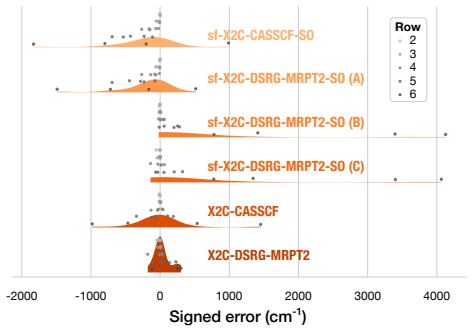
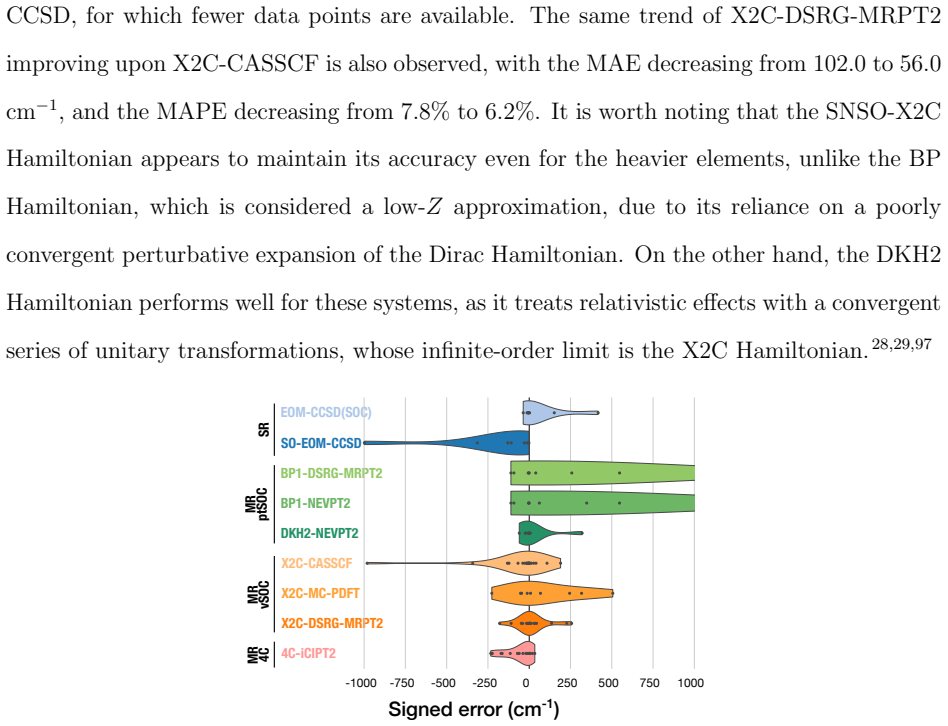
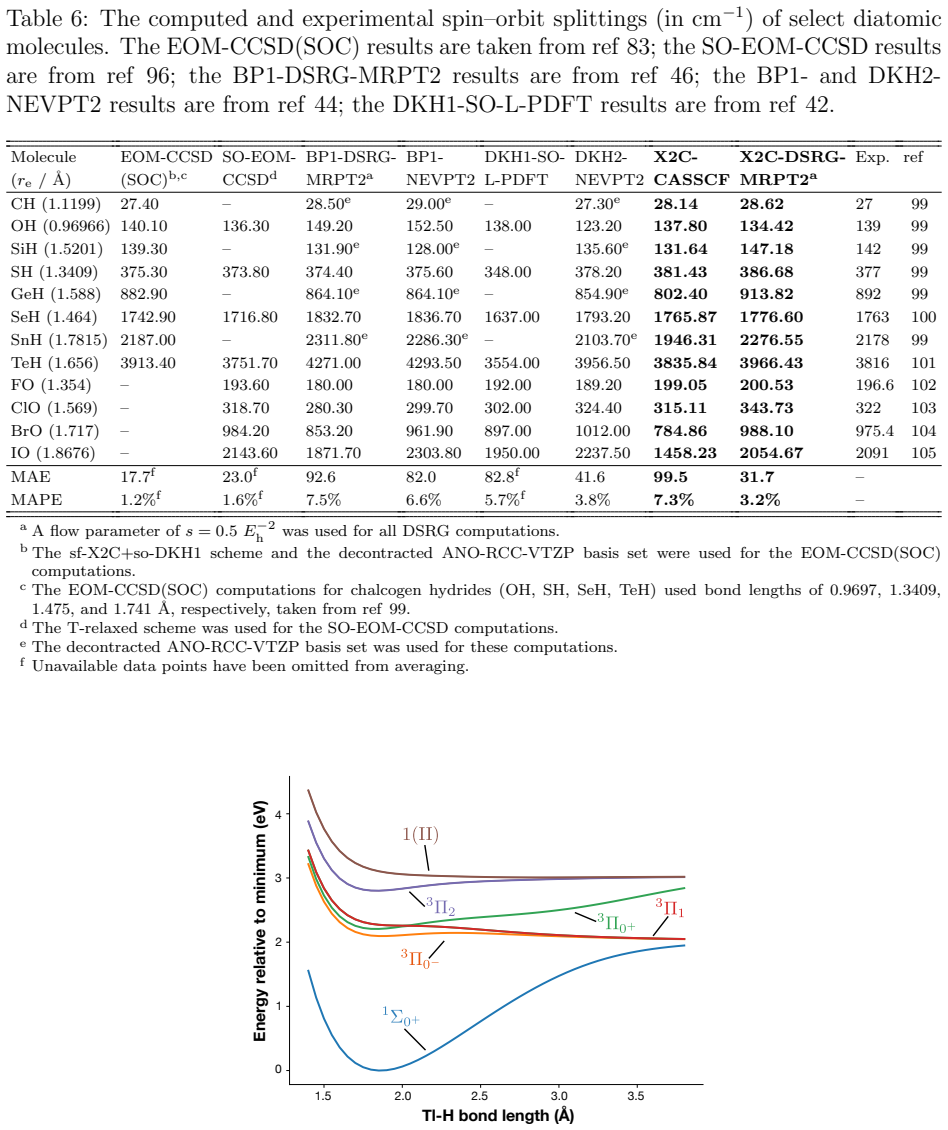
We present an efficient implementation of a one-step relativistic second-order multireference perturbation theory based on the multireference driven similarity renormalization group using the exact two-component Hamiltonian. The X2C-DSRG-MRPT2 method accurately captures spin-orbit coupling effects in strongly correlated systems and yields spin-orbit splittings with mean absolute percentage errors consistently below 7% with respect to experimental values for systems containing up to sixth row elements, providing a promising avenue for the routine treatment of relativistic effects with modest fifth-power scaling.
What carries the argument
The X2C-DSRG-MRPT2 framework, a variational one-step incorporation of spin-orbit coupling via the exact two-component Hamiltonian into the MR-DSRG-MRPT2 perturbation theory.
Load-bearing premise
The one-step variational treatment using the X2C Hamiltonian is sufficient to capture the dominant relativistic contributions for the tested systems without higher-order corrections.
What would settle it
A spin-orbit splitting measurement in a sixth-row element system showing a mean absolute percentage error significantly exceeding 7% would challenge the accuracy claim.
Figures

read the original abstract
We present an efficient implementation of a one-step relativistic second-order multireference perturbation theory based on the multireference driven similarity renormalization group (MR-DSRG) using the exact two-component (X2C) Hamiltonian, which we denote X2C-DSRG-MRPT2. We show that the X2C-DSRG-MRPT2 method can accurately capture spin--orbit coupling (SOC) effects in the electronic structure of strongly correlated systems containing elements across the periodic table. We further demonstrate that the X2C-DSRG-MRPT2 method, through its variational treatment of SOC effects, can yield spin--orbit splittings with mean absolute percentage errors consistently below 7% with respect to experimental values for systems containing up to sixth row elements. With its modest computational scaling (fifth power in system size) and high accuracy, X2C-DSRG-MRPT2 provides a promising avenue for the routine treatment of relativistic effects in strongly correlated molecular systems.
Editorial analysis
A structured set of objections, weighed in public.
Referee Report
Summary. The manuscript introduces X2C-DSRG-MRPT2, an efficient one-step implementation of second-order multireference perturbation theory that incorporates the exact two-component (X2C) Hamiltonian variationally into the driven similarity renormalization group (MR-DSRG) framework. It demonstrates that this approach accurately captures spin-orbit coupling effects in strongly correlated systems containing heavy elements, yielding spin-orbit splittings with mean absolute percentage errors consistently below 7% relative to experiment for molecules with elements up to the sixth row (explicitly benchmarked for BiH, PbO, and At2 in Table 3), while retaining O(N^5) scaling.
Significance. If the reported benchmarks hold, the work is significant as it provides a parameter-free, variational relativistic MRPT2 method that combines modest computational cost with demonstrated accuracy for SOC splittings in multireference heavy-element systems. The direct comparisons in Table 3 to both experiment and two-step DKH-SOC references, together with explicit active-space and basis-set details, support reproducibility and highlight advantages over non-variational treatments. This advances routine relativistic calculations for strongly correlated molecules.
minor comments (3)
- The abstract and results section state fifth-power scaling but should explicitly define N (e.g., number of basis functions or spatial orbitals) and confirm the scaling holds after including the X2C transformation cost.
- Table 3: Provide the exact experimental reference values and the precise formula used for MAPE to allow independent verification of the <7% claim for each system.
- Method section: Add a short paragraph clarifying how the one-step X2C incorporation modifies the MR-DSRG flow equations, particularly the treatment of spin-orbit operators in the similarity transformation.
Simulated Author's Rebuttal
We thank the referee for the positive evaluation of our manuscript introducing the X2C-DSRG-MRPT2 method and for recommending minor revision. We appreciate the recognition of its significance for variational relativistic multireference perturbation theory in heavy-element systems.
Circularity Check
No significant circularity detected
full rationale
The paper introduces an implementation of the X2C-DSRG-MRPT2 method by combining the exact two-component Hamiltonian with the multireference driven similarity renormalization group perturbation theory. The central claims rest on explicit numerical benchmarks against experimental spin-orbit splittings (e.g., MAPE <7% for systems up to sixth-row elements) and comparisons to two-step references, with full details on active spaces, basis sets, and scaling provided in tables. No step in the derivation reduces by construction to a fitted parameter, self-citation, or renamed input; the variational treatment of SOC is derived from standard X2C and MR-DSRG equations without circular redefinition. The work is self-contained against external experimental data.
Axiom & Free-Parameter Ledger
axioms (2)
- domain assumption The exact two-component (X2C) Hamiltonian sufficiently approximates full relativistic effects for the molecular systems considered.
- domain assumption Second-order multireference perturbation theory captures the dominant electron correlation effects when combined with the DSRG framework.
Reference graph
Works this paper leans on
-
[1]
(1) Hoyer, C. E.; Liao, C.; Shumilov, K. D.; Zhang, T.; Li, X. State Interaction for Relativistic Four-Component Methods: Choose the Right Zeroth-Order Hamiltonian for Late-Row Elements.J. Chem. Theory Comput.2024,20, 7969–7978. (2) Pyykk¨ o, P.; Desclaux, J. P. Relativity and the Periodic System of Elements.Acc. Chem. Res.1979,12, 276–281. (3) Pyykk¨ o, ...
work page 2024
-
[2]
The Physics behind Chemistry and the Periodic Table.Chem
(4) Pyykk¨ o, P. The Physics behind Chemistry and the Periodic Table.Chem. Rev.2012, 112, 371–384. (5) Pyykk¨ o, P. Relativistic Effects in Chemistry: More Common Than You Thought. Annu. Rev. Phys. Chem.2012,63, 45–64. (6) Abe, M.; Nakajima, T.; Hirao, K. The Relativistic Complete Active-Space Second- Order Perturbation Theory with the Four-Component Dira...
work page 2012
-
[3]
(25) Watanabe, Y.; Matsuoka, O. Four-Component Relativistic Configuration-Interaction Calculation Using the Reduced Frozen-Core Approximation.J. Chem. Phys.2002, 116, 9585–9590. (26) Iliaˇ s, M.; Saue, T. An Infinite-Order Two-Component Relativistic Hamiltonian by a Simple One-Step Transformation.J. Chem. Phys.2007,126, 064102. 39 (27) Kutzelnigg, W.; Liu...
work page 2002
-
[4]
The Molecular Mean-Field Approach for Correlated Relativistic Calculations.J
(39) Sikkema, J.; Visscher, L.; Saue, T.; Iliaˇ s, M. The Molecular Mean-Field Approach for Correlated Relativistic Calculations.J. Chem. Phys.2009,131, 124116. (40) Surjuse, K. A.; Valeev, E. F. SAP-X2C: Optimally-Simple Two-Component Relativis- tic Hamiltonian with Size-Intensive Picture Change.J. Chem. Theory Comput.2026, 22, 3443–3452. (41) Zhang, C.;...
work page 2009
-
[5]
(47) Zhai, H.; Chan, G. K.-L. A Comparison between the One- and Two-Step Spin–Orbit Coupling Approaches Based on the Ab Initio Density Matrix Renormalization Group. J. Chem. Phys.2022,157, 164108. (48) Fedorov, D. G.; Gordon, M. S. A Study of the Relative Importance of One and Two- Electron Contributions to Spin–Orbit Coupling.J. Chem. Phys.2000,112, 5611...
work page 2022
-
[6]
(56) Sharma, P.; Jenkins, A. J.; Scalmani, G.; Frisch, M. J.; Truhlar, D. G.; Gagliardi, L.; Li, X. Exact-Two-Component Multiconfiguration Pair-Density Functional Theory.J. Chem. Theory Comput.2022,18, 2947–2954. (57) Hoyer, C. E.; Hu, H.; Lu, L.; Knecht, S.; Li, X. Relativistic Kramers-Unrestricted Exact-Two-Component Density Matrix Renormalization Group...
work page 2022
-
[7]
(61) Li, C.; Evangelista, F. A. Driven Similarity Renormalization Group for Excited States: A State-Averaged Perturbation Theory.J. Chem. Phys.2018,148, 124106. (62) Hannon, K. P.; Li, C.; Evangelista, F. A. An Integral-Factorized Implementation of the 43 Driven Similarity Renormalization Group Second-Order Multireference Perturbation Theory.J. Chem. Phys...
work page 2018
-
[8]
(68) Iliaˇ s, M.; Kell¨ o, V.; Visscher, L.; Schimmelpfennig, B. Inclusion of Mean-Field Spin– Orbit Effects Based on All-Electron Two-Component Spinors: Pilot Calculations on Atomic and Molecular Properties.J. Chem. Phys.2001,115, 9667–9674. (69) Zhang, T.; Banerjee, S.; Koulias, L. N.; Valeev, E. F.; DePrince, A. E. I.; Li, X. Dirac– Coulomb–Breit Molec...
work page 2001
-
[9]
44 (72) Wang, X.; Wang, S.; Wu, Y.; Cheng, L. Relativistic Complete Active Space Self- Consistent-Field Method with a Hierarchy of Exact Two-Component Hamiltonians. J. Chem. Theory Comput.2026, (73) Hohenstein, E. G.; Luehr, N.; Ufimtsev, I. S.; Mart´ ınez, T. J. An Atomic Orbital- Based Formulation of the Complete Active Space Self-Consistent Field Metho...
work page 2026
-
[10]
Unified Implementation of Relativistic Wave Function Methods: 4C-iCIPT2 as a Showcase.J
(94) Zhang, N.; Liu, W. Unified Implementation of Relativistic Wave Function Methods: 4C-iCIPT2 as a Showcase.J. Chem. Theory Comput.2024,20, 9003–9017. (95) Zhang, B.; Vandezande, J. E.; Reynolds, R. D.; Schaefer, III, H. F. Spin–Orbit Cou- pling via Four-Component Multireference Methods: Benchmarking on p-Block Ele- ments and Tentative Recommendations.J...
work page 2024
-
[11]
(96) Cheng, L.; Wang, F.; Stanton, J. F.; Gauss, J. Perturbative Treatment of Spin-Orbit- 47 Coupling within Spin-Free Exact Two-Component Theory Using Equation-of-Motion Coupled-Cluster Methods.J. Chem. Phys.2018,148, 044108. (97) K¸ edziera, D.; Barysz, M. Two-Component Relativistic Methods for the Heaviest Ele- ments.J. Chem. Phys.2004,121, 6719–6727. ...
work page 2018
-
[12]
(100) Ram, R. S.; Bernath, P. F. Fourier Transform Infrared Emission Spectroscopy of SeH. J. Mol. Spectrosc.2000,203, 9–15. (101) Fink, E. H.; Setzer, K. D.; Ramsay, D. A.; Vervloet, M. Near-Infrared Emission Bands of TeH and TeD.J. Mol. Spectrosc.1989,138, 19–28. (102) Miller, C. E.; Drouin, B. J. TheX12Π3/2 andX22Π1/2 Potential Energy Surfaces of FO.J. ...
work page 2000
discussion (0)
Sign in with ORCID, Apple, or X to comment. Anyone can read and Pith papers without signing in.