Recognition: 2 theorem links
· Lean TheoremDefect screening and load transfer in minimal hard-soft double networks
Pith reviewed 2026-05-13 02:18 UTC · model grok-4.3
The pith
A minimal model of two coupled disordered linear-elastic networks reproduces all key nonlinear behaviors of double-network materials through inter-network load transfer and defect screening.
A machine-rendered reading of the paper's core claim, the machinery that carries it, and where it could break.
Core claim
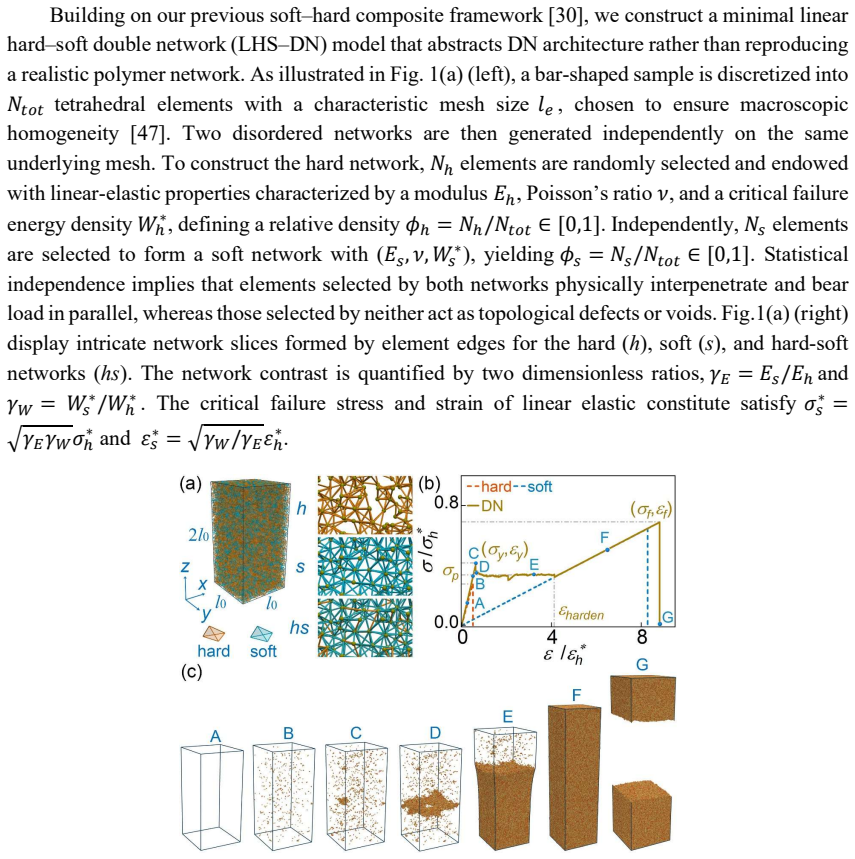
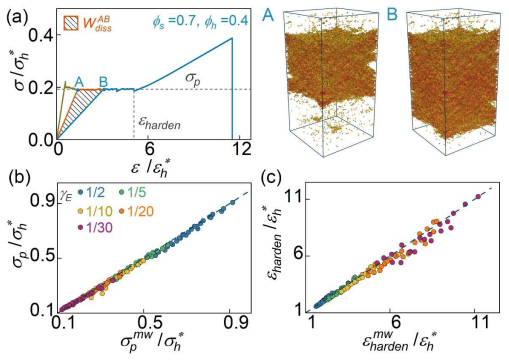
In a minimal three-dimensional model of two coupled, disordered linear-elastic networks, mechanical contrast between the hard and soft components produces inter-network load transfer that screens defects and suppresses stress concentrations in the hard network. Defining a stress-concentration factor K_sc shows that the hard-network failure strain scales universally as 1/K_sc. Complete defect screening triggers the transition from localized necking to delocalized damage, while the stable necking plateau is selected by the balance between potential-energy release and irreversible dissipation.
What carries the argument
The stress-concentration factor K_sc, which quantifies how load transfer from the soft network reduces peak stresses at defects in the hard network and thereby controls the hard-network failure strain.
If this is right
- The model reproduces yielding, necking, strain hardening, and the brittle-to-ductile transition seen in real double-network gels.
- Hard-network failure strain follows the universal scaling 1/K_sc across different network realizations.
- Full defect screening switches deformation from localized necking to delocalized damage.
- The necking plateau is an energetic selection set by the trade-off between elastic-energy release and dissipation.
Where Pith is reading between the lines
- The same load-transfer mechanism could be engineered in other heterogeneous solids to achieve toughness without complex nonlinear chemistry.
- Controlling only the stiffness ratio and network connectivity might allow direct tuning of failure strain via the predicted 1/K_sc relation.
- The minimal model offers a computationally cheap way to explore how disorder statistics affect the brittle-to-ductile boundary in composites.
Load-bearing premise
That purely linear-elastic constitutive behavior plus inter-network coupling in disordered networks is sufficient to generate yielding, necking, hardening, and the brittle-to-ductile transition without any explicit nonlinear material response or rate dependence.
What would settle it
A simulation or experiment in which the hard and soft networks are given identical stiffness (removing mechanical contrast) yet still produce the full suite of DN nonlinear behaviors and the 1/K_sc scaling.
Figures


read the original abstract
Double network (DN) materials exhibit anomalous strength and toughness that far exceed the sum of their constituents. While widely exploited, the fundamental physical mechanisms underlying this synergy remain elusive. Here, we show that a minimal three-dimensional model of two coupled, disordered linear-elastic networks is sufficient to capture the essential physics of DN nonlinear mechanics. The model reproduces the full suite of unique mechanical behaviors, including yielding, necking, strain hardening, and the brittle-to-ductile transition. Mechanical contrast between the hard and soft networks drives inter-network load transfer, which screens defects and suppresses stress concentrations in the hard network. By defining a stress-concentration factor, K_sc, we find that the hard-network failure strain scales universally as 1/K_sc, directly bridging microscopic defect screening to macroscopic yielding. We further show that complete defect screening triggers the shift from localized necking to delocalized damage. Furthermore, the stable necking plateau is identified as an energetic selection governed by the balance between potential energy release and irreversible dissipation. These findings reveal that a simple linear-elastic framework can account for the rich nonlinear landscape of DN materials, providing a general principle for designing next-generation tough solids.
Editorial analysis
A structured set of objections, weighed in public.
Referee Report
Summary. The manuscript introduces a minimal 3D model of two interpenetrating, disordered linear-elastic networks (hard and soft) with tunable mechanical contrast. It claims that inter-network load transfer alone produces the characteristic DN nonlinear response suite—yielding, necking, strain hardening, and brittle-to-ductile transition—by screening defects and suppressing stress concentrations in the hard network. A stress-concentration factor K_sc is defined, and the hard-network failure strain is reported to scale universally as 1/K_sc; complete screening is said to trigger delocalized damage, while the necking plateau arises from an energetic balance between potential-energy release and irreversible dissipation.
Significance. If the central claim holds without circularity or hidden constitutive assumptions, the work would offer a parsimonious, parameter-sparse framework for DN toughness that directly links microscopic load transfer to macroscopic scaling laws. The proposed universal 1/K_sc relation could serve as a design principle for tough solids. The model’s reproducibility and minimal free parameters (primarily the contrast ratio) are strengths that would elevate its impact if the nonlinearity is shown to emerge strictly from elastic coupling rather than from an imposed damage rule.
major comments (2)
- [Model description and abstract] The abstract and model description state that the networks are linear-elastic, yet the results explicitly invoke irreversible dissipation to sustain the necking plateau and bond failure to produce yielding. The manuscript must specify the precise bond-rupture criterion (strain or stress threshold) and demonstrate that this rule is not the source of the reported nonlinearity; otherwise the claim that “a simple linear-elastic framework can account for the rich nonlinear landscape” is not supported.
- [Results on K_sc and failure strain] The scaling “hard-network failure strain scales universally as 1/K_sc” is load-bearing for the micro-to-macro bridge. The definition and computation of K_sc must be shown to be independent of the failure event itself (e.g., K_sc evaluated on the undamaged stress field versus after damage has begun). If K_sc is extracted from the same stress distribution that triggers rupture, the reported scaling risks being tautological rather than an emergent prediction.
minor comments (2)
- [Figures and scaling plots] Figure captions and the text should explicitly state the numerical value of the mechanical contrast ratio used for each data set and whether any data points were excluded from the scaling collapse.
- [Abstract and Results] The abstract asserts that “complete defect screening triggers the shift from localized necking to delocalized damage,” but the manuscript should provide a quantitative metric (e.g., a threshold on the fraction of screened defects or on the spatial variance of stress) used to identify this transition.
Simulated Author's Rebuttal
We are grateful to the referee for their insightful and constructive comments, which have helped us identify areas for clarification in the model description and the independence of the K_sc scaling. We address each major comment in detail below and outline the revisions we will make.
read point-by-point responses
-
Referee: [Model description and abstract] The abstract and model description state that the networks are linear-elastic, yet the results explicitly invoke irreversible dissipation to sustain the necking plateau and bond failure to produce yielding. The manuscript must specify the precise bond-rupture criterion (strain or stress threshold) and demonstrate that this rule is not the source of the reported nonlinearity; otherwise the claim that “a simple linear-elastic framework can account for the rich nonlinear landscape” is not supported.
Authors: We thank the referee for this important clarification request. The individual bonds in each network are linear-elastic springs that obey Hooke's law until a local strain threshold is reached, at which point the bond ruptures irreversibly and the stored elastic energy is dissipated. The rupture criterion is a critical local strain (identical in form for hard and soft networks, though the hard network reaches it at higher stress due to its modulus). We will revise the abstract, model section, and methods to explicitly state this threshold and the resulting dissipation. To demonstrate that the damage rule is not the origin of the observed nonlinearity, we note that identical single-network simulations (same rupture criterion, no interpenetration) produce only linear elasticity followed by abrupt brittle failure, without yielding, necking, or hardening. These features require the mechanical contrast and load transfer. We will add a supplementary comparison of single- versus double-network responses under the same rupture rule to make this explicit. revision: yes
-
Referee: [Results on K_sc and failure strain] The scaling “hard-network failure strain scales universally as 1/K_sc” is load-bearing for the micro-to-macro bridge. The definition and computation of K_sc must be shown to be independent of the failure event itself (e.g., K_sc evaluated on the undamaged stress field versus after damage has begun). If K_sc is extracted from the same stress distribution that triggers rupture, the reported scaling risks being tautological rather than an emergent prediction.
Authors: We agree that independence from the failure event is essential. K_sc is defined as the ratio of the maximum local stress to the average stress in the hard network and is computed exclusively from the linear-elastic stress field of the pristine (undamaged) configuration at small applied strains, prior to any bond rupture. The hard-network failure strain is then identified as the macroscopic strain at which this maximum local stress reaches the critical rupture threshold. The 1/K_sc scaling therefore emerges because load transfer from the soft network lowers K_sc, delaying the onset of local failure. We will add an explicit statement in the results and a methods paragraph confirming that K_sc is always evaluated on the undamaged network; we will also include a supplementary panel showing the initial stress field used for the calculation. revision: yes
Circularity Check
K_sc scaling relation reduces to definition of stress concentration plus fixed local failure threshold
specific steps
-
self definitional
[Abstract]
"By defining a stress-concentration factor, K_sc, we find that the hard-network failure strain scales universally as 1/K_sc, directly bridging microscopic defect screening to macroscopic yielding."
K_sc is constructed from the same stress fields used to determine when the hard network fails. If failure occurs at a fixed local stress threshold, then failure strain = threshold / (E × K_sc) follows immediately from the definition of K_sc, rendering the scaling tautological rather than a derived result.
full rationale
The paper defines K_sc from the simulated stress fields and reports that hard-network failure strain scales as 1/K_sc. Because failure is triggered when local stress reaches a material threshold, the macroscopic strain at failure is necessarily inverse to K_sc by the definition of stress concentration (local stress = K_sc × average stress). This makes the reported universal scaling a direct algebraic consequence rather than an independent prediction. The model is described as linear-elastic yet produces yielding, necking, and irreversible dissipation, implying an additional bond-rupture rule whose details are not shown to be parameter-free or external to the claimed minimal framework. No other load-bearing steps reduce to self-citation or renaming.
Axiom & Free-Parameter Ledger
free parameters (1)
- mechanical contrast ratio
axioms (2)
- domain assumption Networks consist of linear-elastic springs on disordered topologies
- domain assumption Inter-network connections allow load transfer without additional dissipation mechanisms
invented entities (1)
-
stress-concentration factor K_sc
no independent evidence
Lean theorems connected to this paper
-
IndisputableMonolith/Cost/FunctionalEquation.leanwashburn_uniqueness_aczel unclear?
unclearRelation between the paper passage and the cited Recognition theorem.
Element failure is implemented via irreversible damage variables d_α ∈ [0,1]. ... once its local strain-energy density exceeds the predefined threshold W_α*
-
IndisputableMonolith/Foundation/BranchSelection.leanbranch_selection unclear?
unclearRelation between the paper passage and the cited Recognition theorem.
the stable necking plateau is identified as an energetic selection governed by the balance between potential energy release and irreversible dissipation
What do these tags mean?
- matches
- The paper's claim is directly supported by a theorem in the formal canon.
- supports
- The theorem supports part of the paper's argument, but the paper may add assumptions or extra steps.
- extends
- The paper goes beyond the formal theorem; the theorem is a base layer rather than the whole result.
- uses
- The paper appears to rely on the theorem as machinery.
- contradicts
- The paper's claim conflicts with a theorem or certificate in the canon.
- unclear
- Pith found a possible connection, but the passage is too broad, indirect, or ambiguous to say the theorem truly supports the claim.
Reference graph
Works this paper leans on
-
[1]
T. Nakajima, T. Kurokawa, H. Furukawa, and J. P. Gong, Effect of the constituent networks of double- network gels on their mechanical properties and energy dissipation process, Soft Matter 16, 8618 (2020)
work page 2020
-
[2]
F. Tian, K. Sato, Y. Zheng, F. Lu, and J. P. Gong, Fundamental toughening landscape in soft–hard composites: Insights from a minimal framework, Proc. Natl. Acad. Sci. U.S.A. 122, e2506071122 (2025)
work page 2025
-
[3]
F. Lu, T. Nakajima, Y. Zheng, H. Fan, and J. P. Gong, Tensile Behaviors of Double Network Hydrogels with Varied First Network Topological and Chemical Structures, Macromolecules, (2024)
work page 2024
-
[4]
T. L. Anderson and T. L. Anderson, Fracture mechanics: fundamentals and applications (CRC press, 2005)
work page 2005
-
[5]
R. E. Peterson, Notch sensitivity, Metal fatigue, 293 (1959)
work page 1959
-
[6]
H. Neuber, Theory of notch stresses: principles for exact calculation of strength with reference to structural form and material, (No Title), (1961)
work page 1961
-
[7]
J. Liu, C. Yang, T. Yin, Z. Wang, S. Qu, and Z. Suo, Polyacrylamide hydrogels. II. elastic dissipater, J. Mech. Phys. Solids 133, 103737 (2019)
work page 2019
-
[8]
B. Deng, S. Wang, C. Hartquist, and X. Zhao, Nonlocal Intrinsic Fracture Energy of Polymerlike Networks, Phys. Rev. Lett. 131, 228102 (2023)
work page 2023
discussion (0)
Sign in with ORCID, Apple, or X to comment. Anyone can read and Pith papers without signing in.