Recognition: 2 theorem links
· Lean TheoremQuBridge: Layer-wise Fidelity Decomposition in Quantum Computation Pipeline
Pith reviewed 2026-05-13 02:00 UTC · model grok-4.3
The pith
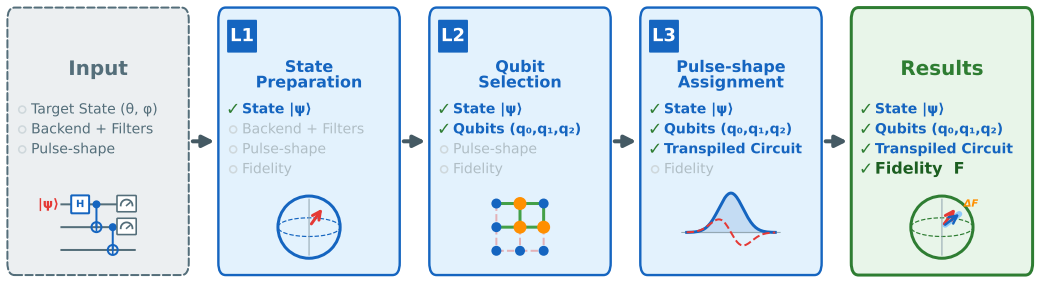
QuBridge decomposes quantum circuit decisions into layers to quantify each one's isolated contribution to output fidelity.
A machine-rendered reading of the paper's core claim, the machinery that carries it, and where it could break.
Core claim
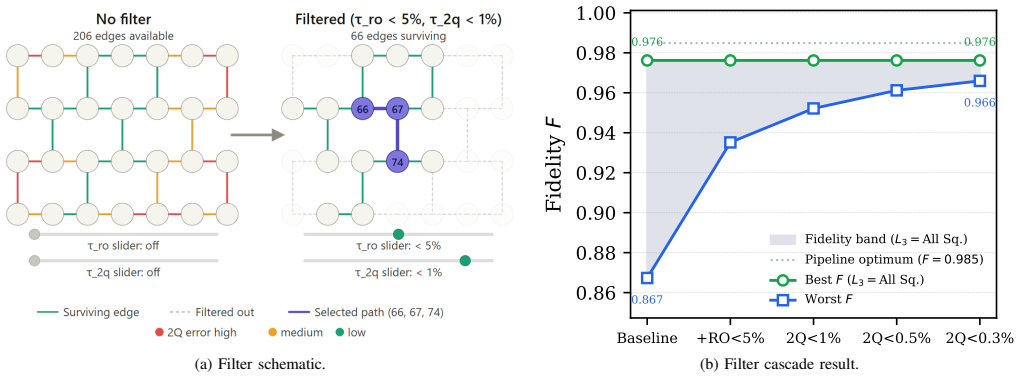
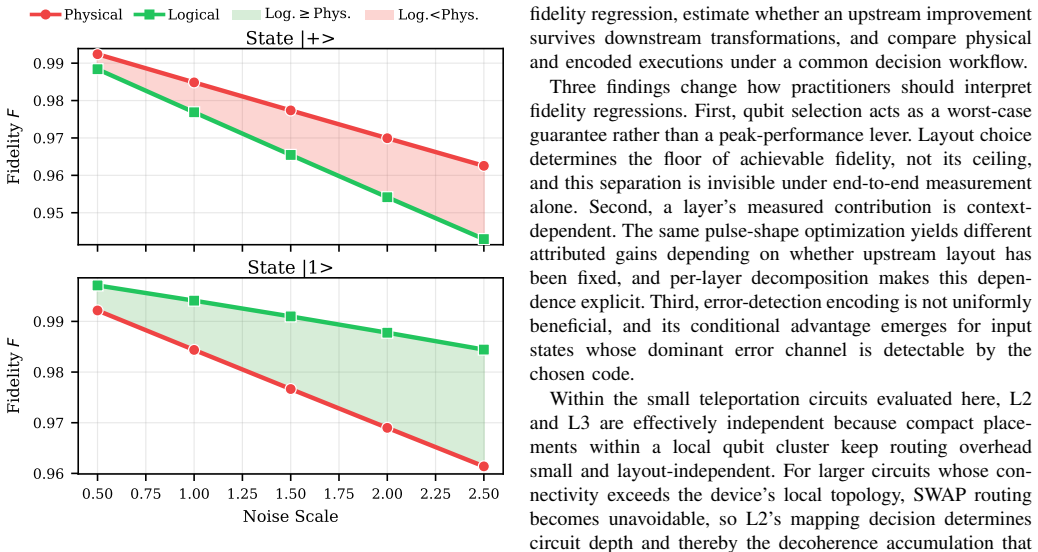
By treating the quantum pipeline as three distinct layers—qubit selection, per-gate pulse-shape assignment, and error-detection encoding—and systematically ablating or isolating each layer in turn, the framework demonstrates that qubit selection narrows the worst-case fidelity spread from 11.8 percent to under 2 percent while leaving the best-case fidelity unchanged; that pulse-shape assignment contributes an additional 0.9 percent gain whose size depends on the upstream layout; and that error-detection encoding improves fidelity only for input states whose dominant errors match the code’s detectable channels.
What carries the argument
Progressive ablation and isolation experiments performed across three decision layers on cached calibration data.
If this is right
- Optimization effort should be allocated first to qubit selection because it controls the lower bound of achievable fidelity.
- Pulse-shape choices should be made after layout is fixed, since their benefit is layout-dependent.
- Error-detection codes should be selected only after the dominant error channel of the target input state is known.
- Pipeline design can be refined iteratively by measuring layer contributions without requiring full end-to-end hardware executions each time.
Where Pith is reading between the lines
- The same layer-wise measurement approach could be applied to other common circuits such as variational algorithms or error-correction routines to identify which decision stages are most sensitive.
- If the observed conditional benefit of encoding holds across more codes, it suggests that runtime state monitoring could trigger dynamic code switching rather than fixed encoding.
- The framework’s reliance on cached data opens the possibility of offline pipeline simulators that predict fidelity ranges before any hardware access.
Load-bearing premise
That the fidelity contribution of each decision layer can be cleanly separated from the others by holding later layers fixed or by comparing otherwise identical configurations.
What would settle it
Repeating the same ablation sequence on a different circuit family or on real hardware runs that include unmodeled crosstalk would produce fidelity bands and gain magnitudes that differ substantially from the reported 11.8-to-2 percent narrowing and 0.9 percent residual gain.
Figures


read the original abstract
Running a quantum circuit on current hardware involves a sequence of engineering decisions, each with tunable parameters and distinct error characteristics. Existing tools optimize each decision in isolation, leaving practitioners unable to determine how much each decision contributes to final output quality. We present QuBridge, a pipeline analysis tool that decomposes quantum computation into three decision layers and measures each layer's fidelity contribution through progressive ablation and isolation experiments. Applied to quantum teleportation under IBM-calibrated noise models, the framework surfaces three phenomena that end-to-end measurement obscures. Qubit selection narrows the worst-case fidelity band from 11.8% to under 2% with downstream layers held fixed, without changing the peak. Per-gate pulse-shape assignment adds a +0.9% residual gain whose attributed magnitude depends on upstream layout. Error-detection encoding is not uniformly advantageous, and its conditional benefit emerges for input states whose dominant error channel is detectable by the chosen code. QuBridge operates on cached calibration data without requiring live hardware access.
Editorial analysis
A structured set of objections, weighed in public.
Referee Report
Summary. The manuscript introduces QuBridge, a pipeline analysis tool that decomposes quantum circuit execution into three decision layers (qubit selection, per-gate pulse-shape assignment, and error-detection encoding) and quantifies each layer's isolated contribution to output fidelity through progressive ablation and isolation experiments. Applied to quantum teleportation under IBM-calibrated noise models using cached calibration data, it reports three phenomena: qubit selection narrows the worst-case fidelity band from 11.8% to under 2% (downstream layers fixed, peak fidelity unchanged); per-gate pulse-shape assignment yields an additional +0.9% gain whose magnitude depends on upstream layout; and error-detection encoding provides conditional rather than uniform benefit, appearing only for input states whose dominant error channel matches the code's detection capability.
Significance. If the progressive ablation successfully isolates orthogonal contributions, the work provides a practical empirical method for attributing fidelity gains across compilation stages, which could inform targeted optimization in noisy intermediate-scale quantum pipelines. The reliance on cached calibration data (no live hardware required) is a clear practical strength that supports reproducibility and accessibility for practitioners.
major comments (2)
- [Abstract / experimental protocol (progressive ablation)] The central claims rest on progressive ablation with downstream layers held fixed (as described in the abstract and the experimental protocol). Given that IBM noise models include correlated readout, gate, and decoherence errors where qubit layout modulates effective rates for subsequent pulse shaping and encoding, the manuscript must demonstrate that the reported deltas (11.8% to <2% band narrowing; +0.9% residual gain) remain invariant under ablation-order reversal or explicit cross-term simulations; absent such checks, the per-layer attributions risk being order-dependent artifacts rather than additive isolations.
- [Abstract / results on fidelity bands] The quantitative phenomena (11.8% to under 2% band narrowing, +0.9% gain) are stated without error bars, number of trials, or statistical tests. This leaves the support for the three phenomena unverifiable and undermines the claim that end-to-end measurement obscures these effects.
minor comments (2)
- [Abstract] The abstract notes operation on cached calibration data; the main text should include explicit details on the IBM calibration dataset version, date, and any preprocessing steps applied.
- A schematic diagram of the three decision layers and the ablation workflow would improve clarity for readers unfamiliar with quantum compilation pipelines.
Simulated Author's Rebuttal
We thank the referee for the constructive feedback on our manuscript. We address each major comment below and indicate the revisions we will make.
read point-by-point responses
-
Referee: [Abstract / experimental protocol (progressive ablation)] The central claims rest on progressive ablation with downstream layers held fixed (as described in the abstract and the experimental protocol). Given that IBM noise models include correlated readout, gate, and decoherence errors where qubit layout modulates effective rates for subsequent pulse shaping and encoding, the manuscript must demonstrate that the reported deltas (11.8% to <2% band narrowing; +0.9% residual gain) remain invariant under ablation-order reversal or explicit cross-term simulations; absent such checks, the per-layer attributions risk being order-dependent artifacts rather than additive isolations.
Authors: We agree that the progressive ablation isolates marginal contributions under the fixed-downstream protocol described in the paper, but we did not explicitly test invariance under order reversal or cross-term interactions. Our design follows the natural sequential order of compilation decisions (layout before pulse shaping before encoding) to reflect practical pipelines. To strengthen the attribution claims, we will add supplementary experiments that reverse the ablation order and include explicit cross-term simulations using the same cached IBM noise models, reporting whether the reported deltas remain stable. revision: yes
-
Referee: [Abstract / results on fidelity bands] The quantitative phenomena (11.8% to under 2% band narrowing, +0.9% gain) are stated without error bars, number of trials, or statistical tests. This leaves the support for the three phenomena unverifiable and undermines the claim that end-to-end measurement obscures these effects.
Authors: We acknowledge that the abstract and main results omit error bars, trial counts, and statistical tests, which reduces verifiability. The underlying experiments used 8192 shots per circuit across 100 random input states drawn from the teleportation protocol, with fidelity computed via state tomography on the cached noise models. We will revise the results section and abstract to include these details, report standard deviations or confidence intervals on the fidelity bands and gains, and add appropriate statistical comparisons (e.g., paired t-tests) to support the three phenomena. revision: yes
Circularity Check
No circularity: results are direct empirical measurements from external noise models
full rationale
The paper presents QuBridge as an empirical pipeline analysis tool that decomposes fidelity via progressive ablation and isolation experiments on IBM-calibrated noise models using cached calibration data. The reported phenomena (fidelity band narrowing, residual gains, conditional encoding benefits) are observational outcomes of holding downstream layers fixed and measuring deltas, with no internal equations, fitted parameters, or self-cited uniqueness theorems that reduce predictions to inputs by construction. The method is self-contained against external benchmarks and does not invoke derivations that tautologically reproduce their own assumptions.
Axiom & Free-Parameter Ledger
axioms (2)
- domain assumption IBM-calibrated noise models accurately capture the dominant error channels for the teleportation circuits tested
- domain assumption Progressive ablation can attribute fidelity changes to individual layers without significant cross-layer interactions
Lean theorems connected to this paper
-
IndisputableMonolith/Foundation/RealityFromDistinction.leanreality_from_one_distinction unclear?
unclearRelation between the paper passage and the cited Recognition theorem.
QuBridge decomposes quantum computation into three decision layers ... measures each layer’s fidelity contribution through progressive ablation and isolation experiments.
-
IndisputableMonolith/Cost/FunctionalEquation.leanwashburn_uniqueness_aczel unclear?
unclearRelation between the paper passage and the cited Recognition theorem.
Qubit selection narrows the worst-case fidelity band from 11.8% to under 2% ... Per-gate pulse-shape assignment adds a +0.9% residual gain
What do these tags mean?
- matches
- The paper's claim is directly supported by a theorem in the formal canon.
- supports
- The theorem supports part of the paper's argument, but the paper may add assumptions or extra steps.
- extends
- The paper goes beyond the formal theorem; the theorem is a base layer rather than the whole result.
- uses
- The paper appears to rely on the theorem as machinery.
- contradicts
- The paper's claim conflicts with a theorem or certificate in the canon.
- unclear
- Pith found a possible connection, but the passage is too broad, indirect, or ambiguous to say the theorem truly supports the claim.
Reference graph
Works this paper leans on
-
[1]
Quantum computing in the NISQ era and beyond,
J. Preskill, “Quantum computing in the NISQ era and beyond,”Quan- tum, vol. 2, p. 79, 2018
work page 2018
-
[2]
Noise-adaptive compiler mappings for noisy intermediate-scale quan- tum computers,
P. Murali, J. M. Baker, A. Javadi-Abhari, F. T. Chong, and M. Martonosi, “Noise-adaptive compiler mappings for noisy intermediate-scale quan- tum computers,” inProceedings of the 24th International Conference on Architectural Support for Programming Languages and Operating Systems (ASPLOS ’19). ACM, 2019, pp. 1015–1029
work page 2019
-
[3]
S. S. Tannu and M. K. Qureshi, “Not all qubits are created equal: a case for variability-aware policies for NISQ-era quantum computers,” inProceedings of the 24th International Conference on Architectural Support for Programming Languages and Operating Systems (ASPLOS ’19). ACM, 2019, pp. 987–999
work page 2019
-
[4]
Analytic control methods for high-fidelity unitary operations in a weakly nonlin- ear oscillator,
J. M. Gambetta, F. Motzoi, S. T. Merkel, and F. K. Wilhelm, “Analytic control methods for high-fidelity unitary operations in a weakly nonlin- ear oscillator,”Physical Review A, vol. 83, no. 1, p. 012308, 2011
work page 2011
-
[5]
Quirk: A drag-and-drop quantum circuit simulator,
C. Gidney, “Quirk: A drag-and-drop quantum circuit simulator,” https: //algassert.com/quirk, 2017, accessed: 2026-02-13
work page 2017
-
[6]
A. Javadi-Abhari, M. Treinish, K. Krsulich, C. J. Wood, J. Lishman, J. Gacon, S. Martiel, P. D. Nation, L. S. Bishop, A. W. Cross, B. R. Johnson, and J. M. Gambetta, “Quantum computing with Qiskit,”arXiv preprint arXiv:2405.08810, 2024, arXiv:2405.08810
work page internal anchor Pith review Pith/arXiv arXiv 2024
-
[7]
t|ket⟩: a retargetable compiler for NISQ devices,
S. Sivarajah, S. Dilkes, A. Cowtan, W. Simmons, A. Edgington, and R. Duncan, “t|ket⟩: a retargetable compiler for NISQ devices,”Quantum Science and Technology, vol. 6, no. 1, p. 014003, 2021
work page 2021
-
[8]
Berke- ley Quantum Synthesis Toolkit (BQSKit),
E. Younis, C. Iancu, W. Lavrijsen, M. Davis, E. Smithet al., “Berke- ley Quantum Synthesis Toolkit (BQSKit),” https://github.com/BQSKit/ bqskit, 2021
work page 2021
-
[9]
IBM Quantum, “IBM quantum platform,” https://quantum.ibm.com, 2016, accessed: 2026-02-13
work page 2016
-
[10]
Virtual lab by Quantum Flytrap: Interactive simulation of quantum mechanics,
K. Jankiewicz, P. Migdał, and P. Grabarz, “Virtual lab by Quantum Flytrap: Interactive simulation of quantum mechanics,” inExtended Abstracts of the 2022 CHI Conference on Human Factors in Computing Systems (CHI EA ’22). ACM, 2022
work page 2022
-
[11]
Quantum software engineering: Landscapes and horizons,
J. Zhao, “Quantum software engineering: Landscapes and horizons,” arXiv preprint arXiv:2007.07047, 2020, arXiv:2007.07047
-
[12]
The Talavera Manifesto for quantum software engineering and programming,
M. Piattini, G. Peterssen, R. P ´erez-Castillo, J. L. Hevia, M. A. Serrano et al., “The Talavera Manifesto for quantum software engineering and programming,” inProceedings of the 1st International Workshop on Quantum Software Engineering and Programming (QANSWER 2020), ser. CEUR Workshop Proceedings, vol. 2561, 2020, pp. 1–5
work page 2020
-
[13]
QDiff: Differential testing of quantum software stacks,
J. Wang, Q. Zhang, G. H. Xu, and M. Kim, “QDiff: Differential testing of quantum software stacks,” inProceedings of the 36th IEEE/ACM International Conference on Automated Software Engineering (ASE ’21). IEEE, 2021, pp. 692–704
work page 2021
-
[14]
Teleporting an unknown quantum state via dual classical and Einstein-Podolsky-Rosen channels,
C. H. Bennett, G. Brassard, C. Cr ´epeau, R. Jozsa, A. Peres, and W. K. Wootters, “Teleporting an unknown quantum state via dual classical and Einstein-Podolsky-Rosen channels,”Physical Review Letters, vol. 70, no. 13, pp. 1895–1899, 1993
work page 1993
-
[15]
A (sub)graph isomorphism algorithm for matching large graphs,
L. P. Cordella, P. Foggia, C. Sansone, and M. Vento, “A (sub)graph isomorphism algorithm for matching large graphs,”IEEE Transactions on Pattern Analysis and Machine Intelligence, vol. 26, no. 10, pp. 1367– 1372, 2004
work page 2004
-
[16]
QuTiP Community, “QuTiP virtual lab,” https://qutip.org/ qutip-virtual-lab.html, accessed: 2026-02-13
work page 2026
-
[17]
Quito: a coverage- guided test generator for quantum programs,
J. Wang, M. Gao, Q. Wang, T. Zhang, and H. Sun, “Quito: a coverage- guided test generator for quantum programs,” inProceedings of the 36th IEEE/ACM International Conference on Automated Software Engineer- ing (ASE ’21). IEEE, 2021, pp. 1237–1241
work page 2021
-
[18]
Simplifying and isolating failure-inducing input,
A. Zeller and R. Hildebrandt, “Simplifying and isolating failure-inducing input,”IEEE Transactions on Software Engineering, vol. 28, no. 2, pp. 183–200, 2002
work page 2002
-
[19]
Empirical evaluation of the tarantula automatic fault-localization technique,
J. A. Jones and M. J. Harrold, “Empirical evaluation of the tarantula automatic fault-localization technique,” inProceedings of the 20th IEEE/ACM International Conference on Automated Software Engineer- ing (ASE ’05). ACM, 2005, pp. 273–282
work page 2005
-
[20]
Probabilistic error cancellation with sparse Pauli-Lindblad models on noisy quantum processors,
E. van den Berg, Z. K. Minev, A. Kandala, and K. Temme, “Probabilistic error cancellation with sparse Pauli-Lindblad models on noisy quantum processors,”Nature Physics, vol. 19, pp. 1116–1121, 2023
work page 2023
-
[21]
Efficient Lindblad synthesis for noise model construction,
M. Malekakhlagh, A. Seif, D. Puzzuoli, L. C. G. Govia, and E. van den Berg, “Efficient Lindblad synthesis for noise model construction,”npj Quantum Information, vol. 11, no. 1, p. 191, 2025, arXiv:2502.03462
-
[22]
Qiskit Aer: High-performance quantum comput- ing simulators with realistic noise models,
Qiskit Contributors, “Qiskit Aer: High-performance quantum comput- ing simulators with realistic noise models,” https://github.com/Qiskit/ qiskit-aer, version 0.16.0. Accessed: 2026-02-13
work page 2026
discussion (0)
Sign in with ORCID, Apple, or X to comment. Anyone can read and Pith papers without signing in.