Recognition: no theorem link
ToF ReSTIR: Time-of-Flight Rendering with Spatio-temporal Reservoir Resampling
Pith reviewed 2026-05-13 02:16 UTC · model grok-4.3
The pith
Path-length-aware shift mapping lets reservoir resampling render time-of-flight light transport at interactive rates.
A machine-rendered reading of the paper's core claim, the machinery that carries it, and where it could break.
Core claim
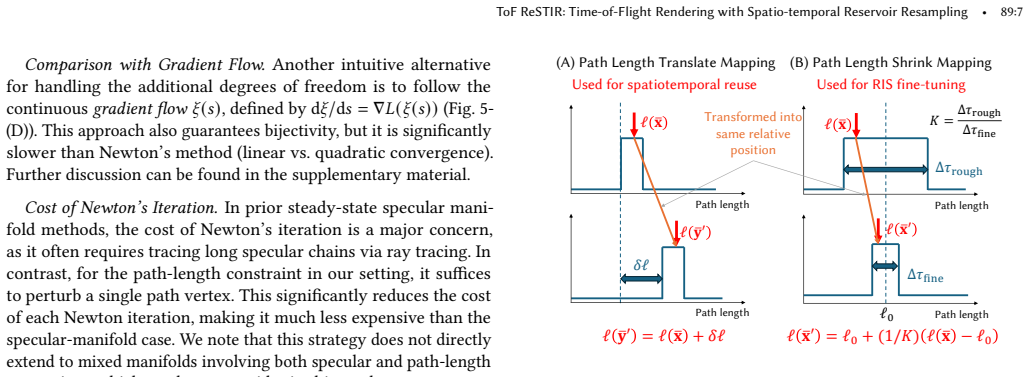
A path reuse formulation that explicitly enforces physically valid optical path lengths via path-length-aware shift mapping, a geometric transformation based on Newton's method, enables efficient unbiased Monte Carlo simulation of time-of-flight phenomena at interactive frame rates even in dynamic scenes with glossy or specular materials.
What carries the argument
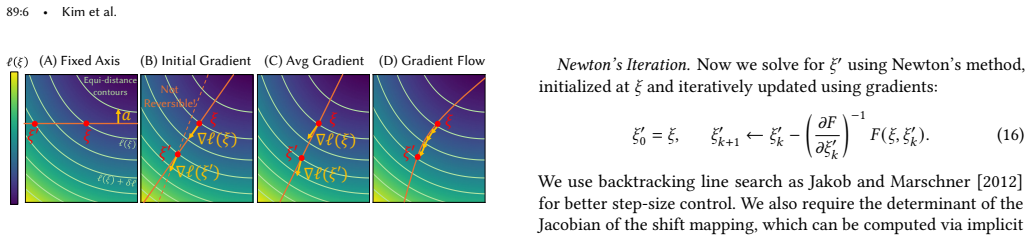
path-length-aware shift mapping: a Newton's-method geometric adjustment that transforms reused light paths to satisfy temporal gating constraints while preserving the signal contribution.
If this is right
- Enables both time-gated and full transient rendering at interactive rates.
- Scales to scenes with glossy materials and object motion without specialized hardware.
- Directly supports downstream tasks such as shape reconstruction from time-of-flight data.
Where Pith is reading between the lines
- The same length-enforcement idea could be tested on other time-dependent path-reuse problems such as motion-blur or wave-optics simulation.
- If the mapping cost stays low, the technique might reduce the sample count needed for production-quality ToF effects in offline pipelines as well.
Load-bearing premise
The Newton's-method shift mapping can reliably and efficiently adjust reused paths to valid lengths without introducing bias or prohibitive cost in complex dynamic scenes.
What would settle it
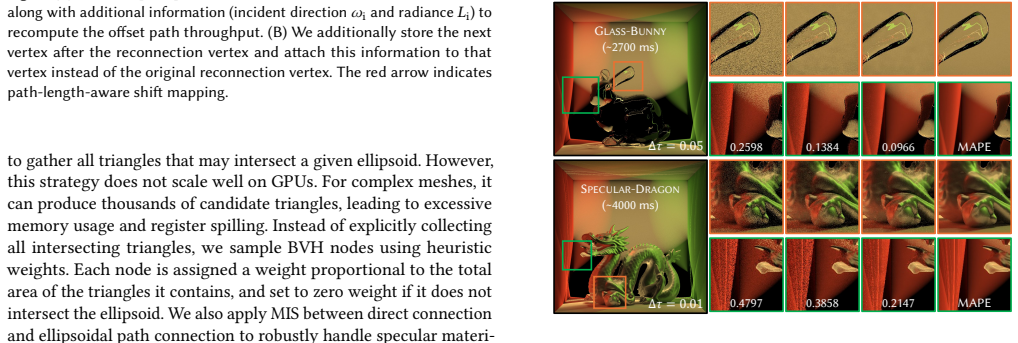
Rendered frames from a dynamic specular scene either match a high-sample ground-truth reference within statistical noise or diverge visibly when the shift mapping fails to converge on many paths.
Figures







read the original abstract
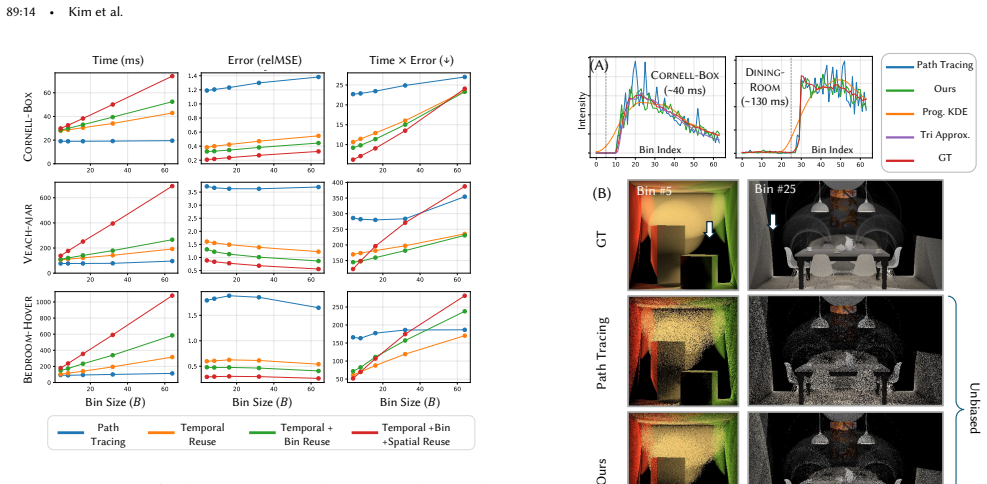
We present a novel spatio-temporal reuse framework for time-resolved light transport, enabling efficient Monte Carlo rendering of time-of-flight (ToF) phenomena such as time-gated imaging and transient light capture. Existing ToF rendering methods are computationally expensive, scale poorly to complex dynamic scenes, and are therefore unsuitable for applications with strict latency constraints. To address this limitation, we draw inspiration from ReSTIR, a reuse-based technique for steady-state real-time rendering, and adapt its core principles to interactive-rate ToF simulation. However, naively applying existing ReSTIR methods to ToF rendering leads to severe inefficiency, as reused paths frequently violate optical path-length constraints and thus contribute little or no signal. We overcome this challenge by introducing a path reuse formulation that explicitly enforces physically valid optical path lengths. The key idea is path-length-aware shift mapping, a geometric transformation based on Newton's method that adjusts reused light paths to satisfy temporal gating constraints, inspired by specular manifold exploration in steady-state caustics rendering. The resulting framework substantially improves the efficiency of ToF rendering across a wide range of scenarios, including complex scenes with glossy or specular materials and dynamic motion. Our method supports both time-gated and transient rendering at interactive frame rates, enabling simulation under practical latency constraints. We demonstrate the effectiveness of our approach through two downstream applications, including shape reconstruction and navigation.
Editorial analysis
A structured set of objections, weighed in public.
Referee Report
Summary. The paper presents ToF ReSTIR, a spatio-temporal reservoir resampling framework for Monte Carlo rendering of time-resolved light transport. It adapts ReSTIR to time-of-flight (ToF) phenomena by introducing path-length-aware shift mapping based on Newton's method to enforce optical path-length constraints on reused paths, addressing the inefficiency of naive reuse under temporal gating. The method is claimed to support both time-gated and transient rendering at interactive rates in complex dynamic scenes with glossy or specular materials, with demonstrations in shape reconstruction and navigation applications.
Significance. If the central efficiency claims hold with unbiased estimators and reliable convergence, the work would represent a meaningful advance in real-time ToF simulation, extending reuse-based techniques to time-resolved domains and enabling practical latency-constrained applications in graphics and vision. The combination of ReSTIR-style resampling with geometric adjustments inspired by specular manifold exploration is a natural and potentially high-impact direction.
major comments (2)
- [Path-length-aware shift mapping section] The efficiency and unbiasedness claims rest on the path-length-aware shift mapping (described in the core technical section following the ReSTIR adaptation). The manuscript must provide a concrete analysis or proof that Newton's method iterations converge reliably across the tested scenes and that any non-convergent or rejected paths are handled with proper importance weighting or MIS correction; otherwise the estimator risks bias when the nonlinear path-length constraint has multiple roots or none, as can occur in dynamic specular geometry.
- [Results and evaluation section] No quantitative results, error bounds, or bias analysis appear in the provided text to support the central claim of substantial efficiency gains and interactive rates. The manuscript should include tables or figures reporting per-frame timings, sample counts, and error metrics (e.g., MSE vs. reference) across the claimed scenarios, including failure cases for the shift mapping.
minor comments (1)
- [Abstract and Introduction] The abstract and introduction would benefit from a brief statement of the precise mathematical formulation of the shift mapping (e.g., the objective function minimized by Newton's method) to allow readers to assess the geometric adjustment without immediately consulting the full methods.
Simulated Author's Rebuttal
We thank the referee for the constructive comments and the recommendation for major revision. We address each point below and will incorporate the suggested improvements into the revised manuscript.
read point-by-point responses
-
Referee: [Path-length-aware shift mapping section] The efficiency and unbiasedness claims rest on the path-length-aware shift mapping (described in the core technical section following the ReSTIR adaptation). The manuscript must provide a concrete analysis or proof that Newton's method iterations converge reliably across the tested scenes and that any non-convergent or rejected paths are handled with proper importance weighting or MIS correction; otherwise the estimator risks bias when the nonlinear path-length constraint has multiple roots or none, as can occur in dynamic specular geometry.
Authors: We appreciate the referee's emphasis on rigorously establishing unbiasedness. The path-length-aware shift mapping employs Newton's method to iteratively solve for the vertex adjustment that satisfies the optical path-length constraint imposed by temporal gating, following the geometric approach of specular manifold exploration. In the manuscript we describe the iteration and note rapid convergence in practice. To strengthen the submission we will add a new subsection with empirical convergence data (average iterations, success rates per scene type, and histograms) across all tested dynamic scenes. Non-convergent paths are rejected by setting their contribution to zero; the rejection probability is folded into the resampling weight via the standard ReSTIR MIS correction, preserving unbiasedness. We will also explicitly discuss the handling of multiple roots by selecting the solution whose path length lies inside the active gating interval. revision: yes
-
Referee: [Results and evaluation section] No quantitative results, error bounds, or bias analysis appear in the provided text to support the central claim of substantial efficiency gains and interactive rates. The manuscript should include tables or figures reporting per-frame timings, sample counts, and error metrics (e.g., MSE vs. reference) across the claimed scenarios, including failure cases for the shift mapping.
Authors: We agree that the results section requires more quantitative support. The current manuscript contains timing measurements and visual comparisons, yet we acknowledge that tabulated MSE values, per-frame statistics, and explicit failure-case analysis were insufficiently detailed. In the revision we will expand the evaluation with (i) a table of per-frame timings and effective sample counts for both time-gated and transient modes, (ii) MSE plots against path-traced references for representative scenes, and (iii) a dedicated figure and accompanying text quantifying shift-mapping failure rates together with the resulting error contribution. revision: yes
Circularity Check
No significant circularity; derivation introduces independent geometric adjustment
full rationale
The paper's core contribution is a new path-length-aware shift mapping (Newton's method) that enforces optical path-length constraints when adapting ReSTIR to ToF rendering. This step is presented as a novel geometric transformation inspired by (but not defined by) prior specular manifold exploration work. No equations reduce the claimed efficiency gains or the shift-mapping procedure to fitted parameters, self-definitions, or load-bearing self-citations. The method is self-contained against external benchmarks such as standard ReSTIR and manifold exploration; the derivation chain does not collapse by construction.
Axiom & Free-Parameter Ledger
Reference graph
Works this paper leans on
-
[1]
Marco Ament, Christoph Bergmann, and Daniel Weiskopf
Bayesian Time-of-Flight for Realtime Shape, Illumination and Albedo.IEEE Transactions on Pattern Analysis and Machine Intelligence(2016). Marco Ament, Christoph Bergmann, and Daniel Weiskopf
work page 2016
-
[2]
doi:10/gbf323 Ian M Baker, Stuart S Duncan, and Jeremy W Copley
Refractive Radiative Transfer Equation.ACM Transactions on Graphics33, 2 (April 2014), 17:1–17:22. doi:10/gbf323 Ian M Baker, Stuart S Duncan, and Jeremy W Copley
work page 2014
-
[3]
doi:10/gg8xc7 Mauro Buttafava, Jessica Zeman, Alberto Tosi, Kevin Eliceiri, and Andreas Velten
Spatiotemporal Reservoir Resampling for Real-Time Ray Tracing with Dynamic Direct Lighting.ACM Transactions on Graphics (Proceedings of SIGGRAPH) 39, 4 (July 2020). doi:10/gg8xc7 Mauro Buttafava, Jessica Zeman, Alberto Tosi, Kevin Eliceiri, and Andreas Velten
work page 2020
-
[4]
Non-Line-of-Sight Imaging Using a Time-Gated Single Photon Avalanche Diode. Optics Express23, 16 (2015). doi:10/gfz5k4 Lucrezia Cester, Ashley Lyons, Maria Chiara Braidotti, and Daniele Faccio
work page 2015
-
[5]
Time- of-Flight Imaging at 10 ps Resolution with an ICCD Camera.Sensors19, 1 (2019),
work page 2019
-
[6]
A General Purpose Unequal Probability Sampling Plan.Biometrika 69, 3 (Dec. 1982), 653–656. doi:10/fd87zs Zhimin Fan, Jie Guo, Yiming Wang, Tianyu Xiao, Hao Zhang, Chenxi Zhou, Zhenyu Chen, Pengpei Hong, Yanwen Guo, and Ling-Qi Yan
work page 1982
-
[7]
ACM Transactions on Graphics (TOG)43, 4 (2024), 1–13
Specular Polynomials. ACM Transactions on Graphics (TOG)43, 4 (2024), 1–13. Zhimin Fan, Pengpei Hong, Jie Guo, Changqing Zou, Yanwen Guo, and Ling-Qi Yan
work page 2024
-
[8]
Manifold path guiding for importance sampling specular chains.ACM Transactions on Graphics (TOG)42, 6 (2023), 1–14. Genevieve Gariepy, Nikola Krstajić, Robert Henderson, Chunyong Li, Robert R Thom- son, Gerald S Buller, Barmak Heshmat, Ramesh Raskar, Jonathan Leach, and Daniele Faccio
work page 2023
-
[9]
Ioannis Gkioulekas, Anat Levin, Frédo Durand, and Todd Zickler
Single-Photon Sensitive Light-in-Fight Imaging.Nature Communica- tions6 (2015). Ioannis Gkioulekas, Anat Levin, Frédo Durand, and Todd Zickler
work page 2015
-
[10]
doi:10/f7mzkt Yoav Grauer and Ezri Sonn
Micron-Scale Light Transport Decomposition Using Interferometry.ACM Transactions on Graphics (Proceedings of SIGGRAPH)34, 4 (2015). doi:10/f7mzkt Yoav Grauer and Ezri Sonn
work page 2015
-
[11]
InVideo Surveillance and Transportation Imaging Applications 2015, Vol
Active gated imaging for automotive safety applica- tions. InVideo Surveillance and Transportation Imaging Applications 2015, Vol
work page 2015
-
[12]
doi:10/gfzv83 Trevor Hedstrom, Markus Kettunen, Daqi Lin, Chris Wyman, and Tzu-Mao Li
Improved Half Vector Space Light Transport.Computer Graphics Forum (Proceedings of the Euro- graphics Symposium on Rendering)34, 4 (July 2015), 65–74. doi:10/gfzv83 Trevor Hedstrom, Markus Kettunen, Daqi Lin, Chris Wyman, and Tzu-Mao Li
work page 2015
-
[13]
ReSTIR BDPT: Bidirectional ReSTIR Path Tracing with Caustics.ACM Transactions on Graphics(2025). Felix Heide, Matthias B. Hullin, James Gregson, and Wolfgang Heidrich
work page 2025
-
[14]
Low- Budget Transient Imaging Using Photonic Mixer Devices.ACM Transactions on Graphics (Proceedings of SIGGRAPH)32, 4 (July 2013), 45:1–45:10. doi:10/gbdg7s Robert K Henderson, Nick Johnston, Francescopaolo Mattioli Della Rocca, Haochang Chen, David Day-Uei Li, Graham Hungerford, Richard Hirsch, David Mcloskey, Philip Yip, and David JS Birch
work page 2013
-
[15]
Pengpei Hong, Meng Duan, Beibei Wang, Cem Yuksel, Tizian Zeltner, and Daqi Lin
A 192x128 time correlated SPAD image sensor in 40-nm CMOS technology.IEEE Journal of Solid-State Circuits54, 7 (2019), 1907–1916. Pengpei Hong, Meng Duan, Beibei Wang, Cem Yuksel, Tizian Zeltner, and Daqi Lin
work page 2019
-
[16]
InProceedings of the SIGGRAPH Asia 2025 Conference Papers
Sample Space Partitioning and Spatiotemporal Resampling for Specular Manifold Sampling. InProceedings of the SIGGRAPH Asia 2025 Conference Papers. 1–10. Binh-Son Hua, Adrien Gruson, Victor Petitjean, Matthias Zwicker, Derek Nowrouzezahrai, Elmar Eisemann, and Toshiya Hachisuka
work page 2025
-
[17]
doi:10/ggd8m5 Julian Iseringhausen and Matthias B
A Survey on Gradient-Domain Rendering.Computer Graphics Forum (Proceedings of Eurographics State of the Art Reports)38, 2 (2019), 455–472. doi:10/ggd8m5 Julian Iseringhausen and Matthias B. Hullin
work page 2019
-
[18]
Non-Line-of-Sight Reconstruction Using Efficient Transient Rendering.ACM Transactions on Graphics39, 1 (Jan. 2020), 8:1–8:14. doi:10/gspq3m ACM Trans. Graph., Vol. 45, No. 4, Article
work page 2020
-
[19]
ACM Transactions on Graphics (Proceedings of SIGGRAPH)31, 4 (July 2012), 58:1– 58:13
Manifold Exploration: A Markov Chain Monte Carlo Technique for Rendering Scenes with Difficult Specular Transport. ACM Transactions on Graphics (Proceedings of SIGGRAPH)31, 4 (July 2012), 58:1– 58:13. doi:10/gfzq4p Wenzel Alban Jakob. 2013.Light Transport on Path-Space Manifolds. Ph. D. Dissertation. Cornell University. Adrian Jarabo. 2012.Femto-Photograp...
work page 2012
-
[20]
A Framework for Transient Rendering.ACM Transactions on Graphics (Proceedings of SIGGRAPH Asia)33, 6 (Nov. 2014), 177:1–177:10. doi:10/ gfznb8 Adrian Jarabo, Belen Masia, Julio Marco, and Diego Gutierrez
work page 2014
-
[21]
Recent Advances in Transient Imaging: A Computer Graphics and Vision Perspective.Visual Informatics 1, 1 (2017), 65–79. doi:10/gfz5mh Wojciech Jarosz, Derek Nowrouzezahrai, Robert Thomas, Peter-Pike Sloan, and Matthias Zwicker
work page 2017
-
[22]
Progressive Photon Beams.ACM Transactions on Graphics (Proceed- ings of SIGGRAPH Asia)30, 6 (Dec. 2011), 181:1–181:12. doi:10/fn5xzj Achuta Kadambi, Jamie Schiel, and Ramesh Raskar
work page 2011
-
[23]
ACM Transactions on Graphics (Proceedings of SIGGRAPH)33, 4 (July 2014), 102:1– 102:13
The Natural- Constraint Representation of the Path Space for Efficient Light Transport Simulation. ACM Transactions on Graphics (Proceedings of SIGGRAPH)33, 4 (July 2014), 102:1– 102:13. doi:10/f6cz85 Markus Kettunen, Marco Manzi, Miika Aittala, Jaakko Lehtinen, Frédo Durand, and Matthias Zwicker
work page 2014
-
[24]
Gradient-domain path tracing.ACM Transactions on Graphics (TOG)34, 4 (2015), 1–13. Juhyeon Kim, Craig Benko, Magnus Wrenninge, Ryusuke Villemin, Zeb Barber, Woj- ciech Jarosz, and Adithya Pediredla
work page 2015
-
[25]
Juhyeon Kim, Wojciech Jarosz, Ioannis Gkioulekas, and Adithya Pediredla
A Monte Carlo Rendering Framework for Simulating Optical Heterodyne Detection.ACM Transactions on Graphics (TOG)44, 4 (2025), 1–19. Juhyeon Kim, Wojciech Jarosz, Ioannis Gkioulekas, and Adithya Pediredla
work page 2025
-
[26]
Ahmed Kirmani, Tyler Hutchison, James Davis, and Ramesh Raskar
Doppler Time-of-Flight Rendering.ACM Transactions on Graphics (TOG)42, 6 (2023), 1–18. Ahmed Kirmani, Tyler Hutchison, James Davis, and Ramesh Raskar
work page 2023
-
[27]
Looking around the Corner Using Ultrafast Transient Imaging.International Journal of Computer Vision (IJCV)95, 1 (2011). doi:10/dsk2dt Jonathan Klein, Christoph Peters, Jaime Martín, Martin Laurenzis, and Matthias B Hullin
work page 2011
-
[28]
Tracking Objects Outside the Line of Sight Using 2D Intensity Images. Scientific Reports6 (2016). doi:10/f82649 Martin Laurenzis and Andreas Velten
work page 2016
-
[29]
doi:10/gfz5mr Jaakko Lehtinen, Tero Karras, Samuli Laine, Miika Aittala, Frédo Durand, and Timo Aila
Nonline-of-Sight Laser Gated Viewing of Scattered Photons.Optical Engineering53, 2 (2014). doi:10/gfz5mr Jaakko Lehtinen, Tero Karras, Samuli Laine, Miika Aittala, Frédo Durand, and Timo Aila
work page 2014
-
[30]
doi:10/gbdghd He Li, Beibei Wang, Changhe Tu, Kun Xu, Nicolas Holzschuch, and Ling-Qi Yan
Gradient-Domain Metropolis Light Transport.ACM Transactions on Graphics (Proceedings of SIGGRAPH)32, 4 (July 2013), 95:1–95:12. doi:10/gbdghd He Li, Beibei Wang, Changhe Tu, Kun Xu, Nicolas Holzschuch, and Ling-Qi Yan
work page 2013
-
[31]
doi:10/gqjn7b Daqi Lin, Chris Wyman, and Cem Yuksel
Generalized Resampled Importance Sampling: Foundations of ReSTIR.ACM Transactions on Graphics (Proceedings of SIGGRAPH)41, 4 (July 2022), 75:1–75:23. doi:10/gqjn7b Daqi Lin, Chris Wyman, and Cem Yuksel
work page 2022
-
[32]
Fast Volume Rendering with Spa- tiotemporal Reservoir Resampling.ACM Transactions on Graphics (Proceedings of SIGGRAPH Asia)40, 6 (Dec. 2021). doi:10/grrjd6 Jeffrey Liu, Daqi Lin, Markus Kettunen, Chris Wyman, and Ravi Ramamoorthi
work page 2021
-
[33]
doi:10.1111/cgf.14584 Julio Marco
Temporally Sliced Photon Primi- tives for Time-of-Flight Rendering.Computer Graphics Forum (Proceedings of the Eurographics Symposium on Rendering)41, 4 (2022). doi:10.1111/cgf.14584 Julio Marco. 2013.Transient Light Transport in Participating Media. Ph. D. Dissertation. Universidad de Zaragoza. Julio Marco, Ibón Guillén, Wojciech Jarosz, Diego Gutierrez,...
-
[34]
doi:10/gfvr9w Matthew O’Toole, Felix Heide, Lei Xiao, Matthias B
Progressive Transient Photon Beams.Computer Graphics Forum38, 1 (March 2019). doi:10/gfvr9w Matthew O’Toole, Felix Heide, Lei Xiao, Matthias B. Hullin, Wolfgang Heidrich, and Kiriakos N. Kutulakos
work page 2019
-
[35]
doi:10/gfz5m2 Yaobin Ouyang, Shiqiu Liu, Markus Kettunen, Matt Pharr, and Jacopo Pantaleoni
Temporal Frequency Probing for 5D Transient Analysis of Global Light Transport.ACM Transactions on Graphics (Proceedings of SIGGRAPH) 33, 4 (2014), 87:1–87:11. doi:10/gfz5m2 Yaobin Ouyang, Shiqiu Liu, Markus Kettunen, Matt Pharr, and Jacopo Pantaleoni
work page 2014
-
[36]
doi:10/gqwmdx Adithya Pediredla, Akshat Dave, and Ashok Veeraraghavan
ReSTIR GI: Path Resampling for Real-Time Path Tracing.Computer Graphics Forum 40, 8 (2021), 17–29. doi:10/gqwmdx Adithya Pediredla, Akshat Dave, and Ashok Veeraraghavan. 2019a. SNLOS: Non-line- of-sight Scanning through Temporal Focusing. InIEEE International Conference on Computational Photography (ICCP). 1–13. doi:10/gspq34 Adithya Pediredla, Ashok Veer...
work page 2021
-
[37]
doi:10/f7wqfq Diego Royo, Jorge García, Adolfo Muñoz, and Adrian Jarabo
Solving Trigonometric Moment Problems for Fast Transient Imaging.ACM Transactions on Graphics (Proceedings of SIGGRAPH Asia)34, 6 (2015). doi:10/f7wqfq Diego Royo, Jorge García, Adolfo Muñoz, and Adrian Jarabo
work page 2015
-
[38]
Non-Line-of-Sight Transient Rendering.Computers & Graphics107 (Oct. 2022), 84–92. doi:10/gspq3r Diego Royo, Jorge Garcia-Pueyo, Miguel Crespo, Óscar Pueyo-Ciutad, Guillermo En- guita, and Diego Bielsa
work page 2022
- [39]
-
[40]
Decorrelating ReSTIR Samplers via MCMC Mutations. arXiv:2211.00166 [cs] doi:10.48550/arXiv.2211.00166 Siddharth Somasundaram, Akshat Dave, Connor Henley, Ashok Veeraraghavan, and Ramesh Raskar
-
[41]
In Proceedings of the IEEE/CVF Conference on Computer Vision and Pattern Recognition
Role of transients in two-bounce non-line-of-sight imaging. In Proceedings of the IEEE/CVF Conference on Computer Vision and Pattern Recognition. 9192–9201. Justin F. Talbot. 2005.Importance Resampling for Global Illumination. Master’s thesis. Brigham Young University. https://scholarsarchive.byu.edu/etd/663 Justin F. Talbot, David Cline, and Parris Egbert
work page 2005
-
[42]
InProceedings of the IEEE Conference on Computer Vision and Pattern Recognition
The geometry of first-returning photons for non-line-of-sight imaging. InProceedings of the IEEE Conference on Computer Vision and Pattern Recognition. 7216–7224. Eric Veach. 1997.Robust Monte Carlo Methods for Light Transport Simulation. Ph. D. Dissertation. Stanford University. Andreas Velten, Thomas Willwacher, Otkrist Gupta, Ashok Veeraraghavan, Moung...
work page 1997
-
[43]
Recovering Three-Dimensional Shape around a Corner Using Ultrafast Time-of-Flight Imaging.Nature Communications3 (2012). Andreas Velten, Di Wu, Adrian Jarabo, Belen Masia, Christopher Barsi, Chinmaya Joshi, Everett Lawson, Moungi Bawendi, Diego Gutierrez, and Ramesh Raskar
work page 2012
-
[44]
Femto-Photography: Capturing and Visualizing the Propagation of Light.ACM Transactions on Graphics (Proceedings of SIGGRAPH)32, 4, Article 44 (July 2013), 8 pages. doi:10/gfxpkt Di Wu, Andreas Velten, Matthew O’Toole, Belen Masia, Amit Agrawal, Qionghai Dai, and Ramesh Raskar
work page 2013
-
[45]
doi:10/f5v589 Lifan Wu, Guangyan Cai, Ravi Ramamoorthi, and Shuang Zhao
Decomposing Global Light Transport Using Time of Flight Imaging.International Journal of Computer Vision (IJCV)107 (2014). doi:10/f5v589 Lifan Wu, Guangyan Cai, Ravi Ramamoorthi, and Shuang Zhao
work page 2014
-
[46]
Differentiable Time-Gated Rendering.ACM Transactions on Graphics (Proceedings of SIGGRAPH Asia)40, 6 (Dec. 2021). doi:10/h2c9 Xiaofeng Xu, Lu Wang, and Beibei Wang
work page 2021
-
[47]
Differentiable Transient Rendering.ACM Transactions on Graphics (Proceedings of SIGGRAPH Asia)40, 6 (Dec. 2021). doi:10/h2db Aaron Young, Nevindu M Batagoda, Harry Zhang, Akshat Dave, Adithya Pediredla, Dan Negrut, and Ramesh Raskar
work page 2021
-
[48]
Tizian Zeltner, Iliyan Georgiev, and Wenzel Jakob
Principles and features of single-photon avalanche diode arrays.Sensors and Actuators A: Physical140, 1 (2007), 103–112. Tizian Zeltner, Iliyan Georgiev, and Wenzel Jakob
work page 2007
-
[49]
Specular Manifold Sampling for Rendering High-Frequency Caustics and Glints.ACM Transactions on Graphics (Proceedings of SIGGRAPH)39, 4 (July 2020). doi:10/gg8xc8 Zheng Zeng, Markus Kettunen, Chris Wyman, Lifan Wu, Ravi Ramamoorthi, Ling-Qi Yan, and Daqi Lin
work page 2020
-
[50]
InProceedings of the SIGGRAPH Asia 2025 Conference Papers
ReSTIR PG: Path Guiding with Spatiotemporally Resampled Paths. InProceedings of the SIGGRAPH Asia 2025 Conference Papers. 1–11. Song Zhang, Daqi Lin, Markus Kettunen, Cem Yuksel, and Chris Wyman
work page 2025
- [51]
-
[52]
Publication date: July 2026
work page 2026
discussion (0)
Sign in with ORCID, Apple, or X to comment. Anyone can read and Pith papers without signing in.