Recognition: 2 theorem links
· Lean TheoremThe Dirac oscillator in the curved spacetime of a cloud of strings
Pith reviewed 2026-05-13 01:22 UTC · model grok-4.3
The pith
The Dirac oscillator admits exact bound-state solutions in the curved spacetime of a cloud of strings, with energies quantized by radial and angular quantum numbers and depending on the oscillator frequency, string curvature, and effective
A machine-rendered reading of the paper's core claim, the machinery that carries it, and where it could break.
Core claim
In both the original and modified forms of the cloud-of-strings metric, the Dirac oscillator is treated by choosing an appropriate tetrad and a stationary ansatz for the four-component spinor in spherical coordinates. This leads to two coupled first-order differential equations that combine into a second-order equation. After a change of the function and the variable, the equation becomes the Whittaker equation, whose solutions give the relativistic energy spectrum quantized in n and κ and depending on ω, a, and m_eff, along with the normalized spinor.
What carries the argument
The tetrad formalism applied to the cloud-of-strings metric combined with a stationary spinor ansatz that reduces the Dirac equation to the solvable Whittaker equation.
If this is right
- The energy eigenvalues are explicitly modified by the curvature parameter a of the string cloud.
- The spectrum remains quantized for both the original and the modified metric forms.
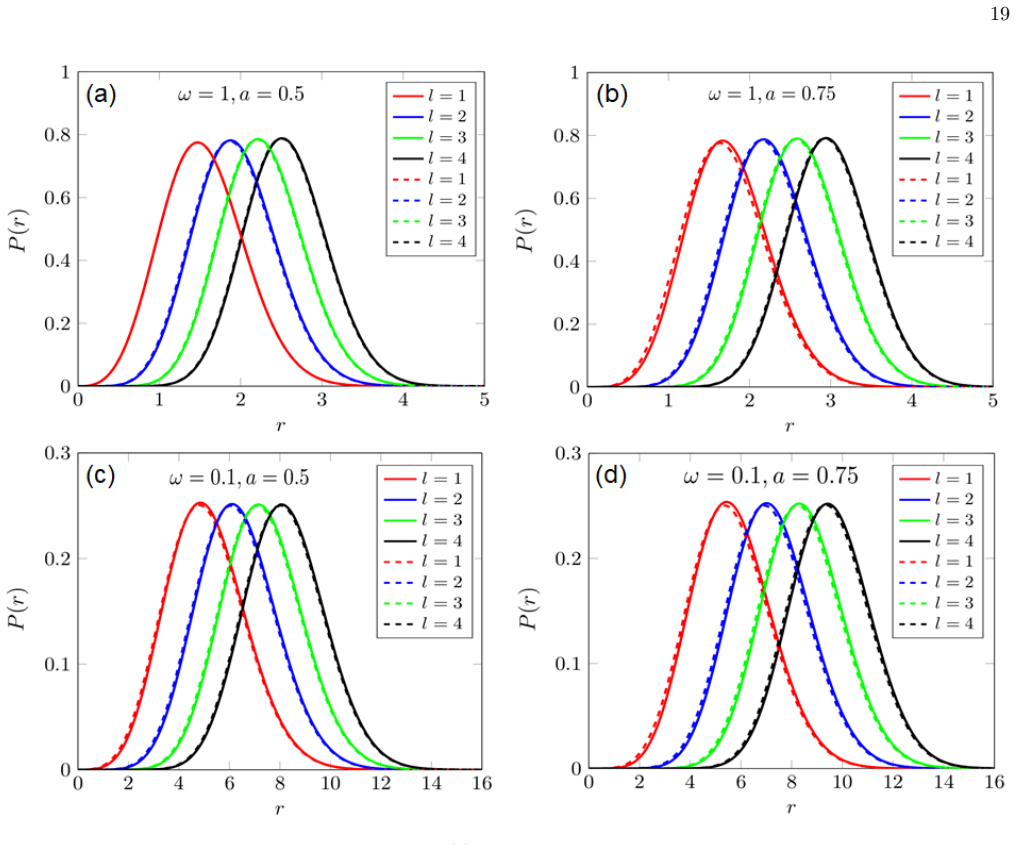
- The radial probability density of the states can be derived from the spinor components and depends on the chosen values of κ, ω, and a.
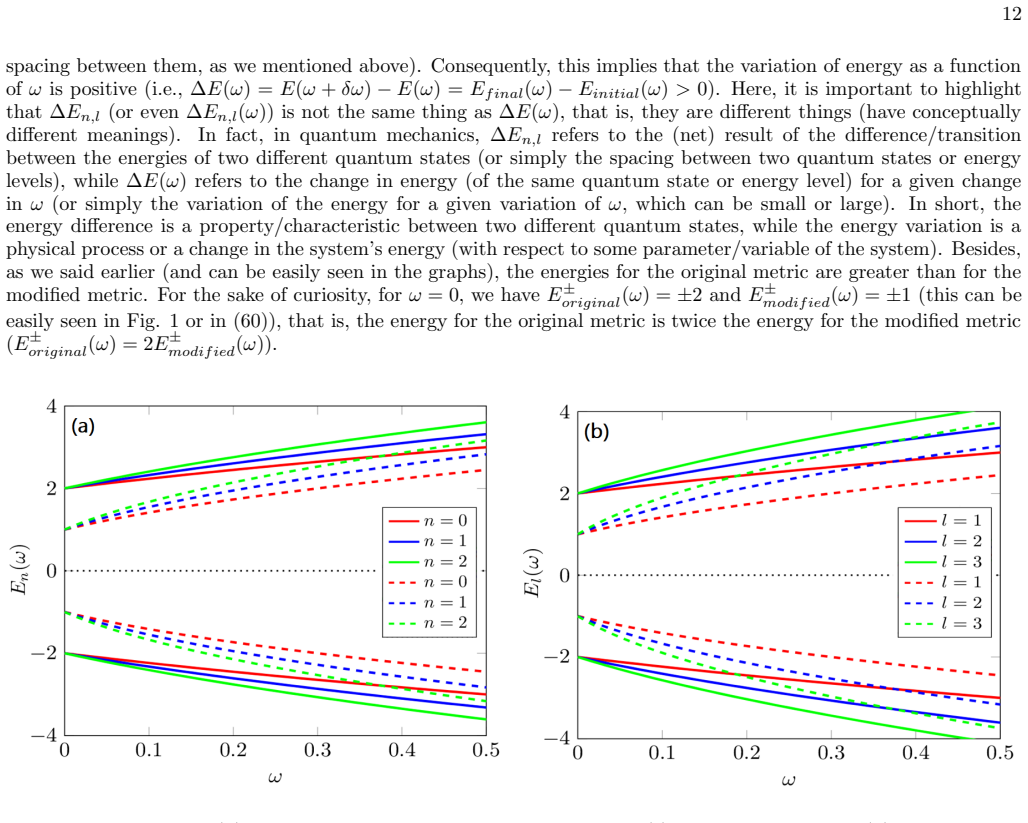
- For fixed n and κ the energies vary with the oscillator frequency ω and the string parameter a, as shown in the graphical analysis.
Where Pith is reading between the lines
- The dependence on an effective mass suggests that curvature can be reinterpreted as a renormalization effect in the oscillator model.
- This exact solvability via reduction to Whittaker functions may extend to other potentials or defect spacetimes if analogous tetrad choices exist.
- The results for both metric configurations indicate that the spectrum is stable under certain redefinitions of the string-cloud geometry.
Load-bearing premise
The tetrad chosen for the cloud-of-strings metric and the assumed stationary four-component form of the spinor accurately describe the Dirac dynamics without introducing inconsistencies in the separation of variables.
What would settle it
Solving the Dirac equation numerically in the same metric for specific values of ω and a and finding that the bound-state energies do not match the analytic expression involving n, κ, and m_eff would falsify the result.
Figures



read the original abstract
In this paper, we determine the relativistic bound-state solutions for the Dirac oscillator (DO) in the curved spacetime of a cloud of strings in $(3+1)$-dimensions, where such solutions are given by the four-component normalized Dirac spinor and by the relativistic energy spectrum. However, unlike in literature, here, we work with the spacetime in two different forms/configurations, that is, both in its original form and in its modified form. To achieve our objective, we work with the curved DO in spherical coordinates, where we use the tetrad formalism. So, by defining a stationary ansatz for the spinor, we obtain two coupled first-order differential equations, and by substituting one equation into the other, we obtain a second-order differential equation. To analytically and exactly solve this differential equation, we use a change of function and of variable. From this, we obtain the well-known Whittaker equation, whose solution is the Whittaker function. Consequently, we obtain the energy spectrum, which is quantized in terms of the radial quantum number $n$ and the angular quantum number $\kappa$, and explicitly depends on the angular frequency $\omega$ (describes the DO), curvature parameter $a$ (describes the cloud of strings), and on the effective rest mass $m_{\text{eff}}$ (describes the rest mass modified by the curvature of spacetime). Besides, we graphically analyze the behavior of the spectrum as a function of $\omega$ and $a$ for three different values of $n$ and $\kappa$, as well as the behavior of the radial probability density for four different values of $\kappa$, $\omega$, and $a$ (with $n=0$).
Editorial analysis
A structured set of objections, weighed in public.
Referee Report
Summary. The paper derives exact bound-state solutions for the Dirac oscillator in the (3+1)-dimensional spacetime of a cloud of strings. Working in spherical coordinates with the tetrad formalism, the authors impose a stationary four-component ansatz for the Dirac spinor, obtain two coupled first-order radial equations, combine them into a second-order equation, and reduce it via a change of dependent and independent variables to the Whittaker equation. Regularity of the Whittaker function supplies the quantization condition, yielding an explicit relativistic energy spectrum E(n, κ, ω, a, m_eff) that depends on the radial quantum number n, angular quantum number κ, oscillator frequency ω, string-cloud parameter a, and effective mass m_eff. The analysis is performed for both the original and modified forms of the metric; the spectrum and radial probability densities are plotted for representative parameter values.
Significance. If the derivation holds, the work supplies a closed-form, analytically solvable model of a relativistic harmonic oscillator in a non-flat background. The explicit dependence of the spectrum on the curvature parameter a and the effective mass m_eff permits direct examination of how the string-cloud geometry modifies the flat-space Dirac-oscillator levels. The reduction to the standard Whittaker equation and the use of its known properties constitute a reproducible, parameter-free derivation once the tetrad and ansatz are fixed.
minor comments (4)
- The abstract states that the spinor is normalized, yet the explicit normalization constant is not displayed in the main text after the Whittaker solution is written; please insert the normalization factor in the expression for the four-component spinor (likely near the end of §3 or in §4).
- In the discussion of the modified metric (around the transition from the original to the modified form), the relation between the two line elements is stated but the corresponding change in the tetrad components is not written explicitly; adding one line of tetrad matrices for the modified case would clarify the subsequent algebra.
- Figure captions for the energy-spectrum plots (e.g., Fig. 1) list three values of n and κ but do not specify the fixed value of m_eff used; please add this information so that the curves can be reproduced.
- The definition of the effective mass m_eff is introduced in the abstract and used throughout, but its explicit expression in terms of the original mass m and the parameter a appears only once; repeating the definition in a dedicated equation would improve readability.
Simulated Author's Rebuttal
We thank the referee for the positive summary, significance assessment, and recommendation of minor revision for our manuscript on the Dirac oscillator in cloud-of-strings spacetime. No specific major comments were provided in the report, so we have no individual points to address.
Circularity Check
No significant circularity; derivation is self-contained
full rationale
The paper starts from the curved-space Dirac equation in the cloud-of-strings metric, applies the tetrad formalism and a stationary four-component ansatz to separate variables, reduces the system to a second-order radial equation, performs a standard change of dependent and independent variables to reach the Whittaker equation, and imposes the regularity condition on the Whittaker function to obtain the quantization condition. This chain relies only on the metric, the Dirac operator, and well-known properties of special functions; the resulting spectrum is not defined in terms of itself, no parameters are fitted to data and then relabeled as predictions, and no load-bearing step reduces to a self-citation or ansatz smuggled from prior work by the same authors. The procedure is therefore independent of its own outputs.
Axiom & Free-Parameter Ledger
free parameters (3)
- ω
- a
- m_eff
axioms (2)
- domain assumption The Dirac equation written with the tetrad formalism correctly describes a spin-1/2 particle in the given static spherically symmetric metric.
- domain assumption A stationary, separable ansatz for the four-component spinor is sufficient to capture all bound states.
Lean theorems connected to this paper
-
IndisputableMonolith/Cost/FunctionalEquation.leanwashburn_uniqueness_aczel unclear?
unclearRelation between the paper passage and the cited Recognition theorem.
by defining a stationary ansatz for the spinor, we obtain two coupled first-order differential equations... obtain the well-known Whittaker equation... energy spectrum... quantized in terms of n and κ... depends on ω, a, and m_eff
-
IndisputableMonolith/Foundation/AlexanderDuality.leanalexander_duality_circle_linking unclear?
unclearRelation between the paper passage and the cited Recognition theorem.
tetrad formalism... spinorial connection Γ_μ = −i/4 ω_abμ σ_ab... line element ds²_original = (1−a)dt² − dr²/(1−a) − r²(dθ²+sin²θ dϕ²)
What do these tags mean?
- matches
- The paper's claim is directly supported by a theorem in the formal canon.
- supports
- The theorem supports part of the paper's argument, but the paper may add assumptions or extra steps.
- extends
- The paper goes beyond the formal theorem; the theorem is a base layer rather than the whole result.
- uses
- The paper appears to rely on the theorem as machinery.
- contradicts
- The paper's claim conflicts with a theorem or certificate in the canon.
- unclear
- Pith found a possible connection, but the passage is too broad, indirect, or ambiguous to say the theorem truly supports the claim.
Reference graph
Works this paper leans on
-
[1]
M. Moshinsky, and A. Szczepaniak, J. Phys. A: Math. Gen.22L817 (1989).https://doi.org/10.1088/0305-4470/22/ 17/002
-
[2]
J. Bentez, R. P. Martinez-y-Romero, H. N. N´ uez-Y´ epez, and A. L. Salas-Brito, Phys. Rev. Lett.64, 1643 (1990).https: //doi.org/10.1103/PhysRevLett.64.1643
- [3]
-
[4]
J. A. Franco-Villafa˜ ne, E. Sadurn´ ı, S. Barkhofen, U. Kuhl, F. Mortessagne, and T. H. Seligman, Phys. Rev. Lett.111, 170405 (2013).https://doi.org/10.1103/PhysRevLett.111.170405. arXiv:1306.2204
- [5]
-
[6]
R. R. S. Oliveira, and R. R. Landim, Acta Phys. Pol. B55, 17 (2024).https://doi.org/10.5506/APhysPolB.55.10-A1. arXiv:2212.10339
-
[7]
V. M. Villalba, Phys. Rev. A49, 586 (1994).https://doi.org/10.1103/PhysRevA.49.586. arXiv:hep-th/9310010
-
[8]
V. M. Villalba, and A. R. Maggiolo, Eur. Phys. J. B22, 31–35 (2001).https://doi.org/10.1007/BF01325457. arXiv:cond- mat/0107529
-
[9]
J. Grineviciute, D. Halderson, Phys. Rev. C85, 054617 (2012).https://doi.org/10.1103/PhysRevC.85.054617. arXiv:1404.4170
-
[11]
C. Quimbay, P. Strange, Graphene physics via the Dirac oscillator in (2+1) dimensions. arXiv:1311.2021 (2013)
-
[12]
A. Belouad, A. Jellal, Y. Zahidi, Phys. Lett. A 380, 773 (2016).https://doi.org/10.1016/j.physleta.2015.11.025. arXiv:1505.08068
-
[13]
R. R. S. Oliveira, R. V. Maluf, and C. A. S. Almeida, Ann. Phys. (N.Y.)400, 1-8 (2019).https://doi.org/10.1016/j. aop.2018.11.005. arXiv:1809.03801
work page doi:10.1016/j 2019
-
[14]
Available: https://link.aps.org/doi/10.1103/PhysRevA
A. Bermudez, M. A. Martin-Delgado, and A. Luis, Phys. Rev. A77, 063815 (2008).https://doi.org/10.1103/PhysRevA. 77.063815. arXiv:0802.0577
-
[15]
J. Yang, and J. Piekarewicz Phys. Rev. C102, 054308 (2020).https://doi.org/10.1103/PhysRevC.102.054308
-
[16]
M. D. de Oliveira, and A. G. M. Schmidt, Few-Body Syst.62, 90 (2021).https://doi.org/10.1007/s00601-021-01680-7
-
[17]
R. R. S. Oliveira, G. Alencar, and R. R. Landim, Phys. Scr.99, 035226 (2024).https://doi.org/10.1088/1402-4896/ ad25b3. arXiv:2211.09592
- [18]
-
[19]
K. Bakke, and C. Furtado, Phys. Lett. A376, 1269-1273 (2012).https://doi.org/10.1016/j.physleta.2012.02.044
-
[20]
K. Bakke, Eur. Phys. J. Plus127, 1-8 (2012).https://doi.org/10.1140/epjp/i2012-12082-2. arXiv:1209.0369
-
[21]
R. R. S. Oliveira, Eur. Phys. J. C79, 725 (2019).https://doi.org/10.1140/epjc/s10052-019-7237-y
-
[22]
R. R. S. Oliveira, Gen. Relativ. Gravit. 52,88(2020).https://doi.org/10.1007/s10714-020-02743-6. arXiv:1906.07369
-
[23]
R. R. S. Oliveira, Gen. Relativ. Gravit. 57,111(2025).https://doi.org/10.1007/s10714-025-03447-5. arXiv:2410.17535
- [24]
-
[25]
A. Guvendi, and A. Boumali, Eur. Phys. J. Plus 136, 1098 (2021).https://doi.org/10.1140/epjp/s13360-021-02083-7
-
[26]
P. S. Letelier, Phys. Rev. D20, 1294 (1979).https://doi.org/10.1103/PhysRevD.20.1294
-
[27]
P. S. Letelier, Nuov. Cim. B63, 519–528 (1981).https://doi.org/10.1007/BF02755096
-
[28]
P. S. Letelier, Phys. Rev. D28, 2414 (1983).https://doi.org/10.1103/PhysRevD.28.2414
-
[29]
I. Yilmaz, Gen. Relativ. Gravit.38, 1397-1406 (2006).https://doi.org/10.1007/s10714-006-0322-1
-
[30]
K. S. Adhav, A. S. Nimkar, and M. V. Dawande, Int. J. Theor. Phys.47, 2002-2010 (2008).https://doi.org/10.1007/ s10773-007-9644-3
work page 2002
-
[31]
M. M. D. Costa, J. M. Toledo, and V. B. Bezerra, Int. J. Mod. Phys. D28, 1950074 (2019).https://doi.org/10.1142/ S0218271819500743
work page 2019
-
[32]
J. M. Toledo, and V. B. Bezerra, Eur. Phys. J. C78, 534 (2018).https://doi.org/10.1140/epjc/s10052-018-6001-z
-
[33]
J. M. Toledo, and V. B. Bezerra, Eur. Phys. J. C79, 117 (2019).https://doi.org/10.1140/epjc/s10052-019-6628-4
-
[34]
A. Ditta, X. Tiecheng, M. Asia, and I. Mahmood, Int. J. Geom. Methods Mod. Phys.21, 2450076 (2024).https://doi. org/10.1142/S0219887824500762 23
-
[35]
X. C. Cai, and Y. G. Miao, Phys. Rev. D101, 104023 (2020).https://doi.org/10.1103/PhysRevD.101.104023
-
[36]
A. Belhaj, Y. Sekhmani, Gen. Relativ. Gravit.54, 17 (2022).https://doi.org/10.1007/s10714-022-02902-x
-
[38]
A. Ali, Int. J. Mod. Phys. D30, 2150018 (2021).https://doi.org/10.1142/S0218271821500188
-
[39]
J. D. M. Toledo, and V. B. Bezerra, Int. J. Mod. Phys. D28, 1950023 (2019).https://doi.org/10.1142/ S0218271819500238
work page 2019
-
[40]
Z. Li, and T. Zhou, Phys. Rev. D104, 104044 (2021).https://doi.org/10.1103/PhysRevD.104.104044
-
[41]
W. Cao, W. Liu, and X. Wu, Phys. Rev. D105, 124039 (2022).https://doi.org/10.1103/PhysRevD.105.124039
-
[42]
J. M. Toledo, and V. B. Bezerra, Gen. Relativ. Gravit.52, 34 (2020).https://doi.org/10.1007/s10714-020-02683-1
-
[43]
J. Sadeghi, S. N. Gashti, I. Sakallı, and B. Pourhassan, Nucl. Phys. B1004, 116581 (2024).https://doi.org/10.1016/ j.nuclphysb.2024.116581
-
[44]
M. E. Rodrigues, and H. A. Vieira, Phys. Rev. D106, 084015 (2022).https://doi.org/10.1103/PhysRevD.106.084015
-
[45]
G. Panotopoulos, and ´A. Rinc´ on, Eur. Phys. J. C78, 851 (2018).https://doi.org/10.1140/epjc/s10052-018-6321-z
-
[46]
B. K. Vishvakarma, S. Kala, and S. Siwach, Ann. Phys.475, 169957 (2025).https://doi.org/10.1016/j.aop.2025. 169957
- [47]
-
[48]
D. J. Gogoi, and U. D. Goswami, JCAP2023, 027 (2023).https://doi.org/10.1088/1475-7516/2023/02/027
-
[49]
A. Saidi, M. B. Sedra, Eur. Phys. J. Plus137, 102 (2022).https://doi.org/10.1140/epjp/s13360-021-02325-8
-
[50]
H. K. Sudhanshu, D. V. Singh, S. Upadhyay, Y. Myrzakulov, and K. Myrzakulov, Phys. Dark Universe46, 101648 (2024). https://doi.org/10.1016/j.dark.2024.101648
-
[51]
A. Al-Badawi, S. Shaymatov, S. K. Jha, and A. Rahaman, Eur. Phys. J. C84, 722 (2024).https://doi.org/10.1140/ epjc/s10052-024-13059-z
work page 2024
-
[52]
D. V. Singh, S. Upadhyay, Y. Myrzakulov, K. Myrzakulov, B. Singh, and M. Kumar, Nucl. Phys. B1016, 116915 (2025). https://doi.org/10.1016/j.nuclphysb.2025.116915
-
[53]
M. L. Deglmann, L. G. Barbosa, and C. C. Barros, Ann. Phys.475, 169948 (2025).https://doi.org/10.1016/j.aop. 2025.169948
-
[54]
G. Fatima, F. Javed, A. Waseem, B. Almutairi, G. Mustafa, F. Atamurotov, and E. G¨ udekli, Phys.Dark Univ. 47, 101820 (2025).https://doi.org/10.1016/j.dark.2025.101820
-
[55]
I. D. Lawrie,A Unified Grand Tour of Theoretical Physics, 3rd ed. (CRC Press, London, 2012)
work page 2012
- [56]
-
[57]
R. R. S. Oliveira, Gen. Relativ. Gravit.56, 30 (2024).https://doi.org/10.1007/s10714-024-03209-9. arXiv:2402.15720
-
[58]
R. R. S. Oliveira, Class. Quantum Grav.41, 175017 (2024).https://doi.org/10.1088/1361-6382/ad69f5. arXiv:2405.11334
-
[59]
X. Antoine, F. Fillion-Gourdeau, E. Lorin, and S. MacLean, J. Comput. Phys.411, 109412 (2020).https://doi.org/10. 1016/j.jcp.2020.109412. arXiv:1909.02894
-
[60]
B. K. Vishvakarma, D. V. Singh, and S. Siwach, Eur. Phys. J. Plus138, 536 (2023).https://doi.org/10.1140/epjp/ s13360-023-04174-z
- [61]
- [62]
-
[63]
V. M. Villalba, and U. Percoco, J. Math. Phys.31, 715–720 (1990).https://doi.org/10.1063/1.528799
-
[64]
J. Jing, Phys. Rev. D69, 084009 (2004).https://doi.org/10.1103/PhysRevD.69.084009. arXiv:gr-qc/0312079
-
[65]
Greiner,Relativistic quantum mechanics, 3rd ed
W. Greiner,Relativistic quantum mechanics, 3rd ed. (Springer, Berlin, 2000)
work page 2000
-
[66]
P. Strange,Relativistic Quantum Mechanics: with applications in condensed matter and atomic physics(Cambridge: Cam- bridge University Press, 1998)
work page 1998
-
[67]
P. Schluter, K. H. Wietschorke, and W. Greiner, J. Phys. A: Math. Gen.16, 1999 (1983).https://doi.org/10.1088/ 0305-4470/16/9/024
work page 1999
-
[68]
K. H. Wietschorke, P. Schluter, and W. Greiner, J. Phys. A: Math. Gen.16, 2017 (1983).https://doi.org/10.1088/ 0305-4470/16/9/025
work page 2017
-
[69]
V. M. Villalba, Eur. J. Phys.15, 191 (1994).https://doi.org/10.1088/0143-0807/15/4/006. arXiv:hep-th/9405033
-
[70]
V. M. Villalba, and R. Pino, Mod. Phys. Lett. B17, 1331-1341 (2003).https://doi.org/10.1142/S0217984903006360. arXiv:cond-mat/0402348
-
[71]
Schr¨ odinger, Commentationes Pontif
E. Schr¨ odinger, Commentationes Pontif. Acad. Sci.2, 321 (1938)
work page 1938
-
[72]
D. R. Brill, and J. A. Wheeler, Rev. Mod. Phys.29, 465 (1957).https://doi.org/10.1103/RevModPhys.29.465
-
[73]
W. G. Unruh, Phys. Rev. D14, 3251 (1976).https://doi.org/10.1103/PhysRevD.14.3251
-
[74]
M. Soffel, B. Muller, and W. Greiner, J. Phys. A: Math. Gen.10, 551 (1977).https://doi.org/10.1088/0305-4470/10/ 4/017
-
[75]
J. Audretsch, and G. Sch¨ afer, Gen. Relat. Gravit.9, 489–500 (1978).https://doi.org/10.1007/BF00759543 24
-
[76]
C. L. Pekeris, and K. Frankowski, Proc. Natl. Acad. Sci. USA83, 1978-1982 (1986).https://doi.org/10.1073/pnas.83. 7.1978
-
[77]
F. Belgiorno, and S. L. Cacciatori, Class. Quantum Grav.25, 105013 (2008).https://doi.org/10.1088/0264-9381/25/ 10/105013. arXiv:0710.2014
-
[78]
J. Smoller, and C. Xie, Ann. Henri Poincar´ e13, 943–989 (2012).https://doi.org/10.1007/s00023-011-0145-9
-
[79]
J. Abedi, and H. Arfaei, Class. Quantum Grav.31, 195005 (2014).https://doi.org/10.1088/0264-9381/31/19/195005. arXiv:1308.1877
-
[80]
V. P. Neznamov, I. I. Safronov, and V. E. Shemarulin, J. Exp. Theor. Phys.127, 684–704 (2018).https://doi.org/10. 1134/S1063776118100199
work page 2018
-
[81]
G. B. Arfken, and H. J. Weber,Mathematical Methods for Physicists, 6th ed. (Elsevier Academic Press, New York, 2005)
work page 2005
-
[82]
Thomson,Modern particle physics(Cambridge University Press, 2013)
M. Thomson,Modern particle physics(Cambridge University Press, 2013)
work page 2013
discussion (0)
Sign in with ORCID, Apple, or X to comment. Anyone can read and Pith papers without signing in.