Recognition: 2 theorem links
· Lean TheoremStability and quasi-normal ringing in analogue black-white holes in SNAIL-based traveling-wave parametric amplifiers
Pith reviewed 2026-05-13 01:25 UTC · model grok-4.3
The pith
SNAIL-TWPA analogue black-white holes are stable with no negative modes and exhibit quasi-normal ringing.
A machine-rendered reading of the paper's core claim, the machinery that carries it, and where it could break.
Core claim
The master equation for the weak probe field has the soliton as an effective potential that realizes analogue event horizons. Supersymmetric quantum mechanics establishes the absence of normalizable negative modes. Semi-analytic and numerical methods yield the quasi-normal mode spectrum, which sets the timescale for nonlinear dispersion to matter and illustrates the excitation of ringdown in the SNAIL-TWPA system.
What carries the argument
The effective potential from the background soliton in the probe field wave equation, treated with supersymmetric quantum mechanics for mode analysis and numerical methods for quasi-normal frequencies.
If this is right
- The analogue system is stable against perturbations that would grow from negative modes.
- Quasi-normal modes dictate the characteristic damping time of the ringdown signal.
- Nonlinear dispersion effects set in after a timescale determined by the imaginary part of the QNM frequency.
- Ringdown can be excited and observed as the probe field relaxes around the analogue horizons.
Where Pith is reading between the lines
- Laboratory experiments with SNAIL-TWPA could measure these QNM frequencies to test predictions of analogue gravity.
- This approach might extend to studying other black hole features like Hawking radiation in the same circuit setup.
- Similar stability analyses could apply to other soliton-based analogue systems in nonlinear optics or fluids.
Load-bearing premise
The dynamics of the circuit are accurately captured by the Korteweg-de Vries or modified Korteweg-de Vries equations in the continuum limit.
What would settle it
An experimental observation of growing unstable modes or a negative norm bound state in the probe field would contradict the stability result; disagreement between the computed QNM frequencies and measured ringdown signals in the circuit would falsify the quasi-normal mode predictions.
Figures




read the original abstract
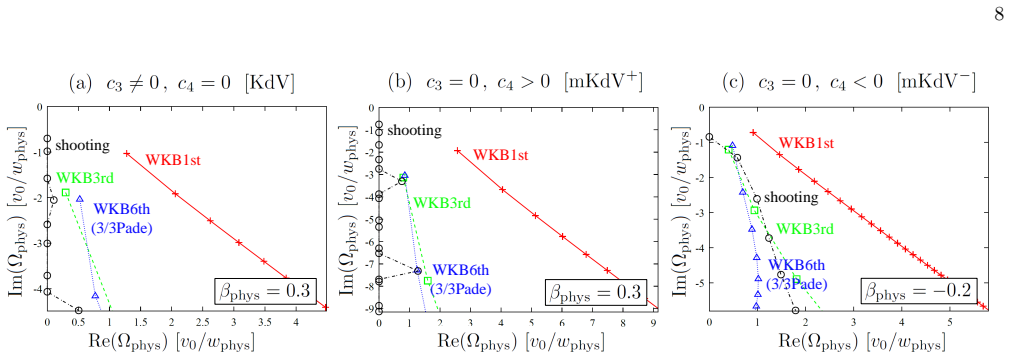
The circuit dynamics constructed by traveling-wave parametric amplifiers (TWPA), using superconducting nonlinear asymmetric elements (SNAILs), are known to be approximately described by the Korteweg-de Vries (KdV) or modified KdV equations in the continuum limit and admit soliton solutions. The soliton spatially modulates the effective propagation velocity of the weak probe field, which leads to the effective realization of the causal structure of the analogue event horizons in the SNAIL-TWPA circuit system. In this paper, we derive the master equation for the weak probe field where the background soliton acts as an effective potential. We show the absence of normalizable negative modes in the SNAIL-TWPA circuit system by using the language of supersymmetric quantum mechanics. We also present the first study of quasi-normal modes (QNM) of the SNAIL-TWPA analogue black-white hole system by semi-analytic and numerical methods. Based on the resultant QNM frequency, we clarify the timescale at which nonlinear dispersion becomes effective in the SNAIL-TWPA circuit system and demonstrate how ringdown is excited.
Editorial analysis
A structured set of objections, weighed in public.
Referee Report
Summary. The paper derives a master equation for the weak probe field in a SNAIL-TWPA circuit, with a soliton background from the KdV/mKdV continuum limit acting as an effective potential that realizes analogue black-white hole causal structures. It applies supersymmetric quantum mechanics to prove the absence of normalizable negative modes. It also presents the first semi-analytic and numerical computation of quasi-normal modes (QNMs) for this analogue system and uses the resulting QNM frequencies to identify the timescale at which nonlinear dispersion becomes important and to illustrate ringdown excitation.
Significance. If the central claims hold, the work supplies the first stability analysis and QNM spectrum for SNAIL-TWPA analogue black-white holes. The SUSY QM argument for the absence of negative modes is elegant and largely parameter-free. The QNM results provide a concrete estimate for the regime of validity of the effective description, which is useful for both theory and potential circuit experiments in analogue gravity.
major comments (1)
- The derivation of the master equation (continuum limit section) replaces the discrete SNAIL-TWPA circuit by the KdV or mKdV equation, so that the soliton supplies the effective potential for the probe. The subsequent SUSY QM stability proof and the QNM frequencies both rest on this effective potential. The skeptic concern is therefore load-bearing: the paper must show that the computed QNM frequencies correspond to wavelengths much longer than the circuit lattice spacing, so that higher-order dispersive and nonlinear terms remain small. Without an explicit check (e.g., k_QNM * a << 1 where a is the lattice constant), the justification for both the stability result and the ringdown timescale is incomplete.
minor comments (1)
- The abstract would benefit from a brief quantitative statement of the main QNM frequency or the derived timescale for nonlinear dispersion.
Simulated Author's Rebuttal
We thank the referee for the careful reading and constructive comments on our manuscript. We appreciate the positive assessment of the significance of the stability analysis and QNM results. We address the single major comment below.
read point-by-point responses
-
Referee: The derivation of the master equation (continuum limit section) replaces the discrete SNAIL-TWPA circuit by the KdV or mKdV equation, so that the soliton supplies the effective potential for the probe. The subsequent SUSY QM stability proof and the QNM frequencies both rest on this effective potential. The skeptic concern is therefore load-bearing: the paper must show that the computed QNM frequencies correspond to wavelengths much longer than the circuit lattice spacing, so that higher-order dispersive and nonlinear terms remain small. Without an explicit check (e.g., k_QNM * a << 1 where a is the lattice constant), the justification for both the stability result and the ringdown timescale is incomplete.
Authors: We agree that an explicit check of the long-wavelength condition is required to rigorously justify the continuum approximation underlying both the SUSY stability argument and the QNM timescale estimate. In the revised manuscript we will add a dedicated paragraph (or short subsection) after the QNM results in which we extract the characteristic wave numbers k_QNM from the computed frequencies using the linear dispersion relation of the probe field in the soliton-free background. We will then verify numerically that k_QNM a ≪ 1 for the circuit parameters employed in the paper, thereby confirming that higher-order lattice corrections remain small throughout the ringdown window identified by the QNM decay rates. revision: yes
Circularity Check
No significant circularity; derivation chain is self-contained
full rationale
The paper derives the master equation for the probe field from the continuum KdV/mKdV approximation of the circuit, applies standard SUSY QM to prove absence of normalizable negative modes on that potential, and computes QNMs via independent semi-analytic/numerical methods on the resulting Schrödinger-like equation. The subsequent use of those QNM frequencies to estimate the onset of nonlinear dispersion is a consistency check on the approximation's validity rather than a definitional or fitted-input reduction. No self-citation is load-bearing for the central claims, no ansatz is smuggled, and no result is renamed or forced by construction. The chain rests on external mathematical tools (SUSY QM) and numerical solution applied to an explicitly stated continuum model.
Axiom & Free-Parameter Ledger
axioms (1)
- domain assumption The dynamics of the SNAIL-TWPA circuit are approximately described by the KdV or modified KdV equations in the continuum limit.
Lean theorems connected to this paper
-
IndisputableMonolith/Foundation/AbsoluteFloorClosure.leanreality_from_one_distinction unclearWe show the absence of normalizable negative modes ... by using the language of supersymmetric quantum mechanics. ... derive the master equation for the weak probe field where the background soliton acts as an effective potential.
-
IndisputableMonolith/Cost/FunctionalEquation.leanwashburn_uniqueness_aczel unclearthe circuit dynamics ... approximately described by the Korteweg-de Vries (KdV) or modified KdV equations in the continuum limit
Reference graph
Works this paper leans on
-
[1]
Details on the numerical method One subtlety in the construction ofδφ ±(eη) is that the wave equation (22) has regular singular points at eη=±eηH :=±η H/w. This issue is resolved by using the Frobenius method to construct the series solutions near the horizons, that is, δφ±(eη) =|eη∓eηH|−ieΩ/eκ nmaxX n=0 a(±) n |eη∓eηH|n ,(C7) wherea (±) n are the coeffic...
-
[2]
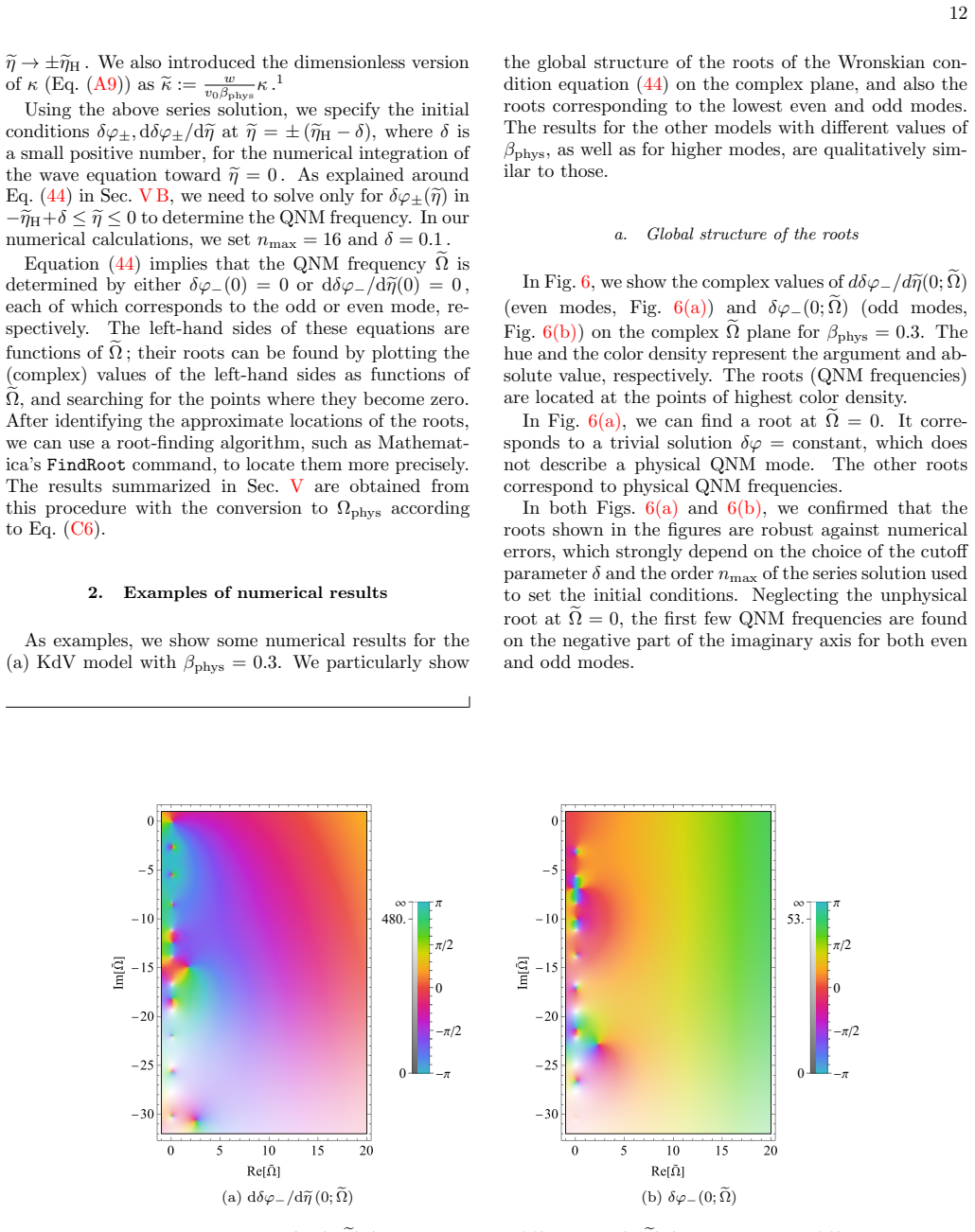
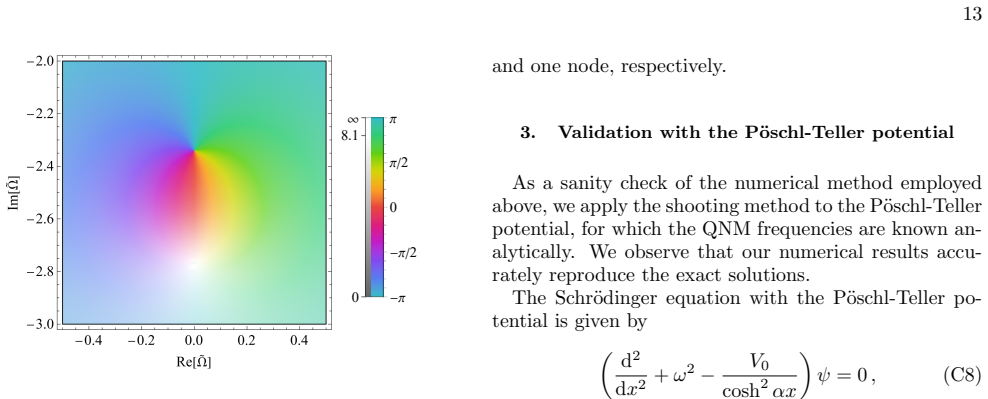
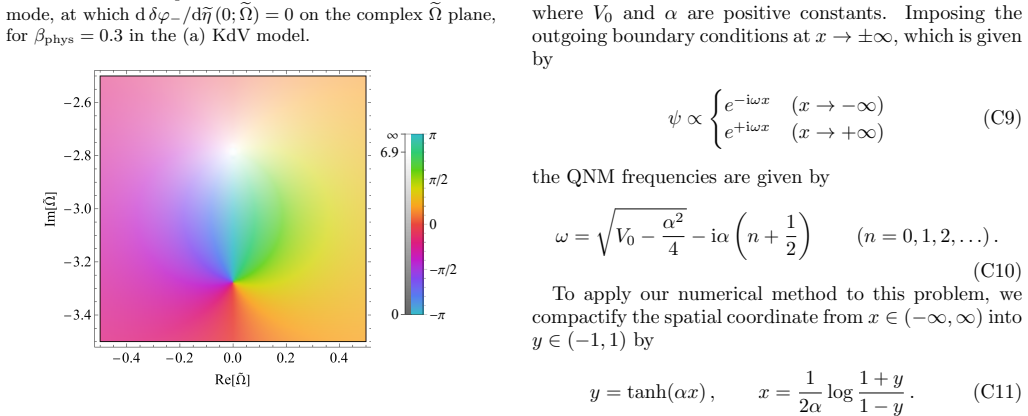
Examples of numerical results As examples, we show some numerical results for the (a) KdV model withβ phys = 0.3. We particularly show the global structure of the roots of the Wronskian con- dition equation (44) on the complex plane, and also the roots corresponding to the lowest even and odd modes. The results for the other models with different values o...
-
[3]
We observe that our numerical results accu- rately reproduce the exact solutions
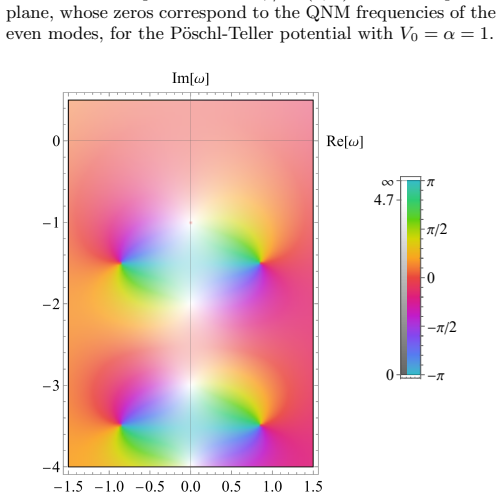
Validation with the P¨ oschl-Teller potential As a sanity check of the numerical method employed above, we apply the shooting method to the P¨ oschl-Teller potential, for which the QNM frequencies are known an- alytically. We observe that our numerical results accu- rately reproduce the exact solutions. The Schr¨ odinger equation with the P¨ oschl-Teller ...
-
[4]
Steinhauer, Nature Phys.10, 864 (2014) doi:10.1038/NPHYS3104 [arXiv:1409.6550 [cond- mat.quant-gas]]
J. Steinhauer, Nature Phys.10, 864 (2014) doi:10.1038/NPHYS3104 [arXiv:1409.6550 [cond- mat.quant-gas]]
-
[5]
Steinhauer, Nature Phys.12, 959 (2016) doi:10.1038/nphys3863 [arXiv:1510.00621 [gr-qc]]
J. Steinhauer, Nature Phys.12, 959 (2016) doi:10.1038/nphys3863 [arXiv:1510.00621 [gr-qc]]
-
[6]
T. G. Philbin, C. Kuklewicz, S. Robertson, S. Hill, F. Konig and U. Leonhardt, Science319, 1367-1370 (2008) doi:10.1126/science.1153625 [arXiv:0711.4796 [gr- qc]]
-
[7]
A. Choudhary and F. K¨ onig, ”Efficient frequency shifting of dispersive waves at solitons,” Opt. Express 20, 5538- 5546 (2012)
work page 2012
-
[8]
J. Drori, Y. Rosenberg, D. Bermudez, Y. Silberberg and U. Leonhardt, Phys. Rev. Lett.122, no.1, 010404 (2019) doi:10.1103/PhysRevLett.122.010404 [arXiv:1808.09244 [gr-qc]]. 15
-
[9]
H. S. Nguyen, D. Gerace, I. Carusotto, D. Sanvitto, E. Galopin, A. Lemaˆ ıtre, I. Sagnes, J. Bloch and A. Amo, Phys. Rev. Lett.114, no.3, 036402 (2015) doi:10.1103/PhysRevLett.114.036402
-
[10]
M. J. Jacquet, T. Boulier, F. Claude, A. Maˆ ıtre, E. Can- cellieri, C. Adrados, A. Amo, S. Pigeon, Q. Glorieux and A. Bramati,et al.Phil. Trans. Roy. Soc. Lond. A378, no.2177, 20190225 (2020) doi:10.1098/rsta.2019.0225 [arXiv:2002.00043 [cond-mat.quant-gas]]
-
[11]
R. Sch¨ utzhold and W. G. Unruh, Phys. Rev. Lett.95, 031301 (2005)
work page 2005
-
[12]
P. D. Nation, M. P. Blencowe, A. J. Rimberg, and E. Buks, Phys. Rev. Lett.103, 087004 (2009)
work page 2009
-
[13]
H. Katayama, N. Hatakenaka and T. Fu- jii, Phys. Rev. D102, no.8, 086018 (2020) doi:10.1103/PhysRevD.102.086018
-
[14]
H. Katayama, N. Hatakenaka and K. i. Matsuda, Uni- verse7, no.9, 334 (2021) doi:10.3390/universe7090334
-
[15]
H. Katayama, S. Ishizaka, N. Hatakenaka, and T. Fujii, Phys. Rev. D103, 066025 (2021)
work page 2021
- [16]
-
[17]
H. Katayama, Sci. Rep.11, no.1, 19137 (2021) doi:10.1038/s41598-021-98456-0
-
[18]
H. Katayama, N. Hatakenaka, T. Fujii and M. P. Blencowe, Phys. Rev. Res.5, no.2, L022055 (2023) doi:10.1103/PhysRevResearch.5.L022055 [arXiv:2212.12234 [quant-ph]]
-
[19]
Corley, S. and Jacobson, T. Hawking spectrum and high frequency dispersion. Phys. Rev. D54, 1568–1586 (1996)
work page 1996
-
[20]
Corley, S. Computing the spectrum of black hole radi- ation in the presence of high frequency dispersion: An analytical approach. Phys. Rev. D57, 6280–6291 (1998)
work page 1998
-
[21]
Corley, S. and Jacobson, T. Black hole lasers. Phys. Rev. D59, 124011 (1999)
work page 1999
-
[22]
Gaona-Reyes, J. L. and Bermudez, D. The theory of optical black hole lasers. Annals of Physics380, 41–58 (2017)
work page 2017
-
[23]
Faccio, D., Arane, T., Lamperti, M. and Leonhardt, U. Optical black hole lasers. Class. Quantum Grav.29, 224009 (2012)
work page 2012
-
[24]
Leonhardt, U. and Philbin, T. G. Black Hole Lasers Re- visited. in Quantum Analogues: From Phase Transitions to Black Holes and Cosmology (eds Unruh, W. G. and Sch¨ utzhold, R.) 229–245 (Springer, Berlin, Heidelberg, 2007)
work page 2007
-
[25]
Living Reviews in Relativity , keywords =
C. Barcelo, S. Liberati and M. Visser, Living Rev. Rel.8, 12 (2005) doi:10.12942/lrr-2005-12 [arXiv:gr-qc/0505065 [gr-qc]]
-
[26]
H. Kodama and A. Ishibashi, Prog. Theor. Phys.110, 701-722 (2003) doi:10.1143/PTP.110.701 [arXiv:hep- th/0305147 [hep-th]]
-
[27]
A. Ishibashi and H. Kodama, Prog. Theor. Phys.110, 901-919 (2003) doi:10.1143/PTP.110.901 [arXiv:hep- th/0305185 [hep-th]]
-
[28]
M. Kimura, Class. Quant. Grav.34, no.23, 235007 (2017) doi:10.1088/1361-6382/aa903f [arXiv:1706.01447 [gr-qc]]
-
[29]
H. P. Nollert, Class. Quant. Grav.16, R159-R216 (1999) doi:10.1088/0264-9381/16/12/201
-
[30]
K. D. Kokkotas and B. G. Schmidt, Living Rev. Rel. 2, 2 (1999) doi:10.12942/lrr-1999-2 [arXiv:gr-qc/9909058 [gr-qc]]
-
[31]
Quasinormal modes of black holes and black branes
E. Berti, V. Cardoso and A. O. Starinets, Class. Quant. Grav.26, 163001 (2009) doi:10.1088/0264- 9381/26/16/163001 [arXiv:0905.2975 [gr-qc]]
work page internal anchor Pith review Pith/arXiv arXiv doi:10.1088/0264- 2009
-
[32]
R. A. Konoplya and A. Zhidenko, Rev. Mod. Phys. 83, 793-836 (2011) doi:10.1103/RevModPhys.83.793 [arXiv:1102.4014 [gr-qc]]
-
[33]
Y. Hatsuda and M. Kimura, Universe7, no.12, 476 (2021) doi:10.3390/universe7120476 [arXiv:2111.15197 [gr-qc]]
-
[34]
C. Burgess, S. Patrick, T. Torres, R. Gregory and F. Koenig, Phys. Rev. Lett.132, no.5, 053802 (2024) doi:10.1103/PhysRevLett.132.053802 [arXiv:2309.10622 [physics.optics]]
-
[35]
S. Okuzumi and M. a. Sakagami, Phys. Rev. D 76, 084027 (2007) doi:10.1103/PhysRevD.76.084027 [arXiv:gr-qc/0703070 [gr-qc]]
-
[36]
E. Berti, V. Cardoso and J. P. S. Lemos, Phys. Rev. D70, 124006 (2004) doi:10.1103/PhysRevD.70.124006 [arXiv:gr-qc/0408099 [gr-qc]]
-
[37]
A. Ranadive, M. Esposito, L. Planat, E. Bonet, C. Naud, O. Buisson, W. Guichard and N. Roch, Nature Com- mun.13, 1737 (2022) doi:10.1038/s41467-022-29375-5 [arXiv:2101.05815 [quant-ph]]
-
[38]
Korteweg, D. J., & de Vries, G. (1895). XLI. On the change of form of long waves advancing in a rectan- gular canal, and on a new type of long stationary waves . The London, Edinburgh, and Dublin Philosoph- ical Magazine and Journal of Science, 39(240), 422–443. https://doi.org/10.1080/14786449508620739
-
[39]
Y. T. Kivshar and B. A. Malomed, Rev. Mod. Phys.61, 763-915 (1989) doi:10.1103/RevModPhys.61.763
-
[40]
R. M. Miura, Korteweg-de Vries Equation and General- izations. I. A Remarkable Explicit Nonlinear Transfor- mation, J. Math. Phys. 9, 1202 (1968)
work page 1968
-
[41]
T.L. Perelman, A.Kh. Fridman, M.M. El’Yashevich, On the relationship between the N-soliton solution of the modified Korteweg-de Vries equation and the KdV equation solution, Physics Letters A, Volume 47, Issue 4, 1974, Pages 321-323, ISSN 0375-9601, https://doi.org/10.1016/0375-9601(74)90185-6
-
[42]
G. Chanteur and M. Raadu, Formation of shocklike mod- ified Korteweg-de Vries solitons: Application to double layers, Phys. Fluids 30, 2708 (1987)
work page 1987
-
[43]
F. Cooper, A. Khare and U. Sukhatme, Phys. Rept. 251, 267-385 (1995) doi:10.1016/0370-1573(94)00080-M [arXiv:hep-th/9405029 [hep-th]]
-
[44]
B. F. Schutz and C. M. Will, Astrophys. J. Lett.291, L33-L36 (1985) doi:10.1086/184453
-
[45]
S. Iyer and C. M. Will, Phys. Rev. D35, 3621 (1987) doi:10.1103/PhysRevD.35.3621
-
[46]
S. Iyer, Phys. Rev. D35, 3632 (1987) doi:10.1103/PhysRevD.35.3632
-
[47]
R. A. Konoplya, Phys. Rev. D68, 024018 (2003) doi:10.1103/PhysRevD.68.024018 [arXiv:gr-qc/0303052 [gr-qc]]
-
[48]
J. Matyjasek and M. Opala, Phys. Rev. D96, no.2, 024011 (2017) doi:10.1103/PhysRevD.96.024011 [arXiv:1704.00361 [gr-qc]]
-
[49]
R. A. Konoplya, A. Zhidenko and A. F. Zinhailo, Class. Quant. Grav.36, 155002 (2019) doi:10.1088/1361- 6382/ab2e25 [arXiv:1904.10333 [gr-qc]]
-
[50]
E. W. Leaver, Proc. Roy. Soc. Lond. A402, 285-298 (1985) doi:10.1098/rspa.1985.0119
discussion (0)
Sign in with ORCID, Apple, or X to comment. Anyone can read and Pith papers without signing in.