Recognition: 2 theorem links
· Lean TheoremOUI as a Structural Observable: Towards an Activation-Centric View of Neural Network Training
Pith reviewed 2026-05-13 01:54 UTC · model grok-4.3
The pith
The Overfitting-Underfitting Indicator (OUI) acts as an early activation-based signal revealing whether neural network training heads into poor or promising regimes before convergence.
A machine-rendered reading of the paper's core claim, the machinery that carries it, and where it could break.
Core claim
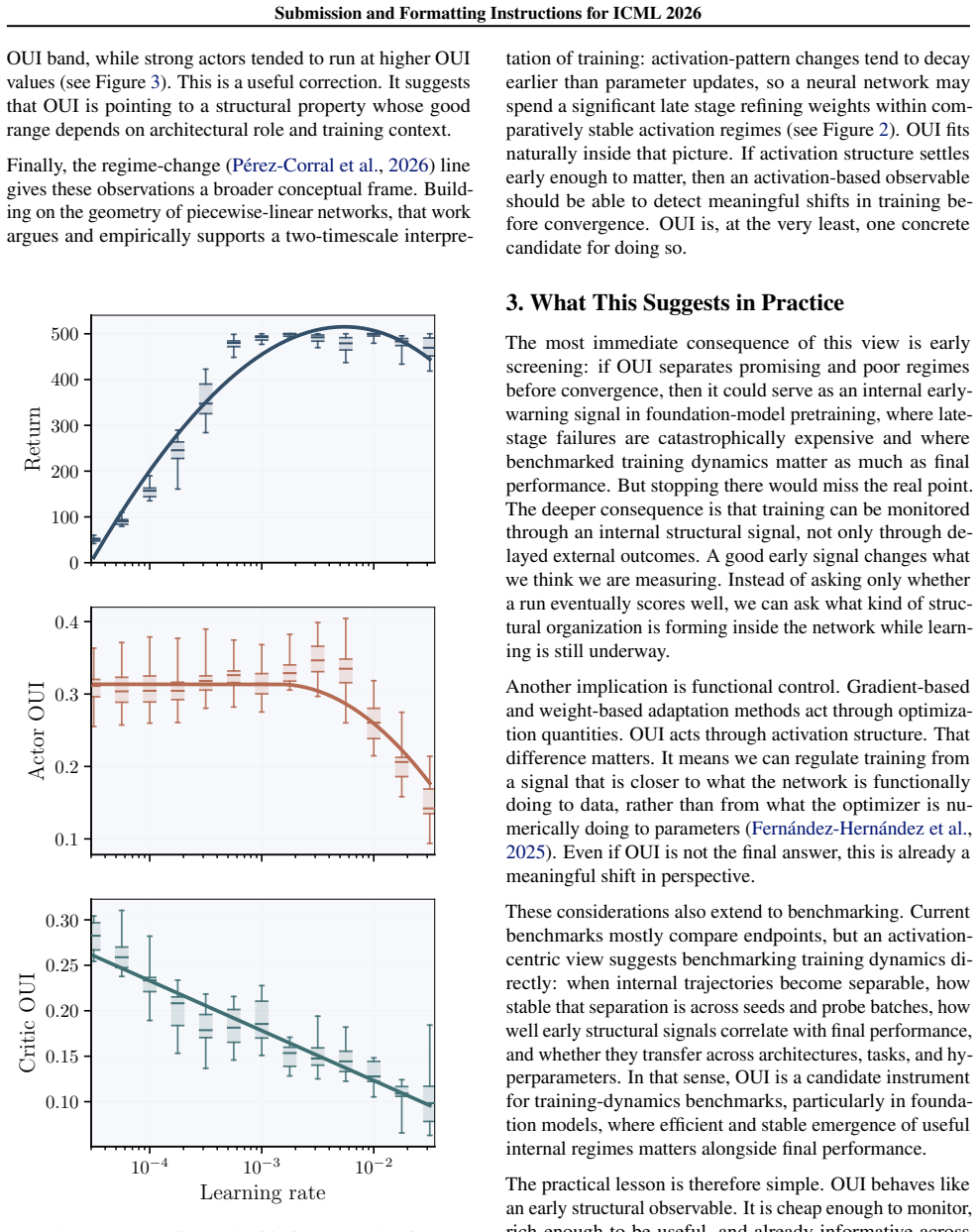
OUI should be understood as a first practical observable of internal network structure. Across results, it consistently appears as an early, label-free, activation-based signal that reveals whether a network is entering a poor or promising training regime before convergence. In supervised learning it anticipates weight decay regimes; in reinforcement learning it discriminates learning-rate regimes early in PPO actor-critic; and in online control it can drive layer-wise weight decay adaptation. Read together with evidence that activation patterns tend to stabilize earlier than parameters, these results suggest a broader research direction: an activation-centric theory of training dynamics, of
What carries the argument
The Overfitting-Underfitting Indicator (OUI), an activation-derived metric that extracts structural regime information from network activations to anticipate training trajectory quality ahead of loss or accuracy signals.
If this is right
- Weight decay selection in supervised training can be guided by OUI before full convergence occurs.
- Learning-rate regimes in PPO actor-critic reinforcement learning can be discriminated early using activation signals.
- Layer-wise weight decay can be adapted dynamically in online control tasks based on per-layer OUI readings.
- Training can be monitored and adjusted using internal activation structure instead of waiting for external performance metrics to evolve.
- An activation-centric theory of training dynamics becomes empirically testable with OUI as a foothold.
Where Pith is reading between the lines
- If OUI generalizes across domains, similar activation observables could be developed for unsupervised or self-supervised regimes to reduce wasted compute on failed runs.
- Early regime detection might enable automated intervention mechanisms that prune or restart training branches in large-scale experiments.
- OUI could be combined with other internal signals such as gradient statistics to build a more complete picture of when networks enter stable structural phases.
Load-bearing premise
Activation patterns stabilize earlier than parameters, and OUI extracts structural information independent of the external loss or accuracy curves it is meant to anticipate.
What would settle it
A controlled run on a new task or architecture where OUI values remain stable yet final performance diverges sharply from the regime OUI indicated, or where OUI tracks only after-the-fact loss rather than preceding it.
Figures


read the original abstract
Activation functions are what make deep networks expressive: without them, the model collapses to a linear map. Yet we still evaluate training mostly from the outside, through loss, accuracy, return, or final calibration, while the internal structural evolution of the network remains largely unobserved. In this paper, we argue that the Overfitting--Underfitting Indicator (OUI) should be understood as a first practical observable of that internal structure. Across our recent results, OUI consistently appears as an early, label-free, activation-based signal that reveals whether a network is entering a poor or promising training regime before convergence. In supervised learning, it anticipates weight decay regimes; in reinforcement learning, it discriminates learning-rate regimes early in PPO actor--critic; and in online control, it can drive layer-wise weight decay adaptation. Read together with recent evidence that activation patterns tend to stabilize earlier than parameters, these results suggest a broader research direction: an activation-centric theory of training dynamics. OUI is becoming an empirical foothold toward this theory.
Editorial analysis
A structured set of objections, weighed in public.
Referee Report
Summary. The manuscript positions the Overfitting-Underfitting Indicator (OUI) as a practical structural observable computed from activation patterns. It claims that OUI supplies an early, label-free signal capable of discriminating poor versus promising training regimes before convergence, with applications to weight-decay selection in supervised learning, learning-rate regime identification in PPO actor-critic, and layer-wise adaptation in online control. The argument rests on cited prior observations that activation statistics stabilize earlier than parameters and on the assertion that OUI extracts information independent of external loss or accuracy curves.
Significance. If the independence claim is substantiated with explicit controls, the work could open an activation-centric line of inquiry that complements loss-based monitoring and enables earlier, more targeted training interventions. The absence of new quantitative demonstrations or falsification tests in the present text, however, limits its immediate contribution to the literature.
major comments (2)
- [Abstract] Abstract: The central claim that OUI 'consistently appears as an early, label-free, activation-based signal' that anticipates regimes 'before convergence' is asserted without any quantitative evidence, error bars, or derivation steps supplied in the manuscript. The reference to 'recent results' is left unspecified, so the reader cannot assess whether the reported behavior is robust or merely descriptive.
- [Abstract] Abstract and introduction: No explicit test (partial correlation, Granger causality, or matched-loss counterfactual) is presented to show that OUI at early t carries incremental predictive power once loss(t) is controlled for. Without such a separation check, the asserted independence from external trajectories remains an untested assumption rather than a demonstrated property, directly undermining the 'structural observable' framing.
minor comments (1)
- [Abstract] The manuscript would benefit from a concise, self-contained definition or formula for OUI early in the text so that readers can evaluate the activation-centric claims without consulting prior work.
Simulated Author's Rebuttal
We thank the referee for the constructive and detailed feedback. We address the major comments point by point below, clarifying the manuscript's scope as a position paper that synthesizes prior empirical work on OUI while strengthening the presentation of evidence and independence claims through targeted revisions.
read point-by-point responses
-
Referee: [Abstract] Abstract: The central claim that OUI 'consistently appears as an early, label-free, activation-based signal' that anticipates regimes 'before convergence' is asserted without any quantitative evidence, error bars, or derivation steps supplied in the manuscript. The reference to 'recent results' is left unspecified, so the reader cannot assess whether the reported behavior is robust or merely descriptive.
Authors: The manuscript is a position paper whose claims rest on previously published empirical studies. In the revised version we explicitly cite those studies (including the specific references where quantitative results, error bars, and derivation details appear) and add a short summary paragraph in the introduction that recapitulates the key empirical patterns observed across supervised, reinforcement-learning, and control settings. This makes the abstract's assertions directly traceable without requiring the reader to consult external material. revision: yes
-
Referee: [Abstract] Abstract and introduction: No explicit test (partial correlation, Granger causality, or matched-loss counterfactual) is presented to show that OUI at early t carries incremental predictive power once loss(t) is controlled for. Without such a separation check, the asserted independence from external trajectories remains an untested assumption rather than a demonstrated property, directly undermining the 'structural observable' framing.
Authors: We agree that formal statistical separation tests would provide stronger support for the independence claim. The current argument for independence is based on OUI's construction—it is computed exclusively from activation statistics and does not require labels or loss values—together with prior evidence that activation patterns stabilize earlier than parameters. In the revised introduction we have added an explicit discussion of this limitation, clarifying that the practical utility demonstrated in the applications (early regime discrimination when loss curves remain similar) serves as complementary evidence, while outlining how partial-correlation or counterfactual analyses could be performed in follow-up work. We have also referenced the activation-stabilization literature to ground the structural-observable framing. revision: partial
Circularity Check
No circularity: OUI introduced as empirical activation statistic with independent experimental support
full rationale
The manuscript presents OUI as a computed quantity derived from internal activation patterns and reports its observed correlation with training regimes across supervised, RL, and control settings. No equations or definitions are supplied in which OUI is constructed from the loss, accuracy, or regime labels it is claimed to anticipate; the indicator is described as label-free and activation-centric. Self-references to prior activation-stabilization observations are used only to motivate the broader research direction and do not serve as the sole justification for the current empirical claims. The derivation chain therefore remains observational rather than self-referential by construction.
Axiom & Free-Parameter Ledger
axioms (1)
- domain assumption Activation patterns stabilize earlier than parameters during training
Lean theorems connected to this paper
-
IndisputableMonolith/Cost/FunctionalEquation.leanwashburn_uniqueness_aczel unclearOUIi(t) = 1/dl sum u(l)j(t) / floor(B/2) where u is min(s, B-s) from binary activation mask m=1{a>0}
-
IndisputableMonolith/Foundation/ArithmeticFromLogic.leanreality_from_one_distinction unclearactivation patterns stabilize earlier than parameters; two-timescale view of training
Reference graph
Works this paper leans on
-
[1]
P. Langley , title =. Proceedings of the 17th International Conference on Machine Learning (ICML 2000) , address =. 2000 , pages =
work page 2000
-
[2]
T. M. Mitchell. The Need for Biases in Learning Generalizations. 1980
work page 1980
-
[3]
M. J. Kearns , title =
-
[4]
Machine Learning: An Artificial Intelligence Approach, Vol. I. 1983
work page 1983
-
[5]
R. O. Duda and P. E. Hart and D. G. Stork. Pattern Classification. 2000
work page 2000
-
[6]
A. Newell and P. S. Rosenbloom. Mechanisms of Skill Acquisition and the Law of Practice. Cognitive Skills and Their Acquisition. 1981
work page 1981
-
[7]
A. L. Samuel. Some Studies in Machine Learning Using the Game of Checkers. IBM Journal of Research and Development. 1959
work page 1959
-
[8]
Frontiers in Artificial Intelligence , author =
Studying the. Frontiers in Artificial Intelligence , author =. doi:10.3389/frai.2021.642374 , abstract =
-
[9]
Pérez-Corral, Cristian and Fernández-Hernández, Alberto and Mestre, Jose I. and Dolz, Manuel F. and Duato, Jose and Quintana-Ortí, Enrique S. , month = feb, year =. Regime. doi:10.48550/arXiv.2602.08333 , abstract =
-
[10]
Fernández-Hernández, Alberto and Mestre, Jose I. and Dolz, Manuel F. and Duato, Jose and Quintana-Ortí, Enrique S. , month = jul, year =. 2025. doi:10.1109/AMLDS63918.2025.11159348 , abstract =
- [11]
-
[12]
Kornblith, Simon and Norouzi, Mohammad and Lee, Honglak and Hinton, Geoffrey , year =. Similarity of. International
discussion (0)
Sign in with ORCID, Apple, or X to comment. Anyone can read and Pith papers without signing in.