Recognition: 2 theorem links
· Lean TheoremCosmology of f(Q,L_m) gravity with Holographic Ricci Dark Energy: Early-Time Inflation and Late-Time Acceleration and RGUP Corrected Observables
Pith reviewed 2026-05-13 01:13 UTC · model grok-4.3
The pith
A single polynomial form of f(Q, L_m) gravity produces both early Starobinsky-like inflation from its quadratic term and late-time acceleration when paired with holographic Ricci dark energy.
A machine-rendered reading of the paper's core claim, the machinery that carries it, and where it could break.
Core claim
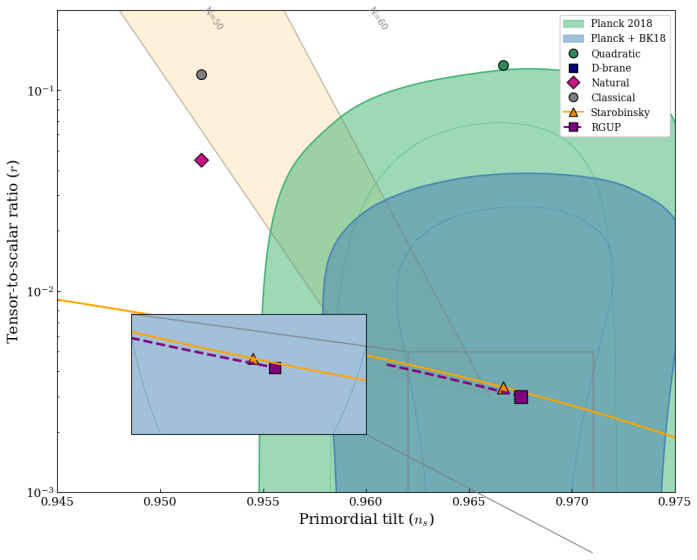
Within the chosen f(Q, L_m) = -Q + alpha Q^2 + 2 L_m + beta Q L_m, the quadratic non-metricity term alone supplies a Starobinsky-like inflationary background whose predicted n_s and r lie inside Planck 2018 bounds; at late times the same function, supplemented by holographic Ricci dark energy, produces stable accelerated expansion whose effective equation of state approaches the de Sitter value; the matter-geometry coupling beta remains consistent with zero under current data, and relativistic generalized-uncertainty corrections induce only sub-leading changes to the running of the spectral index.
What carries the argument
The minimal polynomial f(Q, L_m) = -Q + alpha Q^2 + 2 L_m + beta Q L_m, whose quadratic piece dominates at early high-curvature epochs while the remaining terms plus holographic Ricci dark energy control late-time dynamics.
If this is right
- The quadratic term supplies a purely geometric inflationary phase without an extra inflaton field.
- Late-time acceleration emerges from the interplay of the linear non-metricity term, the matter coupling and the holographic dark-energy density.
- Bayesian constraints show beta is consistent with the Lambda-CDM limit, implying the extra coupling is not required by current observations.
- RGUP momentum corrections leave the background expansion intact but shift the running of the spectral index by a small amount.
- The effective equation of state evolves smoothly toward minus one at late times.
Where Pith is reading between the lines
- If the same function works across both epochs, separate scalar-field sectors for inflation and dark energy could become unnecessary in this class of models.
- Future CMB experiments that tighten the running of the spectral index could directly test the size of the RGUP correction.
- Analogous curvature-dependent dominance might be explored in other non-metricity or teleparallel extensions to see whether the two-epoch unification persists.
Load-bearing premise
The specific polynomial dependence chosen for f(Q, L_m) is assumed to capture the relevant physics across all curvature regimes.
What would settle it
A future measurement of the running of the spectral index that lies outside the narrow band allowed by the RGUP-corrected Starobinsky-like phase, or a failure of the late-time Hubble evolution to fit the combined Pantheon, cosmic-chronometer and DESI BAO data when alpha and beta are varied.
Figures


read the original abstract
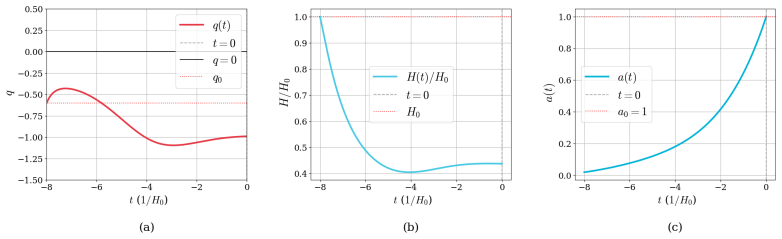
This study investigates a cosmological scenario within the f(Q,L_m) gravity framework to explore whether one geometric model can simultaneously describe the early and late-time accelerated epochs. Motivated by the recently proposed f(Q,L_m) gravity framework by Hazarika et al. [Phys. Dark Universe 50 (2025) 102092], we adopt a minimal polynomial form, f(Q,L_m) = -Q + alpha Q^2 + 2L_m + beta QL_m, and the late-time dynamics are reconstructed by introducing Holographic Ricci Dark Energy (HRDE) as an effective fluid. The resulting background evolution demonstrates smooth accelerated expansion, stable Hubble parameter behavior, and an effective equation of state that approaches the de Sitter regime. Bayesian analysis utilizing Pantheon supernovae, cosmic chronometer, and DESI BAO data reveals that the matter-geometry coupling parameter beta is weakly constrained and remains consistent with the LambdaCDM limit. In the high-curvature regime characteristic of the early Universe, the quadratic non-metricity term alpha Q^2 dominates the dynamics, resulting in a Starobinsky-like inflationary phase driven solely by geometric effects with predicted n_s and r values consistent with Planck 2018 observations. Furthermore, quantum-gravity-inspired corrections are examined through a Relativistic Generalized Uncertainty Principle (RGUP), implemented as a momentum-dependent deformation of the effective spacetime metric. These corrections maintain the geometric inflationary background while introducing minor perturbative shifts in higher-order inflationary observables, specifically the running of the spectral index. Overall, these findings indicate that the f(Q,L_m) framework offers a dynamically consistent geometric model in which early and late cosmic acceleration arise from distinct curvature regimes, with RGUP effects causing sub-leading modifications.
Editorial analysis
A structured set of objections, weighed in public.
Referee Report
Summary. This paper investigates cosmology in the f(Q, L_m) gravity theory with the specific polynomial form f(Q, L_m) = -Q + α Q² + 2 L_m + β Q L_m. It reconstructs late-time acceleration by adding Holographic Ricci Dark Energy (HRDE) as an effective fluid, performs Bayesian analysis with Pantheon supernovae, cosmic chronometers, and DESI BAO data showing consistency with ΛCDM for the coupling parameter β, and demonstrates that the quadratic term α Q² drives a Starobinsky-like inflationary phase in the early universe with n_s and r values compatible with Planck 2018. Additionally, Relativistic Generalized Uncertainty Principle (RGUP) corrections are applied, leading to sub-leading modifications in inflationary observables.
Significance. Should the derivations and fits prove robust, the manuscript offers a framework in which distinct curvature regimes within a single modified gravity model account for both early and late cosmic acceleration, augmented by quantum gravity-inspired corrections. Credit is due for the multi-dataset Bayesian constraints and the explicit matching to observational benchmarks such as Planck 2018 and ΛCDM limits.
major comments (1)
- [Abstract] Abstract: The central claim that 'one geometric model can simultaneously describe the early and late-time accelerated epochs' and that the f(Q, L_m) framework is a 'dynamically consistent geometric model' in which accelerations 'arise from distinct curvature regimes' is undermined by the explicit statement that late-time dynamics are 'reconstructed by introducing Holographic Ricci Dark Energy (HRDE) as an effective fluid.' The manuscript does not demonstrate that the modified Friedmann equations derived from f(Q, L_m) = -Q + α Q² + 2 L_m + β Q L_m alone produce w_eff ≈ -1 at late times without the added HRDE component. This hybrid construction is load-bearing for the unification claim and requires either a derivation showing emergent de Sitter behavior from the geometry or a revised statement of the model's scope.
minor comments (2)
- [Model Setup] The definition of the matter Lagrangian L_m and its explicit coupling to the non-metricity scalar Q should be stated with the assumed matter content (e.g., perfect fluid form) to allow reproduction of the effective fluid equations.
- [Figures] Figure captions for the Hubble parameter evolution and effective equation of state should include the 1σ and 2σ bands from the Bayesian posteriors on α and β for direct visual assessment of consistency with data.
Simulated Author's Rebuttal
We thank the referee for the careful reading and constructive feedback on our manuscript. The major comment highlights an important point regarding the precise scope of our unification claim, which we address below by agreeing to revise the abstract and related statements for accuracy.
read point-by-point responses
-
Referee: [Abstract] Abstract: The central claim that 'one geometric model can simultaneously describe the early and late-time accelerated epochs' and that the f(Q, L_m) framework is a 'dynamically consistent geometric model' in which accelerations 'arise from distinct curvature regimes' is undermined by the explicit statement that late-time dynamics are 'reconstructed by introducing Holographic Ricci Dark Energy (HRDE) as an effective fluid.' The manuscript does not demonstrate that the modified Friedmann equations derived from f(Q, L_m) = -Q + α Q² + 2 L_m + β Q L_m alone produce w_eff ≈ -1 at late times without the added HRDE component. This hybrid construction is load-bearing for the unification claim and requires either a derivation showing emergent de Sitter behavior from the geometry or a revised statement of the model's scope.
Authors: We agree with the referee that the late-time acceleration is not generated solely by the geometric f(Q, L_m) sector. In the manuscript, the modified Friedmann equations from the chosen polynomial form are supplemented by HRDE as an effective fluid to reconstruct the observed late-time expansion with w_eff approaching -1. The early-time Starobinsky-like inflation arises purely from the α Q² term at high curvature, while the β coupling term allows for matter-geometry interaction that is consistent with data. The 'unification' in our framework refers to employing a single f(Q, L_m) action that accommodates both regimes through distinct curvature scales, with HRDE providing the necessary late-time component. We do not claim or derive an emergent de Sitter solution from the geometry alone. To address this, we will revise the abstract and introduction to state more precisely that the model combines geometric inflation with HRDE-driven late-time acceleration within the f(Q, L_m) framework, while retaining the Bayesian constraints and RGUP analysis. This revision will be incorporated in the updated manuscript. revision: yes
Circularity Check
Late-time acceleration reconstructed via added HRDE fluid rather than emerging purely from f(Q,L_m) geometry
specific steps
-
fitted input called prediction
[Abstract]
"the late-time dynamics are reconstructed by introducing Holographic Ricci Dark Energy (HRDE) as an effective fluid. The resulting background evolution demonstrates smooth accelerated expansion, stable Hubble parameter behavior, and an effective equation of state that approaches the de Sitter regime. Bayesian analysis utilizing Pantheon supernovae, cosmic chronometer, and DESI BAO data reveals that the matter-geometry coupling parameter beta is weakly constrained and remains consistent with the LambdaCDM limit."
HRDE density is defined in terms of the Hubble parameter (standard form rho_HRDE = 3c^2 (2H^2 + dot H)), a construction chosen to produce w_eff ~ -1 and late acceleration. Inserting this fluid, solving the modified Friedmann equations, and then Bayesian-tuning beta to data forces the demonstrated de Sitter approach and LambdaCDM consistency; the late-time result therefore reduces to the choice of HRDE input rather than an independent prediction from f(Q,L_m) = -Q + alpha Q^2 + 2L_m + beta Q L_m alone.
full rationale
The paper's central unification claim relies on distinct curvature regimes, but late-time de Sitter behavior is inserted via HRDE (whose density is defined from H and dot{H}) and then fitted with beta; this makes the late-time result partly by construction of the effective fluid input. Early-time Starobinsky-like inflation from the alpha Q^2 term is independent and geometric. The derivation chain therefore contains one instance of fitted input called prediction but retains independent content overall, yielding a moderate circularity score.
Axiom & Free-Parameter Ledger
free parameters (2)
- alpha
- beta
axioms (2)
- domain assumption The background evolution is governed by the modified Friedmann equations derived from the f(Q,L_m) action.
- ad hoc to paper HRDE density is given by the holographic Ricci cutoff.
Lean theorems connected to this paper
-
IndisputableMonolith/Cost/FunctionalEquation.leanwashburn_uniqueness_aczel unclear?
unclearRelation between the paper passage and the cited Recognition theorem.
we adopt a minimal polynomial form, f(Q, L_m) = -Q + αQ² + 2L_m + βQL_m, and the late-time dynamics are reconstructed by introducing Holographic Ricci Dark Energy (HRDE) as an effective fluid
-
IndisputableMonolith/Foundation/RealityFromDistinction.leanreality_from_one_distinction unclear?
unclearRelation between the paper passage and the cited Recognition theorem.
the quadratic non-metricity term αQ² dominates... resulting in a Starobinsky-like inflationary phase driven solely by geometric effects
What do these tags mean?
- matches
- The paper's claim is directly supported by a theorem in the formal canon.
- supports
- The theorem supports part of the paper's argument, but the paper may add assumptions or extra steps.
- extends
- The paper goes beyond the formal theorem; the theorem is a base layer rather than the whole result.
- uses
- The paper appears to rely on the theorem as machinery.
- contradicts
- The paper's claim conflicts with a theorem or certificate in the canon.
- unclear
- Pith found a possible connection, but the passage is too broad, indirect, or ambiguous to say the theorem truly supports the claim.
Reference graph
Works this paper leans on
-
[1]
The general theory of relativity
Albert Einstein. The general theory of relativity. InThe meaning of relativity, pages 54–75. Springer, 1922
work page 1922
-
[2]
Tests of general relativity: A review.arXiv preprint arXiv:1705.04397, 2017
Estelle Asmodelle. Tests of general relativity: A review.arXiv preprint arXiv:1705.04397, 2017
-
[3]
David Blair and Magdalena Kersting. The quest to validate general relativity.Teaching Einsteinian Physics in Schools: An Essential Guide for Teachers in Training and Practice, page 51, 2021
work page 2021
-
[4]
Testing general relativity with grav- itational waves: An overview.Universe, 7(12):497, 2021
NV Krishnendu and Frank Ohme. Testing general relativity with grav- itational waves: An overview.Universe, 7(12):497, 2021
work page 2021
-
[5]
Slava G Turyshev. Experimental tests of general relativity.Annual Review of Nuclear and Particle Science, 58(1):207–248, 2008
work page 2008
-
[6]
Dimitrios Psaltis. Testing general relativity with the event horizon telescope.General Relativity and Gravitation, 51(10):137, 2019
work page 2019
-
[7]
A dynamical study of the friedmann equations.European Journal of Physics, 22(4):371, 2001
Jean-Philippe Uzan and Roland Lehoucq. A dynamical study of the friedmann equations.European Journal of Physics, 22(4):371, 2001
work page 2001
-
[8]
¨Uber die kr¨ ummung des raumes.Zeitschrift f¨ ur Physik, 10(1):377–386, 1922
Alexander Friedman. ¨Uber die kr¨ ummung des raumes.Zeitschrift f¨ ur Physik, 10(1):377–386, 1922. 35
work page 1922
-
[9]
Georges Lemaˆ ıtre. A homogeneous universe of constant mass and in- creasing radius accounting for the radial velocity of extra-galactic neb- ulae.Monthly Notices of the Royal Astronomical Society, Vol. 91, p. 483-490, 91:483–490, 1931
work page 1931
-
[10]
Kinematics and world-structure.Astrophys- ical Journal, vol
Howard Percy Robertson. Kinematics and world-structure.Astrophys- ical Journal, vol. 82, p. 284, 82:284, 1935
work page 1935
-
[11]
Arthur Geoffrey Walker. On milne’s theory of world-structure.Pro- ceedings of the London Mathematical Society, 2(1):90–127, 1937
work page 1937
-
[12]
Irwin I Shapiro. Testing general relativity: Progress, problems, and prospects.General Relativity and Gravitation, 3(1):135–148, 1972
work page 1972
-
[13]
The problem of n bodies in general relativity theory.Proceedings of the Royal Society of London
Arthur Stanley Eddington and Gordon Leonard Clark. The problem of n bodies in general relativity theory.Proceedings of the Royal Society of London. Series A. Mathematical and Physical Sciences, 166(927): 465–475, 1938
work page 1938
-
[14]
John Archibald Wheeler. Problems on the frontiers between general relativity and differential geometry.Reviews of Modern Physics, 34(4): 873, 1962
work page 1962
-
[15]
Alan H Guth. Inflationary universe: A possible solution to the horizon and flatness problems.Physical Review D, 23(2):347, 1981
work page 1981
-
[16]
Andrei D Linde. A new inflationary universe scenario: a possible so- lution of the horizon, flatness, homogeneity, isotropy and primordial monopole problems.Physics Letters B, 108(6):389–393, 1982
work page 1982
-
[17]
Andreas Albrecht and Paul J Steinhardt. Cosmology for grand unified theories with radiatively induced symmetry breaking.Physical Review Letters, 48(17):1220, 1982
work page 1982
-
[18]
Alexei A Starobinsky. Dynamics of phase transition in the new in- flationary universe scenario and generation of perturbations.Physics Letters B, 117(3-4):175–178, 1982
work page 1982
-
[19]
A thousand problems in cosmology: Horizons.arXiv preprint arXiv:1310.6329, 2013
Yu L Bolotin and IV Tanatarov. A thousand problems in cosmology: Horizons.arXiv preprint arXiv:1310.6329, 2013. 36
-
[20]
Phillip Helbig. Is there a flatness problem in classical cosmology? Monthly Notices of the Royal Astronomical Society, 421(1):561–569, 2012
work page 2012
-
[21]
Results from the high-z su- pernova search team.Physics Reports, 307(1-4):31–44, 1998
Alexei V Filippenko and Adam G Riess. Results from the high-z su- pernova search team.Physics Reports, 307(1-4):31–44, 1998
work page 1998
-
[22]
Measurements ofωand λfrom 42 high-redshift supernovae.The Astrophysical Journal, 517(2): 565, 1999
Saul Perlmutter, Goldhaber Aldering, Gerson Goldhaber, Richard A Knop, Peter Nugent, Patricia G Castro, Susana Deustua, Sebastien Fabbro, Ariel Goobar, Donald E Groom, et al. Measurements ofωand λfrom 42 high-redshift supernovae.The Astrophysical Journal, 517(2): 565, 1999
work page 1999
-
[23]
The case forλcdm.arXiv preprint astro-ph/9703161, 1997
Michael S Turner. The case forλcdm.arXiv preprint astro-ph/9703161, 1997
-
[24]
Everyone wants something better thanλcdm.arXiv preprint arXiv:2510.05483, 2025
Michael S Turner. Everyone wants something better thanλcdm.arXiv preprint arXiv:2510.05483, 2025
-
[25]
Modified theories of gravity: Why, how and what?General Relativity and Gravitation, 54 (5):44, 2022
S Shankaranarayanan and Joseph P Johnson. Modified theories of gravity: Why, how and what?General Relativity and Gravitation, 54 (5):44, 2022
work page 2022
-
[26]
Richard Kerner. Cosmology without singularity and nonlinear gravita- tional lagrangians.General Relativity and Gravitation, 14(5):453–469, 1982
work page 1982
-
[27]
Salvatore Capozziello, VF Cardone, and V Salzano. Cosmography of f (r) gravity.Physical Review D—Particles, Fields, Gravitation, and Cosmology, 78(6):063504, 2008
work page 2008
-
[28]
f (r) theories of gravity.Re- views of Modern Physics, 82(1):451–497, 2010
Thomas P Sotiriou and Valerio Faraoni. f (r) theories of gravity.Re- views of Modern Physics, 82(1):451–497, 2010
work page 2010
-
[29]
The dark matter problem from f (r) gravity viewpoint.Annalen der Physik, 524(9-10): 545–578, 2012
Salvatore Capozziello and Mariafelicia De Laurentis. The dark matter problem from f (r) gravity viewpoint.Annalen der Physik, 524(9-10): 545–578, 2012
work page 2012
-
[30]
Modified gravity description of neutron star in the f (r) framework.Axioms, 12 (3):234, 2023
Samprity Das, Irina Radinschi, and Surajit Chattopadhyay. Modified gravity description of neutron star in the f (r) framework.Axioms, 12 (3):234, 2023. 37
work page 2023
-
[31]
Disappearing cosmological constant in f (r) grav- ity.JETP letters, 86(3):157–163, 2007
Alexei A Starobinsky. Disappearing cosmological constant in f (r) grav- ity.JETP letters, 86(3):157–163, 2007
work page 2007
-
[32]
Alvaro De la Cruz-Dombriz and Antonio Dobado. f (r) gravity without a cosmological constant.Physical Review D—Particles, Fields, Gravi- tation, and Cosmology, 74(8):087501, 2006
work page 2006
-
[33]
Stable worm- holes in the background of an exponential f (r) gravity.Universe, 6(4): 48, 2020
Ghulam Mustafa, Ibrar Hussain, and M Farasat Shamir. Stable worm- holes in the background of an exponential f (r) gravity.Universe, 6(4): 48, 2020
work page 2020
-
[34]
J Santos, JS Alcaniz, MJ Reboucas, and FC Carvalho. Energy condi- tions in f (r) gravity.Physical Review D—Particles, Fields, Gravitation, and Cosmology, 76(8):083513, 2007
work page 2007
-
[35]
Confronting rainbow- deformed f (r) gravity with the act data.Physics Letters B, page 139909, 2025
Sergei D Odintsov and Vasilis K Oikonomou. Confronting rainbow- deformed f (r) gravity with the act data.Physics Letters B, page 139909, 2025
work page 2025
-
[36]
Sergei D Odintsov and Vasilis K Oikonomou. Power-law f (r) gravity as deformations to starobinsky inflation in view of act.Physics Letters B, page 139907, 2025
work page 2025
-
[37]
Translation of einstein’s at- tempt of a unified field theory with teleparallelism, 2005
Alexander Unzicker and Timothy Case. Translation of einstein’s at- tempt of a unified field theory with teleparallelism, 2005. URL https://arxiv.org/abs/physics/0503046
-
[38]
Salvatore Capozziello, VF Cardone, H Farajollahi, and A Ravanpak. Cosmography in f (t) gravity.Physical Review D—Particles, Fields, Gravitation, and Cosmology, 84(4):043527, 2011
work page 2011
-
[39]
Accelerating universe from f (t) gravity.The European Physical Journal C, 71(9):1752, 2011
Ratbay Myrzakulov. Accelerating universe from f (t) gravity.The European Physical Journal C, 71(9):1752, 2011
work page 2011
-
[40]
f (t) teleparallel gravity and cosmology.Reports on Progress in Physics, 79(10):106901, 2016
Yi-Fu Cai, Salvatore Capozziello, Mariafelicia De Laurentis, and Em- manuel N Saridakis. f (t) teleparallel gravity and cosmology.Reports on Progress in Physics, 79(10):106901, 2016
work page 2016
-
[41]
Cosmolog- ical solutions of f (t) gravity.Physical Review D, 94(2):023525, 2016
Andronikos Paliathanasis, John D Barrow, and PGL Leach. Cosmolog- ical solutions of f (t) gravity.Physical Review D, 94(2):023525, 2016. 38
work page 2016
-
[42]
Degrees of freedom of f (t) gravity.Journal of High Energy Physics, 2011(7):1–15, 2011
Miao Li, Rong-Xin Miao, and Yan-Gang Miao. Degrees of freedom of f (t) gravity.Journal of High Energy Physics, 2011(7):1–15, 2011
work page 2011
-
[43]
Baojiu Li, Thomas P Sotiriou, and John D Barrow. Large-scale struc- ture in f (t) gravity.Physical Review D—Particles, Fields, Gravitation, and Cosmology, 83(10):104017, 2011
work page 2011
-
[44]
The covariant formulation of f (t) gravity.Classical and Quantum Gravity, 33(11):115009, 2016
Martin Krˇ sˇ s´ ak and Emmanuel N Saridakis. The covariant formulation of f (t) gravity.Classical and Quantum Gravity, 33(11):115009, 2016
work page 2016
-
[45]
LK Duchaniya, Santosh V Lohakare, B Mishra, and SK Tripathy. Dy- namical stability analysis of accelerating f (t) gravity models.The European Physical Journal C, 82(5):448, 2022
work page 2022
-
[46]
J. M. Nester and H-J Yo. Symmetric teleparallel general relativity,
-
[47]
URLhttps://arxiv.org/abs/gr-qc/9809049
work page internal anchor Pith review arXiv
-
[48]
f (Q, Lm) gravity , and its cosmological implications,
Ayush Hazarika, Simran Arora, PK Sahoo, and Tiberiu Harko. f(q, l m) gravity, and its cosmological implications.arXiv preprint arXiv:2407.00989, 2024
-
[49]
Y. Myrzakulov, Alnadhief H.A. Alfedeel, M. Koussour, S. Muminov, E.I. Hassan, and J. Rayimbaev. Modified cosmology in f(q,lm) grav- ity.Physics Letters B, 866:139506, 2025. ISSN 0370-2693. doi: https://doi.org/10.1016/j.physletb.2025.139506. URLhttps://www. sciencedirect.com/science/article/pii/S0370269325002679
-
[50]
Kairat Myrzakulov, M. Koussour, O. Donmez, A. Cilli, E. G¨ udekli, and J. Rayimbaev. Observational analysis of late-time acceleration in f(q,lm) gravity.Journal of High Energy Astrophysics, 44:164–171,
-
[51]
doi: https://doi.org/10.1016/j.jheap.2024
ISSN 2214-4048. doi: https://doi.org/10.1016/j.jheap.2024. 09.014. URLhttps://www.sciencedirect.com/science/article/ pii/S221440482400096X
-
[52]
Yerlan Myrzakulov, O. Donmez, M. Koussour, D. Alizhanov, S. Bekchanov, and J. Rayimbaev. Late-time cosmology in f(q,lm) gravity: Analytical solutions and observational fits.Physics of the Dark Universe, 46:101614, 2024. ISSN 2212-6864. doi: https://doi. org/10.1016/j.dark.2024.101614. URLhttps://www.sciencedirect. com/science/article/pii/S2212686424001961. 39
-
[53]
V. A. Kshirsagar, S. A. Kadam, and Vishwajeet S. Goswami. Cos- mological dynamics of hyperbolic evolution models inf(q, l m) gravity,
- [54]
-
[55]
Waseem Ahmad, Tayyab Naseer, M. Sharif, S. Rehman, and Ozod- bek Rahimov. Role of minimal geometric deformation in construct- ing stellar models in f(q, lm) theory: Stability analysis under kohler- chao-tikekar spacetime.International Journal of Geometric Methods in Modern Physics, 0(ja):null, 0. doi: 10.1142/S0219887826501604. URL https://doi.org/10.1142...
-
[56]
Y. Myrzakulov, O. Donmez, M. Koussour, S. Muminov, I.Y. Davle- tov, and J. Rayimbaev. Constraining f(q,lm) gravity with bulk viscos- ity.Physics of the Dark Universe, 48:101829, 2025. ISSN 2212-6864. doi: https://doi.org/10.1016/j.dark.2025.101829. URLhttps://www. sciencedirect.com/science/article/pii/S221268642500024X
-
[57]
Amit Samaddar and S Surendra Singh. A novel approach to baryo- genesis in f (q, lm) gravity and its cosmological implications.Nuclear Physics B, 1012:116834, 2025
work page 2025
-
[58]
Maryam Shiravand, Saeed Fakhry, Javad T. Firouzjaee, and Ali Tiz- fahm. Cosmological inflation inf(q,L m) gravity, 2025. URLhttps: //arxiv.org/abs/2511.09031
-
[59]
Amit Samaddar and S. Surendra Singh. Observational signatures of scalar field dynamics in modifiedf(q, l m) gravity, 2025. URLhttps: //arxiv.org/abs/2507.08897
-
[60]
A model of holographic dark energy.Physics Let- ters B, 603(1):1–5, 2004
Miao Li. A model of holographic dark energy.Physics Let- ters B, 603(1):1–5, 2004. ISSN 0370-2693. doi: https://doi.org/ 10.1016/j.physletb.2004.10.014. URLhttps://www.sciencedirect. com/science/article/pii/S0370269304014388
-
[61]
Holo- graphic dark energy model from ricci scalar curvature.Phys
Changjun Gao, Fengquan Wu, Xuelei Chen, and You-Gen Shen. Holo- graphic dark energy model from ricci scalar curvature.Phys. Rev. D, 79:043511, Feb 2009. doi: 10.1103/PhysRevD.79.043511. URL https://link.aps.org/doi/10.1103/PhysRevD.79.043511. 40
-
[62]
Antonio Pasqua, Surajit Chattopadhyay, and Iuliia Khomenko. A re- construction of modified holographic ricci dark energy in f(r, t) grav- ity.Canadian Journal of Physics, 91(8):632–638, 2013. doi: 10.1139/ cjp-2013-0016. URLhttps://doi.org/10.1139/cjp-2013-0016
-
[63]
Antonio Pasqua. Generalized holographic and ricci dark energy: Cos- mological diagnostics and scalar field realizations, 2025. URLhttps: //arxiv.org/abs/2509.19386
-
[64]
Xin Zhang. Holographic ricci dark energy: Current observational con- straints, quintom feature, and the reconstruction of scalar-field dark en- ergy.Phys. Rev. D, 79:103509, May 2009. doi: 10.1103/PhysRevD.79. 103509. URLhttps://link.aps.org/doi/10.1103/PhysRevD.79. 103509
-
[65]
Gargee Chakraborty, Surajit Chattopadhyay, Nishi Gupta, and Harpreet Kaur. Baryogenesis and possible insights into the hub- ble tension from f(t) gravity with holographic ricci dark en- ergy.Modern Physics Letters A, 40(37):2550181, 2025. doi: 10.1142/S0217732325501810. URLhttps://doi.org/10.1142/ S0217732325501810
-
[66]
Imanol Albarran and Mariam Bouhmadi-L´ opez. Quantisation of the holographic ricci dark energy model.Journal of Cosmology and As- troparticle Physics, 2015(08):051, aug 2015. doi: 10.1088/1475-7516/ 2015/08/051. URLhttps://doi.org/10.1088/1475-7516/2015/08/ 051
-
[67]
Anisotropic modified holographic ricci dark energy cosmological model with hybrid expansion law
Kanika Das and Tazmin Sultana. Anisotropic modified holographic ricci dark energy cosmological model with hybrid expansion law. Astrophysics and Space Science, 360(1):4, 2015. doi: 10.1007/ s10509-015-2517-y
work page 2015
-
[68]
Chokyi and Surajit Chattopadhyay
Khandro K. Chokyi and Surajit Chattopadhyay. A truncated scale factor to realize cosmological bounce under the purview of modified gravity.Astronomische Nachrichten, 344(7):e220119, 2023. doi: https: //doi.org/10.1002/asna.20220119. URLhttps://onlinelibrary. wiley.com/doi/abs/10.1002/asna.20220119. 41
-
[69]
C. P. Singh and Ajay Kumar. Holographic ricci dark energy with con- stant bulk viscosity in f(r,t) gravity.Gravitation and Cosmology, 25 (1):58–68, 2019. doi: 10.1134/S0202289319010109
-
[70]
Chokyi and Surajit Chattopadhyay
Khandro K. Chokyi and Surajit Chattopadhyay. Cosmological models within f(t, b) gravity in a holographic framework.Particles, 7(3):856– 878, 2024. ISSN 2571-712X. doi: 10.3390/particles7030051. URL https://www.mdpi.com/2571-712X/7/3/51
-
[71]
String theory, supersymmetry, unification, and all that.Reviews of Modern Physics, 71(2):S112, 1999
John H Schwarz and Nathan Seiberg. String theory, supersymmetry, unification, and all that.Reviews of Modern Physics, 71(2):S112, 1999
work page 1999
-
[72]
On the interpretation of minimal length in string theories.Modern Physics Letters A, 4(16), 1989
Tamiaki Yoneya. On the interpretation of minimal length in string theories.Modern Physics Letters A, 4(16), 1989
work page 1989
-
[73]
Baryogenesis without grand unification
D. Amati, M. Ciafaloni, and G. Veneziano. Can spacetime be probed below the string size?Physics Letters B, 216(1): 41–47, 1989. ISSN 0370-2693. doi: https://doi.org/10.1016/ 0370-2693(89)91366-X. URLhttps://www.sciencedirect.com/ science/article/pii/037026938991366X
-
[74]
David J. Gross and Paul F. Mende. String theory beyond the planck scale.Nuclear Physics B, 303(3):407–454, 1988. ISSN 0550-3213. doi: https://doi.org/10.1016/0550-3213(88)90390-2. URLhttps://www. sciencedirect.com/science/article/pii/0550321388903902
-
[75]
G. Veneziano. A stringy nature needs just two constants.Europhysics Letters, 2(3):199, aug 1986. doi: 10.1209/0295-5075/2/3/006. URL https://doi.org/10.1209/0295-5075/2/3/006
-
[76]
Black-hole thermodynamics.Physics Today, 33 (1):24–31, 1980
Jacob D Bekenstein. Black-hole thermodynamics.Physics Today, 33 (1):24–31, 1980
work page 1980
-
[77]
Giovanni Amelino-Camelia. Doubly special relativity.arXiv preprint gr-qc/0207049, 2002
work page Pith review arXiv 2002
-
[78]
Kowalski-Glikman.Introduction to Doubly Special Relativity, pages 131–159
J. Kowalski-Glikman.Introduction to Doubly Special Relativity, pages 131–159. Springer Berlin Heidelberg, Berlin, Heidelberg, 2005. ISBN 978-3-540-31527-8. doi: 10.1007/11377306 5. URLhttps://doi.org/ 10.1007/11377306_5. 42
-
[79]
Giovanni Amelino-Camelia. Doubly-special relativity: first results and key open problems.International Journal of Modern Physics D, 11 (10):1643–1669, 2002
work page 2002
-
[80]
Heisenberg’s uncer- tainty principle.Physics reports, 452(6):155–176, 2007
Paul Busch, Teiko Heinonen, and Pekka Lahti. Heisenberg’s uncer- tainty principle.Physics reports, 452(6):155–176, 2007
work page 2007
discussion (0)
Sign in with ORCID, Apple, or X to comment. Anyone can read and Pith papers without signing in.