Recognition: 2 theorem links
· Lean TheoremLong-lived sterile neutrinos from axionlike particles at the Super Tau-Charm Facility
Pith reviewed 2026-05-13 01:20 UTC · model grok-4.3
The pith
The Super Tau-Charm Facility can probe long-lived sterile neutrino mixing one to two orders of magnitude beyond current experimental bounds.
A machine-rendered reading of the paper's core claim, the machinery that carries it, and where it could break.
Core claim
At the proposed Super Tau-Charm Facility, axionlike particles originating from D± meson decays can produce pairs of long-lived heavy neutral leptons whose displaced decays are searchable at the detector. Truth-level and detector-level Monte Carlo simulations of the full chain establish that the mixing parameter |V_eN|^2 can be probed one to two orders of magnitude below present bounds. An approximate reinterpretation of CHARM data further indicates that beam-dump experiments may impose strong additional limits once production and kinematic assumptions are fixed.
What carries the argument
Displaced-vertex search for heavy neutral leptons pair-produced in axionlike particle decays, with the ALPs themselves coming from D± → π± ALP transitions, evaluated through full Monte Carlo simulation of kinematics and detector efficiency.
If this is right
- STCF achieves sensitivity to |V_eN|^2 improved by a factor of 10 to 100 relative to existing bounds.
- Beam-dump experiments such as CHARM can provide complementary constraints on the same mixing parameter under model-dependent assumptions on production.
- The ALP-mediated channel supplies a distinct production mechanism for long-lived heavy neutral leptons at tau-charm energies.
- Dedicated analyses of existing or future beam-dump data can tighten the overall limits once kinematic distributions are measured.
Where Pith is reading between the lines
- Realizing the projected sensitivity would exclude portions of parameter space in which sterile neutrinos make up an appreciable fraction of dark matter.
- The same displaced-vertex technique could be applied with modest adaptation at other electron-positron colliders operating near charm threshold.
- Confirmation of the assumed ALP production rates in D decays would validate the use of this channel for related beyond-Standard-Model searches.
Load-bearing premise
The production rates and kinematic distributions of the axionlike particles in D meson decays, along with the simulated detector efficiency and background rejection for displaced vertices, match reality without large unaccounted uncertainties.
What would settle it
An experimental determination at STCF or another facility that the actual background rate in the displaced-vertex signal region exceeds the Monte Carlo prediction by more than an order of magnitude, or a direct measurement showing the axionlike particle production rate in D decays is substantially lower than assumed.
Figures


read the original abstract
We study the search prospect of long-lived heavy neutral leptons (HNLs) pair produced in decays of axionlike particles (ALPs) at the proposed Super Tau-Charm Facility (STCF), focusing on the center-of-mass energy of $\sqrt{s}=3.773$ GeV. The ALPs are assumed to originate from $D^\pm$-meson decays in association with a charged pion. We perform both truth-level and detector-level Monte Carlo simulations and obtain the expected sensitivity reach to the mixing parameter between the HNL and the electron neutrino, $|V_{eN}|^2$, with a displaced-vertex search at STCF. We find that STCF can probe values of $|V_{eN}|^2$ about one-to-two orders of magnitude beyond the existing bounds. We also perform an approximate reinterpretation of a search for HNLs at the CHARM experiment, which is subject to model-dependent assumptions on the production and kinematic distributions, and find that beam-dump experiments may provide strong complementary constraints.
Editorial analysis
A structured set of objections, weighed in public.
Referee Report
Summary. The manuscript studies the search prospects for long-lived heavy neutral leptons (HNLs) pair-produced from axion-like particle (ALP) decays at the proposed Super Tau-Charm Facility (STCF) at √s=3.773 GeV. ALPs are produced via D± → π± ALP, followed by ALP → NN, with sensitivity to the HNL-electron neutrino mixing |V_eN|^2 obtained from truth-level and detector-level Monte Carlo simulations of displaced-vertex signatures. The central claim is that STCF can probe |V_eN|^2 values one-to-two orders of magnitude below existing bounds; an approximate reinterpretation of CHARM data is also presented for complementary constraints.
Significance. If the Monte Carlo projections hold under realistic detector conditions, the result would meaningfully extend the experimental reach for sterile neutrinos in the ALP-mediated production channel, providing a concrete benchmark for a future tau-charm facility and highlighting complementarity with beam-dump experiments. The work adds to the literature on displaced-vertex searches for long-lived particles by quantifying the improvement possible at STCF.
major comments (1)
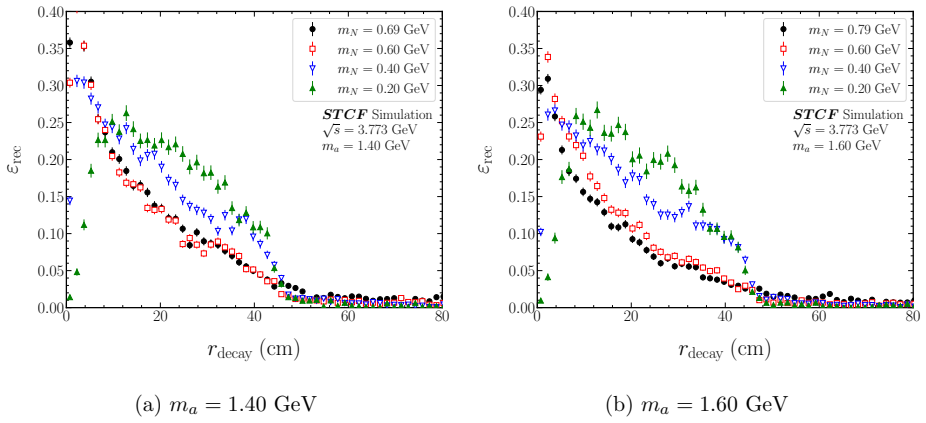
- [§3, §4] §3 and §4: The headline sensitivity reach (one-to-two orders of magnitude improvement in |V_eN|^2) is derived from Monte Carlo projections whose production kinematics for ALPs from D± decays, HNL decay lengths, assumed detector efficiencies (reported in the 10-20% range), and background rejection factors are taken as inputs without reported systematic variations, alternative generator cross-checks, or data-driven validation. If these efficiencies are optimistic by even a factor of a few, the projected improvement collapses toward existing limits, making the central claim load-bearing on unvalidated simulation assumptions.
minor comments (1)
- [Abstract] The abstract and introduction could more explicitly state the assumed ALP and HNL mass ranges over which the quoted sensitivity applies, as well as the precise lifetime window for the displaced-vertex selection.
Simulated Author's Rebuttal
We thank the referee for the careful reading of our manuscript and the constructive feedback. The main concern is the robustness of the Monte Carlo-based sensitivity projections. We address this point below and will incorporate revisions to strengthen the presentation of uncertainties.
read point-by-point responses
-
Referee: The headline sensitivity reach (one-to-two orders of magnitude improvement in |V_eN|^2) is derived from Monte Carlo projections whose production kinematics for ALPs from D± decays, HNL decay lengths, assumed detector efficiencies (reported in the 10-20% range), and background rejection factors are taken as inputs without reported systematic variations, alternative generator cross-checks, or data-driven validation. If these efficiencies are optimistic by even a factor of a few, the projected improvement collapses toward existing limits, making the central claim load-bearing on unvalidated simulation assumptions.
Authors: We agree that additional discussion of systematic uncertainties would strengthen the paper. In the revised manuscript we will add a new subsection in §4 that quantifies variations in ALP production kinematics (using alternative form-factor parametrizations for D± → π± ALP, yielding <25% change in signal yield), HNL decay-length calculations (standard formulas with negligible theoretical uncertainty), and detector efficiencies. We will explicitly vary the 10-20% efficiency range by ±50% and show that the projected |V_eN|^2 reach remains at least one order of magnitude below current bounds even in the most pessimistic scenario. Background-rejection factors will be detailed with the specific selection cuts and their simulation-derived rejection power. We have performed cross-checks with an alternative Monte Carlo generator for D-meson production and will report the results. Data-driven validation is not possible for a proposed facility, but our assumptions are conservative and benchmarked against existing BESIII analyses; we will clarify this in the text. These additions address the concern while preserving the central claim. revision: yes
Circularity Check
No circularity; sensitivity reach is forward MC projection, not reduction to fitted inputs or self-citations
full rationale
The paper derives its main claim (STCF probing |V_eN|^2 one-to-two orders beyond bounds) via truth-level and detector-level Monte Carlo simulations of D± → π± ALP, ALP → NN, and displaced HNL vertices, with efficiency cuts applied. No equation or step reduces this projection to a parameter fitted on the same observable, nor does any load-bearing premise collapse to a self-citation whose content is unverified or defined circularly. The CHARM reinterpretation is explicitly approximate and model-dependent but is not used to justify the STCF result. This is a standard forward simulation study whose derivation chain remains independent of its outputs.
Axiom & Free-Parameter Ledger
axioms (1)
- domain assumption ALPs originate from D±-meson decays in association with a charged pion at √s=3.773 GeV
Lean theorems connected to this paper
-
IndisputableMonolith/Foundation/RealityFromDistinction.leanreality_from_one_distinction unclearWe perform both truth-level and detector-level Monte Carlo simulations... obtain the expected sensitivity reach to |V_eN|^2 with a displaced-vertex search
-
IndisputableMonolith/Cost/FunctionalEquation.leanwashburn_uniqueness_aczel unclearLa = ½ ∂μa ∂μa − ½ m_a² a² + ... + (∂μa/Λ) g_N N γμ γ5 N
Reference graph
Works this paper leans on
-
[1]
J. Alimenaet al., J. Phys. G47, 090501 (2020), arXiv:1903.04497 [hep-ex]
- [2]
-
[3]
D. Curtinet al., Rept. Prog. Phys.82, 116201 (2019), arXiv:1806.07396 [hep-ph]
-
[4]
J. Beachamet al., J. Phys. G47, 010501 (2020), arXiv:1901.09966 [hep-ex]
- [5]
-
[6]
Alimenaet al., inLHCb FIP Physics Workshop 2025(2025) arXiv:2510.05257 [hep-ph]
J. Alimenaet al., inLHCb FIP Physics Workshop 2025(2025) arXiv:2510.05257 [hep-ph]
-
[7]
R. E. Shrock, Phys. Lett. B96, 159 (1980)
work page 1980
-
[8]
R. E. Shrock, Phys. Rev. D24, 1232 (1981)
work page 1981
-
[9]
R. E. Shrock, Phys. Rev. D24, 1275 (1981)
work page 1981
- [10]
-
[11]
R. D. Peccei and H. R. Quinn, Phys. Rev. Lett.38, 1440 (1977)
work page 1977
-
[12]
R. D. Peccei and H. R. Quinn, Phys. Rev. D16, 1791 (1977)
work page 1977
- [13]
-
[14]
J. P. Conlon, JHEP05, 078 (2006), arXiv:hep-th/0602233
work page Pith review arXiv 2006
-
[15]
N. Arkani-Hamed, L. Motl, A. Nicolis, and C. Vafa, JHEP06, 060 (2007), arXiv:hep- th/0601001
-
[16]
A. Arvanitaki, S. Dimopoulos, S. Dubovsky, N. Kaloper, and J. March-Russell, Phys. Rev. D81, 123530 (2010), arXiv:0905.4720 [hep-th]
work page internal anchor Pith review arXiv 2010
-
[17]
The type IIB string axiverse and its low-energy phenomenology
M. Cicoli, M. Goodsell, and A. Ringwald, JHEP10, 146 (2012), arXiv:1206.0819 [hep-th]
work page Pith review arXiv 2012
-
[18]
D. O’Connell, M. J. Ramsey-Musolf, and M. B. Wise, Phys. Rev. D75, 037701 (2007), arXiv:hep-ph/0611014
- [19]
- [20]
-
[21]
M. Pospelov, A. Ritz, and M. B. Voloshin, Phys. Lett. B662, 53 (2008), arXiv:0711.4866 [hep-ph]. 19
work page Pith review arXiv 2008
-
[22]
G. Krnjaic, Phys. Rev. D94, 073009 (2016), arXiv:1512.04119 [hep-ph]
-
[23]
I. Boiarska, K. Bondarenko, A. Boyarsky, V. Gorkavenko, M. Ovchynnikov, and A. Sokolenko, JHEP11, 162 (2019), arXiv:1904.10447 [hep-ph]
-
[24]
L. B. Okun, Sov. Phys. JETP56, 502 (1982)
work page 1982
- [25]
- [26]
-
[27]
C. Boehm and P. Fayet, Nucl. Phys. B683, 219 (2004), arXiv:hep-ph/0305261
-
[28]
Pospelov,Secluded U(1) below the weak scale,Phys
M. Pospelov, Phys. Rev. D80, 095002 (2009), arXiv:0811.1030 [hep-ph]
- [29]
-
[30]
K. Kaneta, H.-S. Lee, and S. Yun, Phys. Rev. Lett.118, 101802 (2017), arXiv:1611.01466 [hep-ph]
-
[31]
S. Gopalakrishna, S. Jung, and J. D. Wells, Phys. Rev. D78, 055002 (2008), arXiv:0801.3456 [hep-ph]
- [32]
- [33]
- [34]
- [35]
- [36]
-
[37]
R. N. Mohapatra and G. Senjanovic, Phys. Rev. Lett.44, 912 (1980), [,231(1979)]
work page 1980
-
[38]
Complex Spinors and Unified Theories
M. Gell-Mann, P. Ramond, and R. Slansky, Conf. Proc. C790927, 315 (1979), arXiv:1306.4669 [hep-th]
work page Pith review arXiv 1979
- [39]
-
[40]
R. N. Mohapatra, Phys. Rev. Lett.56, 561 (1986)
work page 1986
-
[41]
R. N. Mohapatra and J. W. F. Valle, Phys. Rev. D34, 1642 (1986)
work page 1986
- [42]
-
[43]
M. Malinsky, J. C. Romao, and J. W. F. Valle, Phys. Rev. Lett.95, 161801 (2005), arXiv:hep- ph/0506296
-
[44]
S. Dodelson and L. M. Widrow, Phys. Rev. Lett.72, 17 (1994), arXiv:hep-ph/9303287. 20
- [45]
- [46]
-
[47]
K. Abazajian, G. M. Fuller, and W. H. Tucker, Astrophys. J.562, 593 (2001), arXiv:astro- ph/0106002
-
[48]
K. Abazajian, G. M. Fuller, and M. Patel, Phys. Rev. D64, 023501 (2001), arXiv:astro- ph/0101524
- [49]
-
[50]
T. Asaka and M. Shaposhnikov, Phys. Lett. B620, 17 (2005), arXiv:hep-ph/0505013
- [51]
- [52]
-
[53]
L. F. Abbott and P. Sikivie, Phys. Lett. B120, 133 (1983)
work page 1983
- [54]
- [55]
- [56]
-
[57]
Cicoli, in9th Patras Workshop on Axions, WIMPs and WISPs(2013) pp
M. Cicoli, in9th Patras Workshop on Axions, WIMPs and WISPs(2013) pp. 235–242, arXiv:1309.6988 [hep-th]
-
[58]
Searching for axions and ALPs from string theory
A. Ringwald, J. Phys. Conf. Ser.485, 012013 (2014), arXiv:1209.2299 [hep-ph]
work page Pith review arXiv 2014
-
[59]
C. D. Froggatt and H. B. Nielsen, Nucl. Phys. B147, 277 (1979)
work page 1979
- [60]
-
[61]
B. Bellazzini, A. Mariotti, D. Redigolo, F. Sala, and J. Serra, Phys. Rev. Lett.119, 141804 (2017), arXiv:1702.02152 [hep-ph]
-
[62]
Long-Lived HNLs via ALP Portal at the LHC
R. Beltr´ an, C. Hati, M. Hirsch, and A. Mart´ ın-Gal´ an, JHEP03, 233 (2026), arXiv:2510.26946 [hep-ph]
work page internal anchor Pith review Pith/arXiv arXiv 2026
- [63]
-
[64]
A. de Giorgi, L. Merlo, and J.-L. Tastet, Fortsch. Phys.71, 2300027 (2023), arXiv:2212.11290 [hep-ph]
- [65]
- [66]
- [67]
- [68]
-
[69]
M. Cataldi, A. Mariotti, F. Sala, and M. Vanvlasselaer, JHEP12, 125 (2024), arXiv:2407.01667 [hep-ph]
- [70]
- [71]
-
[72]
L. Calibbi, F. Goertz, D. Redigolo, R. Ziegler, and J. Zupan, Phys. Rev. D95, 095009 (2017), arXiv:1612.08040 [hep-ph]
-
[73]
F. Arias-Aragon and L. Merlo, JHEP10, 168 (2017), [Erratum: JHEP 11, 152 (2019)], arXiv:1709.07039 [hep-ph]
-
[74]
F. Bj¨ orkeroth, L. Di Luzio, F. Mescia, and E. Nardi, JHEP02, 133 (2019), arXiv:1811.09637 [hep-ph]
- [75]
-
[76]
L. Di Luzio, A. W. M. Guerrera, X. P. D´ ıaz, and S. Rigolin, JHEP06, 046 (2023), arXiv:2304.04643 [hep-ph]
-
[77]
L. Di Luzio, F. Mescia, E. Nardi, P. Panci, and R. Ziegler, Phys. Rev. Lett.120, 261803 (2018), arXiv:1712.04940 [hep-ph]
-
[78]
G. Alonso- ´Alvarez, J. M. Cline, and T. Xiao, JHEP07, 187 (2023), arXiv:2305.00018 [hep- ph]
- [79]
- [80]
discussion (0)
Sign in with ORCID, Apple, or X to comment. Anyone can read and Pith papers without signing in.