Recognition: 2 theorem links
· Lean TheoremBarnett effect in rotating spinor dipolar quantum droplets
Pith reviewed 2026-05-13 01:02 UTC · model grok-4.3
The pith
Releasing the spin degree of freedom stabilizes vortices in self-bound dipolar droplets and generates spontaneous axial magnetization through orbital-to-spin angular momentum transfer.
A machine-rendered reading of the paper's core claim, the machinery that carries it, and where it could break.
Core claim
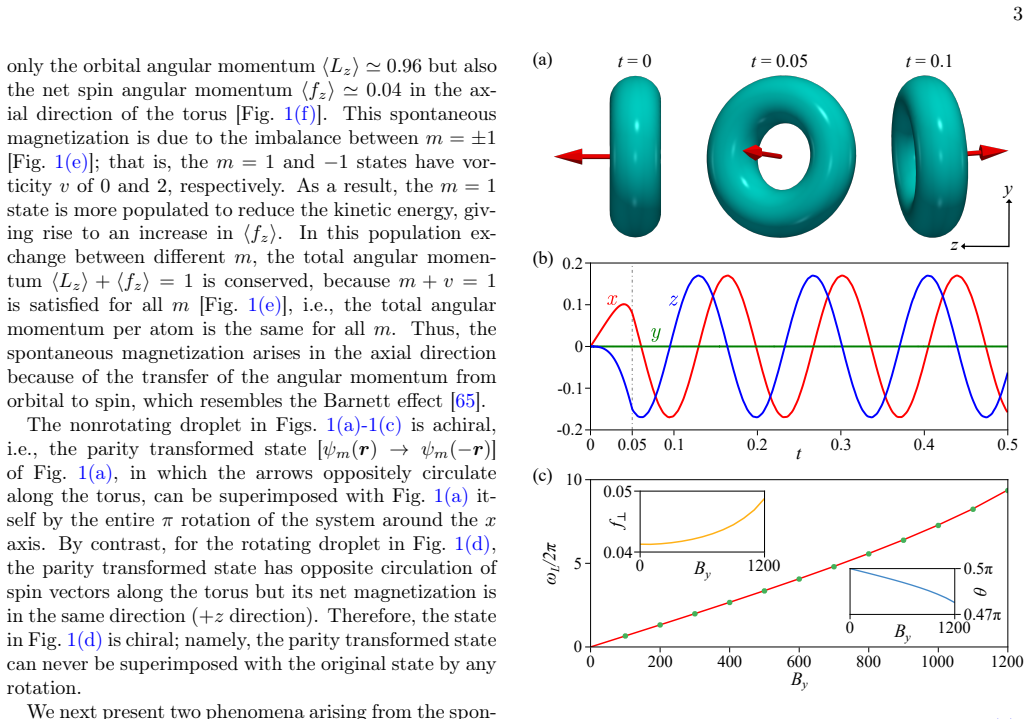
When a vortex is embedded into the droplet, spontaneous magnetization arises in the axial direction via a mechanism similar to the Barnett effect; that is, the orbital angular momentum is transferred to the spin angular momentum. When an external magnetic field is applied to the spontaneously magnetized droplet, the entire atomic cloud starts to rotate without changing its shape, which can be regarded as mechanical Larmor precession of a macroscopic object. A chirally different pair of droplets can form a stable bound state because of the attractive interaction between the spontaneously magnetized droplets.
What carries the argument
Vortex-induced orbital-to-spin angular momentum conversion in a spinor dipolar condensate that produces spontaneous axial magnetization.
If this is right
- The droplet acquires spontaneous axial magnetization solely from the embedded vortex.
- An applied magnetic field induces rigid-body rotation of the entire cloud without deformation.
- Oppositely chiral magnetized droplets attract and form stable bound states.
- Releasing spin provides a route to long-lived vortex states inside self-bound dipolar droplets.
Where Pith is reading between the lines
- The effect supplies a clean platform for testing mechanical analogs of Larmor precession in isolated quantum objects.
- Multi-droplet assemblies could exhibit collective rotational dynamics driven by the chiral binding.
- Similar orbital-to-spin transfer may appear in other self-bound spinor systems once the spin channel is opened.
Load-bearing premise
Releasing the spin degree of freedom stabilizes the vortex in the self-bound droplet without introducing other instabilities or requiring adjustments beyond the mean-field model.
What would settle it
Direct measurement of axial magnetization in a vortex-laden dipolar droplet in the absence of any external field, or observation that the droplet rotates rigidly as a whole under a weak applied field while its density profile remains unchanged.
Figures



read the original abstract
We propose releasing the spin degree of freedom to stabilize the vortex state in self-bound droplets of dipolar Bose-Einstein condensates. When a vortex is embedded into the droplet, spontaneous magnetization arises in the axial direction via a mechanism similar to the Barnett effect; that is, the orbital angular momentum is transferred to the spin angular momentum. When an external magnetic field is applied to the spontaneously magnetized droplet, the entire atomic cloud starts to rotate without changing its shape, which can be regarded as mechanical Larmor precession of a macroscopic object. A chirally different pair of droplets can form a stable bound state because of the attractive interaction between the spontaneously magnetized droplets.
Editorial analysis
A structured set of objections, weighed in public.
Referee Report
Summary. The manuscript proposes that releasing the spin degree of freedom in self-bound dipolar Bose-Einstein condensate droplets stabilizes embedded vortex states. A vortex induces spontaneous axial magnetization through orbital-to-spin angular momentum transfer analogous to the Barnett effect. Application of an external magnetic field then drives rigid rotation of the entire droplet without shape deformation, interpreted as mechanical Larmor precession. Pairs of droplets with opposite chirality are shown to form stable bound states via attractive interactions between their spontaneous magnetizations.
Significance. If the proposed states prove dynamically stable, the work would establish a concrete route to angular-momentum transfer and macroscopic precession analogs in quantum droplets, extending known scalar-droplet physics to spinor dipolar systems. The mean-field plus LHY framework is a standard and appropriate starting point for such calculations.
major comments (2)
- [Numerical results on vortex embedding and magnetization] The central claim that releasing the spin degree of freedom stabilizes the vortex state rests on stationarity of the mean-field solution but lacks explicit verification of dynamical stability. Spin-dependent dipolar interactions and possible roton softening introduce additional channels absent in the scalar case; the manuscript must supply the Bogoliubov-de Gennes spectrum or real-time evolution to confirm the absence of imaginary modes before the Barnett-like magnetization and subsequent Larmor response can be regarded as realizable.
- [Response to external magnetic field] The assertion that an external magnetic field induces rigid rotation of the spontaneously magnetized droplet without shape change is presented as a direct consequence of the axial magnetization. However, the torque balance and the absence of shape oscillations under the applied field are not quantified; the effective equations of motion for the collective coordinates should be derived or simulated to substantiate the mechanical Larmor precession interpretation.
minor comments (1)
- [Abstract] The abstract summarizes the claims but supplies neither the energy functional nor any quantitative parameters (e.g., droplet size, vortex winding, magnetic-field strength), making immediate assessment of the numerics difficult.
Simulated Author's Rebuttal
We thank the referee for the careful reading and constructive feedback on our manuscript. The comments highlight important aspects of dynamical stability and collective dynamics that we address below. We have revised the manuscript to incorporate additional analysis where needed.
read point-by-point responses
-
Referee: [Numerical results on vortex embedding and magnetization] The central claim that releasing the spin degree of freedom stabilizes the vortex state rests on stationarity of the mean-field solution but lacks explicit verification of dynamical stability. Spin-dependent dipolar interactions and possible roton softening introduce additional channels absent in the scalar case; the manuscript must supply the Bogoliubov-de Gennes spectrum or real-time evolution to confirm the absence of imaginary modes before the Barnett-like magnetization and subsequent Larmor response can be regarded as realizable.
Authors: We agree that explicit confirmation of dynamical stability is essential, particularly given the additional channels from spin-dependent dipolar interactions. The original manuscript established the existence of stationary mean-field solutions with embedded vortices and spontaneous axial magnetization. In the revised version, we have added the Bogoliubov-de Gennes spectrum for these states, which shows no imaginary frequencies across the relevant parameter regime. This verifies the absence of unstable modes and supports the realizability of the Barnett-like effect and subsequent dynamics. revision: yes
-
Referee: [Response to external magnetic field] The assertion that an external magnetic field induces rigid rotation of the spontaneously magnetized droplet without shape change is presented as a direct consequence of the axial magnetization. However, the torque balance and the absence of shape oscillations under the applied field are not quantified; the effective equations of motion for the collective coordinates should be derived or simulated to substantiate the mechanical Larmor precession interpretation.
Authors: We appreciate this observation on the need for quantitative support of the mechanical Larmor precession. In the revised manuscript, we derive the effective equations of motion for the droplet's collective coordinates under the external field, demonstrating torque balance that leads to rigid-body rotation without shape deformation. We have also included real-time simulations confirming the absence of shape oscillations during the precession, thereby substantiating the interpretation. revision: yes
Circularity Check
No significant circularity; mechanism applies known Barnett effect without self-referential reduction.
full rationale
The paper's central claim applies the established Barnett effect (orbital-to-spin angular momentum transfer) to a spinor dipolar droplet with an embedded vortex, after releasing the spin degree of freedom. This is presented as a physical mechanism within the mean-field plus LHY energy functional, not derived by fitting parameters to the target magnetization or by renaming the input. No self-definitional equations appear (e.g., no quantity defined in terms of its own predicted value). No load-bearing self-citations reduce the uniqueness or stability claim to prior author work that itself assumes the result. The numerical stationarity evidence is independent of the final Larmor-precession interpretation. The skeptic concern about possible spin-wave instabilities is a correctness/falsifiability issue, not a circularity reduction. Overall derivation chain remains self-contained against external benchmarks.
Axiom & Free-Parameter Ledger
Lean theorems connected to this paper
-
IndisputableMonolith/Cost/FunctionalEquation.leanwashburn_uniqueness_aczel unclearWe propose releasing the spin degree of freedom to stabilize the vortex state in self-bound droplets of dipolar Bose-Einstein condensates... spontaneous magnetization arises... via a mechanism similar to the Barnett effect
-
IndisputableMonolith/Foundation/AbsoluteFloorClosure.leanreality_from_one_distinction unclearthe eGPE in Eq. (1) is numerically solved using the pseudospectral method... imaginary-time evolution
Reference graph
Works this paper leans on
-
[1]
D. S. Petrov, Quantum mechanical stabilization of a col- lapsing Bose-Bose mixture, Phys. Rev. Lett.115, 155302 (2015)
work page 2015
-
[2]
T. D. Lee, K. Huang, and C. N. Yang, Eigenvalues and eigenfunctions of a Bose system of hard spheres and its low-temperature properties, Phys. Rev.106, 1135 (1957)
work page 1957
- [3]
- [4]
-
[5]
M. Schmitt, M. Wenzel, F. Böttcher, I. Ferrier-Barbut, and T. Pfau, Self-bound droplets of a dilute magnetic quantum liquid, Nature (London)539, 259 (2016)
work page 2016
-
[6]
I. Ferrier-Barbut, H. Kadau, M. Schmitt, M. Wenzel, and T. Pfau, Observation of quantum droplets in a strongly dipolar Bose gas, Phys. Rev. Lett.116, 215301 (2016)
work page 2016
- [7]
-
[8]
I. Ferrier-Barbut, M. Wenzel, F. Böttcher, T. Langen, M. Isoard, S.Stringari, andT.Pfau, Scissorsmodeofdipolar quantum droplets of dysprosium atoms, Phys. Rev. Lett. 120, 160402 (2018)
work page 2018
-
[9]
C. R. Cabrera, L. Tanzi, J. Sanz, B. Naylor, P. Thomas, P. Cheiney, and L. Tarruell, Quantum liquid droplets in a mixture of Bose-Einstein condensates, Science359, 301 (2018)
work page 2018
-
[10]
G. Semeghini, G. Ferioli, L. Masi, C. Mazzinghi, L. Wol- swijk, F. Minardi, M. Modugno, G. Modugno, M. In- guscio, and M. Fattori, Self-bound quantum droplets of atomic mixtures in free space, Phys. Rev. Lett.120, 235301 (2018)
work page 2018
-
[11]
P. Cheiney, C. R. Cabrera, J. Sanz, B. Naylor, L. Tanzi, and L. Tarruell, Bright soliton to quantum droplet tran- sition in a mixture of Bose-Einstein condensates, Phys. Rev. Lett.120, 135301 (2018)
work page 2018
-
[12]
F. Wächtler and L. Santos, Quantum filaments in dipolar Bose-Einstein condensates, Phys. Rev. A93, 061603(R) (2016)
work page 2016
-
[13]
F. Wächtler and L. Santos, Ground-state properties and elementary excitations of quantum droplets in dipolar Bose-Einstein condensates, Phys. Rev. A94, 043618 (2016)
work page 2016
-
[14]
H. Saito, Path-integral Monte Carlo study on a droplet of a dipolar Bose-Einstein condensate stabilized by quan- tum fluctuation, J. Phys. Soc. Jpn.85, 053001 (2016)
work page 2016
-
[15]
R. N. Bisset, R. M. Wilson, D. Baillie, and P. B. Blakie, Ground-state phase diagram of a dipolar condensate with quantum fluctuations, Phys. Rev. A94, 033619 (2016)
work page 2016
- [16]
-
[17]
D. Baillie, R. M. Wilson, and P. B. Blakie, Collective excitations of self-bound droplets of a dipolar quantum fluid, Phys. Rev. Lett.119, 255302 (2017)
work page 2017
-
[18]
A. R. P. Lima and A. Pelster, Quantum fluctuations in dipolar Bose gases, Phys. Rev. A84, 041604(R) (2011)
work page 2011
-
[19]
A. R. P. Lima and A. Pelster, Beyond mean-field low- lying excitations of dipolar Bose gases, Phys. Rev. A86, 063609 (2012)
work page 2012
-
[20]
F. Böttcher, M. Wenzel, J. Schmidt, M. Guo, T. Langen, I. Ferrier-Barbut, T. Pfau, R. Bombín, J. Sánchez-Baena, J. Boronat, and F. Mazzanti, Dilute dipolar quantum droplets beyond the extended Gross-Pitaevskii equation, Phys. Rev. Res.1, 033088 (2019)
work page 2019
-
[21]
R. Ołdziejewski, W. Górecki, K. Pawłowski, and K. Rzążewski, Strongly correlated quantum droplets in quasi-1D dipolar Bose gas, Phys. Rev. Lett.124, 090401 (2020)
work page 2020
-
[22]
R. N. Bisset, L. A. Peña Ardila, and L. Santos, Quan- tum droplets of dipolar mixtures, Phys. Rev. Lett.126, 025301 (2021)
work page 2021
-
[23]
J. C. Smith, D. Baillie, and P. B. Blakie, Quantum droplet states of a binary magnetic gas, Phys. Rev. Lett. 126, 025302 (2021)
work page 2021
-
[24]
Boninsegni, Morphology of dipolar Bose droplets, Re- sults Phys.31, 104935 (2021)
M. Boninsegni, Morphology of dipolar Bose droplets, Re- sults Phys.31, 104935 (2021)
work page 2021
-
[25]
J. Kopyciński, M. Łebek, W. Górecki, and K. Pawłowski, Ultrawidedarksolitonsanddroplet-solitoncoexistencein a dipolar Bose gas with strong contact interactions, Phys. Rev. Lett.130, 043401 (2023)
work page 2023
-
[26]
H. Saito and M. Ueda, Split Instability of a Vortex in an Attractive Bose-Einstein Condensate, Phys. Rev. Lett. 89, 190402 (2002)
work page 2002
-
[27]
S. Banerjee, K. Zhou, S. K. Tiwari, H. Tamura, R. Li, P. Kevrekidis, S. I. Mistakidis, V. Walther, and C. Hung, Collapse of a Quantum Vortex in an Attractive Two- Dimensional Bose Gas, Phys. Rev. Lett.135, 073401 (2025)
work page 2025
- [28]
- [29]
-
[30]
S. Nikolaou, G. M. Kavoulakis, and M. Ögren, Rotating quantumdropletsconfinedinaharmonicpotential, Phys. Rev. A108, 053309 (2023)
work page 2023
-
[31]
T. A. Yoğurt, U. Tanyeri, A. Keleş, and M. Ö. Oktel, Vortex lattices in strongly confined quantum droplets, Phys. Rev. A108, 033315 (2023)
work page 2023
- [32]
-
[33]
B. Liu, X. Cai, X. Qin, X. Jiang, J. Xie, B. A. Malomed, and Y. Li, Ring-shaped quantum droplets with hidden vorticity in a radially periodic potential, Phys. Rev. E 108, 044210 (2023)
work page 2023
-
[34]
L. Dong, M. Fan, and B. A. Malomed, Stable higher- order vortex quantum droplets in an annular potential, Chaos, Solitons & Fractals179, 114472 (2024). 6
work page 2024
-
[35]
J. Hu, H. Wang, G. Chen, and Q. Zhang, Stable quantum dropletswithhigh-ordervorticityinzero-orderBessellat- tice, Sci. Rep.15, 3737 (2025)
work page 2025
-
[36]
Y. V. Kartashov, B. A. Malomed, L. Tarruell, and L. Torner, Three-dimensional droplets of swirling superflu- ids, Phys. Rev. A98, 013612 (2018)
work page 2018
-
[37]
Y. Li, Z. Chen, Z. Luo, C. Huang, H. Tan, W. Pang, and B. A. Malomed, Two-dimensional vortex quantum droplets, Phys. Rev. A98, 063602 (2018)
work page 2018
-
[38]
J. R. Salgueiro, A. Paredes, J. Guerra-Carmenate, and H. Michinel, On the stability of vortex quantum droplets, Results Phys.64, 107923 (2024)
work page 2024
-
[39]
G. Li, Z. Zhao, R. Zhang, Z. Chen, B. Liu, B. A. Mal- omed, and Y. Li, Elongated vortex quantum droplets in binary Bose-Einstein condensates, Phys. Rev. A112, 013318 (2025)
work page 2025
-
[40]
M. N. Tengstrand, P. Stürmer, E. Ö. Karabulut, and S. M. Reimann, Rotating Binary Bose-Einstein Conden- sates and Vortex Clusters in Quantum Droplets, Phys. Rev. Lett.123, 160405 (2019)
work page 2019
-
[41]
P. Examilioti and G. M. Kavoulakis, Ground state and rotationalpropertiesoftwo-dimensionalself-boundquan- tum droplets, J. Phys. B: At. Mol. Opt.53, 175301 (2020)
work page 2020
-
[42]
L. Dong and Y. V. Kartashov, Rotating Multidimen- sional Quantum Droplets, Phys. Rev. Lett.126, 244101 (2021)
work page 2021
-
[43]
M. Caldara and F. Ancilotto, Vortices in quantum droplets of heteronuclear Bose mixtures, Phys. Rev. A 105, 063328 (2022)
work page 2022
-
[44]
S. Nikolaou, G. M. Kavoulakis, and M. Ögren, Rotating quantum droplets confined in an anharmonic potential, Phys. Rev. A109, 043304 (2024)
work page 2024
-
[45]
Y. Cai, Y. Yuan, M. Rosenkranz, H. Pu, and W. Bao, Vortex patterns and the critical rotational frequency in rotating dipolar Bose-Einstein condensates, Phys. Rev. A98, 023610 (2018)
work page 2018
-
[46]
D. Liu, Y. Gao, D. Fan, B. A. Malomed, and L. Zhang, Rotating dipole and quadrupole quantum droplets in binary Bose-Einstein condensates, Phys. Rev. Res.6, 033186 (2024)
work page 2024
-
[47]
G. Li, Z. Zhao, X. Jiang, Z. Chen, B. Liu, B. A. Mal- omed, and Y. Li, Strongly Anisotropic Vortices in Dipo- lar Quantum Droplets, Phys. Rev. Lett.133, 053804 (2024)
work page 2024
-
[48]
B. Pasquiou, E. Maréchal, G. Bismut, P. Pedri, L. Vernac, O. Gorceix, and B. Laburthe-Tolra, Spontaneous Demagnetization of a Dipolar Spinor Bose Gas in an Ultralow Magnetic Field, Phys. Rev. Lett.106, 255303 (2011)
work page 2011
-
[49]
S. Lepoutre, K. Kechadi, B. Naylor, B. Zhu, L. Gabar- dos, L. Isaev, P. Pedri, A. M. Rey, L. Vernac, and B. Laburthe-Tolra, Spin mixing and protection of ferromag- netism in a spinor dipolar condensate, Phys. Rev. A97, 023610 (2018)
work page 2018
- [50]
-
[51]
Y. Kawaguchi, H. Saito, K. Kudo, and M. Ueda, Sponta- neous magnetic ordering in a ferromagnetic spinor dipo- lar Bose-Einstein condensate, Phys. Rev. A82, 043627 (2010)
work page 2010
-
[52]
S. Hoshi and H. Saito, Symmetry-breaking magnetiza- tion dynamics of spinor dipolar Bose-Einstein conden- sates, Phys. Rev. A81, 013627 (2010)
work page 2010
-
[53]
T. Świsłocki, M. Brewczyk, M. Gajda, and K. Rzążewski, Spinor condensate of 87Rbas a dipolar gas, Phys. Rev. A81, 033604 (2010)
work page 2010
-
[54]
Y.Kawaguchi, H.Saito, andM.Ueda, Canspinordipolar effects be observed in Bose-Einstein condensates?, Phys. Rev. Lett.98, 110406 (2007)
work page 2007
-
[55]
K. Kudo and Y. Kawaguchi, Hydrodynamic equation of a spinor dipolar Bose-Einstein condensate, Phys. Rev. A 82, 053614 (2010)
work page 2010
-
[56]
T. Oshima and Y. Kawaguchi, Spin Hall effect in a spinor dipolar Bose-Einstein condensate, Phys. Rev. A 93, 053605 (2016)
work page 2016
- [57]
-
[58]
Y. Kawaguchi, H. Saito, and M. Ueda, Spontaneous circulation in ground-state spinor dipolar Bose-Einstein condensates, Phys. Rev. Lett.97, 130404 (2006)
work page 2006
-
[59]
M. Takahashi, S. Ghosh, T. Mizushima, and K. Machida, Spinor dipolar Bose-Einstein condensates: Classical spin approach, Phys. Rev. Lett.98, 260403 (2007)
work page 2007
-
[60]
J. A. M. Huhtamäki, M. Takahashi, T. P. Simula, T. Mizushima, and K. Machida, Spin textures in conden- sates with large dipole moments, Phys. Rev. A81, 063623 (2010)
work page 2010
-
[61]
T. P. Simula, J. A. M. Huhtamäki, M. Takahashi, T. Mizushima, and K. Machida, Rotating dipolar spin-1 Bose-Einstein condensates, J. Phys. Soc. Jpn.80, 013001 (2011)
work page 2011
-
[62]
B. Liao, S. Li, C. Huang, Z. Luo, W. Pang, H. Tan, B. A. Malomed, and Y. Li, Anisotropic semivortices in dipolar spinor condensates controlled by Zeeman splitting, Phys. Rev. A96, 043613 (2017)
work page 2017
-
[63]
M. O. Borgh, J. Lovegrove, and J. Ruostekoski, Inter- nal structure and stability of vortices in a dipolar spinor Bose-Einstein condensate, Phys. Rev. A95, 053601 (2017)
work page 2017
- [64]
-
[65]
S. J. Barnett, Magnetization by Rotation, Phys. Rev.6, 239 (1915)
work page 1915
- [66]
-
[67]
T. A. Yoğurt, A. Keleş, and M. Ö. Oktel, Spinor bo- son droplets stabilized by spin fluctuations, Phys. Rev. A105, 043309 (2022)
work page 2022
-
[68]
Movies are provide in Supplemental files
See Appendix, which provides additional explanations to the system. Movies are provide in Supplemental files
-
[69]
J. M. Higbie, L. E. Sadler, S. Inouye, A. P. Chikkatur, S. R. Leslie, K. L. Moore, V. Savalli, and D. M. Stamper- Kurn, Direct Nondestructive Imaging of Magnetization in a Spin-1 Bose-Einstein Gas, Phys. Rev. Lett.95, 050401 (2005)
work page 2005
-
[70]
D. F. J. Kimball, A. O. Sushkov, and D. Budker, Pre- cessing Ferromagnetic Needle Magnetometer, Phys. Rev. Lett.116, 190801 (2016). 7 APPENDIX Dimensionless quantities We normalize the length, time, and wave functions as ˜r=r/L 0, ˜t=tℏ/(M L 2 0), and ˜ψm =L 3/2 0 N −1/2ψm, respectively, whereL 0 is a length unit. The extended Gross-Pitaevskii equation (e...
work page 2016
discussion (0)
Sign in with ORCID, Apple, or X to comment. Anyone can read and Pith papers without signing in.