Recognition: 1 theorem link
· Lean TheoremOnline Continual Learning with Dynamic Label Hierarchies
Pith reviewed 2026-05-13 06:30 UTC · model grok-4.3
The pith
Organized learnable hierarchical prototypes regularize adaptive classification heads to handle evolving label taxonomies in online continual learning.
A machine-rendered reading of the paper's core claim, the machinery that carries it, and where it could break.
Core claim
HALO adaptively combines complementary classification heads, regularized by organized learnable hierarchical prototypes, enabling rapid adaptation, hierarchical consistency, and structured knowledge consolidation as the taxonomy evolves.
What carries the argument
Organized learnable hierarchical prototypes that regularize the adaptively combined classification heads to preserve structure across changing granularities.
If this is right
- Partial supervision at single hierarchy levels no longer limits plasticity or cross-level consistency.
- Granularity-dependent interference is reduced, stabilizing replay buffers and regularization terms.
- Knowledge consolidates in a structured manner that tracks taxonomy changes rather than being overwritten.
- Hierarchical accuracy rises and mistake severity falls relative to methods that ignore hierarchy dynamics.
Where Pith is reading between the lines
- The same prototype organization could transfer to other continual settings where concepts carry implicit hierarchies, such as evolving product catalogs or medical diagnosis codes.
- Visual inspection of the learned prototypes might reveal how the model reorganizes knowledge when a new level is introduced.
- The method suggests that explicit hierarchy modeling should be default rather than optional for real-world lifelong learning systems.
- Testing the prototypes on non-image modalities with naturally changing taxonomies would clarify whether the benefit is modality-specific.
Load-bearing premise
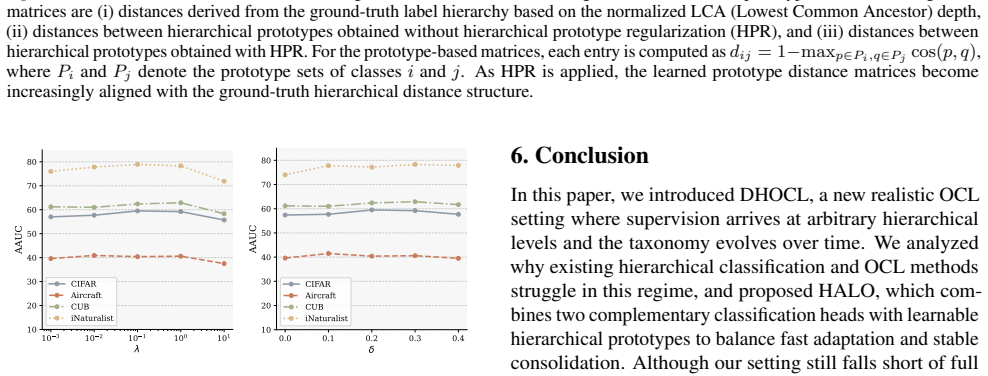
Dynamically evolving hierarchies can be captured and regularized through organized learnable prototypes without introducing new interference or needing per-evolution hyperparameter tuning.
What would settle it
If HALO shows no gain in hierarchical accuracy or higher forgetting rates than flat-label baselines on streams where label granularity shifts frequently and at irregular intervals, the central claim would be falsified.
Figures






read the original abstract
Online Continual Learning (OCL) aims to learn from endless non\text{-}stationary data streams, yet most existing methods assume a flat label space and overlook the hierarchical organization of real\text{-}world concepts that evolves both horizontally (sibling classes) and vertically (coarse or fine categories). To better reflect this context, we introduce a new problem setting, DHOCL (Online Continual Learning from Dynamic Hierarchies), where taxonomies evolve across granularities and each sample provides supervision at a single hierarchical level. In this setting, we find two fundamental issues: (i) partial supervision under mixed granularities provides only point-wise signals over an evolving path-wise hierarchy, which constrains plasticity and undermines cross-level semantic consistency, and (ii) the dynamically evolving hierarchies induce granularity-dependent interference, destabilizing popular replay and regularization mechanisms and thereby exacerbating catastrophic forgetting. To tackle these issues, we propose HALO (Hierarchical Adaptive Learning with Organized Prototypes), which adaptively combines complementary classification heads, regularized by organized learnable hierarchical prototypes, enabling rapid adaptation, hierarchical consistency, and structured knowledge consolidation as the taxonomy evolves. Extensive experiments on multiple benchmarks demonstrate that HALO consistently outperforms existing methods across hierarchical accuracy, mistake severity, and continual performance.
Editorial analysis
A structured set of objections, weighed in public.
Referee Report
Summary. The paper introduces the DHOCL setting for online continual learning under dynamically evolving label hierarchies, where each sample receives supervision at only one granularity level. It identifies two core issues—partial supervision constraining plasticity and cross-level consistency, plus granularity-dependent interference destabilizing replay and regularization—and proposes HALO, which adaptively combines complementary classification heads regularized by organized learnable hierarchical prototypes to support rapid adaptation, hierarchical consistency, and structured consolidation. Experiments on multiple benchmarks report consistent gains in hierarchical accuracy, mistake severity, and continual performance metrics.
Significance. If the results hold under controlled hierarchy evolution schedules, the work is significant for moving OCL beyond flat label spaces toward more realistic evolving taxonomies. The explicit tying of prototype organization to cross-level consistency losses and the use of adaptive heads provide a coherent mechanism for handling partial supervision without requiring oracle taxonomies or bounded evolution rates. This could serve as a useful baseline for future research on hierarchical continual learning.
minor comments (2)
- The abstract states consistent outperformance but omits details on experimental controls, error bars, and exact hyperparameter settings for hierarchy evolution; adding these in the main text or appendix would strengthen verifiability.
- Notation for the organized prototypes and cross-level consistency losses could be made more explicit (e.g., by defining the prototype organization matrix in a dedicated equation) to aid reproducibility.
Simulated Author's Rebuttal
We thank the referee for their encouraging summary and for recognizing the potential significance of introducing the DHOCL setting and the HALO method for handling dynamically evolving label hierarchies in online continual learning. We appreciate the assessment that the work provides a coherent mechanism for partial supervision and could serve as a baseline for future research.
Circularity Check
No significant circularity in derivation chain
full rationale
The paper introduces DHOCL as a new problem setting and proposes HALO via explicit architectural components (adaptive heads + organized prototypes) and loss terms for cross-level consistency. These are defined directly in the method without reducing any central claim to a fitted parameter renamed as prediction, a self-citation chain, or an imported uniqueness theorem. The derivation remains self-contained against external benchmarks and controlled hierarchy-evolution experiments; no load-bearing step collapses by construction to its inputs.
Axiom & Free-Parameter Ledger
axioms (1)
- domain assumption Non-stationary data streams with evolving taxonomies provide supervision at single hierarchical levels.
Lean theorems connected to this paper
-
IndisputableMonolith/Foundation/RealityFromDistinction.leanreality_from_one_distinction unclear?
unclearRelation between the paper passage and the cited Recognition theorem.
HALO employs learnable hierarchical prototypes... PredLA aggregates calibrated predictions per level... HPR maintains class-specific prototype banks
What do these tags mean?
- matches
- The paper's claim is directly supported by a theorem in the formal canon.
- supports
- The theorem supports part of the paper's argument, but the paper may add assumptions or extra steps.
- extends
- The paper goes beyond the formal theorem; the theorem is a base layer rather than the whole result.
- uses
- The paper appears to rely on the theorem as machinery.
- contradicts
- The paper's claim conflicts with a theorem or certificate in the canon.
- unclear
- Pith found a possible connection, but the passage is too broad, indirect, or ambiguous to say the theorem truly supports the claim.
Reference graph
Works this paper leans on
-
[1]
Achiam, J., Adler, S., Agarwal, S., Ahmad, L., Akkaya, I., Aleman, F. L., Almeida, D., Altenschmidt, J., Altman, S., Anadkat, S., et al. Gpt-4 technical report.arXiv preprint arXiv:2303.08774,
work page internal anchor Pith review Pith/arXiv arXiv
-
[2]
On Tiny Episodic Memories in Continual Learning
Chaudhry, A., Ranzato, M., Rohrbach, M., and Elhoseiny, M. Efficient lifelong learning with a-gem.ICLR, 2019a. Chaudhry, A., Rohrbach, M., Elhoseiny, M., Ajanthan, T., Dokania, P. K., Torr, P. H., and Ranzato, M. On tiny episodic memories in continual learning.arXiv preprint arXiv:1902.10486, 2019b. Chaudhry, A., Khan, N., Dokania, P., and Torr, P. Contin...
work page Pith review arXiv 1902
-
[3]
Chrysakis, A. and Moens, M.-F. Online continual learning from imbalanced data. InInternational Conference on Machine Learning, pp. 1952–1961. PMLR,
work page 1952
-
[4]
Lai, G., Zhou, D.-W., Yang, X., and Ye, H.-J. The lie of the average: How class incremental learning evaluation deceives you?arXiv preprint arXiv:2509.22580,
-
[5]
Fine-Grained Visual Classification of Aircraft
Maji, S., Rahtu, E., Kannala, J., Blaschko, M., and Vedaldi, A. Fine-grained visual classification of aircraft.arXiv preprint arXiv:1306.5151,
work page internal anchor Pith review Pith/arXiv arXiv
-
[6]
Rebuffi, S.-A., Kolesnikov, A., Sperl, G., and Lampert, C. H. icarl: Incremental classifier and representation learning. InProceedings of the IEEE conference on Computer Vision and Pattern Recognition, pp. 2001–2010,
work page 2001
-
[7]
Caltech-ucsd birds-200-2011.California Institute of Technology, pp
Wah, C., Branson, S., Welinder, P., Perona, P., and Belongie, S. Caltech-ucsd birds-200-2011.California Institute of Technology, pp. CNS–TR–2011–001,
work page 2011
-
[8]
Im- proving plasticity in online continual learning via col- laborative learning
Wang, M., Michel, N., Xiao, L., and Yamasaki, T. Im- proving plasticity in online continual learning via col- laborative learning. InProceedings of the IEEE/CVF Conference on Computer Vision and Pattern Recognition, pp. 23460–23469, 2024a. Wang, X., Geng, C., Wan, W., Li, S.-Y ., and Chen, S. For- getting, ignorance or myopia: Revisiting key challenges in...
work page 2025
-
[9]
arXiv preprint arXiv:2205.13218 (2022)
12 Online Continual Learning with Dynamic Label Hierarchies Zhou, D.-W., Wang, Q.-W., Ye, H.-J., and Zhan, D.-C. A model or 603 exemplars: Towards memory-efficient class- incremental learning.arXiv preprint arXiv:2205.13218,
-
[10]
Zhuang, H., Chen, Y ., Fang, D., He, R., Tong, K., Wei, H., Zeng, Z., and Chen, C. Gacl: Exemplar-free generalized analytic continual learning.Advances in Neural Informa- tion Processing Systems, 37:83024–83047, 2024a. Zhuang, H., Liu, Y ., He, R., Tong, K., Zeng, Z., Chen, C., Wang, Y ., and Chau, L.-P. F-oal: Forward-only on- line analytic learning with...
work page 2011
-
[11]
that encode hierarchical relationships through some specific label or feature embeddings (these embeddings can be typically perceived as class-mean vectors) derived from hierarchical distances or predefined semantics, then align visual features with these embeddings; (2)Loss-based methods that design hierarchical-aware loss functions, such as hierarchical...
work page 2020
-
[12]
or optimal transport-based losses(Yang et al., 2018; Yurochkin et al., 2019), to penalize misclassifications based on their semantic distances in the hierarchy; and (3)Architecture-based methods(Liang & Davis, 2023; Wu et al., 2016; Liang et al.,
work page 2018
-
[13]
that employ multi-level classification heads or dynamic network structures to handle different granularities(Wu et al., 2016; Liang et al., 2018; Chang et al., 2021; Lu et al., 2025). While these methods effectively exploit hierarchical label structures, they are primarily designed for static settings with fixed label hierarchies. Recent attempts to exten...
work page 2016
-
[14]
Training of linear heads.Training the linear heads is straightforward: during training we directly optimize both the linear heads and the feature extractor with the cross-entropy loss. Given a mini-batch of features and one-hot labels, 2 Online Continual Learning with Dynamic Label Hierarchies Φ =f(X)∈R d×b andY∈R C×b, we minimize the following cross-entr...
work page 2022
-
[15]
Algorithm 1Training procedure of HALO 1: Input:Data stream Dt; Updated label tree Tt; Current backbone ft; Prototype adapter fA; Prototype banks {P} ; Replay bufferM 2:Initialize prototypes for new classes; Cache pretrained backbone asf 0; 3:for(x, y)fromD t and(x m, ym)fromMdo 4:Complete the label of streamy, and label of memoryy m to˜y,˜ym along ancesto...
work page 2023
-
[16]
For this counter-intuitive finding, we give a more detailed analysis in the Sec D. C.2. Results on Imbalanced Hierarchy: ImageNet-H In this section, we report results on ImageNet-H, which has an imbalanced hierarchical structure. We construct two DHOCL streams by partitioning the fine-grained classes into 10 and 20 groups, respectively, following the proc...
work page 2018
discussion (0)
Sign in with ORCID, Apple, or X to comment. Anyone can read and Pith papers without signing in.