Recognition: 2 theorem links
· Lean TheoremIn-medium Y(1S,2S,3S) suppression in Pb-Pb collisions at sqrt(s_NN)=5.02 TeV
Pith reviewed 2026-05-13 05:50 UTC · model grok-4.3
The pith
A model of in-medium suppression reproduces the sequential suppression of Y(1S,2S,3S) states in 5.02 TeV Pb-Pb collisions when initial central temperature and formation times are fitted to CMS data.
A machine-rendered reading of the paper's core claim, the machinery that carries it, and where it could break.
Core claim
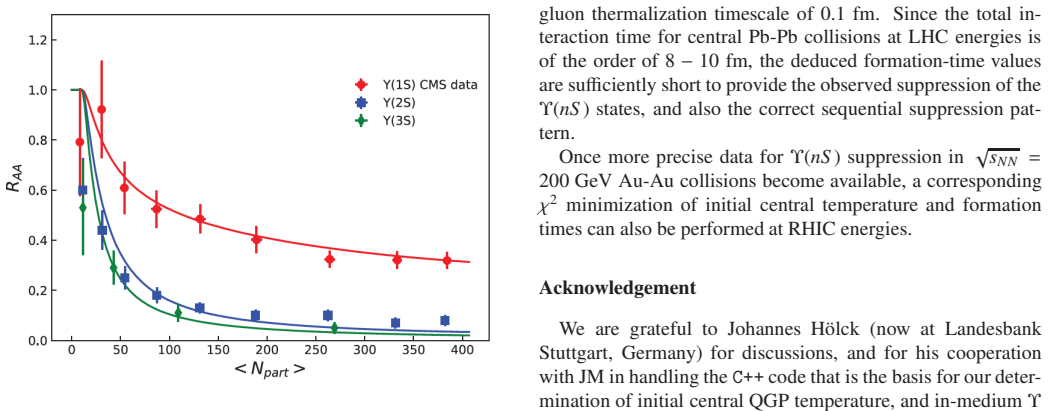
The sequential centrality- and transverse-momentum-dependent suppression of the observed Y(1S,2S,3S) states is reproduced by the model with initial central temperature and formation times determined in simultaneous chi^2 minimizations with respect to the CMS data.
What carries the argument
The in-medium suppression model whose parameters (initial central temperature and Y(nS) formation times) are fixed by simultaneous chi^2 fits to the full CMS data set for all three states.
If this is right
- The fitted initial temperature provides a direct constraint on the thermal conditions reached in the collisions.
- The extracted formation times indicate when each bottomonium state becomes sensitive to the medium.
- The same parameters allow predictions for suppression patterns in other collision systems or energies.
- The sequential ordering of suppression follows from the different binding properties of the three states.
Where Pith is reading between the lines
- The success of the fit implies that regeneration contributions remain small for these states at LHC energies.
- The framework could be tested by applying the same temperature and formation-time values to charmonium suppression data.
- Extension to hydrodynamic evolution models would link the extracted temperature to the space-time profile of the collision.
Load-bearing premise
The chosen in-medium suppression mechanism together with the two fitted parameters fully accounts for the observed patterns without significant missing contributions from other effects such as regeneration or feed-down.
What would settle it
Measurements of Y(1S,2S,3S) suppression in Pb-Pb collisions at a different beam energy or with finer centrality bins that lie outside the range predicted by the fitted model would falsify the claim.
Figures



read the original abstract
We present model calculations for the in-medium suppression of the Y(1S,2S,3S) states in sqrt(s_NN)=5.02 TeV Pb-Pb collisions at the Large Hadron Collider in comparison with recent CMS data for all three spin-triplet s-wave states. The model parameters initial central temperature, and formation times for the Y(nS) states are determined in simultaneous chi^2 minimizations with respect to the data, such that the sequential centrality- and transverse-momentum-dependent suppression of the observed states is reproduced.
Editorial analysis
A structured set of objections, weighed in public.
Referee Report
Summary. The manuscript presents model calculations for the in-medium suppression of the Y(1S,2S,3S) states in √s_NN=5.02 TeV Pb-Pb collisions, comparing to recent CMS data. The initial central temperature and formation times for the Y(nS) states are determined via simultaneous χ² minimizations such that the sequential centrality- and p_T-dependent suppression patterns are reproduced.
Significance. The work demonstrates a consistent phenomenological description of bottomonium suppression data using a minimal set of fitted parameters. If the underlying dissociation mechanism is robust and the formation times retain physical meaning after accounting for feed-down and regeneration, it could aid interpretation of QGP effects on quarkonia at LHC energies. However, the fitted nature of the parameters limits claims of explanatory power beyond data reproduction.
major comments (2)
- Abstract: the central claim states that the sequential suppression is reproduced by χ² minimization of the initial central temperature and formation times against the CMS data; this agreement is constructed by the fit rather than constituting an independent test of the in-medium mechanism.
- Model section (inferred from abstract description): the chosen suppression mechanism omits regeneration (which scales with bottom-quark density squared and is relevant at LHC energies) and explicit feed-down contributions; the fitted formation times may therefore act as effective parameters absorbing these missing effects rather than representing physical formation timescales.
minor comments (2)
- Abstract and results: report the explicit functional form of the in-medium dissociation rate and the full set of χ²/dof values for the simultaneous fits to allow assessment of fit quality.
- Figures: ensure all centrality and p_T bins used in the χ² minimizations are clearly labeled and that error bands from the fits are shown alongside the data points.
Simulated Author's Rebuttal
We thank the referee for the careful reading of our manuscript and the constructive comments. We address the major comments point by point below and are prepared to revise the text for improved clarity on the phenomenological nature of the work.
read point-by-point responses
-
Referee: Abstract: the central claim states that the sequential suppression is reproduced by χ² minimization of the initial central temperature and formation times against the CMS data; this agreement is constructed by the fit rather than constituting an independent test of the in-medium mechanism.
Authors: We agree that the reproduction of the sequential suppression patterns is achieved through the χ² minimization used to determine the initial central temperature and formation times. This is explicitly a phenomenological fit to the CMS data rather than an independent prediction. We will revise the abstract to state clearly that the parameters are obtained via fitting, thereby removing any implication of an a priori test of the mechanism. revision: yes
-
Referee: Model section (inferred from abstract description): the chosen suppression mechanism omits regeneration (which scales with bottom-quark density squared and is relevant at LHC energies) and explicit feed-down contributions; the fitted formation times may therefore act as effective parameters absorbing these missing effects rather than representing physical formation timescales.
Authors: The referee correctly identifies that regeneration and explicit feed-down are omitted from the model. The formation times are therefore effective parameters that can absorb contributions from these and other unmodeled effects. We will add a dedicated paragraph in the model description section acknowledging these limitations and clarifying the effective character of the fitted times. We do not intend to incorporate regeneration in the present work, as that would introduce additional parameters and require separate constraints. revision: partial
Circularity Check
Reproduction of suppression patterns achieved by fitting parameters to the same data
specific steps
-
fitted input called prediction
[Abstract]
"The model parameters initial central temperature, and formation times for the Y(nS) states are determined in simultaneous chi^2 minimizations with respect to the data, such that the sequential centrality- and transverse-momentum-dependent suppression of the observed states is reproduced."
The key parameters are explicitly fitted to the CMS data, and the reproduction of the centrality- and pT-dependent suppression patterns is stated as the direct outcome of this minimization. The agreement is therefore statistically forced by the fit rather than emerging as a prediction or derivation from the suppression mechanism alone.
full rationale
The paper's central claim is that the model reproduces the observed sequential suppression of Y(1S,2S,3S) states, but this is accomplished by determining the load-bearing parameters (initial central temperature and formation times) via simultaneous chi^2 minimization directly against the CMS data being modeled. This reduces the agreement to a fitted result by construction rather than an independent test of the underlying in-medium mechanism. The approach is transparent in the abstract, but qualifies as a fitted-input-called-prediction pattern per the analysis criteria. No self-citations, ansatzes, or other circular elements are identified in the provided text, and the suppression mechanism itself may retain independent physical content.
Axiom & Free-Parameter Ledger
free parameters (2)
- initial central temperature
- formation times for the Y(nS) states
axioms (2)
- domain assumption Suppression of Y states arises from in-medium dissociation in the quark-gluon plasma
- domain assumption The collision medium evolves according to a thermal or hydrodynamic description whose temperature profile is characterized by a single initial central value
Lean theorems connected to this paper
-
IndisputableMonolith/Cost/FunctionalEquation.leanwashburn_uniqueness_aczel contradictsThe model parameters initial central temperature, and formation times for the Υ(nS) states are determined in simultaneous χ² minimizations with respect to the data
-
IndisputableMonolith/Foundation/RealityFromDistinction.leanreality_from_one_distinction unclearhydrodynamic treatment of the background bulk evolution... relativistic, perfect fluid... initiation time τini = 0.1 fm
Reference graph
Works this paper leans on
-
[1]
A. Adare, et al. (PHENIX Collaboration), J/ψ production versus central- ity, transverse momentum, and rapidity in Au-Au collisions at √ sNN = 200 GeV, Phys. Rev. Lett. 98 (2007) 0232301
work page 2007
-
[2]
B. Abelev, et al. (ALICE Collaboration), J/ψ suppression at forward rapidity in Pb-Pb collisions at √sNN = 2. 76 TeV, Phys. Rev. Lett. 109 (2012) 072301
work page 2012
-
[3]
S. Acharya, et al. (ALICE Collaboration), Studies of J/ψ production at forward rapidity in Pb-Pb collisions at √sNN = 5. 02 TeV, JHEP 2020 (2020) 41
work page 2020
- [4]
-
[5]
S. Chatrchyan, et al. (CMS Collaboration), Observation of sequential Up- silon suppression in PbPb collisions, Phys. Rev. Lett. 109 ( 2012) 222301
work page 2012
-
[6]
V . Khachatryan, et al. (CMS Collaboration), Suppressio n of Υ(1S ), Υ(2S ), and Υ(3S ) quarkonium states in PbPb collisions at √s = 2. 76 TeV, Phys. Lett. B 770 (2017) 357
work page 2017
-
[7]
B. E. Aboona, et al. (STAR Collaboration), Measurement o f sequential Υsuppression in Au +Au collisions at √sNN = 200 GeV with the STAR experiment, Phys. Rev. Lett. 130 (2023) 112301
work page 2023
-
[8]
J. Adam, et al. (ALICE Collaboration), J/ψ suppression at forward ra- pidity in Pb-Pb collisions at √sNN = 5. 02 TeV, Phys. Lett. B 766 (2017) 212–224
work page 2017
-
[9]
S. Acharya, et al. (ALICE Collaboration), Prompt and non -prompt J/ψ production at midrapidity in Pb-Pb collisions at √sNN = 5. 02 GeV, JHEP 02 (2024) 066
work page 2024
-
[10]
A. M. Sirunyan, et al. (CMS Collaboration), Measuremen t of nuclear modification factors of Υ(1S ), Υ(2S ), and Υ(3S ) mesons in PbPb colli- sions at √sNN = 5. 02 TeV, Phys. Lett. B 790 (2019) 270–293
work page 2019
-
[11]
A. Tumasyan, et al. (CMS Collaboration), Observation o f the Υ(3S ) me- son and suppression of Υstates in Pb-Pb collisions at √sNN = 5. 02 TeV, Phys. Rev. Lett. 133 (2024) 022302
work page 2024
- [12]
-
[13]
Wolschin, Bottomonium spectroscopy in the quark-gl uon plasma, Int
G. Wolschin, Bottomonium spectroscopy in the quark-gl uon plasma, Int. J. Mod. Phys. A 35 (2020) 2030016
work page 2020
-
[14]
T. Song, C. M. Ko, S. H. Lee, Quarkonium formation time in relativistic heavy-ion collisions, Phys. Rev. C 91 (2015) 044909
work page 2015
-
[15]
G. Chen, B. Chen, J. Zhao, Bottomonium evolution with in -medium heavy quark potential from lattice QCD, Eur. Phys. J. C 84 (20 24) 869
-
[16]
S. Acharya, et al. (ALICE Collaboration), Υsuppression at forward ra- pidity in Pb-Pb collisions at √sNN = 5. 02 TeV, Phys. Lett. B 790 (2019) 89
work page 2019
-
[17]
F. Nendzig, G. Wolschin, Υsuppression in PbPb collisions at energies available at the CERN Large Hadron Collider, Phys. Rev. C 87 ( 2013) 024911. 6
work page 2013
-
[18]
J.-P . Blaizot, J. Liao, Y . Mehtar-Tani, The thermalization of soft modes in non-expanding isotropic quark gluon plasmas, Nucl. Phys. A 961 (2017) 37–67
work page 2017
-
[19]
W. Florkowski, E. Maksymiuk, R. Ryblewski, Coupled kin etic equations for fermions and bosons in the relaxation-time approximati on, Phys. Rev. C 97 (2018) 024915
work page 2018
-
[20]
Wolschin, Nonlinear di ffusion of gluons, Physica A 597 (2026) 127299
G. Wolschin, Nonlinear di ffusion of gluons, Physica A 597 (2026) 127299
work page 2026
-
[21]
J. R¨ ossler, G. Wolschin, Numerical solution of the non linear boson diffu- sion equation for gluons, Physica A 682 (2026) 131157
work page 2026
-
[22]
N. Brambilla, M. A. Escobedo, J. Ghiglieri, A. V airo, Th ermal width and gluo-dissociation of quarkonium in pNRQCD, JHEP 2011 (2011 ) 116
work page 2011
-
[23]
Strickland, Thermal Υ(1s) and χb1 suppression in √sNN = 2
M. Strickland, Thermal Υ(1s) and χb1 suppression in √sNN = 2. 76 TeV Pb-Pb collisions at the LHC, Phys. Rev. Lett. 107 (2011) 1323 01
work page 2011
-
[24]
T. Song, K. C. Han, C. M. Ko, Bottomonia suppression in he avy-ion collisions, Phys. Rev. C 85 (2012) 014902
work page 2012
-
[25]
Y . Liu, K. Zhou, P . Zhuang, Quarkonia in high energy nucl ear collisions, Int. J. Mod. Phys. E 24 (2015) 1530015
work page 2015
-
[26]
J.-P . Blaizot, D. D. Boni, P . Faccioli, G. Garberoglio, Heavy quark bound states in a quark-gluon plasma: Dissociation and recombina tion, Nucl. Phys. A 946 (2016) 49–88
work page 2016
-
[27]
X. Du, M. He, R. Rapp, Color screening and regeneration o f bottomonia in high-energy heavy-ion collisions, Phys. Rev. C 96 (2017) 054901
work page 2017
-
[28]
E. G. Ferreiro, J. P . Lansberg, Is bottomonium suppress ion in proton- nucleus and nucleus-nucleus collisions at LHC energies due to the same effects?, JHEP 2018 (2018) 094
work page 2018
-
[29]
J. Boyd, T. Cook, A. Islam, M. Strickland, Heavy quarkon ium suppres- sion beyond the adiabatic limit, Phys. Rev. D 100 (2019) 0760 19
work page 2019
-
[30]
Rothkopf, Heavy quarkonium in extreme conditions, P hys
A. Rothkopf, Heavy quarkonium in extreme conditions, P hys. Rep. 858 (2020) 1–117
work page 2020
-
[31]
N. Brambilla, M. A. Escobedo, A. Islam, M. Strickland, A . Tiwari, A. V airo, P . V . Griend, Regeneration of bottomonia in an open quantum system approach, Phys. Rev. D 946 (2023) L011502
work page 2023
-
[32]
F. Nendzig, G. Wolschin, Bottomium suppression in PbPb collisions at LHC energies, J. Phys. G: Nuclear and Particle Physics 41 (2014) 095003
work page 2014
-
[33]
V . H. Dinh, J. Hoelck, G. Wolschin, Hot-medium e ffects on Υyields in pPb collisions at √sNN = 8. 16 TeV, Phys. Rev. C 100 (2019) 024906
work page 2019
-
[34]
E. Braaten, R. Pisarski, Resummation and gauge invaria nce of the gluon damping rate in hot QCD, Phys. Rev. Lett. 64 (1990) 1338–1341
work page 1990
-
[35]
Rebhan, Non-abelian Debye mass at next-to-leading o rder, Phys
A. Rebhan, Non-abelian Debye mass at next-to-leading o rder, Phys. Rev. D 48 (1993) R3967–R3970
work page 1993
- [36]
- [37]
-
[38]
N. Brambilla, J. Ghiglieri, A. V airo, P . Petreczky, Sta tic quark-antiquark pairs at finite temperature, Phys. Rev. D 78 (2008) 014017
work page 2008
-
[39]
A. Beraudo, J. P . Blaizot, C. Ratti, Real and imaginary- time Q ¯Q correla- tors in a thermal medium, Nucl. Phys. A 806 (2008) 312–338
work page 2008
- [40]
-
[41]
Bethke, World Summary of αS (2012), Nucl
S. Bethke, World Summary of αS (2012), Nucl. Phys. B (Proc. Supp.) 234 (2013) 229–234
work page 2012
-
[42]
N. Brambilla, A. Pineda, J. Soto, A. V airo, E ffective-field theories for heavy quarkonium, Rev. Mod. Phys. 77 (2005) 1423
work page 2005
-
[43]
F. Brezinski, G. Wolschin, Gluodissociation and scree ning of Υstates in PbPb collisions at √sNN = 2. 76 TeV, Phys. Lett. B 707 (2012) 534–538
work page 2012
-
[44]
M. A. Escobedo, F. Giannuzzi, M. Mannarelli, J. Soto, He avy quarko- nium moving in a quark-gluon plasma, Phys. Rev. D 87 (2013) 11 4005
work page 2013
-
[45]
F. V accaro, F. Nendzig, G. Wolschin, The influence of the χb(3P) state on the decay cascade of bottomium in PbPb collisions at LHC en ergies, EPL 102 (2013) 42001
work page 2013
-
[46]
S. Navas, et al. (Particle Data Group), Review of Partic le Physics, Phys. Rev. D 110 (2024) 030001
work page 2024
-
[47]
F. Daghighian, D. Silverman, Relativistic formulatio n of the radiative transitions of charmonium and b-quarkonium, Phys. Rev. D 36 (1987) 3401–3416
work page 1987
-
[48]
J. D. Bjorken, Highly relativistic nucleus-nucleus co llisions: The central rapidity region, Phys. Rev. D 27 (1983) 140–151
work page 1983
-
[49]
G. Baym, B. L. Friman, J.-P . Blaizot, M. Soyeur, W. Czy˙ z, Hydrodynam- ics of ultra-relativistic heavy ion collisions, Nucl. Phys . A 407 (1983) 541–570
work page 1983
-
[50]
M. Gyulassy, T. Matsui, Quark-gluon-plasma evolution in scaling hydro- dynamics, Phys. Rev. D 29 (1984) 419–425
work page 1984
-
[51]
J. Adam, et al. (ALICE Collaboration), Centrality depe ndence of the pseudorapidity density distribution for charged particle s in Pb-Pb colli- sions at √sNN = 5. 02 TeV, Phys. Lett. B 772 (2017) 567–577
work page 2017
-
[52]
W. H. Press, S. A. Teukolsky, W. T. V etterling, B. P . Flannery, Numerical recipes in C: The art of scientific computing, Cambridge Univ ersity Press, 2nd edition (1993)
work page 1993
-
[53]
R. Aaij, et al. (LHCb Collaboration), Measurement of Υproduction in pp collisions at √s = 5 TeV, JHEP 07 (2023) 069
work page 2023
-
[54]
G. Aad, et al. (A TLAS Collaboration), Production of Υ(nS ) mesons in Pb+Pb and pp collisions at 5.02 TeV, Phys. Rev. C 107 (2023) 05491 2
work page 2023
-
[55]
K.-P . Lohs, G. Wolschin, J. H¨ ufner, Nuclear Auger e ffect in muonic atoms, Nucl. Phys. A 236 (1974) 457–468
work page 1974
-
[56]
D. Kharzeev, R. L. Thews, Quarkonium formation time in a model- independent approach, Phys. Rev. C 60 (1999) 041901. 7
work page 1999
discussion (0)
Sign in with ORCID, Apple, or X to comment. Anyone can read and Pith papers without signing in.