Recognition: 2 theorem links
· Lean TheoremRealization of Backward Retrieval in a Stark-modulated Spin-wave Quantum Memory
Pith reviewed 2026-05-13 05:52 UTC · model grok-4.3
The pith
Stark modulation enables first backward retrieval in spin-wave quantum memory with over 97% fidelity
A machine-rendered reading of the paper's core claim, the machinery that carries it, and where it could break.
Core claim
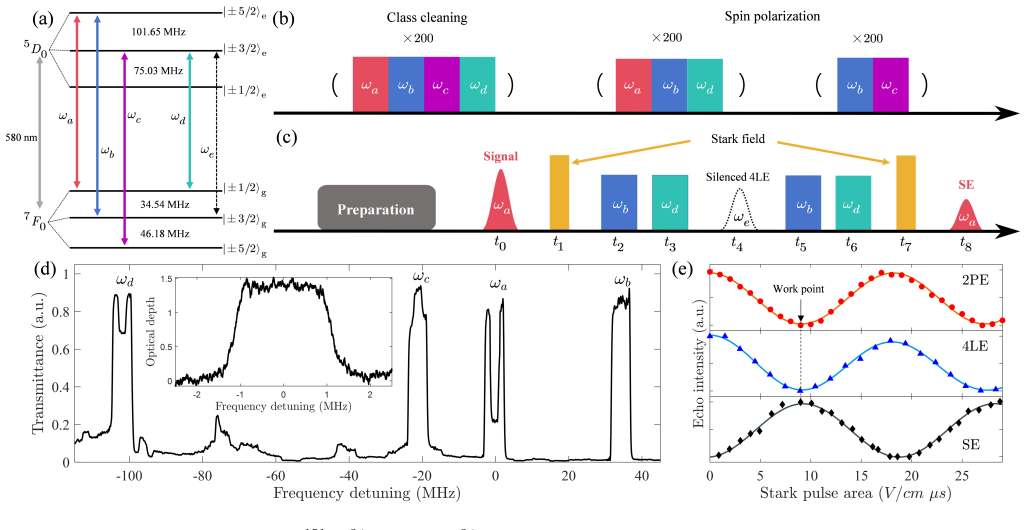
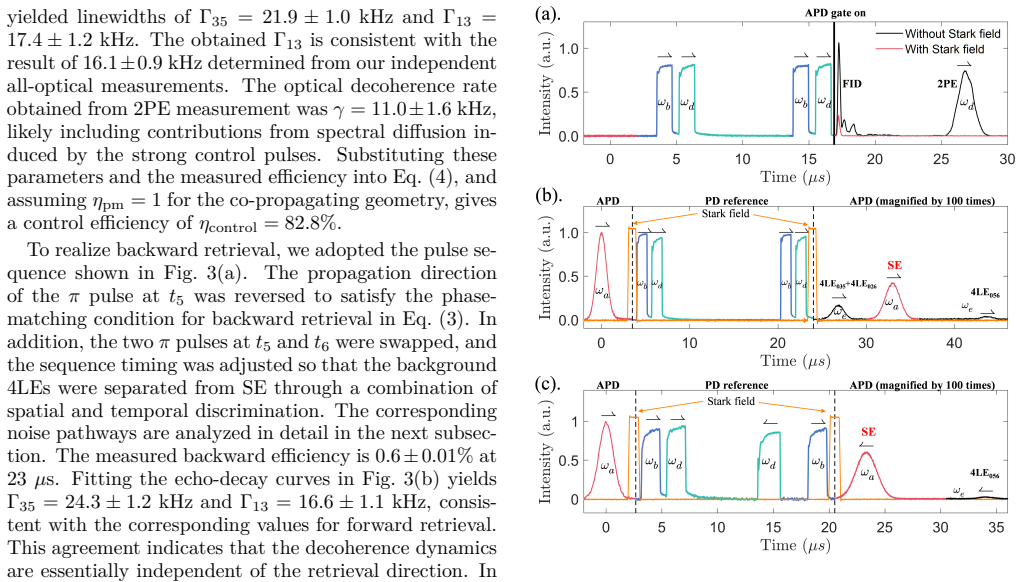
We report the first experimental realization of backward retrieval in a spin-wave quantum memory based on a Stark-echo-modulated protocol in Eu3+:Y2SiO5. By using Stark control, we preserve the full optical depth of the ensemble while suppressing coherent noise, enabling conditional storage fidelities above 97%. Our analysis shows that the present backward-retrieval efficiency is mainly limited by technical imperfections rather than by fundamental constraints. With realistic engineering improvements, backward retrieval in this protocol could move beyond the reabsorption-limited forward-emission regime. The protocol is also compatible with cavity-enhanced operation, offering an additional
What carries the argument
Stark-echo-modulated protocol, which applies electric-field control to a spin-wave memory to enable backward retrieval while preserving full optical depth and suppressing coherent noise.
If this is right
- Backward retrieval can exceed the efficiency limits imposed by reabsorption in forward emission.
- Realistic technical improvements can raise performance without changing the core protocol.
- Cavity enhancement supplies an independent route to still higher efficiencies.
- The approach supports long-lived solid-state quantum memories suitable for practical use.
- Conditional fidelities above 97% become available for quantum information tasks.
Where Pith is reading between the lines
- The technique may simplify quantum repeater designs by reducing reliance on complex cavities at the outset.
- It could extend to other rare-earth-doped crystals to combine high efficiency with longer coherence times.
- Noise-suppression ideas from this modulation method might apply to related quantum-optics storage schemes.
Load-bearing premise
The claim that backward-retrieval efficiency is limited mainly by technical imperfections rather than by some unavoidable physical constraint in the protocol itself.
What would settle it
An experiment that reduces all identified technical noise sources and imperfections yet finds no further improvement in backward-retrieval efficiency beyond the present value would indicate a fundamental limit instead.
Figures



read the original abstract
We report the first experimental realization of backward retrieval in a spin-wave quantum memory based on a Stark-echo-modulated protocol in Eu3+:Y2SiO5. By using Stark control, we preserve the full optical depth of the ensemble while suppressing coherent noise, enabling conditional storage fidelities above 97%. Our analysis shows that the present backward-retrieval efficiency is mainly limited by technical imperfections rather than by fundamental constraints. With realistic engineering improvements, backward retrieval in this protocol could move beyond the reabsorption-limited forward-emission regime. The protocol is also compatible with cavity-enhanced operation, offering an additional route toward higher efficiencies. These findings establish Stark-echo modulation as a practical and scalable route to high-efficiency, long-lived solid-state quantum memories.
Editorial analysis
A structured set of objections, weighed in public.
Referee Report
Summary. The manuscript reports the first experimental realization of backward retrieval in a Stark-echo-modulated spin-wave quantum memory in Eu3+:Y2SiO5. It achieves conditional storage fidelities above 97% while preserving full optical depth and suppressing coherent noise, and claims that current backward-retrieval efficiency is limited primarily by technical imperfections rather than fundamental reabsorption or dephasing constraints, with potential for further gains via engineering and cavity enhancement.
Significance. If the central claims hold, this establishes Stark-echo modulation as a viable route to high-fidelity backward retrieval in solid-state systems, offering a path beyond the reabsorption-limited performance of forward emission and compatibility with cavity enhancement for scalable quantum memories. The experimental demonstration of >97% fidelity in a rare-earth ensemble adds concrete evidence for practical long-lived quantum storage.
major comments (2)
- [Abstract] Abstract: The assertion that 'present backward-retrieval efficiency is mainly limited by technical imperfections rather than by fundamental constraints' and that improvements 'could move beyond the reabsorption-limited forward-emission regime' lacks an explicit quantitative comparison to the theoretical maximum efficiency set by the measured optical depth in the backward geometry and the Stark-modulation parameters. A direct calculation (e.g., using the protocol's expected efficiency formula and the ensemble OD) is required to substantiate the gap to the fundamental limit and the claim that engineering changes will suffice.
- [Abstract] Abstract and methods: The reported conditional storage fidelities above 97% are presented without error bars, raw data, detailed exclusion criteria, or statistical analysis. This omission makes it impossible to assess the robustness of the central fidelity claim and the attribution of efficiency limits to technical factors alone.
Simulated Author's Rebuttal
We thank the referee for their careful reading of the manuscript and for the constructive comments. We address each major point below and have revised the manuscript to incorporate the requested clarifications and additions.
read point-by-point responses
-
Referee: [Abstract] Abstract: The assertion that 'present backward-retrieval efficiency is mainly limited by technical imperfections rather than by fundamental constraints' and that improvements 'could move beyond the reabsorption-limited forward-emission regime' lacks an explicit quantitative comparison to the theoretical maximum efficiency set by the measured optical depth in the backward geometry and the Stark-modulation parameters. A direct calculation (e.g., using the protocol's expected efficiency formula and the ensemble OD) is required to substantiate the gap to the fundamental limit and the claim that engineering changes will suffice.
Authors: We agree that an explicit quantitative comparison strengthens the claim. In the revised manuscript we have added a direct calculation of the theoretical maximum retrieval efficiency for the backward Stark-echo-modulated protocol, using the measured optical depth of the ensemble together with the applied Stark-modulation parameters and the known reabsorption and dephasing terms. The calculation shows that the experimentally observed efficiency lies well below this limit, confirming that technical factors (pulse imperfections, residual laser noise, and detection losses) dominate. We also include a brief discussion of how realistic engineering improvements and cavity enhancement can close the remaining gap and surpass the forward-emission reabsorption limit. revision: yes
-
Referee: [Abstract] Abstract and methods: The reported conditional storage fidelities above 97% are presented without error bars, raw data, detailed exclusion criteria, or statistical analysis. This omission makes it impossible to assess the robustness of the central fidelity claim and the attribution of efficiency limits to technical factors alone.
Authors: We acknowledge the omission. The revised manuscript now reports the conditional fidelity with standard-error bars obtained from repeated measurements, specifies the total number of experimental runs, and describes the exclusion criteria (primarily laser-frequency drift and detector saturation events). A short statistical-methods subsection has been added, and the raw coincidence data have been deposited in a public repository with a DOI link included in the paper. revision: yes
Circularity Check
No circularity: experimental results with independent measurements
full rationale
The paper reports an experimental realization of backward retrieval in a Stark-modulated spin-wave memory, with claims resting on measured conditional fidelities (>97%) and efficiency data in Eu3+:Y2SiO5. No derivation chain, first-principles prediction, or fitted parameter is presented that reduces to its own inputs by construction; the analysis of technical vs. fundamental limits is an interpretation of direct measurements rather than a self-referential equation or self-citation load-bearing step. The work is self-contained as an empirical demonstration without the enumerated circular patterns.
Axiom & Free-Parameter Ledger
axioms (1)
- standard math Standard quantum optics treatment of spin-wave storage and Stark shifts in rare-earth ions
Lean theorems connected to this paper
-
IndisputableMonolith/Cost/FunctionalEquation.leanwashburn_uniqueness_aczel unclearηretrieval = d²e^{-d} for forward retrieval and ηretrieval = (1 - e^{-d})² for backward retrieval, with d = αL the optical depth
Reference graph
Works this paper leans on
-
[1]
H. J. Kimble, The quantum internet, Nature 453, 1023 (2008)
work page 2008
-
[2]
K. Hammerer, A. S. Sørensen, and E. S. Polzik, Quantum interface between light and atomic ensembles, Reviews of Modern Physics 82, 1041 (2010)
work page 2010
- [3]
-
[4]
X. Lei, J. Li, X. Zhou, J. Yan, M. Ji, Z. Yan, X. Jia, C. Xie, and K. Peng, Deterministic nonlocal quantum gate with room-temperature memory modules, Physical Review Letters 135, 130806 (2025)
work page 2025
-
[5]
K. Heshami, D. G. England, P. C. Humphreys, P. J. Bustard, V. M. Acosta, J. Nunn, and B. J. Sussman, Quantum memories: emerging applications and recent advances, Journal of modern optics 63, 2005 (2016)
work page 2005
-
[6]
C. Simon, M. Afzelius, J. Appel, A. Boyer De La Giro- day, S. Dewhurst, N. Gisin, C. Hu, F. Jelezko, S. Kröll, J. Müller, et al. , Quantum memories: a review based on the european integrated project “qubit applications (qap)”, The European Physical Journal D 58, 1 (2010)
work page 2010
-
[7]
H.-J. Briegel, W. Dür, J. I. Cirac, and P. Zoller, Quantum repeaters: the role of imperfect local operations in quan- tum communication, Phys. Rev. Lett. 81, 5932 (1998)
work page 1998
-
[8]
L.-M. Duan, M. D. Lukin, J. I. Cirac, and P. Zoller, Long- distance quantum communication with atomic ensembles and linear optics, Nature 414, 413 (2001)
work page 2001
-
[9]
J. V. Rakonjac, D. Lago-Rivera, A. Seri, M. Mazzera, S. Grandi, and H. de Riedmatten, Entanglement between a telecom photon and an on-demand multimode solid- state quantum memory, Phys. Rev. Lett. 127 (2021)
work page 2021
-
[10]
S. Moiseev, V. Tarasov, and B. Ham, Quantum memory photon echo-like techniques in solids, Journal of Optics B: Quantum and Semiclassical Optics 5, S497 (2003)
work page 2003
-
[11]
M. Nilsson and S. Kröll, Solid state quantum memory using complete absorption and re-emission of photons by tailored and externally controlled inhomogeneous absorp- tion profiles, Optics communications 247, 393 (2005)
work page 2005
- [12]
- [13]
-
[14]
F. Wang, M. Ren, W. Sun, M. Guo, M. J. Sellars, R. L. Ahlefeldt, J. G. Bartholomew, J. Yao, S. Liu, and M. Zhong, Nuclear spins in a solid exceeding 10-hour co- herence times for ultra-long-term quantum storage, PRX Quantum 6, 010302 (2025)
work page 2025
-
[15]
G. S. Lago-Rivera D, Rakonjac J V and de Riedmatten H, Long distance multiplexed quantum teleportation from a telecom photon to a solid-state qubit, Nat. Commun. 14, 2041 (2023)
work page 2041
-
[16]
J.-S. Tang, Z.-Q. Zhou, Y.-T. Wang, Y.-L. Li, X. Liu, Y.-L. Hua, Y. Zou, S. Wang, D.-Y. He, G. Chen, et al. , Storage of multiple single-photon pulses emitted from a quantum dot in a solid-state quantum memory, Nature communications 6, 8652 (2015)
work page 2015
-
[17]
J. V. Rakonjac, G. Corrielli, D. Lago-Rivera, A. Seri, M. Mazzera, S. Grandi, R. Osellame, and H. de Riedmat- ten, Storage and analysis of light-matter entanglement in a fiber-integrated system, Science Advances 8, eabn3919 (2022)
work page 2022
- [18]
-
[19]
S. Moiseev and S. Kröll, Complete reconstruction of the quantum state of a single-photon wave packet absorbed by a doppler-broadened transition, Phys. Rev. Lett. 87, 173601 (2001)
work page 2001
-
[20]
S. Moiseev and M. Noskov, The possibilities of the quan- tum memory realization for short pulses of light in the photon echo technique, Laser Physics Letters 1, 303 (2004)
work page 2004
- [21]
- [22]
-
[23]
N. Timoney, B. Lauritzen, I. Usmani, M. Afzelius, and N. Gisin, Atomic frequency comb memory with spin wave storage in 153Eu3+ : Y 2SiO5, Journal of Physics B Atomic Molecular Physics 45, 124001 (2012)
work page 2012
-
[24]
M. Gündoğan, P. M. Ledingham, K. Kutluer, M. Mazzera, and H. De Riedmatten, Solid state spin- wave quantum memory for time-bin qubits, Phys. Rev. Lett. 114, 230501 (2015)
work page 2015
-
[25]
M. K. Alqedra, S. P. Horvath, A. Kinos, A. Walther, S. Kröll, and L. Rippe, Stark control of solid-state quan- tum memory with spin-wave storage, Physical Review A 109, 012607 (2024)
work page 2024
-
[26]
N. Sangouard, C. Simon, M. Afzelius, and N. Gisin, Anal- ysis of a quantum memory for photons based on con- trolled reversible inhomogeneous broadening, Phys. Rev. A—Atomic, Molecular, and Optical Physics 75, 032327 (2007)
work page 2007
-
[27]
M. Afzelius, C. Simon, H. De Riedmatten, and N. Gisin, Multimode quantum memory based on atomic frequency combs, Phys. Rev. A—Atomic, Molecular, and Optical Physics 79, 052329 (2009)
work page 2009
- [28]
- [29]
- [30]
-
[31]
Y.-Z. Ma, M. Jin, D.-L. Chen, Z.-Q. Zhou, C.-F. Li, and G.-C. Guo, Elimination of noise in optically rephased photon echoes, Nat. Commun. 12, 4378 (2021)
work page 2021
-
[32]
M. Guo, Q. Li, Z. Xu, S. Liu, F. Wang, and M. Zhong, Decoherence characterization and quantum memory de- sign in 167Er3+ : Y 2SiO5, Frontiers of Physics 21, 033201 (2026)
work page 2026
-
[33]
S. E. Beavan, P. M. Ledingham, J. J. Longdell, and M. J. Sellars, Photon echo without a free induction decay in a double-λ system, Optics letters 36, 1272 (2011)
work page 2011
-
[34]
A. Arcangeli, A. Ferrier, and P. Goldner, Stark echo mod- ulation for quantum memories, Physical Review A 93, 062303 (2016)
work page 2016
-
[35]
R. M. Macfarlane, A. Arcangeli, A. Ferrier, and P. Gold- ner, Optical measurement of the effect of electric fields on the nuclear spin coherence of rare-earth ions in solids, Phys. Rev. Lett. 113, 157603 (2014)
work page 2014
-
[36]
T.-X. Zhu, C. Liu, L. Zheng, Z.-Q. Zhou, C.-F. Li, and G.-C. Guo, Coherent optical memory based on a laser- written on-chip waveguide, Physical Review Applied 14 (2020)
work page 2020
-
[37]
A. Kaplyanskii, Linear Stark effect in spectroscopy and luminescence of doped inorganic insulating crystals, Journal of Luminescence 100, 21 (2002)
work page 2002
-
[38]
R. M. Macfarlane, Optical stark spectroscopy of solids, Journal of luminescence 125, 156 (2007)
work page 2007
-
[39]
Mahan, Local-field corrections to coulomb interac- tions, Physical Review 153, 983 (1967)
G. Mahan, Local-field corrections to coulomb interac- tions, Physical Review 153, 983 (1967)
work page 1967
-
[40]
S. A. Moiseev and J. L. Le Gouët, Rephasing processes and quantum memory for light: reversibility issues and how to fix them, Journal of Physics B: Atomic, Molecular and Optical Physics 45, 124003 (2012)
work page 2012
-
[41]
N. M. Arslanov and S. A. Moiseev, Optimal periodic fre- quency combs for high-efficiency optical quantum mem- ory based on rare-earth ion crystals, Quantum Electron- ics 47, 783 (2017)
work page 2017
-
[42]
S. Moiseev, K. Gerasimov, M. Minnegaliev, and E. Moi- seev, Optical quantum memory on macroscopic coher- ence, Physical Review Letters 134, 070803 (2025)
work page 2025
-
[43]
See supplemental materials about details of experimental setup, noise modeling and protocal validation
-
[44]
B. Lauritzen, N. Timoney, N. Gisin, M. Afzelius, H. de Riedmatten, Y. Sun, R. Macfarlane, and R. Cone, Spectroscopic investigations of Eu3+ : Y 2SiO5 for quantum memory applications, Physical Review B— Condensed Matter and Materials Physics 85, 115111 (2012)
work page 2012
- [45]
-
[46]
S. E. Beavan, M. P. Hedges, and M. J. Sellars, Demon- stration of photon-echo rephasing of spontaneous emis- sion, Physical Review Letters 109, 093603 (2012)
work page 2012
-
[47]
M. Afzelius and C. Simon, Impedance-matched cavity quantum memory, Phys. Rev. A—Atomic, Molecular, and Optical Physics 82, 022310 (2010)
work page 2010
- [48]
-
[49]
I. Roos and K. Mølmer, Quantum computing with an in- homogeneously broadened ensemble of ions: Suppression of errors from detuning variations by specially adapted pulses and coherent population trapping, Phys. Rev. A 69, 022321 (2004)
work page 2004
-
[50]
M. Tian, T. Chang, K. D. Merkel, and W. R. Babbitt, Reconfiguration of spectral absorption features using a frequency-chirped laser pulse, Applied Optics 50, 6548 (2011)
work page 2011
-
[51]
R. L. Ahlefeldt, M. R. Hush, and M. J. Sellars, Ultranar- row optical inhomogeneous linewidth in a stoichiometric rare-earth crystal, Phys. Rev. Lett. 117, 250504 (2016)
work page 2016
-
[52]
E. Vasilenko, V. U. Chorakkunnath, J. Resch, N. Jobbitt, D. Serrano, P. Goldner, S. K. Kuppusamy, M. Ruben, and D. Hunger, Optically detected nuclear magnetic res- onance of coherent spins in a molecular complex, arXiv preprint arXiv:2509.01467 (2025)
-
[53]
M. Sabooni, Q. Li, S. Kröll, and L. Rippe, Efficient quan- tum memory using a weakly absorbing sample, Physical review letters 110, 133604 (2013)
work page 2013
-
[54]
S. A. Moiseev, S. N. Andrianov, and F. F. Gubaidullin, Efficient multimode quantum memory based on pho- ton echo in an optimal qed cavity, Physical Review A—Atomic, Molecular, and Optical Physics 82, 022311 (2010)
work page 2010
-
[55]
E. Moiseev, A. Tashchilina, S. Moiseev, and B. C. Sanders, Broadband quantum memory in a cavity via zero spectral dispersion, New Journal of Physics 23, 063071 (2021)
work page 2021
discussion (0)
Sign in with ORCID, Apple, or X to comment. Anyone can read and Pith papers without signing in.