Recognition: 2 theorem links
· Lean TheoremKinematic Closure of Drop Impact
Pith reviewed 2026-05-13 05:06 UTC · model grok-4.3
The pith
Deriving spreading time and velocity from energy balance yields a unified scaling law for maximum spreading of wetting drops.
A machine-rendered reading of the paper's core claim, the machinery that carries it, and where it could break.
Core claim
The maximum spreading ratio of wetting drops is obtained by multiplying the total spreading time and the characteristic spreading velocity, both derived directly from the energy balance with explicit capillary and viscous contributions, which produces a closed, unified scaling law valid across the inertio-capillary and inertio-viscous regimes that collapses data without adjustable prefactors.
What carries the argument
The kinematic closure formed by taking the product of spreading time and spreading velocity extracted from a single energy balance equation.
If this is right
- The maximum spreading diameter can be predicted with one expression for both low and high viscosity impacts.
- Experimental data over broad Weber and Ohnesorge numbers collapse onto this law without regime-specific adjustments.
- Predictions remain consistent for varying droplet sizes and surface wettabilities.
- The approach eliminates the need for asymptotic matching between different impact regimes.
Where Pith is reading between the lines
- Similar energy-based derivations could provide closed forms for other dynamic processes in fluid mechanics, such as bubble or jet impacts.
- Numerical simulations of drop impacts could use this law as a benchmark for validation across parameter space.
- The method suggests that self-consistent kinematic relations might resolve other scaling problems in drop dynamics where regime transitions occur.
Load-bearing premise
The energy balance supplies explicit and self-consistent expressions for spreading time and velocity that hold uniformly without requiring different limiting cases for different flow regimes.
What would settle it
Measurements of maximum spreading diameter for drops at intermediate values of the Ohnesorge number that fail to follow the predicted unified scaling.
Figures

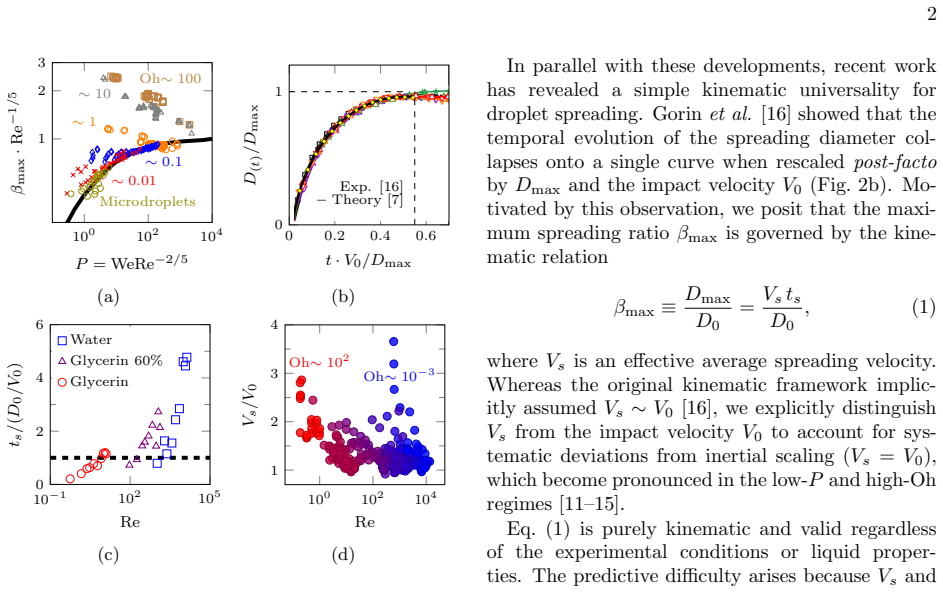


read the original abstract
Existing models for droplet impact prescribe the spreading contact time and effective spreading velocity from asymptotic arguments, which prevents a self-consistent prediction of the maximum spreading ratio across regimes. Here, the total spreading time and characteristic spreading velocity are derived directly from the energy balance, with explicit capillary and viscous contributions. Multiplying this time and velocity to obtain the maximum spreading diameter yields a closed, unified scaling law for the maximum spreading ratio of wetting drops across inertio-capillary and inertio-viscous regimes. The resulting expression quantitatively collapses the present measurements and literature data over wide ranges of Weber and Ohnesorge numbers, droplet sizes, and surface wettabilities without prefactors that need to be adjusted to a certain regime.
Editorial analysis
A structured set of objections, weighed in public.
Referee Report
Summary. The paper claims that existing models rely on asymptotic arguments for spreading contact time and effective velocity, preventing self-consistent predictions across regimes. It derives the total spreading time and characteristic spreading velocity directly from the energy balance with explicit capillary and viscous contributions, then multiplies them to obtain a closed-form expression for the maximum spreading diameter. This yields a unified scaling law for the maximum spreading ratio of wetting drops that is asserted to quantitatively collapse both new measurements and literature data over wide ranges of Weber and Ohnesorge numbers, droplet sizes, and surface wettabilities, without regime-specific prefactors.
Significance. If the separation of time and velocity from the single energy-balance constraint is shown to be self-consistent and free of hidden asymptotic or post-hoc choices, the result would provide a useful parameter-free unification of inertio-capillary and inertio-viscous spreading. The reported data collapse across broad parameter space is a potential strength, as is the explicit inclusion of both capillary and viscous terms in the derivation.
major comments (2)
- [Energy-balance derivation] The energy balance supplies a single integral relation between initial kinetic energy and the sum of capillary work plus viscous dissipation evaluated at maximum spread. This constrains only a combination of t_spread and V_char (or their product). The manuscript must explicitly state the auxiliary kinematic or power-balance closure used to disentangle independent expressions for t_spread and V_char (see the paragraph immediately following the energy-balance equation). It must also demonstrate that this closure remains regime-independent and does not implicitly contain the final diameter or regime-specific functional forms; otherwise the unified claim is at risk of circularity.
- [Results and data collapse] The abstract asserts quantitative collapse without adjustable prefactors, yet no error analysis, data-selection criteria, or sensitivity to the precise definition of V_char is provided. Please add a dedicated subsection (or appendix) showing the fitting residuals, the range of We and Oh covered, and a direct comparison against the leading asymptotic models to confirm that the improvement is not due to additional degrees of freedom in the auxiliary closure.
minor comments (2)
- [Notation] Define the characteristic velocity V_char more explicitly in terms of the instantaneous velocity field or an integral average; the current notation leaves open whether it is evaluated at a particular instant or averaged over the spreading phase.
- [Introduction] The introduction should include a brief comparison table or paragraph contrasting the new expressions with the most common asymptotic limits (e.g., the inertio-capillary t ~ sqrt(rho R^3 / sigma) and inertio-viscous t ~ rho R^2 / mu) to highlight where the unified form differs.
Simulated Author's Rebuttal
We thank the referee for the careful reading and constructive comments on our manuscript. We address each major comment below and indicate the revisions we will make.
read point-by-point responses
-
Referee: [Energy-balance derivation] The energy balance supplies a single integral relation between initial kinetic energy and the sum of capillary work plus viscous dissipation evaluated at maximum spread. This constrains only a combination of t_spread and V_char (or their product). The manuscript must explicitly state the auxiliary kinematic or power-balance closure used to disentangle independent expressions for t_spread and V_char (see the paragraph immediately following the energy-balance equation). It must also demonstrate that this closure remains regime-independent and does not implicitly contain the final diameter or regime-specific functional forms; otherwise the unified claim is at risk of circularity.
Authors: We agree that the single energy-balance relation constrains a combination of spreading time and characteristic velocity, and that an auxiliary closure is required to obtain independent expressions. The manuscript derives these expressions directly from the energy balance by incorporating explicit capillary and viscous terms and applying a kinematic relation based on the instantaneous power balance during spreading (detailed in the paragraph following the energy-balance equation). This closure is obtained from the drop geometry and the definition of characteristic scales without invoking asymptotic regime limits or presupposing the final diameter. To address the concern, we will revise the manuscript to state the auxiliary closure explicitly and demonstrate its regime independence by showing that the same functional form applies across the full range of We and Oh without adjustment or hidden dependence on the maximum diameter. revision: yes
-
Referee: [Results and data collapse] The abstract asserts quantitative collapse without adjustable prefactors, yet no error analysis, data-selection criteria, or sensitivity to the precise definition of V_char is provided. Please add a dedicated subsection (or appendix) showing the fitting residuals, the range of We and Oh covered, and a direct comparison against the leading asymptotic models to confirm that the improvement is not due to additional degrees of freedom in the auxiliary closure.
Authors: We agree that quantitative support for the claimed data collapse would strengthen the presentation. We will add a dedicated subsection (or appendix) that reports: the ranges of We and Oh covered by our experiments and the compiled literature data; explicit data-selection criteria; fitting residuals and error metrics for the unified scaling; sensitivity of the collapse to the precise definition of V_char; and direct side-by-side comparisons with the leading asymptotic models. These additions will confirm that the improvement arises from the closed-form energy-balance derivation rather than extra degrees of freedom. revision: yes
Circularity Check
Derivation self-contained from energy balance without reduction to inputs
full rationale
The paper derives total spreading time and characteristic spreading velocity directly from the energy balance with explicit capillary and viscous contributions, then multiplies them to obtain maximum spreading diameter as a unified scaling law. This is presented as avoiding asymptotic regime-specific arguments used in prior models, with the resulting expression collapsing data across Weber and Ohnesorge ranges without adjustable prefactors. No self-definitional, fitted-input, or self-citation load-bearing steps are identifiable; the energy balance acts as an independent physical input rather than a tautological re-expression of the target diameter. The central claim remains non-circular on inspection of the stated chain.
Axiom & Free-Parameter Ledger
axioms (1)
- domain assumption Energy balance governs droplet spreading dynamics with explicit capillary and viscous terms
Lean theorems connected to this paper
-
IndisputableMonolith/Cost/FunctionalEquation.leanwashburn_uniqueness_aczel unclearthe total spreading time and characteristic spreading velocity are derived directly from the energy balance, with explicit capillary and viscous contributions... E ≈ V²T² + Λ V⁶ T⁵... T≈ √E/V [1 + (Λ V E^{3/2})^{1/5}]^{-1}
-
IndisputableMonolith/Foundation/RealityFromDistinction.leanreality_from_one_distinction unclearunified scaling law for the maximum spreading ratio... without prefactors that need to be adjusted to a certain regime
Reference graph
Works this paper leans on
-
[1]
C. Josserand and S. T. Thoroddsen, Annual review of fluid mechanics48, 365 (2016)
work page 2016
-
[2]
A. L. Yarin, Annu. Rev. Fluid Mech.38, 159 (2006)
work page 2006
-
[3]
A. M. Worthington,The splash of a drop(Society for Promoting Christian Knowledge, 1895)
- [4]
- [5]
-
[6]
I. V. Roisman, Physics of Fluids21(2009)
work page 2009
-
[7]
J. M. Gordillo, G. Riboux, and E. S. Quintero, Jour- nal of Fluid Mechanics866, 298 (2019)
work page 2019
-
[8]
N. Laan, K. G. De Bruin, D. Bartolo, C. Josserand, and D. Bonn, Physical Review Applied2, 044018 (2014)
work page 2014
-
[9]
J. B. Lee, N. Laan, K. G. de Bruin, G. Skantzaris, N. Shahidzadeh, D. Derome, J. Carmeliet, and D. Bonn, Journal of Fluid Mechanics786, R4 (2016)
work page 2016
-
[10]
T. C. de Goede, K. G. de Bruin, N. Shahidzadeh, and D. Bonn, Physical review fluids4, 053602 (2019)
work page 2019
- [11]
-
[12]
Jørgensen, Physical Review Fluids9, 083601 (2024)
L. Jørgensen, Physical Review Fluids9, 083601 (2024)
work page 2024
-
[13]
L. Liu, G. Cai, W. Wang, B. He, and P. A. Tsai, Journal of Fluid Mechanics1018, A42 (2025)
work page 2025
- [14]
-
[15]
Y. T. Aksoy, P. Eneren, E. Koos, and M. R. Vetrano, Physics of Fluids34(2022)
work page 2022
- [16]
-
[17]
J. McLauchlan, J. S. Walker, V. Sanjay, M. Jalaal, J. P. Reid, A. M. Squires, and A. Souslov, Pro- ceedings of the National Academy of Sciences122, e2507309122 (2025)
work page 2025
-
[18]
J. Du, X. Wang, Y. Li, Q. Min, and X. Wu, Lang- muir37, 7582 (2021)
work page 2021
-
[19]
L. Liu, B. He, W. Wang, G. Cai, and P. A. Tsai, Physical Review Fluids8, 073602 (2023)
work page 2023
-
[20]
Cheng, Industrial & Engineering Chemistry Pro- cess Design and Development16, 192 (1977)
L. Cheng, Industrial & Engineering Chemistry Pro- cess Design and Development16, 192 (1977)
work page 1977
-
[21]
M. Pasandideh-Fard, Y. Qiao, S. Chandra, and J. Mostaghimi, Physics of fluids8, 650 (1996)
work page 1996
- [22]
-
[23]
T. Naoe, M. Futakawa, R. G. Kenny, and M. Ot- suki, Journal of Fluid Science and Technology9, JFST0002 (2014)
work page 2014
-
[24]
M. H. Iqbal, M. A. Quetzeri-Santiago, A. A. Cas- trej´ on-Pita, and J. R. Castrej´ on-Pita, Journal of Colloid and Interface Science , 139385 (2025)
work page 2025
- [25]
-
[26]
E. Jambon-Puillet, T. J. Jones, and P.-T. Brun, Na- ture Physics16, 585 (2020)
work page 2020
-
[27]
W¨ orner, International Journal of Multiphase Flow167, 104528 (2023)
M. W¨ orner, International Journal of Multiphase Flow167, 104528 (2023)
work page 2023
-
[28]
I. Roisman, J. Breitenbach, and C. Tropea, Journal of Fluid Mechanics842, 87 (2018)
work page 2018
-
[29]
K. Isukwem, C.-A. Charles, T. Phou, L. Ramos, C. Ligoure, E. Hachem, and A. Pereira, Journal of Fluid Mechanics1002, A32 (2025)
work page 2025
discussion (0)
Sign in with ORCID, Apple, or X to comment. Anyone can read and Pith papers without signing in.