Recognition: 1 theorem link
· Lean TheoremReaccumulation process after a catastrophic disruption event on a differentiated asteroid
Pith reviewed 2026-05-13 05:14 UTC · model grok-4.3
The pith
Catastrophic impacts on differentiated asteroids with molten cores produce iron-rich rubble piles from uniform-composition fragments.
A machine-rendered reading of the paper's core claim, the machinery that carries it, and where it could break.
Core claim
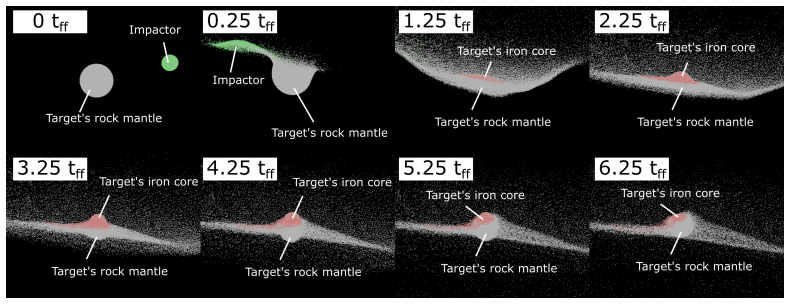
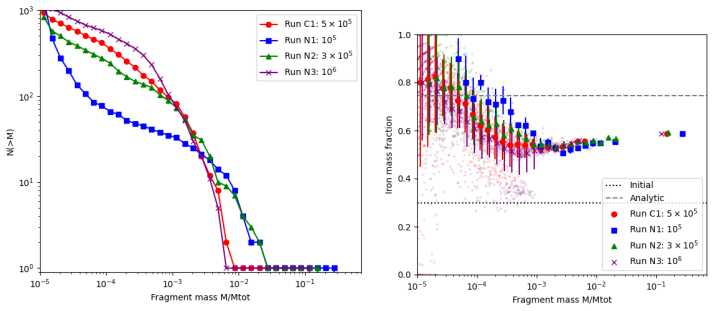
Catastrophic disruption produces a sheet-like structure in which core and mantle materials are stretched and subsequently fragment under self-gravity. The resulting fragments exhibit nearly identical iron-rock mass ratios, so the largest remnant is an iron-rich rubble pile assembled from these mixed fragments, whereas remnants formed through mantle stripping retain a layered structure with an iron core and rocky mantle.
What carries the argument
The sheet-like structure created during catastrophic disruption, which stretches and mixes core and mantle materials before they fragment and reaccumulate under self-gravity.
If this is right
- Iron-rich rubble-pile asteroids form only when the iron core is molten during the impact.
- Mantle-stripping events leave a layered remnant with a preserved iron core and rocky mantle.
- Higher mantle strength reduces the number of small fragments produced.
- A solid core suppresses full catastrophic disruption and therefore limits mixed rubble-pile formation.
Where Pith is reading between the lines
- The same reaccumulation process could account for other observed metal-rich asteroids that are not explicitly modeled here.
- Asteroid families created by single catastrophic events should contain fragments with statistically uniform iron-rock ratios.
- Missions measuring the internal density variations of large metal-rich bodies could distinguish rubble-pile from layered structures.
Load-bearing premise
The simulations assume particular values for material strength and equations of state that distinguish molten from solidified core and mantle states, and that self-gravity alone governs reaccumulation.
What would settle it
Discovery of an asteroid family whose fragments show widely varying iron-rock ratios after a known catastrophic disruption, or a large iron-rich body whose interior structure is monolithic rather than a rubble pile of mixed fragments.
Figures




read the original abstract
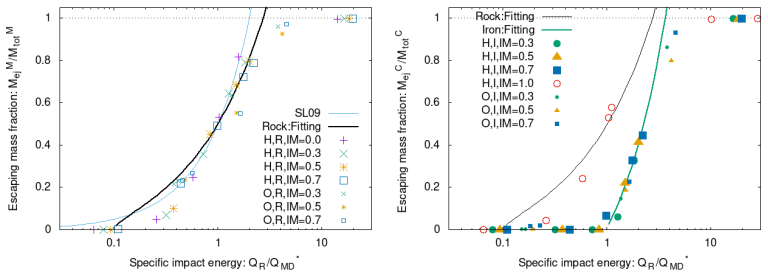
Rubble-pile asteroids can form through the self-gravitational reaccumulation of fragments produced during large-scale collisions. To investigate how differentiated bodies are disrupted and how iron-rich rubble piles may form, we performed smoothed particle hydrodynamics simulations of impacts between differentiated asteroids with molten or solidified interiors. Our results show that catastrophic disruption produces a sheet-like structure in which core and mantle materials are stretched and subsequently fragment under self-gravity. The resulting fragments exhibit nearly identical iron-rock mass ratios, indicating that catastrophic disruption naturally generates numerous compositionally similar fragments. The largest remnant formed in such events is therefore an iron-rich rubble pile assembled from these mixed fragments, whereas remnants formed through mantle stripping retain a layered structure with an iron core and rocky mantle. We further find that fragment production is sensitive to material strength and the equation of state: mantle strength reduces the number of small fragments, while core strength suppresses catastrophic disruption when the core is solid. These results imply that iron-rich rubble-pile asteroids can form only when the iron core is molten. Our findings provide a unified framework for the formation of metal-rich asteroids such as (16) Psyche and the (22) Kalliope system, and offer predictions for the surface and internal structure that the NASA Psyche mission may test.
Editorial analysis
A structured set of objections, weighed in public.
Referee Report
Summary. The paper uses smoothed particle hydrodynamics (SPH) simulations to model catastrophic impacts on differentiated asteroids with molten or solidified cores and mantles. It reports that such disruptions produce a sheet-like structure in which core and mantle materials are stretched and then fragment under self-gravity, yielding fragments with nearly identical iron-rock mass ratios. The largest remnant is therefore described as an iron-rich rubble pile assembled from these mixed fragments, while mantle-stripping events preserve a layered structure. Fragment production is noted to be sensitive to material strength and equations of state, with the implication that iron-rich rubble piles form only when the core is molten. The work frames these results as a unified formation pathway for metal-rich asteroids such as (16) Psyche and the (22) Kalliope system, with predictions for the Psyche mission.
Significance. If the reported mixing and fragment uniformity hold under broader conditions, the results would supply a concrete numerical mechanism linking catastrophic disruption to the assembly of compositionally homogeneous iron-rich rubble piles, offering a single framework that connects observed metal-rich asteroids to their collisional histories and generating specific, testable predictions for surface composition and internal structure that the Psyche mission could evaluate. The forward-simulation approach with explicit material models provides direct, reproducible numerical evidence for the sheet-like stretching and subsequent gravitational fragmentation process.
major comments (3)
- [Abstract and Results] Abstract and Results: The central claim that 'the resulting fragments exhibit nearly identical iron-rock mass ratios' is load-bearing for the inference that catastrophic disruption 'naturally generates numerous compositionally similar fragments' and that the largest remnant is an iron-rich rubble pile. However, the manuscript provides no quantitative statistics (e.g., mean ratio, standard deviation, or distribution across fragments) or direct comparison of ratios between different impact energies or angles, leaving the degree of uniformity and its robustness unquantified.
- [Abstract and Methods] Abstract and Methods: The abstract states that 'fragment production is sensitive to material strength and the equation of state' (mantle strength reduces small fragments; solid core suppresses disruption), yet the reported simulations appear to use only a limited set of fixed strength and EOS parameters distinguishing molten versus solidified states. No systematic variation or sensitivity analysis over plausible ranges of these parameters is described, which is required to support the generality of the 'nearly identical' ratios and the conclusion that iron-rich rubble piles form 'only when the iron core is molten.'
- [Methods and Results] Methods and Results: The reaccumulation phase is governed solely by self-gravity after the initial SPH impact phase. No resolution or convergence tests (e.g., varying particle number and checking fragment mass ratios or size distributions) are reported, despite the known sensitivity of SPH fragmentation outcomes to numerical resolution; this directly affects the reliability of the reported fragment compositions and the sheet-like structure.
minor comments (2)
- [Methods] The manuscript would benefit from explicit statements of the total number of simulations performed, the range of impact parameters explored, and the specific numerical values chosen for strength and EOS parameters.
- [Figures] Figure captions should include the number of SPH particles used and any post-processing steps applied to identify fragments and compute mass ratios.
Simulated Author's Rebuttal
We thank the referee for their constructive and detailed review. We appreciate the recognition of the work's potential significance and have carefully considered each major comment. Below we respond point by point, indicating the revisions we will implement to address the concerns raised.
read point-by-point responses
-
Referee: [Abstract and Results] Abstract and Results: The central claim that 'the resulting fragments exhibit nearly identical iron-rock mass ratios' is load-bearing for the inference that catastrophic disruption 'naturally generates numerous compositionally similar fragments' and that the largest remnant is an iron-rich rubble pile. However, the manuscript provides no quantitative statistics (e.g., mean ratio, standard deviation, or distribution across fragments) or direct comparison of ratios between different impact energies or angles, leaving the degree of uniformity and its robustness unquantified.
Authors: We agree that quantitative statistics would strengthen the presentation of our results. In the revised manuscript we will add explicit measures of the iron-rock mass ratios, including mean values, standard deviations, and distributions (e.g., histograms) for the fragments produced in the primary simulations. We will also include direct comparisons of these ratios across the different impact energies and angles we have already simulated, allowing readers to evaluate the uniformity and its robustness directly from the data. revision: yes
-
Referee: [Abstract and Methods] Abstract and Methods: The abstract states that 'fragment production is sensitive to material strength and the equation of state' (mantle strength reduces small fragments; solid core suppresses disruption), yet the reported simulations appear to use only a limited set of fixed strength and EOS parameters distinguishing molten versus solidified states. No systematic variation or sensitivity analysis over plausible ranges of these parameters is described, which is required to support the generality of the 'nearly identical' ratios and the conclusion that iron-rich rubble piles form 'only when the iron core is molten.'
Authors: The molten versus solidified core distinction is the central physical variable explored in the study, with parameters drawn from standard literature values for each regime. To address the request for greater generality, we will expand the Methods section with a justification of the chosen parameters and add a new discussion (supported by additional targeted simulations) exploring the sensitivity of fragment ratios and disruption outcomes to plausible variations in mantle strength and core EOS. This will better substantiate the claim that iron-rich rubble piles form only when the core is molten. revision: yes
-
Referee: [Methods and Results] Methods and Results: The reaccumulation phase is governed solely by self-gravity after the initial SPH impact phase. No resolution or convergence tests (e.g., varying particle number and checking fragment mass ratios or size distributions) are reported, despite the known sensitivity of SPH fragmentation outcomes to numerical resolution; this directly affects the reliability of the reported fragment compositions and the sheet-like structure.
Authors: We acknowledge that SPH results for fragmentation can depend on numerical resolution. Although the sheet-like mixing and compositional uniformity are robust qualitative features across our existing runs, we will add a resolution study in the revised manuscript. This will include reruns of representative cases at multiple particle numbers, with quantitative reporting of how fragment mass ratios, size distributions, and the overall sheet-like structure converge with increasing resolution. revision: yes
Circularity Check
No circularity: results from forward SPH simulations with external parameters
full rationale
The paper's central claims (sheet-like stretching, uniform iron-rock fragment ratios, iron-rich rubble-pile largest remnants) are direct outputs of numerical SPH runs using independently chosen material strengths and equations of state for molten versus solid core/mantle states. No derivation reduces these outcomes to quantities fitted from the same data, self-defined quantities, or load-bearing self-citations. The text explicitly notes sensitivity to those parameters without claiming the results are parameter-independent or derived by construction. This is a standard forward-modeling study whose conclusions stand or fall on the chosen inputs and simulation fidelity, not on internal circular reduction.
Axiom & Free-Parameter Ledger
free parameters (2)
- mantle and core strength parameters
- equation of state parameters for iron and rock
axioms (2)
- domain assumption Smoothed particle hydrodynamics with self-gravity accurately captures the large-scale deformation and reaccumulation of asteroid fragments.
- domain assumption Material strength and equation of state fully determine whether the core remains intact or mixes during disruption.
Lean theorems connected to this paper
-
IndisputableMonolith/Cost/FunctionalEquation.leanwashburn_uniqueness_aczel unclear?
unclearRelation between the paper passage and the cited Recognition theorem.
fragment production is sensitive to material strength and the equation of state: mantle strength reduces the number of small fragments, while core strength suppresses catastrophic disruption when the core is solid
What do these tags mean?
- matches
- The paper's claim is directly supported by a theorem in the formal canon.
- supports
- The theorem supports part of the paper's argument, but the paper may add assumptions or extra steps.
- extends
- The paper goes beyond the formal theorem; the theorem is a base layer rather than the whole result.
- uses
- The paper appears to rely on the theorem as machinery.
- contradicts
- The paper's claim conflicts with a theorem or certificate in the canon.
- unclear
- Pith found a possible connection, but the passage is too broad, indirect, or ambiguous to say the theorem truly supports the claim.
Reference graph
Works this paper leans on
-
[1]
Alexander, A. M., Marchi, S., Chocron, S., Walker, J.\ 2022.\ Benchmarking iSALE and CTH Shock Physics Codes to In Situ High-Velocity Impact Experiments Into Fe-Ni Targets.\ Earth and Space Science 9. doi:10.1029/2021EA00199210.1002/essoar.10507852.1
work page doi:10.1029/2021ea00199210.1002/essoar.10507852.1 2022
-
[2]
Asphaug, E., Reufer, A.\ 2014.\ Mercury and other iron-rich planetary bodies as relics of inefficient accretion.\ Nature Geoscience 7, 564–568. doi:10.1038/ngeo2189
-
[3]
Avdellidou, C., Bhat, U., Bujdoso, K., Delbo, M., Marsset, M., Vernazza, P.\ 2025.\ Kalliope sings rock and metal.\ Monthly Notices of the Royal Astronomical Society 539, 3534–3550. doi:10.1093/mnras/staf640
-
[4]
Benavidez, P. G. and 7 colleagues 2012.\ A comparison between rubble-pile and monolithic targets in impact simulations: Application to asteroid satellites and family size distributions.\ Icarus 219, 57–76. doi:10.1016/j.icarus.2012.01.015
-
[5]
Benz, W., Slattery, W. L., Cameron, A. G. W.\ 1988.\ Collisional stripping of Mercury's mantle.\ Icarus 74, 516–528. doi:10.1016/0019-1035(88)90118-2
-
[6]
Benz, W., Asphaug, E.\ 1994.\ Impact Simulations with Fracture. I. Method and Tests.\ Icarus 107, 98–116. doi:10.1006/icar.1994.1009
-
[7]
doi:10.1016/0010-4655(94)00176-3
Benz, W., Asphaug, E.\ 1995.\ Simulations of brittle solids using smooth particle hydrodynamics.\ Computer Physics Communications 87, 253–265. doi:10.1016/0010-4655(94)00176-3
-
[8]
Benz, W., Asphaug, E.\ 1999.\ Catastrophic Disruptions Revisited.\ Icarus 142, 5–20. doi:10.1006/icar.1999.6204
-
[9]
A.\ 2007.\ The Origin of Mercury.\ Space Science Reviews 132, 189–202
Benz, W., Anic, A., Horner, J., Whitby, J. A.\ 2007.\ The Origin of Mercury.\ Space Science Reviews 132, 189–202. doi:10.1007/s11214-007-9284-1
-
[10]
Bottke, W. F., Nolan, M. C., Greenberg, R., Kolvoord, R. A.\ 1994.\ Velocity Distributions among Colliding Asteroids.\ Icarus 107, 255–268. doi:10.1006/icar.1994.1021
-
[11]
F., Nesvorn \'y , D., Grimm, R
Bottke, W. F., Nesvorn \'y , D., Grimm, R. E., Morbidelli, A., O'Brien, D. P.\ 2006.\ Iron meteorites as remnants of planetesimals formed in the terrestrial planet region.\ Nature 439, 821–824. doi:10.1038/nature04536
-
[12]
Burbine, T. H., McCoy, T. J., Meibom, A., Gladman, B., Keil, K.\ 2002.\ Meteoritic Parent Bodies: Their Number and Identification.\ Asteroids III 653–667
work page 2002
-
[13]
Bus, S. J., Binzel, R. P.\ 2002.\ Phase II of the Small Main-Belt Asteroid Spectroscopic Survey. A Feature-Based Taxonomy.\ Icarus 158, 146–177. doi:10.1006/icar.2002.6856
-
[14]
Cambioni, S., de Kleer, K., Shepard, M.\ 2022.\ The Heterogeneous Surface of Asteroid (16) Psyche.\ Journal of Geophysical Research (Planets) 127. doi:10.1029/2021JE007091
-
[15]
Cambioni, S. and 7 colleagues 2025.\ Can metal-rich worlds form by giant impacts?.\ Astronomy and Astrophysics 696. doi:10.1051/0004-6361/202450128
-
[16]
Cambioni, S. and 14 colleagues 2026.\ Formation of Asteroid (16) Psyche by a Giant Impact.\ Journal of Geophysical Research (Planets) 131. doi:10.1029/2025JE009317
-
[17]
Carter, P. J., Leinhardt, Z. M., Elliott, T., Stewart, S. T., Walter, M. J.\ 2018.\ Collisional stripping of planetary crusts.\ Earth and Planetary Science Letters 484, 276–286. doi:10.1016/j.epsl.2017.12.012
-
[18]
Chau, A., Reinhardt, C., Helled, R., Stadel, J.\ 2018.\ Forming Mercury by Giant Impacts.\ The Astrophysical Journal 865. doi:10.3847/1538-4357/aad8b0
-
[19]
Cloutis, E. A., Hardersen, P. S., Bish, D. L., Bailey, D. T., Gaffey, M. J., Craig, M. A.\ 2010.\ Reflectance spectra of iron meteorites: Implications for spectral identification of their parent bodies.\ Meteoritics and Planetary Science 45, 304–332. doi:10.1111/j.1945-5100.2010.01033.x
-
[20]
Collins, G. S., Melosh, H. J., Ivanov, B. A.\ 2004.\ Modeling damage and deformation in impact simulations.\ Meteoritics and Planetary Science 39, 217–231. doi:10.1111/j.1945-5100.2004.tb00337.x
-
[21]
Davison, T. M., Collins, G. S., Ciesla, F. J.\ 2010.\ Numerical modelling of heating in porous planetesimal collisions.\ Icarus 208, 468–481. doi:10.1016/j.icarus.2010.01.034
-
[22]
Dehnen, W., Aly, H.\ 2012.\ Improving convergence in smoothed particle hydrodynamics simulations without pairing instability.\ Monthly Notices of the Royal Astronomical Society 425, 1068–1082. doi:10.1111/j.1365-2966.2012.21439.x
-
[23]
de Kleer, K., Cambioni, S., Shepard, M.\ 2021.\ The Surface of (16) Psyche from Thermal Emission and Polarization Mapping.\ The Planetary Science Journal 2. doi:10.3847/PSJ/ac01ec
-
[24]
de Kleer, K., Cambioni, S., Butler, B., Shepard, M.\ 2024.\ Surface Properties of the Kalliope Linus System from ALMA and VLA Data.\ The Planetary Science Journal 5. doi:10.3847/PSJ/ad7797
-
[25]
DeMeo, F. E., Binzel, R. P., Slivan, S. M., Bus, S. J.\ 2009.\ An extension of the Bus asteroid taxonomy into the near-infrared.\ Icarus 202, 160–180. doi:10.1016/j.icarus.2009.02.005
-
[26]
Dibb, S. D., Bell, J. F., Elkins-Tanton, L. T., Williams, D. A.\ 2023.\ Visible to Near-Infrared Reflectance Spectroscopy of Asteroid (16) Psyche: Implications for the Psyche Mission's Science Investigations.\ Earth and Space Science 10. doi:10.1029/2022EA002694
-
[27]
Dibb, S. D. and 15 colleagues 2024.\ A Post-Launch Summary of the Science of NASA's Psyche Mission.\ AGU Advances 5. doi:10.1029/2023AV001077
-
[28]
Dodds, K. H., Bryson, J. F. J., Neufeld, J. A., Harrison, R. J.\ 2021.\ The Thermal Evolution of Planetesimals During Accretion and Differentiation: Consequences for Dynamo Generation by Thermally Driven Convection.\ Journal of Geophysical Research (Planets) 126. doi:10.1029/2020JE00670410.1002/essoar.10504425.1
work page doi:10.1029/2020je00670410.1002/essoar.10504425.1 2021
-
[29]
Dollfus, A., Mandeville, J. C., Duseaux, M.\ 1979.\ The nature of the M-type asteroids from optical polarimetry.\ Icarus 37, 124–132. doi:10.1016/0019-1035(79)90120-9
-
[30]
Dou, J., Carter, P. J., Leinhardt, Z. M.\ 2024.\ Formation of super-Mercuries via giant impacts.\ Monthly Notices of the Royal Astronomical Society 529, 2577–2594. doi:10.1093/mnras/stae644
-
[31]
Durda, D. D. and 6 colleagues 2007.\ Size-frequency distributions of fragments from SPH/ N-body simulations of asteroid impacts: Comparison with observed asteroid families.\ Icarus 186, 498–516. doi:10.1016/j.icarus.2006.09.013
-
[32]
Elkins-Tanton, L. T., Weiss, B. P., Zuber, M. T.\ 2011.\ Chondrites as samples of differentiated planetesimals.\ Earth and Planetary Science Letters 305, 1–10. doi:10.1016/j.epsl.2011.03.010
-
[33]
Elkins-Tanton, L. T. and 21 colleagues 2020.\ Observations, Meteorites, and Models: A Preflight Assessment of the Composition and Formation of (16) Psyche.\ Journal of Geophysical Research (Planets) 125. doi:10.1029/2019JE006296
-
[34]
Elkins-Tanton, L. T. and 21 colleagues 2022.\ Distinguishing the Origin of Asteroid (16) Psyche.\ Space Science Reviews 218. doi:10.1007/s11214-022-00880-9
-
[35]
doi:10.1016/j.icarus.2017.09.017
Emsenhuber, A., Jutzi, M., Benz, W.\ 2018.\ SPH calculations of Mars-scale collisions: The role of the equation of state, material rheologies, and numerical effects.\ Icarus 301, 247–257. doi:10.1016/j.icarus.2017.09.017
-
[36]
Emsenhuber, A. and 6 colleagues 2024.\ A New Database of Giant Impacts over a Wide Range of Masses and with Material Strength: A First Analysis of Outcomes.\ The Planetary Science Journal 5. doi:10.3847/PSJ/ad2178
-
[37]
doi:10.1016/0019-1035(82)90003-3
Farinella, P., Paolicchi, P., Zappala, V.\ 1982.\ The asteroids as outcomes of catastrophic collisions.\ Icarus 52, 409–433. doi:10.1016/0019-1035(82)90003-3
-
[38]
Farnocchia, D., Fuentes-Mu \ n oz, O., Park, R. S., Baer, J., Chesley, S. R.\ 2024.\ Mass, Density, and Radius of Asteroid (16) Psyche from High-precision Astrometry.\ The Astronomical Journal 168. doi:10.3847/1538-3881/ad50ca
-
[39]
Franco, P., Izidoro, A., Winter, O. C., Torres, K. S., Amarante, A.\ 2022.\ Explaining mercury via a single giant impact is highly unlikely.\ Monthly Notices of the Royal Astronomical Society 515, 5576–5586. doi:10.1093/mnras/stac2183
-
[40]
Gabriel, T. S. J., Cambioni, S.\ 2023.\ The Role of Giant Impacts in Planet Formation.\ Annual Review of Earth and Planetary Sciences 51, 671–695. doi:10.1146/annurev-earth-031621-055545
-
[41]
doi:10.1016/j.icarus.2017.03.009
Genda, H., Fujita, T., Kobayashi, H., Tanaka, H., Suetsugu, R., Abe, Y.\ 2017.\ Impact erosion model for gravity-dominated planetesimals.\ Icarus 294, 234–246. doi:10.1016/j.icarus.2017.03.009
-
[42]
Grady, D. E., Kipp, M. E.\ 1980.\ Continuum modelling of explosive fracture in oil shale.\ International Journal of Rock Mechanics and Mining Sciences and Geomechanics Abstracts 17, 147–157. doi:10.1016/0148-9062(80)91361-3
-
[43]
Hardersen, P. S., Gaffey, M. J., Abell, P. A.\ 2005.\ Near-IR spectral evidence for the presence of iron-poor orthopyroxenes on the surfaces of six M-type asteroids.\ Icarus 175, 141–158. doi:10.1016/j.icarus.2004.10.017
-
[44]
Hongbin, J., Xin, D.\ 2005.\ On criterions for smoothed particle hydrodynamics kernels in stable field.\ Journal of Computational Physics 202, 699–709. doi:10.1016/j.jcp.2004.08.002
-
[45]
Hosono, N., Karato, S.-. ichiro .\ 2022.\ The Influence of Equation of State on the Giant Impact Simulations.\ Journal of Geophysical Research (Planets) 127. doi:10.1029/2021JE006971
-
[46]
ichiro ., Makino, J., Saitoh, T
Hosono, N., Karato, S.-. ichiro ., Makino, J., Saitoh, T. R.\ 2019.\ Terrestrial magma ocean origin of the Moon.\ Nature Geoscience 12, 418–423. doi:10.1038/s41561-019-0354-2
-
[47]
Hosono, N., Saitoh, T. R., Makino, J.\ 2016.\ A Comparison of SPH Artificial Viscosities and Their Impact on the Keplerian Disk.\ The Astrophysical Journal Supplement Series 224. doi:10.3847/0067-0049/224/2/32
-
[48]
doi:10.1016/j.icarus.2016.09.012
Hyodo, R., Charnoz, S., Ohtsuki, K., Genda, H.\ 2017.\ Ring formation around giant planets by tidal disruption of a single passing large Kuiper belt object.\ Icarus 282, 195–213. doi:10.1016/j.icarus.2016.09.012
-
[49]
Iwasawa, M., Tanikawa, A., Hosono, N., Nitadori, K., Muranushi, T., Makino, J.\ 2016.\ Implementation and performance of FDPS: a framework for developing parallel particle simulation codes.\ Publications of the Astronomical Society of Japan 68. doi:10.1093/pasj/psw053
-
[50]
Johnson, G.R. and Cook, W.H.\ 1983.\ A Constitutive Model and Data for Metals Subjected to Large Strains, High Strain Rates, and High Temperatures. Proceedings 7th International Symposium on Ballistics, The Hague, 19-21 April 1983, 541-547
work page 1983
-
[51]
Johnson, B. C., Bowling, T. J., Melosh, H. J.\ 2014.\ Jetting during vertical impacts of spherical projectiles.\ Icarus 238, 13–22. doi:10.1016/j.icarus.2014.05.003
-
[52]
Jutzi, M., Michel, P., Benz, W., Richardson, D. C.\ 2010.\ Fragment properties at the catastrophic disruption threshold: The effect of the parent body s internal structure.\ Icarus 207, 54–65. doi:10.1016/j.icarus.2009.11.016
-
[53]
Jutzi, M., Asphaug, E., Gillet, P., Barrat, J.-A., Benz, W.\ 2013.\ The structure of the asteroid 4 Vesta as revealed by models of planet-scale collisions.\ Nature 494, 207–210. doi:10.1038/nature11892
-
[54]
Jutzi, M.\ 2015.\ SPH calculations of asteroid disruptions: The role of pressure dependent failure models.\ Planetary and Space Science 107, 3–9. doi:10.1016/j.pss.2014.09.012
-
[55]
Jutzi, M., Michel, P., Richardson, D. C.\ 2019.\ Fragment properties from large-scale asteroid collisions: I: Results from SPH/N-body simulations using porous parent bodies and improved material models.\ Icarus 317, 215–228. doi:10.1016/j.icarus.2018.08.006
-
[56]
doi:10.1016/j.icarus.2020.113867
Jutzi, M., Michel, P.\ 2020.\ Collisional heating and compaction of small bodies: Constraints for their origin and evolution.\ Icarus 350. doi:10.1016/j.icarus.2020.113867
-
[57]
Kegerreis, J. A., Eke, V. R., Massey, R. J., Teodoro, L. F. A.\ 2020.\ Atmospheric Erosion by Giant Impacts onto Terrestrial Planets.\ The Astrophysical Journal 897. doi:10.3847/1538-4357/ab9810
-
[58]
Kegerreis, J. A., Eke, V. R., Catling, D. C., Massey, R. J., Teodoro, L. F. A., Zahnle, K. J.\ 2020.\ Atmospheric Erosion by Giant Impacts onto Terrestrial Planets: A Scaling Law for any Speed, Angle, Mass, and Density.\ The Astrophysical Journal 901. doi:10.3847/2041-8213/abb5fb
-
[59]
Kegerreis, J. A., Lissauer, J. J., Eke, V. R., Sandnes, T. D., Elphic, R. C.\ 2025.\ Origin of Mars's moons by disruptive partial capture of an asteroid.\ Icarus 425. doi:10.1016/j.icarus.2024.116337
-
[60]
Keil, K., Stoeffler, D., Love, S. G., Scott, E. R. D.\ 1997.\ Constraints on the role of impact heating and melting in asteroids.\ Meteoritics and Planetary Science 32, 349–363. doi:10.1111/j.1945-5100.1997.tb01278.x
-
[61]
Kleine, T., Mezger, K., Palme, H., Scherer, E., M \"u nker, C.\ 2005.\ Early core formation in asteroids and late accretion of chondrite parent bodies: Evidence from ^ 182 Hf- ^ 182 W in CAIs, metal-rich chondrites, and iron meteorites.\ Geochimica et Cosmochimica Acta 69, 5805–5818. doi:10.1016/j.gca.2005.07.012
-
[62]
Kobayashi, H., Tanaka, H., Hasegawa, Y., Inutsuka, S.-. ichiro .\ 2026.\ Modeling of Collisional Outcomes Based on Impact Simulations of Mars-sized Bodies.\ The Astrophysical Journal 998. doi:10.3847/1538-4357/ae1ef7
-
[63]
Kurosaki, K., Inutsuka, S.-. ichiro .\ 2019.\ The Exchange of Mass and Angular Momentum in the Impact Event of Ice Giant Planets: Implications for the Origin of Uranus.\ The Astronomical Journal 157. doi:10.3847/1538-3881/aaf165
-
[64]
Kurosaki, K., Inutsuka, S.-. ichiro .\ 2023.\ Giant Impact Events for Protoplanets: Energetics of Atmospheric Erosion by Head-on Collision.\ The Astrophysical Journal 954. doi:10.3847/1538-4357/ace9ba
-
[65]
doi:10.1016/j.icarus.2025.116874
Kurosaki, K., Arakawa, M.\ 2026.\ Numerical simulation of impact cratering and induced seismic waves in sand targets.\ Icarus 446. doi:10.1016/j.icarus.2025.116874
-
[66]
Kurosawa, K., Genda, H.\ 2018.\ Effects of Friction and Plastic Deformation in Shock-Comminuted Damaged Rocks on Impact Heating.\ Geophysical Research Letters 45, 620–626. doi:10.1002/2017GL076285
-
[67]
Leinhardt, Z. M., Stewart, S. T.\ 2012.\ Collisions between Gravity-dominated Bodies. I. Outcome Regimes and Scaling Laws.\ The Astrophysical Journal 745. doi:10.1088/0004-637X/745/1/79
-
[68]
Leinhardt, Z. M., Stewart, S. T.\ 2009.\ Full numerical simulations of catastrophic small body collisions.\ Icarus 199, 542–559. doi:10.1016/j.icarus.2008.09.013
-
[69]
Lichtenberg, T., Keller, T., Katz, R. F., Golabek, G. J., Gerya, T. V.\ 2019.\ Magma ascent in planetesimals: Control by grain size.\ Earth and Planetary Science Letters 507, 154–165. doi:10.1016/j.epsl.2018.11.034
-
[70]
Lichtenberg, T., Schaefer, L. K., Nakajima, M., Fischer, R. A.\ 2023.\ Geophysical Evolution During Rocky Planet Formation.\ Protostars and Planets VII 534, 907. doi:10.48550/arXiv.2203.10023
-
[71]
Lucy, L. B.\ 1977.\ A numerical approach to the testing of the fission hypothesis.\ The Astronomical Journal 82, 1013–1024. doi:10.1086/112164
-
[72]
doi:10.1051/0004-6361/202243587
Mahlke, M., Carry, B., Mattei, P.-A.\ 2022.\ Asteroid taxonomy from cluster analysis of spectrometry and albedo.\ Astronomy and Astrophysics 665. doi:10.1051/0004-6361/202243587
-
[73]
Marcus, R. A., Stewart, S. T., Sasselov, D., Hernquist, L.\ 2009.\ Collisional Stripping and Disruption of Super-Earths.\ The Astrophysical Journal 700, L118–L122. doi:10.1088/0004-637X/700/2/L118
-
[74]
Melosh, H. J.\ 1989.\ Impact cratering : a geologic process.\ New York : Oxford University Press ; Oxford : Clarendon Press, 1989
work page 1989
-
[75]
Michel, P., Tanga, P., Benz, W., Richardson, D. C.\ 2002.\ Formation of Asteroid Families by Catastrophic Disruption: Simulations with Fragmentation and Gravitational Reaccumulation.\ Icarus 160, 10–23. doi:10.1006/icar.2002.6948
-
[76]
Michel, P., Benz, W., Richardson, D. C.\ 2003.\ Disruption of fragmented parent bodies as the origin of asteroid families.\ Nature 421, 608–611. doi:10.1038/nature01364
-
[77]
Monaghan, J. J., Gingold, R. A.\ 1983.\ Shock Simulation by the Particle Method SPH.\ Journal of Computational Physics 52, 374–389. doi:10.1016/0021-9991(83)90036-0
-
[78]
Monaghan, J. J.\ 1992.\ Smoothed particle hydrodynamics..\ Annual Review of Astronomy and Astrophysics 30, 543–574. doi:10.1146/annurev.aa.30.090192.002551
-
[79]
J.\ 1997.\ SPH and Riemann Solvers.\ Journal of Computational Physics 136, 298–307
Monaghan, J. J.\ 1997.\ SPH and Riemann Solvers.\ Journal of Computational Physics 136, 298–307. doi:10.1006/jcph.1997.5732
-
[80]
J., Quitt \'e , G.\ 2023.\ Differentiation time scales of small rocky bodies.\ Icarus 390
Monnereau, M., Guignard, J., N \'e ri, A., Toplis, M. J., Quitt \'e , G.\ 2023.\ Differentiation time scales of small rocky bodies.\ Icarus 390. doi:10.1016/j.icarus.2022.115294
discussion (0)
Sign in with ORCID, Apple, or X to comment. Anyone can read and Pith papers without signing in.