Recognition: 2 theorem links
· Lean TheoremAdiabatic Quantum Simulation of the Topological Su--Schrieffer--Heeger--Hubbard Model
Pith reviewed 2026-05-13 05:47 UTC · model grok-4.3
The pith
Adiabatic quantum circuits show SSH topology survives weak Hubbard interactions but breaks when symmetry-breaking terms exceed a threshold.
A machine-rendered reading of the paper's core claim, the machinery that carries it, and where it could break.
Core claim
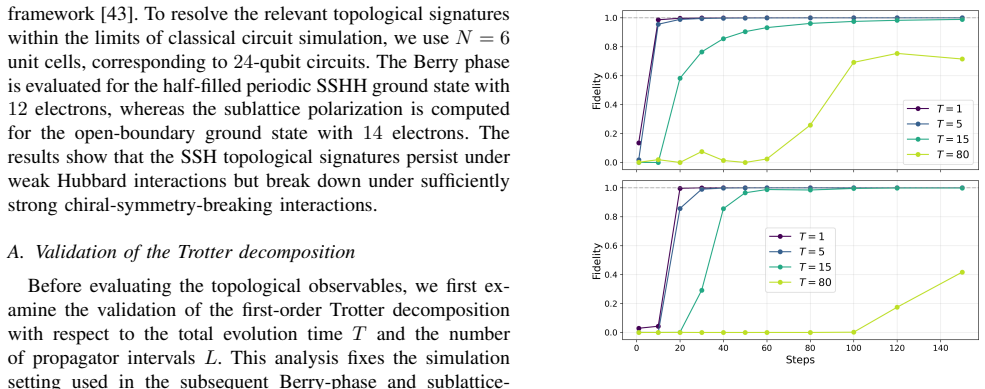
We develop an adiabatic quantum simulation framework on gate-based quantum computers to probe topological signatures of the one-dimensional fermionic Su--Schrieffer--Heeger--Hubbard (SSHH) model. We present explicit quantum-circuit constructions for initial-state preparation and time evolution, together with a practical measurement protocol and classical post-processing procedure for extracting the many-body Berry phase and the spatial profile of the sublattice polarization. Using classical simulations of the proposed circuits, we demonstrate -- for the first time within a genuine many-body framework -- that the topological characteristics of the SSH model remain robust against weak Hubbard
What carries the argument
The adiabatic quantum simulation framework built from explicit quantum circuits for state preparation, Hamiltonian evolution, and a measurement-plus-post-processing protocol that extracts the many-body Berry phase while tracking sublattice polarization in the SSHH model.
If this is right
- The topological phase of the SSH model remains intact for weak Hubbard interactions in a full many-body treatment.
- The phase is destroyed once the chiral-symmetry-breaking interaction component exceeds a finite threshold.
- All qubit counts, gate depths, shot numbers, and classical costs scale polynomially with system size.
- The construction supplies a working proof-of-concept for quantum simulation of interacting topological phases on future hardware.
Where Pith is reading between the lines
- The same circuit template could be repurposed for other one-dimensional interacting topological models such as extended Kitaev or Su-Schrieffer-Heeger variants with longer-range terms.
- On actual NISQ devices, decoherence and gate errors would likely require additional error-mitigation techniques to keep the Berry-phase extraction reliable at the sizes simulated classically.
- The interaction threshold identified here could be tested directly in cold-atom or superconducting-circuit experiments that realize tunable Hubbard interactions on an SSH lattice.
Load-bearing premise
Classical simulations of the circuits faithfully reproduce the results that would be measured on real quantum hardware, with the measurement protocol and post-processing accurately recovering the Berry phase without large bias from shot noise or imperfections.
What would settle it
Executing the circuits on quantum hardware and observing that the extracted many-body Berry phase fails to remain quantized for weak interactions or does not exhibit the predicted breakdown at the interaction threshold found in the classical simulations.
Figures


read the original abstract
We develop an adiabatic quantum simulation framework on gate-based quantum computers to probe topological signatures of the one-dimensional fermionic Su--Schrieffer--Heeger--Hubbard (SSHH) model. We present explicit quantum-circuit constructions for initial-state preparation and time evolution, together with a practical measurement protocol and classical post-processing procedure for extracting the many-body Berry phase and the spatial profile of the sublattice polarization. Using classical simulations of the proposed circuits, we demonstrate -- for the first time within a genuine many-body framework -- that the topological characteristics of the SSH model remain robust against weak Hubbard interactions but eventually break down as the chiral-symmetry-breaking component of the interaction exceeds a threshold. The required qubit number, gate complexity, measurement shots, and classical pre- and post-processing costs all scale polynomially with system size. Our results provide a proof-of-concept framework for probing topological properties of interacting many-body systems via adiabatic quantum simulation on future large-scale quantum computers.
Editorial analysis
A structured set of objections, weighed in public.
Referee Report
Summary. The paper develops an adiabatic quantum simulation framework for the one-dimensional fermionic Su-Schrieffer-Heeger-Hubbard (SSHH) model on gate-based quantum computers. It provides explicit quantum-circuit constructions for initial-state preparation and time evolution under the SSHH Hamiltonian, together with a measurement protocol and classical post-processing to extract the many-body Berry phase and the spatial profile of the sublattice polarization. Classical simulations of these ideal circuits are used to demonstrate that topological characteristics remain robust against weak Hubbard interactions but break down once the chiral-symmetry-breaking component of the interaction exceeds a threshold. Resource costs (qubits, gates, shots, and classical processing) scale polynomially with system size.
Significance. If the results hold, the work supplies a concrete proof-of-concept for probing topological invariants in genuinely interacting many-body systems via adiabatic quantum simulation, extending prior non-interacting SSH studies. The explicit circuit constructions, independent measurement protocol, and use of exact classical simulations of ideal circuits are strengths that directly validate the framework for the finite sizes considered. Polynomial scaling is a positive indicator for future hardware feasibility. The stress-test concern about faithful representation on noisy hardware does not land, as the paper reports only ideal classical simulations rather than hardware runs.
minor comments (2)
- [Abstract] The abstract would benefit from a brief statement of the system sizes simulated and the precise criterion used to identify the interaction threshold, even if these details appear in the main text.
- [Measurement protocol section] Notation for the many-body Berry phase and its extraction via post-processing could be made fully explicit with a short equation or pseudocode block to aid reproducibility.
Simulated Author's Rebuttal
We thank the referee for the positive and accurate summary of our manuscript on the adiabatic quantum simulation framework for the SSHH model. The referee correctly notes the explicit circuit constructions, the use of classical simulations of ideal circuits to demonstrate robustness of topological signatures to weak interactions, the breakdown beyond a symmetry-breaking threshold, and the polynomial resource scaling. We also appreciate the clarification that concerns regarding noisy hardware do not apply, as our results are based on exact classical simulations rather than hardware execution. Since no specific major comments are provided in the report, we have no individual points to address.
Circularity Check
No significant circularity detected
full rationale
The paper constructs explicit gate-based quantum circuits for adiabatic state preparation and time evolution under the SSHH Hamiltonian, defines a measurement protocol with classical post-processing to extract the many-body Berry phase and sublattice polarization, and then performs classical simulations of these ideal circuits to demonstrate the claimed robustness of topological invariants. These steps form a self-contained forward chain: the circuits and protocol are defined independently of the final topological claim, the simulations compute the direct consequences of the model and protocol for finite sizes, and the reported breakdown threshold emerges as an output of the simulation rather than a fitted input or self-referential definition. No load-bearing self-citations, ansatzes smuggled via prior work, or renamings of known results are present in the derivation; the results are falsifiable via the stated simulation procedure.
Axiom & Free-Parameter Ledger
axioms (1)
- domain assumption The adiabatic theorem applies to the time-dependent Hamiltonian used in the simulation
Lean theorems connected to this paper
-
IndisputableMonolith/Cost/FunctionalEquation.leanwashburn_uniqueness_aczel unclear?
unclearRelation between the paper passage and the cited Recognition theorem.
We develop an adiabatic quantum simulation framework... explicit quantum-circuit constructions for initial-state preparation and time evolution... many-body Berry phase... sublattice polarization... topological characteristics remain robust against weak Hubbard interactions but eventually break down as the chiral-symmetry-breaking component exceeds a threshold.
-
IndisputableMonolith/Foundation/RealityFromDistinction.leanreality_from_one_distinction unclear?
unclearRelation between the paper passage and the cited Recognition theorem.
U(T,0) = T exp(-i/ℏ ∫ H(t) dt) ... first-order Trotter decomposition ... U_ℓ = exp(-i δt/ℏ (2ℓ-1)/(2L) H_1) exp(-i δt/ℏ H_0)
What do these tags mean?
- matches
- The paper's claim is directly supported by a theorem in the formal canon.
- supports
- The theorem supports part of the paper's argument, but the paper may add assumptions or extra steps.
- extends
- The paper goes beyond the formal theorem; the theorem is a base layer rather than the whole result.
- uses
- The paper appears to rely on the theorem as machinery.
- contradicts
- The paper's claim conflicts with a theorem or certificate in the canon.
- unclear
- Pith found a possible connection, but the passage is too broad, indirect, or ambiguous to say the theorem truly supports the claim.
Reference graph
Works this paper leans on
-
[1]
Quantum computing in the NISQ era and beyond,
J. Preskill, “Quantum computing in the NISQ era and beyond,”Quan- tum, vol. 2, p. 79, 2018
work page 2018
-
[2]
Noisy intermediate- scale quantum algorithms,
K. Bharti, A. Cervera-Lierta, T. H. Kyaw, T. Haug, S. Alperin-Lea, A. Anand, M. Degroote, H. Heimonen, J. S. Kottmann, T. Menke, W.-K. Mok, S. Sim, L.-C. Kwek, and A. Aspuru-Guzik, “Noisy intermediate- scale quantum algorithms,”Reviews of Modern Physics, vol. 94, p. 015004, 2022
work page 2022
-
[3]
The density-matrix renormalization group,
U. Schollw ¨ock, “The density-matrix renormalization group,”Reviews of Modern Physics, vol. 77, pp. 259–315, 2005
work page 2005
-
[4]
Computational complexity and fundamental limitations to fermionic quantum monte carlo simulations,
M. Troyer and U.-J. Wiese, “Computational complexity and fundamental limitations to fermionic quantum monte carlo simulations,”Physical Review Letters, vol. 94, p. 170201, 2005
work page 2005
-
[5]
The complexity of the local hamiltonian problem,
J. Kempe, A. Kitaev, and O. Regev, “The complexity of the local hamiltonian problem,”SIAM Journal on Computing, vol. 35, no. 5, pp. 1070–1097, 2006
work page 2006
-
[6]
Simulating physics with computers,
R. P. Feynman, “Simulating physics with computers,”International Journal of Theoretical Physics, vol. 21, no. 6–7, pp. 467–488, 1982
work page 1982
-
[7]
S. Lloyd, “Universal quantum simulators,”Science, vol. 273, no. 5278, pp. 1073–1078, 1996
work page 1996
-
[8]
A variational eigenvalue solver on a photonic quantum processor,
A. Peruzzo, J. McClean, P. Shadbolt, M.-H. Yung, X.-Q. Zhou, P. J. Love, A. Aspuru-Guzik, and J. L. O’Brien, “A variational eigenvalue solver on a photonic quantum processor,”Nature Communications, vol. 5, no. 1, July 2014. [Online]. Available: http://dx.doi.org/10.1038/ ncomms5213
work page 2014
-
[9]
Hardware-efficient variational quantum eigensolver for small molecules and quantum magnets,
A. Kandala, A. Mezzacapo, K. Temme, M. Takita, M. Brink, J. M. Chow, and J. M. Gambetta, “Hardware-efficient variational quantum eigensolver for small molecules and quantum magnets,”Nature, vol. 549, pp. 242–246, 2017
work page 2017
-
[10]
Variational quantum algorithms,
M. Cerezo, A. Arrasmith, R. Babbush, S. C. Benjamin, S. Endo, K. Fujii, J. R. McClean, K. Mitarai, X. Yuan, L. Cincioet al., “Variational quantum algorithms,”Nature Reviews Physics, vol. 3, no. 9, pp. 625– 644, 2021
work page 2021
-
[11]
The variational quantum eigensolver: A review of methods and best practices,
J. Tilly, H. Chen, S. Cao, D. Picozzi, K. Setia, Y . Li, E. Grant, L. Wossnig, I. Rungger, G. H. Booth, and J. Tennyson, “The variational quantum eigensolver: A review of methods and best practices,” Physics Reports, vol. 986, p. 1–128, Nov. 2022. [Online]. Available: http://dx.doi.org/10.1016/j.physrep.2022.08.003
-
[12]
The theory of variational hybrid quantum-classical algorithms,
J. R. McClean, J. Romero, R. Babbush, and A. Aspuru-Guzik, “The theory of variational hybrid quantum-classical algorithms,”New Journal of Physics, vol. 18, no. 2, p. 023023, feb 2016. [Online]. Available: https://doi.org/10.1088/1367-2630/18/2/023023
-
[13]
Physically motivated improvements of variational quan- tum eigensolvers,
N. Vaquero-Sabater, A. Carreras, R. Or ´us, N. J. Mayhall, and D. Casanova, “Physically motivated improvements of variational quan- tum eigensolvers,”Journal of Chemical Theory and Computation, vol. 20, no. 12, pp. 5133–5144, 2024
work page 2024
-
[14]
Efficient variational quantum circuit structure for correlated topological phases,
R.-Y . Sun, T. Shirakawa, and S. Yunoki, “Efficient variational quantum circuit structure for correlated topological phases,”Physical Review B, vol. 108, p. 075127, 2023
work page 2023
-
[15]
Symmetry-protecting ansatz for the variational quantum eigensolver,
G. B. Yoo, J. Kim, and Y . Kwon, “Symmetry-protecting ansatz for the variational quantum eigensolver,”Physical Review A, vol. 111, p. 032615, 2025
work page 2025
-
[16]
A quantum adiabatic evolution algorithm applied to random instances of an np-complete problem,
E. Farhi, J. Goldstone, S. Gutmann, J. Lapan, A. Lundgren, and D. Preda, “A quantum adiabatic evolution algorithm applied to random instances of an np-complete problem,”Science, vol. 292, no. 5516, pp. 472–475, 2001
work page 2001
-
[17]
Adiabatic quantum computation,
T. Albash and D. A. Lidar, “Adiabatic quantum computation,”Reviews of Modern Physics, vol. 90, p. 015002, 2018
work page 2018
-
[18]
Quantum annealing with manufactured spins,
M. W. Johnson, M. H. S. Amin, S. Gildert, T. Lanting, F. Hamze, N. Dickson, R. Harris, A. J. Berkley, J. Johansson, P. Bunyk, E. M. Chapple, C. Enderud, J. P. Hilton, K. Karimi, E. Ladizinsky, N. Ladizin- sky, T. Oh, I. Perminov, C. Rich, M. C. Thom, E. Tolkacheva, C. J. S. Truncik, S. Uchaikin, J. Wang, B. Wilson, and G. Rose, “Quantum annealing with man...
work page 2011
-
[19]
Quantum annealing in the transverse Ising model,
T. Kadowaki and H. Nishimori, “Quantum annealing in the transverse Ising model,”Physical Review E, vol. 58, pp. 5355–5363, 1998
work page 1998
-
[20]
Perspectives of quantum annealing: methods and implementations,
P. Hauke, H. G. Katzgraber, W. Lechner, H. Nishimori, and W. D. Oliver, “Perspectives of quantum annealing: methods and implementations,” Reports on Progress in Physics, vol. 83, no. 5, p. 054401, may 2020. [Online]. Available: https://doi.org/10.1088/1361-6633/ab85b8
-
[21]
Towards solving the fermi-hubbard model via tailored quantum annealers,
R. Levy, Z. G. Izquierdo, Z. Wang, J. Marshall, J. Barreto, L. Fry- Bouriaux, D. T. O’Connor, P. A. Warburton, N. Wiebe, E. Rieffel et al., “Towards solving the fermi-hubbard model via tailored quantum annealers,”arXiv preprint arXiv:2207.14374, 2022
-
[22]
Fermionic quantum computation,
S. B. Bravyi and A. Y . Kitaev, “Fermionic quantum computation,” Annals of Physics, vol. 298, no. 1, pp. 210–226, 2002
work page 2002
-
[23]
The Bravyi-Kitaev transformation for quantum computation of electronic structure,
J. T. Seeley, M. J. Richard, and P. J. Love, “The Bravyi-Kitaev transformation for quantum computation of electronic structure,”The Journal of Chemical Physics, vol. 137, no. 22, p. 224109, 2012
work page 2012
-
[24]
Quantum computers as universal quantum simulators: State-of-the-art and perspectives,
F. Tacchino, A. Chiesa, S. Carretta, and D. Gerace, “Quantum computers as universal quantum simulators: State-of-the-art and perspectives,” Advanced Quantum Technologies, vol. 3, no. 3, p. 1900052, 2020. [Online]. Available: https://advanced.onlinelibrary.wiley.com/doi/abs/10. 1002/qute.201900052
work page 2020
-
[25]
Quantum many-body simulations on digital quantum computers: State-of-the-art and future challenges,
B. Fauseweh, “Quantum many-body simulations on digital quantum computers: State-of-the-art and future challenges,”Nature Communica- tions, vol. 15, no. 1, p. 2123, 2024
work page 2024
-
[26]
Adiabatic quantum computation is equivalent to standard quantum computation,
D. Aharonov, W. van Dam, J. Kempe, Z. Landau, S. Lloyd, and O. Regev, “Adiabatic quantum computation is equivalent to standard quantum computation,”SIAM Review, vol. 50, no. 4, pp. 755–787, 2008
work page 2008
-
[27]
Hubbard versus peierls and the su-schrieffer-heeger model of polyacetylene,
S. Kivelson and D. E. Heim, “Hubbard versus peierls and the su-schrieffer-heeger model of polyacetylene,”Phys. Rev. B, vol. 26, pp. 4278–4292, Oct 1982. [Online]. Available: https: //link.aps.org/doi/10.1103/PhysRevB.26.4278
-
[28]
W. P. Su, J. R. Schrieffer, and A. J. Heeger, “Solitons in polyacetylene,” Phys. Rev. Lett., vol. 42, pp. 1698–1701, Jun 1979. [Online]. Available: https://link.aps.org/doi/10.1103/PhysRevLett.42.1698
-
[29]
Electron correlations in narrow energy bands,
J. Hubbard, “Electron correlations in narrow energy bands,”Proceedings of the Royal Society of London. A. Mathematical and Physical Sciences, vol. 276, no. 1365, pp. 238–257, 11 1963. [Online]. Available: https://doi.org/10.1098/rspa.1963.0204
-
[30]
Phase diagram of the su-schrieffer-heeger-hubbard model on a square lattice,
C. Feng, B. Xing, D. Poletti, R. Scalettar, and G. Batrouni, “Phase diagram of the su-schrieffer-heeger-hubbard model on a square lattice,” Physical Review B, vol. 106, no. 8, Aug. 2022. [Online]. Available: http://dx.doi.org/10.1103/PhysRevB.106.L081114
-
[31]
Topological phases of a dimerized fermi–hubbard model for semiconductor nano- lattices,
N. H. Le, A. J. Fisher, N. J. Curson, and E. Ginossar, “Topological phases of a dimerized fermi–hubbard model for semiconductor nano- lattices,”npj Quantum Information, vol. 6, no. 1, Feb. 2020. [Online]. Available: http://dx.doi.org/10.1038/s41534-020-0253-9
-
[32]
B.-H. Chen and D.-W. Chiou, “An elementary rigorous proof of bulk-boundary correspondence in the generalized su-schrieffer-heeger model,”Physics Letters A, vol. 384, no. 7, p. 126168, Mar. 2020. [Online]. Available: http://dx.doi.org/10.1016/j.physleta.2019.126168
-
[33]
Topological phases of the interacting su-schrieffer-heeger model: An analytical study,
E. Di Salvo, A. Moustaj, C. Xu, L. Fritz, A. K. Mitchell, C. M. Smith, and D. Schuricht, “Topological phases of the interacting su-schrieffer-heeger model: An analytical study,”Physical Review B, vol. 110, no. 16, Oct. 2024. [Online]. Available: http://dx.doi.org/10.1103/PhysRevB.110.165145
-
[34]
H.-C. Chang, H.-C. Hsu, and Y .-C. Lin, “Probing entanglement dynamics and topological transitions on noisy intermediate-scale quantum computers,”Physical Review Research, vol. 7, no. 1, Jan
-
[35]
Stochastic properties of the frequency dynamics in real and synthetic power grids,
[Online]. Available: http://dx.doi.org/10.1103/PhysRevResearch. 7.013043
-
[36]
Quantum mechanical position operator and localization in extended systems,
A. A. Aligia and G. Ortiz, “Quantum mechanical position operator and localization in extended systems,”Physical Review Letters, vol. 82, no. 12, p. 2560–2563, Mar. 1999. [Online]. Available: http://dx.doi.org/10.1103/PhysRevLett.82.2560
-
[37]
Electron localization in the insulating state,
R. Resta and S. Sorella, “Electron localization in the insulating state,” Physical Review Letters, vol. 82, no. 2, p. 370–373, Jan. 1999. [Online]. Available: http://dx.doi.org/10.1103/PhysRevLett.82.370
-
[38]
Quantum-mechanical position operator in extended systems,
R. Resta, “Quantum-mechanical position operator in extended systems,” Physical Review Letters, vol. 80, no. 9, p. 1800–1803, Mar. 1998. [Online]. Available: http://dx.doi.org/10.1103/PhysRevLett.80.1800
-
[39]
Berry’s phase for energy bands in solids,
J. Zak, “Berry’s phase for energy bands in solids,”Phys. Rev. Lett., vol. 62, pp. 2747–2750, Jun 1989. [Online]. Available: https://link.aps.org/doi/10.1103/PhysRevLett.62.2747
-
[40]
J. K. Asb ´oth, L. Oroszl ´any, and A. P ´alyi,A Short Course on Topological Insulators. Springer International Publishing, 2016. [Online]. Available: http://dx.doi.org/10.1007/978-3-319-25607-8
-
[41]
Quantum algorithms to simulate many-body physics of correlated fermions,
Z. Jiang, K. J. Sung, K. Kechedzhi, V . N. Smelyanskiy, and S. Boixo, “Quantum algorithms to simulate many-body physics of correlated fermions,”Physical Review Applied, vol. 9, no. 4, Apr. 2018. [Online]. Available: http://dx.doi.org/10.1103/PhysRevApplied.9.044036
-
[42]
Openfermion: The electronic structure package for quantum computers,
J. R. McClean, K. J. Sung, I. D. Kivlichan, Y . Cao, C. Dai, E. S. Fried, C. Gidney, B. Gimby, P. Gokhale, T. H ¨aner, T. Hardikar, V . Havl´ıˇcek, O. Higgott, C. Huang, J. Izaac, Z. Jiang, X. Liu, S. McArdle, M. Neeley, T. O’Brien, B. O’Gorman, I. Ozfidan, M. D. Radin, J. Romero, N. Rubin, N. P. D. Sawaya, K. Setia, S. Sim, D. S. Steiger, M. Steudtner, Q...
-
[43]
G. Q. AI. Openfermion. [Online]. Available: https://quantumai.google/ openfermion
-
[44]
Quantum computing with Qiskit,
A. Javadi-Abhari, M. Treinish, K. Krsulich, C. J. Wood, J. Lishman, J. Gacon, S. Martiel, P. D. Nation, L. S. Bishop, A. W. Cross, B. R. Johnson, and J. M. Gambetta, “Quantum computing with Qiskit,” 2024
work page 2024
discussion (0)
Sign in with ORCID, Apple, or X to comment. Anyone can read and Pith papers without signing in.