Recognition: 2 theorem links
· Lean TheoremPointNeRT: A Physics Aware Neural Ray Tracing Surrogate for Propagation Channel Modeling
Pith reviewed 2026-05-13 05:34 UTC · model grok-4.3
The pith
A neural network takes raw point clouds as input and reconstructs radio multipath paths and attenuation without building meshes or defining material rules.
A machine-rendered reading of the paper's core claim, the machinery that carries it, and where it could break.
Core claim
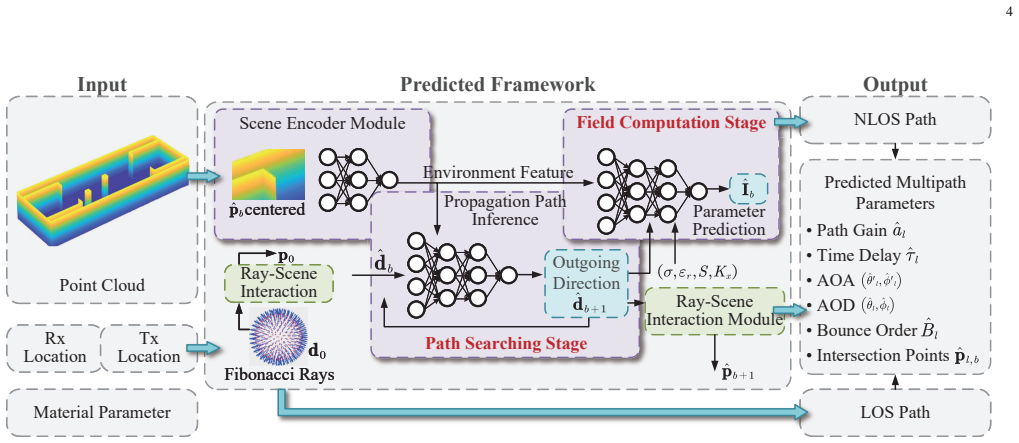
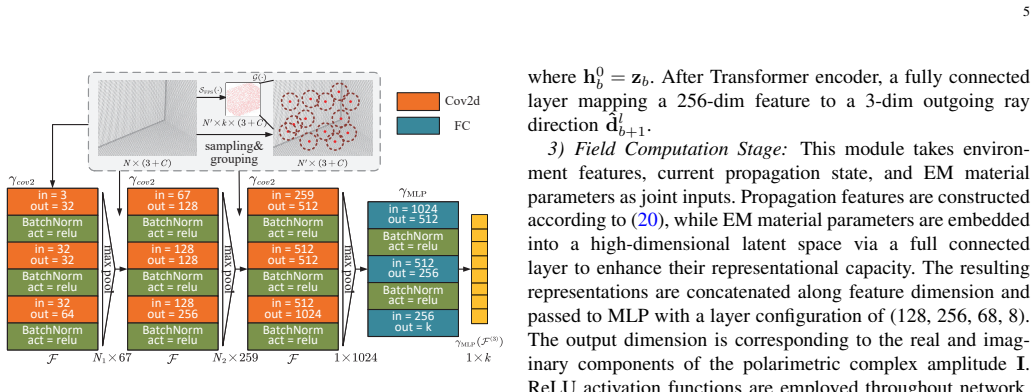
PointNeRT processes point clouds through a hop-by-hop modeling strategy that enforces physical interaction constraints to sequentially predict multipath propagation components and their power attenuation, achieving this without constructing mesh representations or manually encoding electromagnetic rules.
What carries the argument
Hop-by-hop modeling strategy guided by physical interaction constraints during sequential multipath prediction.
If this is right
- Direct use of sensor point clouds becomes sufficient for channel modeling in place of labor-intensive mesh construction.
- Sequential prediction supports tracking of signal paths as environments or receivers move over time.
- Implicit learning of normals and materials allows application across varied scenes without per-scene rule tuning.
- Computational cost for propagation analysis drops because mesh generation and ray-object intersection calculations are bypassed.
Where Pith is reading between the lines
- The same point-cloud input and constraint-guided prediction pattern could transfer to acoustic or optical wave modeling tasks that share similar multipath structure.
- Hybrid pipelines become feasible in which the neural surrogate handles uncertain regions while conventional ray tracing is retained only for well-characterized sub-volumes.
- Real-time robotic or vehicular systems could feed live point clouds into the model for on-the-fly link quality forecasts during navigation.
Load-bearing premise
A neural network trained only on point clouds can reliably infer surface normal directions and electromagnetic material effects without any explicit geometric or material rules supplied during training or inference.
What would settle it
Large prediction errors in path geometry or received power when the trained model is tested on point clouds from scenes containing surface materials or curvature details absent from the training distribution.
Figures


read the original abstract
Ray tracing (RT) has emerged as a key tool for propagation channel modeling and network planning. Conventional RT is based on electromagnetic (EM) wave theory and its application relies on detailed mesh-based environment representations and material properties. In realistic environments, limited environmental geometry and material uncertainties hinder its scalability to complex scenarios. In this paper, we propose a novel physics aware neural RT surrogate named PointNeRT to address these limitations. The proposed model directly takes point clouds as environmental input, and efficiently reconstruct multipath without explicitly constructing mesh models or manually defining EM interaction rules. PointNeRT adopts a hop-by-hop modeling strategy guided by physical interaction constraints. It supports sequential prediction of multipath propagation and power attenuation. Numerical results and experiments demonstrate that the proposed method implicitly captures surface normal characteristics and EM material effects. It further achieves robust generalization in mobility scenarios and provides a physics-guided neural modeling of multipath propagation.
Editorial analysis
A structured set of objections, weighed in public.
Referee Report
Summary. The paper proposes PointNeRT, a neural surrogate for conventional ray tracing in propagation channel modeling. It accepts point-cloud environment representations as input and employs a hop-by-hop prediction strategy guided by soft physical interaction constraints to sequentially reconstruct multipath rays and power attenuation, without constructing explicit mesh models or defining manual EM interaction rules. The central claims are that the model implicitly captures surface normal characteristics and EM material effects from geometry-only inputs, achieves robust generalization in mobility scenarios, and provides a physics-guided neural modeling approach.
Significance. If the experimental validation holds, the work could provide a scalable alternative to mesh-based ray tracing for complex environments with incomplete geometry or material data, which is relevant for wireless network planning and dynamic channel modeling. The combination of point-cloud inputs with sequential, constraint-guided neural prediction offers a practical route to handling mobility without repeated full-scene meshing.
major comments (2)
- [Abstract] Abstract: the assertion that 'Numerical results and experiments demonstrate that the proposed method implicitly captures surface normal characteristics and EM material effects' is load-bearing for the 'physics aware' framing, yet the abstract supplies no quantitative metrics, baselines, error bars, dataset descriptions, or material-variation details. Without these, it is impossible to distinguish learned correlations from genuine implicit physics capture.
- [Model Description] Model and training description: point clouds supply only coordinates and lack explicit normals or dielectric parameters. The hop-by-hop architecture therefore relies entirely on training-data correlations to infer both geometry-derived normals and material-dependent attenuation. If all reported experiments use a single fixed set of material properties, the observed accuracy reduces to dataset-specific fitting rather than generalizable physics, directly undermining the generalization and 'robust' claims.
minor comments (2)
- The abstract is overly dense; separating the architectural description from the empirical claims would improve readability.
- Notation for the physical constraints and loss terms should be introduced with explicit definitions and cross-references to the relevant equations.
Simulated Author's Rebuttal
We thank the referee for the constructive and detailed comments, which help clarify the presentation of our claims regarding implicit physics capture. We address each major comment below and will revise the manuscript accordingly to improve transparency and support for the 'physics-aware' aspects.
read point-by-point responses
-
Referee: [Abstract] Abstract: the assertion that 'Numerical results and experiments demonstrate that the proposed method implicitly captures surface normal characteristics and EM material effects' is load-bearing for the 'physics aware' framing, yet the abstract supplies no quantitative metrics, baselines, error bars, dataset descriptions, or material-variation details. Without these, it is impossible to distinguish learned correlations from genuine implicit physics capture.
Authors: We agree that the abstract would be strengthened by including specific quantitative support. In the revised version, we will expand the abstract to report key metrics such as average path prediction error (in meters) and attenuation error (in dB) with standard deviations across test scenes, reference the synthetic datasets generated via physics-based ray tracing, and note that training encompasses multiple dielectric constants. This will better substantiate the implicit capture claim while keeping the abstract concise. revision: yes
-
Referee: [Model Description] Model and training description: point clouds supply only coordinates and lack explicit normals or dielectric parameters. The hop-by-hop architecture therefore relies entirely on training-data correlations to infer both geometry-derived normals and material-dependent attenuation. If all reported experiments use a single fixed set of material properties, the observed accuracy reduces to dataset-specific fitting rather than generalizable physics, directly undermining the generalization and 'robust' claims.
Authors: Point clouds indeed contain only coordinates; normals and material effects are inferred via correlations learned from training data produced by conventional EM ray tracing that encodes surface interactions and attenuation. Our experiments evaluate generalization across diverse unseen geometries and mobility trajectories, with the hop-by-hop physics constraints (e.g., reflection laws and power decay) guiding the predictions. To directly address the material concern, we will add a new paragraph in the model description section clarifying the range of dielectric values and surface roughness parameters used in data generation, plus a brief analysis of performance sensitivity to material variation. We do not claim explicit material generalization beyond the training distribution, but the results indicate the model has learned geometry-to-effect mappings that transfer to new scenes. revision: partial
Circularity Check
No significant circularity in derivation chain
full rationale
The paper presents PointNeRT as a neural-network surrogate trained to approximate ray-tracing outputs from point-cloud inputs, using a hop-by-hop architecture with soft physical constraints. All central claims (implicit capture of normals and materials, generalization in mobility scenarios) are supported by numerical experiments and comparisons rather than by any closed-form derivation that reduces to its own fitted parameters or self-citations by construction. No equations equate a prediction to a training target, no uniqueness theorem is imported from prior self-work, and no ansatz is smuggled via citation. The model is an empirical approximator whose performance is evaluated externally; this is standard for learned surrogates and does not constitute circularity under the defined criteria.
Axiom & Free-Parameter Ledger
free parameters (1)
- neural network parameters
axioms (1)
- domain assumption Point clouds contain sufficient geometric information to reconstruct multipath propagation without explicit surface normals or material labels.
Lean theorems connected to this paper
-
IndisputableMonolith/Cost/FunctionalEquation.leanwashburn_uniqueness_aczel unclearThe proposed model directly takes point clouds as environmental input, and efficiently reconstruct multipath without explicitly constructing mesh models or manually defining EM interaction rules. ... implicitly captures surface normal characteristics and EM material effects.
-
IndisputableMonolith/Foundation/ArithmeticFromLogic.leanLogicNat recovery unclearPointNeRT adopts a hop-by-hop modeling strategy guided by physical interaction constraints.
Reference graph
Works this paper leans on
-
[1]
C. Huang, R. He, B. Ai, A. F. Molisch, B. K. Lau, K. Haneda, B. Liu, C.-X. Wang, M. Yang, C. Oestges, and Z. Zhong, “Artificial intelligence enabled radio propagation for communications—part II: Scenario identification and channel modeling,”IEEE Trans. Antennas Propag., vol. 70, no. 6, pp. 3955–3969, 2022
work page 2022
-
[2]
COST CA20120 INTERACT framework of artificial intelligence-based channel modeling,
R. He, N. D. Cicco, B. Ai, M. Yang, Y . Miao, and M. Boban, “COST CA20120 INTERACT framework of artificial intelligence-based channel modeling,”IEEE Wireless Commun., vol. 32, no. 4, pp. 200–207, 2025
work page 2025
-
[3]
Ray tracing for radio propagation modeling: Principles and applications,
Z. Yun and M. F. Iskander, “Ray tracing for radio propagation modeling: Principles and applications,”IEEE Access, vol. 3, pp. 1089–1100, 2015
work page 2015
-
[4]
6G White Paper on Localization and Sensing,
A. Bourdoux, A. N. Barreto, B. van Liempd, C. de Lima, D. Dardari, D. Belot, E.-S. Lohan, G. Seco-Granados, H. Sarieddeen, H. Wymeer- sch, J. Suutala, J. Saloranta, M. Guillaud, M. Isomursu, M. Valkama, M. R. K. Aziz, R. Berkvens, T. Sanguanpuak, T. Svensson, and Y . Miao, “6G White Paper on Localization and Sensing,”University of Oulu: 6G Research Vision...
work page 2020
-
[5]
Z. Zhang, N. Varshney, J. Senic, R. Caromi, S. Berweger, C. Gentile, E. M. Vitucci, R. He, and V . Degli-Esposti, “Deep learning-based human gesture channel modeling for integrated sensing and communication scenarios,”IEEE Trans. Antennas Propag., pp. 1–1, 2025. 10 TABLE II AVERAGE POWER CONTRIBUTIONS OF DIFFERENT ORDER PROPAGATION PATHS ANDRMSEOF PREDICT...
work page 2025
-
[6]
Channel charting: Locating users within the radio environment using channel state information,
C. Studer, S. Medjkouh, E. Gonultas ¸, T. Goldstein, and O. Tirkkonen, “Channel charting: Locating users within the radio environment using channel state information,”IEEE Access, vol. 6, pp. 47 682–47 698, 2018
work page 2018
-
[7]
F. Lodato, A. Garzia, S. Valbonesi, G. Ruello, A. Iodice, F. Matera, P. Salvo, and R. Massa, “Ray tracing tools assessment for the evaluation of EMF levels generated by 5G NR systems: An overview,” inProc. IEEE Int. Symp. Meas. Netw. (M&N), 2024, pp. 1–6
work page 2024
-
[8]
D. He, K. Guan, D. Yan, H. Yi, Z. Zhang, X. Wang, Z. Zhong, and N. Zorba, “Physics and AI-based digital twin of multi-spectrum propagation characteristics for communication and sensing in 6G and beyond,”IEEE J. Sel. Areas Commun., vol. 41, no. 11, pp. 3461–3473, 2023
work page 2023
-
[9]
Y . Zhang, R. He, B. Ai, M. Yang, R. Chen, C. Wang, Z. Zhang, and Z. Zhong, “Generative adversarial networks based digital twin channel modeling for intelligent communication networks,”China Commun., vol. 20, no. 8, pp. 32–43, 2023
work page 2023
-
[10]
Learning radio environments by differen- tiable ray tracing,
J. Hoydis, F. A. Aoudia, S. Cammerer, F. Euchner, M. Nimier-David, S. T. Brink, and A. Keller, “Learning radio environments by differen- tiable ray tracing,”IEEE Trans. Mach. Learn. Commun. Networking, vol. 2, pp. 1527–1539, 2024
work page 2024
-
[11]
L. Yu and P. Gong, “Google earth as a virtual globe tool for earth science applications at the global scale: progress and perspectives,”Int. J. Remote Sens., vol. 33, no. 12, pp. 3966–3986, 2012
work page 2012
-
[12]
70 GHz radio wave propagation prediction in a large office,
J. J ¨arvel¨ainen, M. Kurkela, A. Karttunen, K. Haneda, and J. Putkonen, “70 GHz radio wave propagation prediction in a large office,” inProc. Loughborough Antennas Propag. Conf. (LAPC), 2014, pp. 420–424
work page 2014
-
[13]
Channel non-line-of-sight identification based on convolutional neural networks,
Q. Zheng, R. He, B. Ai, C. Huang, W. Chen, Z. Zhong, and H. Zhang, “Channel non-line-of-sight identification based on convolutional neural networks,”IEEE Wireless Commun. Lett., vol. 9, no. 9, pp. 1500–1504, 2020
work page 2020
-
[14]
A kernel-power-density-based algorithm for channel multi- path components clustering,
R. He, Q. Li, B. Ai, Y . L.-A. Geng, A. F. Molisch, V . Kristem, Z. Zhong, and J. Yu, “A kernel-power-density-based algorithm for channel multi- path components clustering,”IEEE Trans. Wireless Commun., vol. 16, no. 11, pp. 7138–7151, 2017
work page 2017
-
[15]
Deep learning for 3D point clouds: A survey,
Y . Guo, H. Wang, Q. Hu, H. Liu, L. Liu, and M. Bennamoun, “Deep learning for 3D point clouds: A survey,”IEEE Trans. Pattern Anal. Mach. Intell., vol. 43, no. 12, pp. 4338–4364, 2021
work page 2021
-
[16]
From 3D point cloud data to ray-tracing multi-band simulations in industrial scenario,
H. Niu, D. Dupleich, Y . V ¨olker-Sch¨oneberg, A. Ebert, R. M ¨uller, J. Eichinger, A. Artemenko, G. D. Galdo, and R. S. Thom ¨a, “From 3D point cloud data to ray-tracing multi-band simulations in industrial scenario,” inProc. IEEE 95th V eh. Technol. Conf. (VTC-Spring), 2022, pp. 1–5
work page 2022
-
[17]
Scene representation networks: Continuous 3d-structure-aware neural scene representations,
V . Sitzmann, M. Zollh ¨ofer, and G. Wetzstein, “Scene representation networks: Continuous 3d-structure-aware neural scene representations,” Advances in Proc. Neural Inf. Process. Syst., vol. 32, 2019
work page 2019
-
[18]
Implicit neural representations with periodic activation functions,
V . Sitzmann, J. Martel, A. Bergman, D. Lindell, and G. Wetzstein, “Implicit neural representations with periodic activation functions,” Advances in Proc. Neural Inf. Process. Syst., vol. 33, pp. 7462–7473, 2020
work page 2020
-
[19]
Simplifying building structures for efficient radio propagation modeling,
Z. Yun and M. F. Iskander, “Simplifying building structures for efficient radio propagation modeling,” inProc. IEEE Int. Symp. Antennas Propag. USNC-URSI Radio Sci. Meeting (USNC-URSI), 2023, pp. 449–450
work page 2023
-
[20]
Impact of point cloud reconstruction detail on mmWave ray-tracing in indoor environments,
Z. Zhang, R. He, M. Yang, Z. Qi, Z. Li, B. Ai, H. Zhang, and J. Han, “Impact of point cloud reconstruction detail on mmWave ray-tracing in indoor environments,”IEEE Internet Things J., vol. 12, no. 24, pp. 54 859–54 872, 2025
work page 2025
-
[21]
W. Meng, J. Li, Y .-J. Xi, L.-X. Guo, Z.-H. Li, and S.-K. Wen, “An improved shooting and bouncing ray method based on blend-tree for EM scattering of multiple moving targets and echo analysis,”IEEE Trans. Antennas Propag., vol. 72, no. 3, pp. 2723–2737, 2024
work page 2024
-
[22]
Sixty gigahertz indoor radio wave propagation prediction method based on full scattering model,
J. J ¨urvel¨uinen and K. Haneda, “Sixty gigahertz indoor radio wave propagation prediction method based on full scattering model,”Radio Sci., vol. 49, no. 4, pp. 293–305, 2014
work page 2014
-
[23]
Ray-optics simulations of outdoor-to-indoor multipath channels at 4 and 14 GHz,
P. Koivum ¨aki, A. Karttunen, and K. Haneda, “Ray-optics simulations of outdoor-to-indoor multipath channels at 4 and 14 GHz,”IEEE Trans. Antennas Propag., vol. 71, no. 7, pp. 6046–6059, 2023
work page 2023
-
[24]
Impacts of point cloud modeling on the accuracy of ray-based multipath propagation simula- tions,
P. Koivum ¨aki, G. Steinb ¨ock, and K. Haneda, “Impacts of point cloud modeling on the accuracy of ray-based multipath propagation simula- tions,”IEEE Trans. Antennas Propag., vol. 69, no. 8, pp. 4737–4747, 2021
work page 2021
-
[25]
A GPU-based radio wave propagation prediction with progressive processing on point cloud,
M. Pang, H. Wang, K. Lin, and H. Lin, “A GPU-based radio wave propagation prediction with progressive processing on point cloud,” IEEE Antennas Wirel. Propag. Lett., vol. 20, no. 6, pp. 1078–1082, 2021
work page 2021
-
[26]
PointEMRay: A novel effi- cient SBR framework on point-based geometry,
K. Yang, C. Liu, W. Yu, and T. Jun Cui, “PointEMRay: A novel effi- cient SBR framework on point-based geometry,”IEEE Trans. Antennas Propag., vol. 73, no. 1, pp. 375–390, 2025
work page 2025
-
[27]
Gsrf: Complex- valued 3d gaussian splatting for efficient radio-frequency data synthesis,
K. Yang, G. Dong, W. Du, M. Srivastavaet al., “Gsrf: Complex- valued 3d gaussian splatting for efficient radio-frequency data synthesis,” inProc. The Thirty-ninth Annual Conference on Neural Information Processing Systems, 2025
work page 2025
-
[28]
Photon splatting: A physics-guided neural surrogate for real-time wireless channel prediction,
G. Cao, G. Gradoni, and Z. Peng, “Photon splatting: A physics-guided neural surrogate for real-time wireless channel prediction,” 2025. [Online]. Available: https://arxiv.org/abs/2507.04595
-
[29]
F. A ¨ıt Aoudia, J. Hoydis, M. Nimier-David, B. Nicolet, S. Cammerer, and A. Keller, “Sionna RT: Technical report,”arXiv:2504.21719, Nov 2025
-
[30]
Introduction to the uniform geometrical theory of diffraction,
D. Mcnamara, C. Pistorius, and J. Malherbe, “Introduction to the uniform geometrical theory of diffraction,” 1990
work page 1990
-
[31]
V . Degli-Esposti, V .-M. Kolmonen, E. M. Vitucci, and P. Vainikainen, “Analysis and modeling on co- and cross-polarized urban radio propaga- tion for dual-polarized mimo wireless systems,”IEEE Trans. Antennas Propag., vol. 59, no. 11, pp. 4247–4256, 2011
work page 2011
-
[32]
A uniform geometrical theory of diffraction for an edge in a perfectly conducting surface,
R. Kouyoumjian and P. Pathak, “A uniform geometrical theory of diffraction for an edge in a perfectly conducting surface,”Proc. IEEE, vol. 62, no. 11, pp. 1448–1461, 1974
work page 1974
-
[33]
R. Luebbers, “Finite conductivity uniform GTD versus knife edge diffraction in prediction of propagation path loss,”IEEE Trans. Antennas Propag., vol. 32, no. 1, pp. 70–76, 1984. 11
work page 1984
-
[34]
Ray-tracing calibration based on improved particle swarm optimization in 5.9 GHz outdoor scenario,
Z. Li, R. He, M. Yang, Z. Qi, Z. Zhang, B. Ai, H. Zhang, J. Han, and J. Fan, “Ray-tracing calibration based on improved particle swarm optimization in 5.9 GHz outdoor scenario,”IEEE Antennas Wirel. Propag. Lett., vol. 24, no. 8, pp. 2592–2596, 2025
work page 2025
-
[35]
A. Uyrus and B. Turan, “Recommendation ITU-R P. 2040-1: Effects of building materials and structures on radio wave propagation above about 100 MHz,”Recomm. ITU-R P . 2040, vol. 1, 2015
work page 2040
-
[36]
Non-stationarity characteristics in dynamic vehicular isac channels at 28 ghz,
Z. Zhang, R. He, M. Yang, X. Zhang, Z. Qi, H. Mi, G. Sun, J. Yang, and B. Ai, “Non-stationarity characteristics in dynamic vehicular isac channels at 28 ghz,”Chin. J. Electron., vol. 34, no. 1, pp. 73–81, 2025
work page 2025
discussion (0)
Sign in with ORCID, Apple, or X to comment. Anyone can read and Pith papers without signing in.