Recognition: 2 theorem links
· Lean TheoremGeometrical Imperfections in a Digital Quadrupole Mass Filter: A Comprehensive Simulation Study in the First Stability Zone
Pith reviewed 2026-05-13 04:29 UTC · model grok-4.3
The pith
Geometrical imperfections from rod radius and position variations degrade both mass resolution and ion transmission in rectangular-wave quadrupole mass filters, with results depending on the initial pulse waveform state.
A machine-rendered reading of the paper's core claim, the machinery that carries it, and where it could break.
Core claim
Simulations of a rectangular wave driven quadrupole mass filter operating in the first stability zone show that controlled radial asymmetries from single rod radius variation, single rod displacement, diagonal rod radius variation, and diagonal rod displacement introduce octupole field components. These distortions reduce mass resolution and ion transmission efficiency in every case examined. The results also exhibit a strong dependence on the initial state of the applied pulsed waveform, specifically which voltage level reaches the asymmetric rod pair first.
What carries the argument
Numerical integration of ion trajectories under the combined quadrupolar and octupole fields produced by controlled deviations in rod radius and position.
Load-bearing premise
The numerical simulations of field distortions and ion trajectories accurately capture real-device behavior without experimental validation or comparison to measured data.
What would settle it
Building a physical rectangular-wave quadrupole mass filter with rod imperfections matching the simulated geometries, then measuring its actual mass resolution and transmission efficiency for direct comparison to the simulation outputs.
Figures





read the original abstract
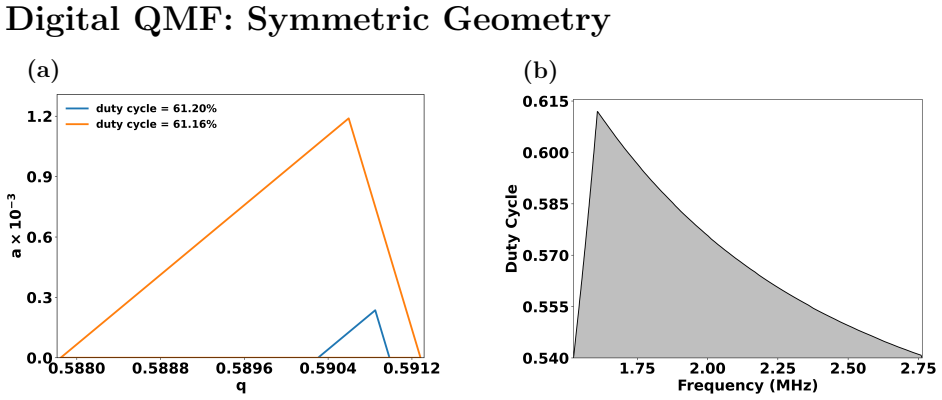
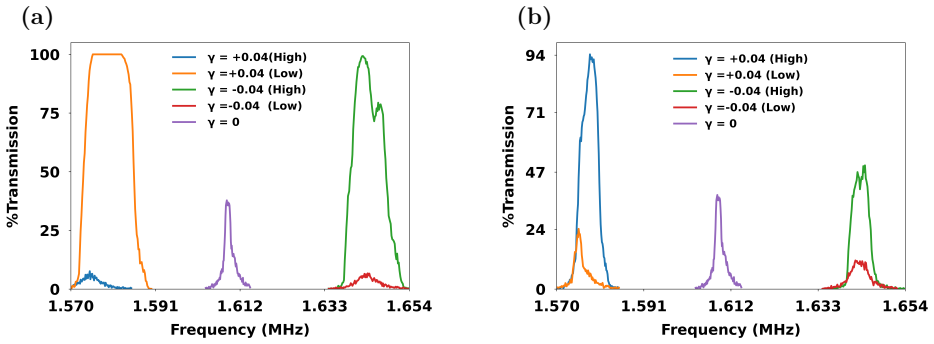
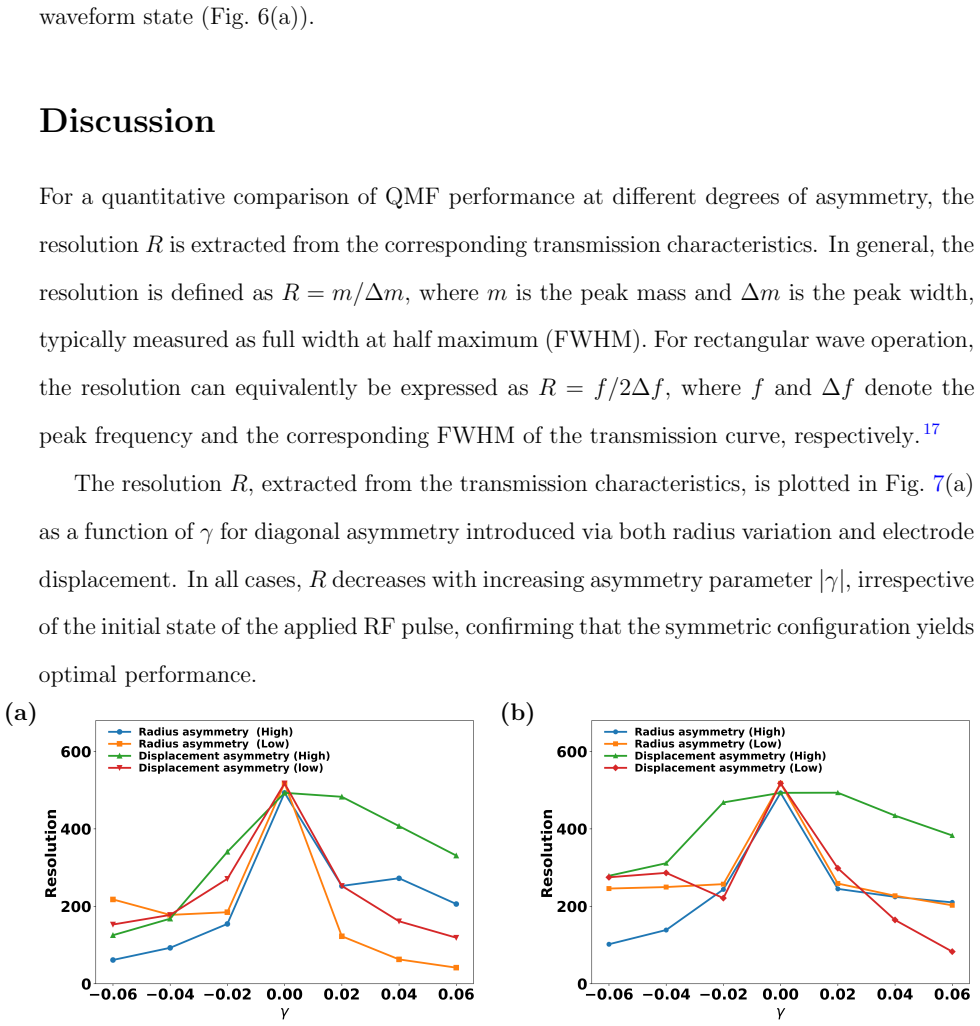
Geometrical imperfections in quadrupole mass filters introduce higher-order field components that can significantly influence device performance, particularly under non-sinusoidal excitation. In this work, a comprehensive simulation study is carried out to investigate the effect of geometrical imperfections on the performance of a rectangular wave driven quadrupole mass filter operating in the first stability zone. Radial field distortions arising from controlled variations in rod geometry and position, including single rod radius variation, single rod displacement, diagonal rod radius variation, and diagonal rod displacement, are examined. These imperfections introduce octupole field components that distort the ideal quadrupolar field distribution. The influence of such distortions on key performance parameters, namely mass resolution and ion transmission efficiency, is systematically evaluated. The results show that the presence of radial asymmetry leads to a degradation of both resolution and transmission efficiency in all cases considered. Furthermore, the study reveals a strong dependence of mass filter performance on the initial state of the applied pulsed waveform, specifically whether the asymmetric rod pair is subjected to the high or low level of the RF pulse. These findings provide important insights into the tolerance limits of geometrical imperfections and their impact on the performance of pulsed wave driven quadrupole mass filters, which are relevant for the design and optimization of high-resolution digital mass filtering systems.
Editorial analysis
A structured set of objections, weighed in public.
Referee Report
Summary. The paper conducts a simulation study of geometrical imperfections (single and diagonal rod radius/position variations) in a rectangular-wave-driven quadrupole mass filter operating in the first stability zone. It models the resulting octupole field distortions and reports that radial asymmetry degrades both mass resolution and ion transmission efficiency in all cases examined, with a strong additional dependence on whether the asymmetric rod pair is driven at the high or low level of the RF pulse.
Significance. If the numerical results hold, the work supplies useful design guidance on tolerance limits for digital quadrupole mass filters and underscores the importance of waveform phasing relative to geometric asymmetry. The systematic coverage of multiple imperfection types is a positive feature of the study.
major comments (3)
- [Methods / Simulation Setup] The central quantitative claims (degradation of resolution and transmission, plus waveform-initial-state dependence) rest on the accuracy of the electrostatic field solver and ion-trajectory integrator, yet the manuscript reports neither a mesh-convergence study nor a benchmark of the ideal (symmetric) case against the known analytic Mathieu stability boundaries for rectangular drive. This omission directly affects in the reported performance metrics.
- [Results / Discussion] No experimental validation or comparison to measured data from a physical device is provided, leaving open the possibility that unmodeled effects (space charge, collisions, non-ideal pulse shapes) alter the predicted degradation. The abstract itself notes the absence of details on mesh convergence, ion initial conditions, and error bars.
- [Results] The reported strong dependence on the initial state of the pulsed waveform is presented without accompanying sensitivity analysis to ion starting conditions or phase jitter, which is load-bearing for the claim that performance is “strongly” affected by this parameter.
minor comments (1)
- [Abstract] The abstract would benefit from a brief statement of the range of geometrical variations examined and the number of ions or trajectories used in the statistics.
Simulated Author's Rebuttal
We thank the referee for the constructive and detailed report. We have addressed each major comment point by point below. Revisions have been made to improve the reporting of simulation methods and to discuss limitations, while maintaining the scope of this computational study.
read point-by-point responses
-
Referee: [Methods / Simulation Setup] The central quantitative claims (degradation of resolution and transmission, plus waveform-initial-state dependence) rest on the accuracy of the electrostatic field solver and ion-trajectory integrator, yet the manuscript reports neither a mesh-convergence study nor a benchmark of the ideal (symmetric) case against the known analytic Mathieu stability boundaries for rectangular drive. This omission directly affects in the reported performance metrics.
Authors: We agree that explicit documentation of mesh convergence and analytic benchmarking would increase confidence in the results. We have now performed a mesh-refinement study across three successively finer discretizations of the electrode geometry; the computed octupole coefficients and ion trajectories converge to within 0.5 % once the mesh density exceeds the value used in the original runs. These data are presented in a new Appendix A. For the ideal symmetric case we have added a direct comparison of the numerically obtained stability boundaries against the analytic Mathieu stability diagram for rectangular-wave drive (reference to the known analytic expressions). The boundaries agree to better than 1 % in both a and q parameters. Both additions are incorporated in the revised Methods section. revision: yes
-
Referee: [Results / Discussion] No experimental validation or comparison to measured data from a physical device is provided, leaving open the possibility that unmodeled effects (space charge, collisions, non-ideal pulse shapes) alter the predicted degradation. The abstract itself notes the absence of details on mesh convergence, ion initial conditions, and error bars.
Authors: The work is a controlled simulation study of geometric imperfections under idealized conditions; experimental validation lies outside its present scope. We have expanded the Discussion to quantify the possible influence of space charge, residual gas collisions, and finite rise-time pulse shapes, and we now state the assumptions under which the reported degradation trends are expected to hold. Ion initial-condition distributions and statistical error estimation (standard deviations from 5000 trajectories per point) have been added to the Methods and Results sections. The abstract has been updated to remove the noted omissions and to reference the new validation material. revision: partial
-
Referee: [Results] The reported strong dependence on the initial state of the pulsed waveform is presented without accompanying sensitivity analysis to ion starting conditions or phase jitter, which is load-bearing for the claim that performance is “strongly” affected by this parameter.
Authors: We have performed additional sensitivity tests by varying ion starting positions within the acceptance ellipse, initial velocities corresponding to 300 K thermal spread, and introducing ±2° phase jitter on the RF waveform. Across these ensembles the qualitative ordering (high-level versus low-level asymmetry) and the magnitude of the resolution/transmission degradation remain unchanged; quantitative variations stay below 8 % in resolution and 5 % in transmission. These results are now shown in a new figure and accompanying text in the Results section, confirming that the reported dependence is robust under the examined perturbations. revision: yes
Circularity Check
No significant circularity; results are direct simulation outputs
full rationale
The paper conducts a numerical simulation study of electrostatic fields and ion trajectories in a digital quadrupole mass filter under imposed geometrical imperfections (rod radius/position variations). Performance metrics (resolution, transmission) are computed outputs from the field solver and trajectory integrator applied to the modified geometries and rectangular-wave drive. No parameters are fitted to data and then relabeled as predictions; no equations define a quantity in terms of itself; no load-bearing self-citations or uniqueness theorems are invoked. The central claims follow directly from the first-principles modeling without reduction to the inputs by construction, consistent with the reader's assessment of score 2.0.
Axiom & Free-Parameter Ledger
axioms (2)
- domain assumption Electrostatic field can be computed accurately from geometry via finite-element or similar numerical methods without significant truncation error
- standard math Ion trajectories are deterministic and follow classical mechanics under the computed fields
Lean theorems connected to this paper
-
IndisputableMonolith/Foundation/RealityFromDistinction.leanreality_from_one_distinction unclearThe motion of an ion ... is governed by the Hill differential equation: d²u/dξ² + (a_u + 2q_u S(ξ))u = 0 ... stability criterion |Tr(M)| ≤ 2
-
IndisputableMonolith/Cost/FunctionalEquation.leanwashburn_uniqueness_aczel unclearRadial asymmetry ... introduce octupole field components that distort the ideal quadrupolar field distribution
Reference graph
Works this paper leans on
-
[1]
Richards, J. A. and Huey, R. M. and Hiller, J. , title =. International Journal of Mass Spectrometry and Ion Physics , year =
-
[2]
Schrader, Robert L. and Anderson, Gordon A. and Russell, David H. , title =. Journal of the American Society for Mass Spectrometry , year =
-
[3]
International Journal of Mass Spectrometry , volume=
Mapping ion stability in digitally driven ion traps and guides , author=. International Journal of Mass Spectrometry , volume=. 2014 , publisher=
work page 2014
-
[4]
Capek, P. and Howdieshell, D. and Garand, E. , title =. Journal of the American Society for Mass Spectrometry , year =
-
[5]
Journal of Mass Spectrometry , volume=
Modelling some rod set imperfections of a quadrupole mass filter , author=. Journal of Mass Spectrometry , volume=. 2023 , publisher=
work page 2023
-
[6]
Journal of the American Society for Mass Spectrometry , year =
Jana, Sukanya and Bose, Snigdha and Chakraborty, Sayel and Mandal, Pintu and Deb, Nabanita , title =. Journal of the American Society for Mass Spectrometry , year =
-
[7]
International Journal of Mass Spectrometry , year =
Jana, Sukanya and Nath, Santu and Mandal, Pintu and Deb, Nabanita , title =. International Journal of Mass Spectrometry , year =
-
[8]
Journal of applied physics , volume=
Matrix solution of equations of the Mathieu-Hill type , author=. Journal of applied physics , volume=. 1953 , note =
work page 1953
-
[9]
Journal of the American Society for Mass Spectrometry , volume=
Matrix methods for the calculation of stability diagrams in quadrupole mass spectrometry , author=. Journal of the American Society for Mass Spectrometry , volume=. 2002 , publisher=
work page 2002
- [10]
-
[11]
Rapid Communications in Mass Spectrometry , volume=
Influence of the 6th and 10th spatial harmonics on the peak shape of a quadrupole mass filter with round rods , author=. Rapid Communications in Mass Spectrometry , volume=. 2002 , publisher=
work page 2002
-
[12]
Journal of the American Society for Mass Spectrometry , volume=
Linear quadrupoles with added hexapole fields , author=. Journal of the American Society for Mass Spectrometry , volume=. 2006 , publisher=
work page 2006
-
[13]
International Journal of Mass Spectrometry , volume=
Balance of the 6 TH and 10 TH spatial harmonics amplitudes of a quadrupole mass filter with round rods , author=. International Journal of Mass Spectrometry , volume=. 2022 , publisher=
work page 2022
-
[14]
Journal of mass spectrometry , volume=
Prediction of the effects of imperfect construction of a QMS filter , author=. Journal of mass spectrometry , volume=. 2008 , publisher=
work page 2008
-
[15]
Rapid Communications in Mass Spectrometry , volume=
Quadrupole mass filters with octopole fields , author=. Rapid Communications in Mass Spectrometry , volume=. 2003 , publisher=
work page 2003
-
[16]
Journal of Analytical Chemistry , volume=
Simulation of a Quadrupole Mass Filter with Octupole Field , author=. Journal of Analytical Chemistry , volume=. 2023 , publisher=
work page 2023
-
[17]
International Journal of Mass Spectrometry , volume=
Non-degenerate dodecapole resonances in an asymmetric linear ion trap of round rod geometry , author=. International Journal of Mass Spectrometry , volume=. 2024 , publisher=
work page 2024
-
[18]
Spatial harmonics of the field in a quadrupole mass filter with circular electrodes , author=. Technical Physics , volume=. 1999 , publisher=
work page 1999
-
[19]
Quadrupole mass spectrometry and its applications , author=. 2013 , publisher=
work page 2013
-
[20]
Journal of The American Society for Mass Spectrometry , volume=
Computational analysis of quadrupole mass filters employing nontraditional waveforms , author=. Journal of The American Society for Mass Spectrometry , volume=. 2016 , publisher=
work page 2016
-
[21]
Rapid Communications in Mass Spectrometry , volume=
Simulation study of digital waveform-driven quadrupole mass filter operated in higher stability regions for high-resolution inductively coupled plasma mass spectrometry , author=. Rapid Communications in Mass Spectrometry , volume=. 2024 , publisher=
work page 2024
-
[22]
International Journal of Mass Spectrometry , volume =
Influence of octupole field on quadrupole mass filter performance in the second stability zone , author =. International Journal of Mass Spectrometry , volume =. 2026 , issn =
work page 2026
-
[23]
International Journal of Mass Spectrometry , volume=
Simulations of a digital ion filter and a digital ion trap for heavy biomolecules , author=. International Journal of Mass Spectrometry , volume=. 2022 , publisher=
work page 2022
-
[24]
International Journal of Mass Spectrometry , volume=
Characterization of quadrupole mass filters operated with frequency-asymmetric and amplitude-asymmetric waveforms , author=. International Journal of Mass Spectrometry , volume=. 2016 , publisher=
work page 2016
-
[25]
Ein neues massenspektrometer ohne magnetfeld , author=. Zeitschrift f. 1953 , note=
work page 1953
-
[26]
Das elektrische massenfilter , author=. Zeitschrift f. 1955 , publisher=
work page 1955
-
[27]
International Journal of Mass Spectrometry , volume=
The stability diagram of the digital ion trap , author=. International Journal of Mass Spectrometry , volume=. 2013 , publisher=
work page 2013
-
[28]
European Journal of Mass Spectrometry , volume=
The second stability region of quadrupole mass filter with square wave shape power supply , author=. European Journal of Mass Spectrometry , volume=. 2025 , publisher=
work page 2025
-
[29]
Analytical chemistry , volume=
Optimization of a Digital Mass Filter for the Isolation of Intact Protein Complexes in Stability Zone 1, 1 , author=. Analytical chemistry , volume=. 2023 , publisher=
work page 2023
-
[30]
Mass Spectrometry Reviews , year=
The Development of the Digital Ion Trap , author=. Mass Spectrometry Reviews , year=
-
[31]
Simulation and modeling of quadrupole mass spectrometer fringing fields using SIMION , author=. 3rd International Conference on Applied Mathematics, Modelling, and Intelligent Computing (CAMMIC 2023) , volume=. 2023 , organization=
work page 2023
discussion (0)
Sign in with ORCID, Apple, or X to comment. Anyone can read and Pith papers without signing in.