Recognition: 2 theorem links
· Lean TheoremInformation-Preserving SGS model based on the local inter-scale equilibrium hypothesis
Pith reviewed 2026-05-13 04:52 UTC · model grok-4.3
The pith
Maximizing mutual information between turbulence scales derives parameter-free SGS model parameters that match empirical accuracy.
A machine-rendered reading of the paper's core claim, the machinery that carries it, and where it could break.
Core claim
By maximizing mutual information between scales, the model parameters are chosen so that the resolved field preserves the information content associated with the local inter-scale equilibrium hypothesis. This information-preserving procedure removes the need for separately prescribed empirical constants. The resulting model reproduces previously reported empirical parameter values in a priori tests and delivers comparable accuracy to existing SGS closures in both homogeneous and wall-bounded turbulence simulations.
What carries the argument
Mutual information maximization between resolved and subgrid scales, which enforces the information-preservation condition taken as equivalent to local inter-scale equilibrium.
If this is right
- The same parameter set can be used across different flow geometries and Reynolds numbers without retuning.
- Parameters acquire a clear physical meaning tied to information transfer rather than remaining free fitting coefficients.
- The model maintains accuracy levels already achieved by conventional SGS closures in both periodic-box and channel configurations.
Where Pith is reading between the lines
- The same information-maximization step could be applied to other scale-interaction closures in turbulence modeling.
- Direct comparison of mutual-information-derived parameters against those obtained from high-fidelity data in more complex geometries would test the claimed generality.
- Combining the information-preservation constraint with additional conservation laws might further reduce residual modeling error.
Load-bearing premise
Maximizing mutual information between scales directly implements the local inter-scale equilibrium hypothesis and thereby produces a model that generalizes without empirical parameters.
What would settle it
In a previously untested turbulent flow, the information-maximizing parameters produce noticeably larger errors than an empirically tuned reference model.
Figures





read the original abstract
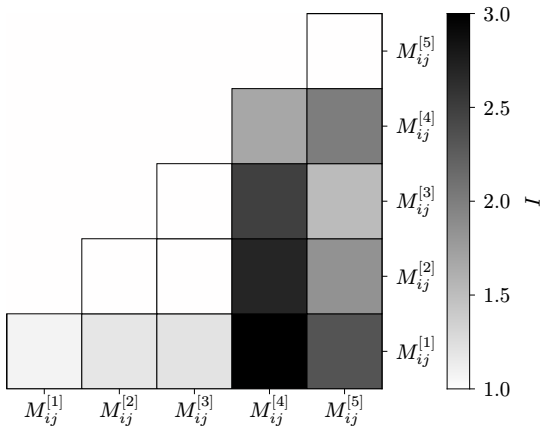
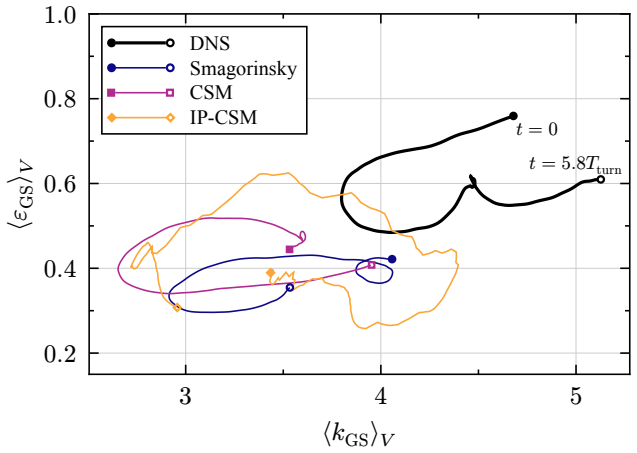
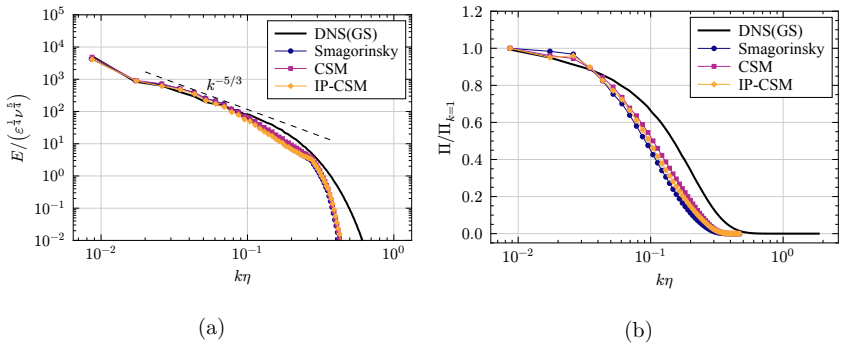
Large eddy simulation has been widely used to simulate turbulence at balanced computational cost and accuracy. Many Subgrid-Scale (SGS) models have been proposed over the years, where data-driven and machine learning-aided approaches set the recent trend. To address the problem of extrapolation in these models, we propose a new data-driven SGS model based on an information-theoretic picture of turbulence. To this end, we estimate the model parameters by maximizing mutual information, which correspond to the scale-by-scale local equilibrium hypothesis in developed turbulence or "information preservation." An a priori test confirmed that the estimated parameters are in good agreement with the previously reported empirical values. Furthermore, a posteriori tests on periodic box turbulence and channel turbulence exhibited accuracy comparable to the existing models. These results suggest the utility of the information-theoretic picture of turbulence for constructing more generic SGS models without the need for empirically prescribed model parameters, while enhancing physical interpretability beyond black-box approaches.
Editorial analysis
A structured set of objections, weighed in public.
Referee Report
Summary. The manuscript proposes an information-preserving subgrid-scale (SGS) model for large-eddy simulation by estimating model parameters through maximization of mutual information between resolved and unresolved scales. This procedure is asserted to implement the local inter-scale equilibrium hypothesis (or 'information preservation') in developed turbulence. An a priori test recovers previously reported empirical parameter values, while a posteriori tests on periodic-box turbulence and channel flow report accuracy comparable to standard SGS models such as Smagorinsky and dynamic variants. The work claims this yields more generic SGS models without empirically prescribed parameters and improves physical interpretability over black-box approaches.
Significance. If the asserted equivalence between mutual-information maximization and the local equilibrium hypothesis can be placed on a rigorous footing, the approach would supply a principled, interpretable route to SGS closure that reduces case-by-case tuning. The reported a priori consistency with independent empirical values and the a posteriori performance on two canonical flows constitute initial supporting evidence, though the absence of quantitative error metrics limits the strength of the generalization claim.
major comments (2)
- [Introduction and model formulation] Introduction and model-formulation section: the central claim that maximizing mutual information 'corresponds to' the scale-by-scale local equilibrium hypothesis is asserted without a derivation linking the information-theoretic objective to the Navier-Stokes equations, the constant inter-scale energy flux in the inertial range, or the equilibrium assumption. This equivalence is load-bearing for the assertion that the resulting model is hypothesis-driven rather than implicitly calibrated.
- [A posteriori tests] A posteriori tests section: the statement that the new model exhibits 'accuracy comparable to the existing models' is not accompanied by quantitative error norms, uncertainty estimates, or details on statistical sampling, rendering the comparability claim difficult to evaluate and weakening support for the generalization argument.
minor comments (3)
- [Abstract and Introduction] The abstract and introduction repeatedly use the phrase 'without the need for empirically prescribed model parameters,' yet the maximization step is performed on simulation data; a brief clarification of how this procedure differs from standard empirical calibration would improve clarity.
- [Results figures] Figures presenting a posteriori results would benefit from the inclusion of error bars or ensemble statistics to allow direct visual assessment of the reported comparability.
- [Methods] Notation for mutual information, filter scales, and the SGS stress tensor should be introduced with explicit definitions at first use to aid readers unfamiliar with the information-theoretic framing.
Simulated Author's Rebuttal
We thank the referee for the careful reading and constructive feedback. The comments highlight important areas for strengthening the manuscript: clarifying the link between mutual information maximization and the local inter-scale equilibrium hypothesis, and providing quantitative support for the a posteriori performance claims. We address each point below and will revise the manuscript to incorporate these improvements.
read point-by-point responses
-
Referee: Introduction and model formulation section: the central claim that maximizing mutual information 'corresponds to' the scale-by-scale local equilibrium hypothesis is asserted without a derivation linking the information-theoretic objective to the Navier-Stokes equations, the constant inter-scale energy flux in the inertial range, or the equilibrium assumption. This equivalence is load-bearing for the assertion that the resulting model is hypothesis-driven rather than implicitly calibrated.
Authors: We acknowledge that the current manuscript motivates the equivalence at a conceptual level, drawing on the physical picture that constant inter-scale energy flux in the inertial range implies local equilibrium, which in turn can be interpreted as preservation of information between scales. Maximizing mutual information is proposed as a way to enforce this preservation when estimating SGS parameters. However, we agree that a more explicit justification is needed to avoid the appearance of implicit calibration. In the revised manuscript we will expand the model formulation section with a dedicated paragraph (and supporting references) that steps through the reasoning: (i) the inertial-range flux constancy implies statistical equilibrium between adjacent scales, (ii) this equilibrium entails that resolved-scale statistics carry information about unresolved scales, and (iii) mutual-information maximization provides an information-theoretic proxy for maintaining that transfer without solving the full Navier-Stokes equations. While a complete first-principles derivation from the NS equations remains an open theoretical question, the added discussion will make the hypothesis-driven character of the approach transparent and distinguish it from purely data-driven fitting. revision: yes
-
Referee: A posteriori tests section: the statement that the new model exhibits 'accuracy comparable to the existing models' is not accompanied by quantitative error norms, uncertainty estimates, or details on statistical sampling, rendering the comparability claim difficult to evaluate and weakening support for the generalization argument.
Authors: We agree that the comparability statement requires quantitative backing. The original a posteriori tests compared mean profiles and spectra visually but did not report explicit error norms or sampling details. In the revised manuscript we will add tables (or inline values) reporting L2 norms of the mean velocity, Reynolds stresses, and energy spectra relative to DNS reference data for both the periodic-box and channel-flow cases. We will also include the temporal averaging windows, number of independent samples, and any uncertainty estimates obtained from multiple realizations or block bootstrapping. These additions will allow readers to assess the degree of comparability with the Smagorinsky and dynamic models in a statistically rigorous manner. revision: yes
Circularity Check
No circularity: derivation relies on posited equivalence rather than definitional reduction
full rationale
The paper asserts that maximizing mutual information corresponds to the local inter-scale equilibrium hypothesis and uses this to estimate SGS parameters, then validates via a priori agreement with prior empirical values and a posteriori tests on box and channel flows. No quoted equation or step reduces the central result to its inputs by construction (e.g., no parameter fit is relabeled as an independent prediction, no self-citation chain supplies a uniqueness theorem, and no ansatz is smuggled without external grounding). The information-theoretic framing is an interpretive step whose validity is left to the reader's assessment of the hypothesis, but the reported tests remain independent consistency checks rather than tautological outputs. This is the common case of a data-driven model with a physics-motivated ansatz that does not collapse mathematically onto its calibration data.
Axiom & Free-Parameter Ledger
free parameters (1)
- SGS model parameters
axioms (1)
- domain assumption scale-by-scale local equilibrium hypothesis in developed turbulence
Lean theorems connected to this paper
-
IndisputableMonolith/Cost/FunctionalEquation.leanwashburn_uniqueness_aczel echoesestimate the model parameters by maximizing mutual information, which correspond to the scale-by-scale local equilibrium hypothesis in developed turbulence or 'information preservation.'
-
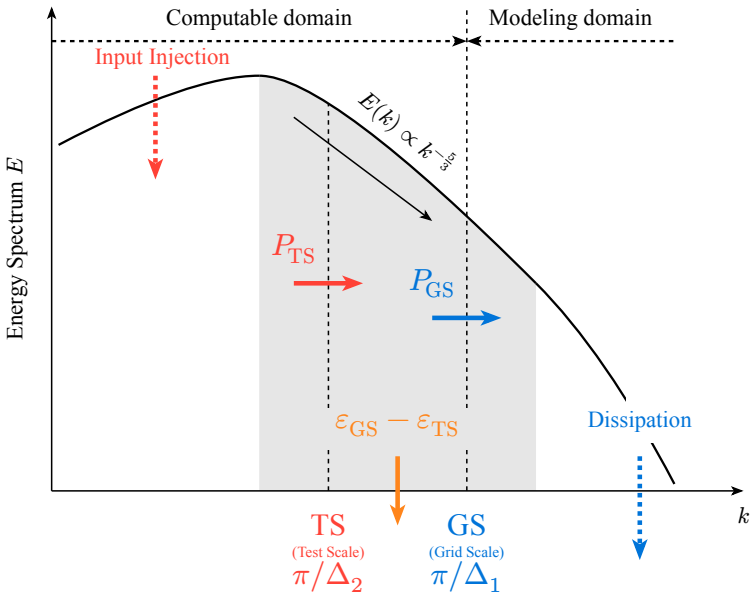
IndisputableMonolith/Foundation/ArrowOfTime.leanentropy_monotone echoeswe assume that the temporal variation of kTG is insensitive to the energy production and dissipation terms to obtain the local inter-scale equilibrium
Reference graph
Works this paper leans on
-
[1]
S. B. Pope, Turbulent flows, Measurement Science and Technology12, 2020 (2001)
work page 2020
-
[2]
Davidson,Turbulence: An Introduction for Scientists and Engineers(Oxford University Press, 2015)
P. Davidson,Turbulence: An Introduction for Scientists and Engineers(Oxford University Press, 2015)
work page 2015
-
[3]
Smagorinsky, General circulation experiments with the primitive equations: I
J. Smagorinsky, General circulation experiments with the primitive equations: I. the basic experiment, Monthly Weather Review91, 99 (1963)
work page 1963
-
[4]
M. Lesieur and O. Metais, New trends in large-eddy simulations of turbulence, Annual Review of Fluid Mechanics28, 45 (1996)
work page 1996
-
[5]
C. Meneveau and J. Katz, Scale-invariance and turbulence models for large-eddy simulation, Annual Review of Fluid Mechanics32, 1 (2000)
work page 2000
-
[6]
Y. Zhiyin, Large-eddy simulation: Past, present and the future, Chinese Journal of Aeronautics 28, 11 (2015)
work page 2015
-
[7]
T. Kajishima and K. Taira,Computational fluid dynamics: incompressible turbulent flows (Springer, 2016)
work page 2016
-
[8]
R. D. Moser, S. W. Haering, and G. R. Yalla, Statistical properties of subgrid-scale turbulence models, Annual Review of Fluid Mechanics53, 255 (2021). 24
work page 2021
-
[9]
M. Gamahara and Y. Hattori, Searching for turbulence models by artificial neural network, Physical Review Fluids2, 054604 (2017)
work page 2017
-
[10]
S. L. Brunton, B. R. Noack, and P. Koumoutsakos, Machine learning for fluid mechanics, Annual Review of Fluid Mechanics52, 477 (2020)
work page 2020
- [11]
-
[12]
A. Beck and M. Kurz, A perspective on machine learning methods in turbulence modeling, GAMM-Mitteilungen44, e202100002 (2021)
work page 2021
-
[13]
K. Duraisamy, Perspectives on machine learning-augmented Reynolds-averaged and large eddy simulation models of turbulence, Physical Review Fluids6, 050504 (2021)
work page 2021
-
[14]
P. Sharma, W. T. Chung, B. Akoush, and M. Ihme, A review of physics-informed machine learning in fluid mechanics, Energies16, 10.3390/en16052343 (2023)
-
[15]
Y. Zhang, D. Zhang, and H. Jiang, Review of challenges and opportunities in turbulence modeling: A comparative analysis of data-driven machine learning approaches, Journal of Marine Science and Engineering11, 10.3390/jmse11071440 (2023)
-
[16]
J. Park and H. Choi, Toward neural-network-based large eddy simulation: application to turbulent channel flow, Journal of Fluid Mechanics914, A16 (2021)
work page 2021
-
[17]
L. Yang, D. Li, K. Zhang, K. Luo, and J. Fan, Artificial neural-network-based subgrid-scale model for large-eddy simulation of isotropic turbulence, Physics of Fluids36, 075113 (2024)
work page 2024
-
[18]
M. Inubushi and S. Goto, Transfer learning for nonlinear dynamics and its application to fluid turbulence, Physical Review E102, 043301 (2020)
work page 2020
- [19]
-
[20]
K. Fukami and K. Taira, Grasping extreme aerodynamics on a low-dimensional manifold, Nature Communications14, 6480 (2023)
work page 2023
-
[21]
G. Boffetta, M. Cencini, M. Falcioni, and A. Vulpiani, Predictability: a way to characterize complexity, Physics Reports356, 367 (2002)
work page 2002
-
[22]
A. Vela-Mart´ ın and J. Jim´ enez, Entropy, irreversibility and cascades in the inertial range of isotropic turbulence, Journal of Fluid Mechanics915, A36 (2021)
work page 2021
-
[23]
A. Lozano-Dur´ an and G. Arranz, Information-theoretic formulation of dynamical sys- 25 tems: Causality, modeling, and control, Physical Review Research4, 10.1103/PhysRevRe- search.4.023195 (2022), 023195
- [24]
-
[25]
A. D. Bahamonde, P. Cornejo, and H. H. Sep´ ulveda, Laminar to turbulent transition in terms of information theory, Physica A: Statistical Mechanics and its Applications629, 129190 (2023)
work page 2023
-
[26]
T. Tanogami and R. Araki, Information-thermodynamic bound on information flow in turbu- lent cascade, Physical Review Research6, 013090 (2024)
work page 2024
-
[27]
T. Tanogami and R. Araki, Scale-to-scale information flow amplifies turbulent fluctuations, Physical Review Research7, 023078 (2025)
work page 2025
-
[28]
L. Engelmann, M. Ihme, I. Wlokas, and A. Kempf, Towards the suitability of information entropy as an LES quality indicator, Flow Turbulence Combust108, 353 (2022)
work page 2022
-
[29]
A. Vela-Mart´ ın, The uncertainty cascade in isotropic turbulence, Journal of Fluid Mechanics 1021, A8 (2025)
work page 2025
-
[30]
´A. Mart´ ınez-S´ anchez, G. Arranz, and A. Lozano-Dur´ an, Decomposing causality into its syn- ergistic, unique, and redundant components, Nature Communications15, 9296 (2024)
work page 2024
-
[31]
T. S. Lund and E. Novikov, Parameterization of subgrid-scale stress by the velocity gradient tensor, inProceedings of NASA Annual Research Briefs(1993) 94N12286
work page 1993
-
[32]
K. Horiuti, Backward scatter of subgrid-scale energy in wall-bounded and free shear turbu- lence, Journal of the Physical Society of Japan66, 91 (1997)
work page 1997
-
[33]
C. E. Shannon, A mathematical theory of communication, Bell System Technical Journal27, 379 (1948)
work page 1948
-
[34]
T. Tohme and W. Bialek, A brief tutorial on information theory, SciPost Physics Lecture Notes , 87 (2024)
work page 2024
-
[35]
S. Kullback and R. A. Leibler, On information and sufficiency, Annals of Mathematical Statis- tics22, 79 (1951)
work page 1951
-
[36]
H. Kobayashi, The subgrid-scale models based on coherent structures for rotating homoge- neous turbulence and turbulent channel flow, Physics of Fluids17, 045104 (2005)
work page 2005
-
[37]
M. H. Silvis,Physics-based turbulence models for large-eddy simulation: Theory and applica- 26 tion to rotating turbulent flows, PhD thesis, University of Groningen, The Netherlands (2020)
work page 2020
-
[38]
S. Laizet and E. Lamballais, High-order compact schemes for incompressible flows: A simple and efficient method with quasi-spectral accuracy, Journal of Computational Physics228, 5989 (2009)
work page 2009
-
[39]
P. Bartholomew, G. Deskos, R. A. Frantz, F. N. Schuch, E. Lamballais, and S. Laizet, Xcom- pact3d: An open-source framework for solving turbulence problems on a Cartesian mesh, SoftwareX12, 10.1016/j.softx.2020.100550 (2020), 100550
-
[40]
M. Germano, U. Piomelli, P. Moin, and W. H. Cabot, A dynamic subgrid-scale eddy viscosity model, Physics of Fluids A: Fluid Dynamics3, 1760 (1991)
work page 1991
-
[41]
T. Murota, A dynamic subgrid scale model of eddy viscosity type deduced from a local inter- scale equilibrium assumption of energy transfer, inThird Symposium on Turbulence and Shear Flow Phenomena(Begel House Inc., 2003)
work page 2003
-
[42]
S. Goto, Y. Saito, and G. Kawahara, Hierarchy of antiparallel vortex tubes in spatially periodic turbulence at high Reynolds numbers, Physical Review Fluids2, 064603 (2017)
work page 2017
-
[43]
A. Vela-Mart´ ın, Subgrid-scale models of isotropic turbulence need not produce energy backscatter, Journal of Fluid Mechanics937, A14 (2022)
work page 2022
- [44]
-
[45]
H. Abe, H. Kawamura, and Y. Matsuo, Direct numerical simulation of a fully developed turbulent channel flow with respect to the Reynolds number dependence, Journal of Fluids Engineering123, 382 (2001)
work page 2001
-
[46]
T. Tsukahara, Y. Seki, H. Kawamura, and D. Tochio, DNS of turbulent channel flow at very low Reynolds numbers, inProceeding of Fourth International Symposium on Turbulence and Shear Flow Phenomena(2005)
work page 2005
-
[47]
E. R. Van Driest, On turbulent flow near a wall, Journal of the Aeronautical Sciences23, 1007 (1956)
work page 1956
-
[48]
L. Marstorp, G. Brethouwer, O. Grundestam, and A. V. Johansson, Explicit algebraic subgrid stress models with application to rotating channel flow, Journal of Fluid Mechanics639, 403–432 (2009). 27 𝑀 [2] 𝑖𝑗 𝑀 [3] 𝑖𝑗 𝑀 [4] 𝑖𝑗 𝑀 [5] 𝑖𝑗 𝑀 [2] 𝑖𝑗 𝑀 [3] 𝑖𝑗 𝑀 [4] 𝑖𝑗 𝑀 [5] 𝑖𝑗 𝑀 [1] 𝑖𝑗 𝑀 [3] 𝑖𝑗 𝑀 [4] 𝑖𝑗 𝑀 [5] 𝑖𝑗 𝑀 [3] 𝑖𝑗 𝑀 [4] 𝑖𝑗 𝑀 [5] 𝑖𝑗 𝑀 [2] 𝑖𝑗 𝑀 [4] 𝑖𝑗 𝑀 [5] ...
work page 2009
-
[49]
D. Lilly, The representation of small-scale turbulence in numerical simulation experiments, NCAR Report 10.5065/D62R3PMM (1966)
-
[50]
Y. Morinishi and O. V. Vasilyev, A recommended modification to the dynamic two-parameter mixed subgrid scale model for large eddy simulation of wall bounded turbulent flow, Physics of Fluids13, 3400 (2001)
work page 2001
-
[51]
D. K. Lilly, A proposed modification of the germano subgrid-scale closure method, Physics of Fluids A: Fluid Dynamics4, 633 (1992)
work page 1992
-
[52]
Z. Yuan, Y. Wang, C. Xie, and J. Wang, Dynamic nonlinear algebraic models with scale- similarity dynamic procedure for large-eddy simulation of turbulence, Advances in Aerody- namics4, 16 (2022)
work page 2022
- [53]
-
[54]
E. Williams and A. Lozano-Duran, Information-theoretic approach for subgrid-scale modeling for high-speed compressible wall turbulence, inAIAA AVIATION 2022 Forum(2022) p. 3326
work page 2022
-
[55]
A. Freitas, L. Biferale, M. Desbrun, G. Eyink, A. A. Mailybaev, and K. Um, On the importance of stochasticity in closures of turbulence, Europhysics Letters154, 23002 (2026). 28 Appendix A: A Case with Three Model Terms In the main text, we discussed the model consists of two terms out of five candidates: see Eqs. (9) and (21). Here, we consider the model...
work page 2026
discussion (0)
Sign in with ORCID, Apple, or X to comment. Anyone can read and Pith papers without signing in.