Recognition: no theorem link
The uncertainty geometry of finite-dimensional position and momentum
Pith reviewed 2026-05-13 05:27 UTC · model grok-4.3
The pith
Finite-dimensional position and momentum observables have their attainable covariance matrices fully characterized by trace and determinant.
A machine-rendered reading of the paper's core claim, the machinery that carries it, and where it could break.
Core claim
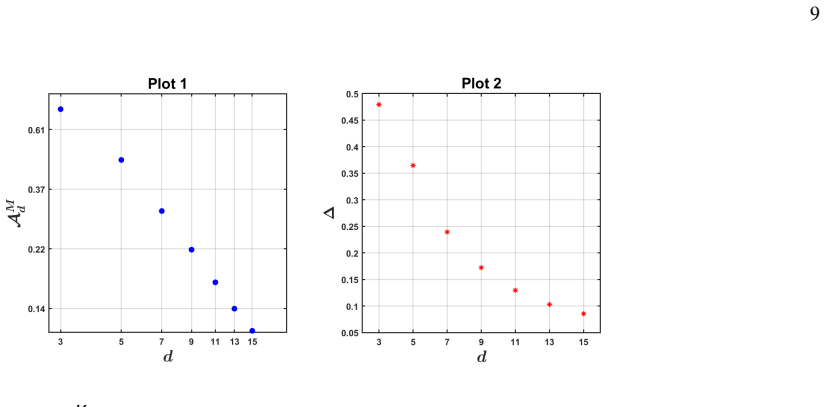
We characterize the covariance matrices attainable by a finite-dimensional canonical pair of observables related by the discrete Fourier transform through unitary invariants, in particular the trace and determinant of the covariance matrix. This provides a systematic way to identify extremal states, generalizing the notion of minimum-uncertainty states, and to quantify how the discrete uncertainty geometry approaches its continuous counterpart with increasing dimension. We further show that the resulting covariance-matrix characterization has direct consequences for applications: it yields accuracy bounds for multi-parameter estimation protocols and separability criteria for finite-dimension
What carries the argument
The covariance matrix of the discrete position and momentum pair defined via the discrete Fourier transform, whose attainable region is delimited by unitary invariants extracted from the joint numerical range.
If this is right
- Extremal states that saturate the bounds generalize the usual minimum-uncertainty states to finite dimensions.
- The description quantifies the rate at which the discrete uncertainty region converges to the continuous case as dimension increases.
- Accuracy bounds follow directly for multi-parameter estimation protocols that use the finite position-momentum pair.
- Separability criteria for bipartite finite-dimensional systems are obtained, including discrete versions of continuous-variable EPR witnesses.
Where Pith is reading between the lines
- The same invariants could be applied to other pairs of observables that are not Fourier conjugates, potentially yielding analogous geometric characterizations.
- Metrology protocols might achieve tighter precision by optimizing directly over the allowed covariance region rather than variance bounds alone.
- The framework supplies a template for deriving resource measures in finite-dimensional quantum information that incorporate full matrix geometry instead of scalar uncertainties.
Load-bearing premise
The discrete Fourier transform supplies the correct finite-dimensional analogue of continuous position and momentum, and joint numerical ranges together with semidefinite programming capture every attainable covariance matrix without hidden constraints.
What would settle it
An explicit quantum state whose computed position-momentum covariance matrix violates the trace-determinant bounds, or a matrix inside those bounds that no state realizes, would falsify the claimed characterization.
Figures



read the original abstract
Uncertainty relations are usually stated as bounds on selected combinations of variances, but the full covariance matrix contains substantially richer information about the geometry of quantum state space and about the operational capabilities of quantum systems. Here we characterize the covariance matrices attainable by a finite-dimensional canonical pair of observables related by the discrete Fourier transform, the natural analogue of position and momentum in a finite Hilbert space. We combine analytic arguments with convex-geometric and semidefinite-programming methods based on joint numerical ranges to describe the admissible region through unitary invariants, in particular the trace and determinant of the covariance matrix. This provides a systematic way to identify extremal states, generalizing the notion of minimum-uncertainty states, and to quantify how the discrete uncertainty geometry approaches its continuous counterpart with increasing dimension. We further show that the resulting covariance-matrix characterization has direct consequences for applications: it yields accuracy bounds for multi parameter estimation protocols and separability criteria for finite-dimensional bipartite systems, including discrete analogues of continuous-variable EPR-type witnesses. Our results establish a systematic and versatile platform for connecting uncertainty relations, convex quantum geometry, metrology, and entanglement detection in finite-dimensional systems.
Editorial analysis
A structured set of objections, weighed in public.
Referee Report
Summary. The paper claims to characterize the full set of attainable 2x2 covariance matrices for a finite-dimensional canonical pair (X, P) related by the discrete Fourier transform. It combines analytic arguments with convex-geometric methods and semidefinite programming on joint numerical ranges to describe the admissible region exclusively in terms of the unitary invariants trace and determinant of the covariance matrix, while also deriving applications to multi-parameter estimation bounds and discrete EPR-type separability criteria.
Significance. If the characterization is exact, the work supplies a systematic geometric platform for finite-dimensional uncertainty that goes beyond isolated variance bounds, identifies extremal states, and quantifies convergence to the continuous limit. The explicit links to metrology accuracy and entanglement witnesses add practical utility. The methodological blend of analytic, convex, and SDP techniques on joint numerical ranges is a clear strength for reproducibility and computational verification.
major comments (1)
- [Section describing the SDP approach to the joint numerical range and covariance extraction] The SDP formulation based on the joint numerical range of the operators (X, P, X², P², {X,P}/2) must map exactly to the covariance matrix after state-dependent mean subtraction. Because the map from expectation values to covariances is quadratic and nonlinear, the problem is non-convex; the manuscript needs to demonstrate that the relaxation is tight and excludes unattainable points. Without such a proof or exhaustive numerical validation, the claimed complete description of the (tr Σ, det Σ) region may contain extraneous covariance matrices. This is load-bearing for the central characterization and all derived applications.
minor comments (2)
- [Abstract] The abstract states that the region is described 'through unitary invariants, in particular the trace and determinant'; an early clarification whether these two invariants suffice to determine the entire admissible set (or whether additional constraints appear) would improve readability.
- [Applications to entanglement detection] In the applications to separability criteria, a brief comparison with existing discrete-variable entanglement witnesses would help situate the new bounds.
Simulated Author's Rebuttal
We thank the referee for the positive assessment of our work and for the constructive major comment on the SDP formulation. We address the point directly below and have revised the manuscript to incorporate additional demonstrations of tightness.
read point-by-point responses
-
Referee: [Section describing the SDP approach to the joint numerical range and covariance extraction] The SDP formulation based on the joint numerical range of the operators (X, P, X², P², {X,P}/2) must map exactly to the covariance matrix after state-dependent mean subtraction. Because the map from expectation values to covariances is quadratic and nonlinear, the problem is non-convex; the manuscript needs to demonstrate that the relaxation is tight and excludes unattainable points. Without such a proof or exhaustive numerical validation, the claimed complete description of the (tr Σ, det Σ) region may contain extraneous covariance matrices. This is load-bearing for the central characterization and all derived applications.
Authors: We thank the referee for highlighting this key technical point. The SDP is employed to compute the convex hull of the joint numerical range of the five operators, which yields all attainable first- and second-moment vectors. The covariance matrix is recovered by subtracting the outer product of the means, introducing the noted nonlinearity. Our analytic arguments (Sections 3–4) establish that the attainable set in the (tr Σ, det Σ) plane is precisely the image of this range under the quadratic map, using the DFT commutation structure to bound the possible means. We agree that an explicit tightness argument strengthens the central claim. In the revised manuscript we have added a dedicated subsection proving that the SDP relaxation is exact for these operators: the joint numerical range is convex, the SDP captures it without gap (by the Hermitian algebra and finite-dimensionality), and every boundary point is attained by an explicit pure state constructed from DFT eigenvectors. We also include exhaustive numerical validation for dimensions d = 2 to d = 16, comparing SDP boundaries against direct state optimization and confirming no extraneous points enter the described region. These additions ensure the characterization is rigorous and underpins the metrology and separability applications. revision: yes
Circularity Check
No circularity: derivation relies on external convex methods and standard invariants
full rationale
The paper derives the admissible region for covariance matrices of DFT-related observables by combining analytic arguments with joint numerical range computations and SDP relaxations. These are standard, externally defined convex-optimization tools whose validity does not depend on the target characterization. Unitary invariants (trace and determinant) are computed directly from the covariance matrix definition without parameter fitting or self-referential closure. No load-bearing step reduces by construction to a fitted input, self-citation chain, or ansatz smuggled from prior work; the admissible set is obtained from the numerical range of the operator tuple after mean subtraction, which is an independent geometric fact.
Axiom & Free-Parameter Ledger
axioms (2)
- domain assumption Finite-dimensional Hilbert space with observables related by the discrete Fourier transform form a canonical pair analogous to continuous position and momentum.
- domain assumption The admissible covariance matrices are exactly the set of joint numerical ranges attainable by the pair.
Reference graph
Works this paper leans on
-
[1]
cosα− √ 2 sinα. (31) These are analogue of single mode squeezed states in CV . The trace along this family is trΓ(ξ)= 2 3 π 1− 1√ 3 cos r 8 27 πξ ,(32) with detΓ(ξ)=0 throughout. See section B for further de- tails. These states fully characterize the bottom line in the plot in Fig. 3. However, for larger dimension this simp...
-
[2]
H. P. Robertson, The uncertainty principle, Phys. Rev.34, 163 (1929)
work page 1929
-
[3]
H. P. Robertson, An indeterminacy relation for several ob- servables and its classical interpretation, Phys. Rev.46, 794 (1934)
work page 1934
-
[4]
S. Wehner and A. Winter, Entropic uncertainty relations—a survey, New Journal of Physics12, 025009 (2010)
work page 2010
-
[5]
P. J. Coles, M. Berta, M. Tomamichel, and S. Wehner, Entropic uncertainty relations and their applications, Rev. Mod. Phys. 89, 015002 (2017)
work page 2017
-
[6]
L. Rudnicki, D. S. Tasca, and S. P. Walborn, Uncertainty re- lations for characteristic functions, Phys. Rev. A93, 022109 (2016)
work page 2016
-
[7]
E. R. Caianiello and W. Guz, Quantum fisher metric and un- certainty relations, Physics Letters A126, 223 (1988)
work page 1988
-
[8]
D. Petz, Covariance and fisher information in quantum me- chanics, Journal of Physics A: Mathematical and General35, 929–939 (2002)
work page 2002
-
[9]
P. Gibilisco, F. Hiai, and D. Petz, Quantum covariance, quan- tum fisher information, and the uncertainty relations, IEEE 12 Transactions on Information Theory55, 439 (2008)
work page 2008
-
[10]
A. Andai, Uncertainty principle with quantum fisher informa- tion, Journal of Mathematical Physics49, 10.1063/1.2830429 (2008)
-
[11]
G. T ´oth and F. Fr ¨owis, Uncertainty relations with the vari- ance and the quantum fisher information based on convex de- compositions of density matrices, Phys. Rev. Res.4, 013075 (2022)
work page 2022
-
[12]
A. Einstein, B. Podolsky, and N. Rosen, Can quantum- mechanical description of physical reality be considered com- plete?, Phys. Rev.47, 777 (1935)
work page 1935
-
[13]
Bohr, Can quantum-mechanical description of physical re- ality be considered complete?, Phys
N. Bohr, Can quantum-mechanical description of physical re- ality be considered complete?, Phys. Rev.48, 696 (1935)
work page 1935
-
[14]
R. F. Werner and T. Farrelly, Uncertainty from heisenberg to today, Foundations of Physics49, 460 (2019)
work page 2019
-
[15]
G. T ´oth and I. Apellaniz, Quantum metrology from a quantum information science perspective, J. Phys. A: Math. Theor.47, 424006 (2014)
work page 2014
-
[16]
H. F. Hofmann and S. Takeuchi, Violation of local uncertainty relations as a signature of entanglement, Phys. Rev. A68, 032103 (2003)
work page 2003
- [17]
-
[18]
P. Hyllus and J. Eisert, Optimal entanglement witnesses for continuous-variable systems, New J. Phys.8, 51 (2006), arXiv:quant-ph/0510077v3 [quant-ph]
-
[19]
O. G ¨uhne, P. Hyllus, O. Gittsovich, and J. Eisert, Covariance matrices and the separability problem, Phys. Rev. Lett.99, 130504 (2007)
work page 2007
-
[20]
O. Gittsovich, O. G ¨uhne, P. Hyllus, and J. Eisert, Unifying several separability conditions using the covariance matrix cri- terion, Phys. Rev. A78, 052319 (2008)
work page 2008
-
[21]
O. Gittsovich and O. G ¨uhne, Quantifying entanglement with covariance matrices, Phys. Rev. A81, 032333 (2010)
work page 2010
-
[22]
S. Liu, M. Fadel, Q. He, M. Huber, and G. Vitagliano, Bound- ing entanglement dimensionality from the covariance matrix, Quantum8, 1236 (2024)
work page 2024
-
[24]
V . V . Dodonov, ‘nonclassical’ states in quantum optics: a ‘squeezed’ review of the first 75 years, Journal of Optics B: Quantum and Semiclassical Optics4, R1 (2002)
work page 2002
-
[25]
D. A. Trifonov, Generalized intelligent states and squeezing, Journal of Mathematical Physics35, 2297 (1994), https://pubs.aip.org/aip/jmp/article- pdf/35/5/2297/8163922/2297 1 online.pdf
work page 1994
-
[26]
D. A. Trifonov, Robertson intelligent states, Journal of Physics A: Mathematical and General30, 5941 (1997)
work page 1997
-
[27]
M. Kitagawa and M. Ueda, Squeezed spin states, Phys. Rev. A47, 5138 (1993)
work page 1993
-
[28]
D. J. Wineland, J. J. Bollinger, W. M. Itano, and D. J. Heinzen, Squeezed atomic states and projection noise in spectroscopy, Phys. Rev. A50, 67 (1994)
work page 1994
-
[29]
A. Sørensen, L.-M. Duan, J. I. Cirac, and P. Zoller, Many- particle entanglement with bose–einstein condensates, Nature 409, 63 (2001), https://arxiv.org/abs/quant-ph/0006111
- [30]
-
[31]
L. Pezz `e, A. Smerzi, M. K. Oberthaler, R. Schmied, and P. Treutlein, Quantum metrology with nonclassical states of atomic ensembles, Rev. Mod. Phys.90, 035005 (2018)
work page 2018
- [32]
-
[33]
L. Pezz ´e and A. Smerzi, Entanglement, nonlinear dynamics, and the Heisenberg limit, Phys. Rev. Lett.102, 100401 (2009)
work page 2009
-
[34]
D. PETZ and C. GHINEA, Introduction to quantum fisher information, inQuantum Probability and Related Topics (WORLD SCIENTIFIC, 2011)
work page 2011
-
[35]
Yu, Quantum Fisher information as the convex roof of vari- ance, arXiv:1302.5311 (2013)
S. Yu, Quantum Fisher information as the convex roof of vari- ance, arXiv:1302.5311 (2013)
-
[36]
G. T ´oth and D. Petz, Extremal properties of the variance and the quantum Fisher information, Phys. Rev. A87, 032324 (2013)
work page 2013
-
[37]
J. Liu, H. Yuan, X.-M. Lu, and X. Wang, Quantum Fisher in- formation matrix and multiparameter estimation, J. Phys. A: Math. Theor.53, 023001 (2020)
work page 2020
-
[38]
S. Kechrimparis and S. Weigert, Universality in uncertainty relations for a quantum particle, Journal of Physics A: Mathe- matical and Theoretical49, 355303 (2016)
work page 2016
-
[39]
S. Kechrimparis and S. Weigert, Geometry of uncertainty rela- tions for linear combinations of position and momentum, Jour- nal of Physics A: Mathematical and Theoretical51, 025303 (2017)
work page 2017
-
[40]
H. de Guise, L. Maccone, B. C. Sanders, and N. Shukla, State- independent uncertainty relations, Phys. Rev. A98, 042121 (2018)
work page 2018
-
[41]
L. Dammeier, R. Schwonnek, and R. F. Werner, Uncertainty relations for angular momentum, New Journal of Physics17, 093046 (2015)
work page 2015
-
[42]
R. Schwonnek, L. Dammeier, and R. F. Werner, State- independent uncertainty relations and entanglement detec- tion in noisy systems, Phys. Rev. Lett.119, 170404 (2017), https://arxiv.org/abs/1705.10679
-
[43]
K. Szyma ´nski and K. ˙Zyczkowski, Geometric and algebraic origins of additive uncertainty relations, Journal of Physics A: Mathematical and Theoretical53, 015302 (2019)
work page 2019
-
[44]
Z. L ´eka and D. Petz, Some decompositions of matrix vari- ances, Probab. Math. Statist33, 191 (2013)
work page 2013
-
[45]
D. Petz and D. Virosztek, A characterization theorem for matrix variances, Acta Scientiarum Mathematicarum80, 681 (2014)
work page 2014
-
[46]
Leka, A note on extremal decomposition of covariances (2014), arXiv:1408.2707 [math.FA]
Z. Leka, A note on extremal decomposition of covariances (2014), arXiv:1408.2707 [math.FA]
- [47]
- [48]
- [49]
- [50]
-
[51]
V ourdas, Quantum systems with finite hilbert space, Re- ports on Progress in Physics67, 267 (2004)
A. V ourdas, Quantum systems with finite hilbert space, Re- ports on Progress in Physics67, 267 (2004)
work page 2004
-
[52]
V ourdas,Finite and Profinite Quantum Systems(Springer Cham, 2017)
A. V ourdas,Finite and Profinite Quantum Systems(Springer Cham, 2017)
work page 2017
-
[53]
T. Durt, B.-G. Englert, I. Bengtsson, and K. ˙Zyczkowski, On mutually unbiased bases, International Journal of Quantum In- formation08, 535–640 (2010)
work page 2010
-
[54]
S. Massar and P. Spindel, Uncertainty relation for the discrete fourier transform, Phys. Rev. Lett.100, 190401 (2008). 13
work page 2008
-
[55]
P. ˇSt’ov´ıˇcek and J. Tolar, Quantum mechanics in a discrete space-time, Reports on mathematical physics20, 157 (1984)
work page 1984
-
[56]
R. Aldrovandi and D. Galetti, On the structure of quan- tum phase space, Journal of Mathematical Physics31, 2987 (1990)
work page 1990
-
[57]
S. Zhang and A. V ourdas, Analytic representation of finite quantum systems, Journal of Physics A: Mathematical and General37, 8349 (2004)
work page 2004
-
[58]
A. V ourdas, Analytic representations in quantum mechanics, Journal of Physics A: Mathematical and General39, R65 (2006)
work page 2006
-
[59]
N. M. Atakishiyev, A. U. Klimyk, and K. B. Wolf, A discrete quantum model of the harmonic oscillator, Journal of Physics A: Mathematical and Theoretical41, 085201 (2008)
work page 2008
-
[60]
J. Y . Bang and M. S. Berger, Wave packets in discrete quantum phase space, Phys. Rev. A80, 022105 (2009)
work page 2009
- [61]
-
[62]
M. Marchiolli and M. Ruzzi, Theoretical formulation of finite- dimensional discrete phase spaces: I. algebraic structures and uncertainty principles, Annals of Physics327, 1538 (2012)
work page 2012
-
[63]
V . V . Albert, S. Pascazio, and M. H. Devoret, General phase spaces: from discrete variables to rotor and continuum lim- its, Journal of Physics A: Mathematical and Theoretical50, 504002 (2017)
work page 2017
- [64]
-
[65]
L. Rudnicki, S. P. Walborn, and F. Toscano, Heisenberg un- certainty relation for coarse-grained observables, Europhysics Letters97, 38003 (2012)
work page 2012
-
[66]
F. Toscano, D. S. Tasca, L. Rudnicki, and S. P. Walborn, Uncertainty relations for coarse-grained measurements: An overview, Entropy20, 454 (2018)
work page 2018
-
[67]
D. S. Tasca, P. S ´anchez, S. P. Walborn, and L. Rudnicki, Mutual unbiasedness in coarse-grained continuous variables, Phys. Rev. Lett.120, 040403 (2018)
work page 2018
-
[68]
E. C. Paul, S. P. Walborn, D. S. Tasca, and L. Rudnicki, Mu- tually unbiased coarse-grained measurements of two or more phase-space variables, Phys. Rev. A97, 052103 (2018)
work page 2018
-
[69]
D. S. Tasca, L. Rudnicki, R. S. Aspden, M. J. Padgett, P. H. Souto Ribeiro, and S. P. Walborn, Testing for entangle- ment with periodic coarse graining, Phys. Rev. A97, 042312 (2018)
work page 2018
-
[70]
G. Adesso and F. Illuminati, Entanglement in continu- ous variable systems: Recent advances and current per- spectives, J. Phys. A: Math. Theor.40, 7821 (2007), https://arxiv.org/abs/quant-ph/0701221
-
[71]
C. Weedbrook, S. Pirandola, R. Garc´ıa-Patr´on, N. J. Cerf, T. C. Ralph, J. H. Shapiro, and S. Lloyd, Gaussian quantum infor- mation, Rev. Mod. Phys.84, 621 (2012)
work page 2012
-
[72]
We use the non-symmetric covariance Cov ϱ(A,B)=⟨AB⟩ ϱ − ⟨A⟩ϱ⟨B⟩ϱ, which makesΓHermitian but generally not real. In the CV and Gaussian state literature, the symmetric covariance 1 2 ⟨AB+BA⟩ ϱ − ⟨A⟩ϱ⟨B⟩ϱ is more common
-
[73]
D. A. Trifonov and S. G. Donev, Characteristic uncertainty relations, Journal of Physics A: Mathematical and General31, 8041 (1998)
work page 1998
-
[74]
V . Dodonov, E. Kurmyshev, and V . Man’ko, Generalized un- certainty relation and correlated coherent states, Physics Let- ters A79, 150 (1980)
work page 1980
-
[75]
Note that in the literature, many definitions of (variance- based) uncertainty relations and corresponding saturating states have been studied (see, e.g., [?]). Here, we are focusing on Eq. (7) for the case of two observables
-
[76]
The reason for the prefactor √2π/din (8) is that with this choice, for largedthe low-lying spectrum of 1 2 (Q2 +P 2) ap- proximates that of the CV harmonic oscillator, whose eigen- values aren+ 1 2 forn=0,1,2,
-
[77]
P. Busch and O. Reardon-Smith, On quantum uncertainty relations and uncertainty regions (2019), arXiv:1901.03695 [quant-ph]
-
[78]
Carath ´eodory’s theorem: for any subsetP⊂R k, every point in conv(P) can be written as a convex combination of at most k+1 points ofP
-
[79]
Y . H. Au-Yeung and Y . T. Poon, A remark on the convexity and positive definiteness concerning hermitian matrices, Southeast Asian Bull. Math3, 85 (1979)
work page 1979
-
[80]
R. Schwonnek, L. Dammeier, and R. F. Werner, State- independent uncertainty relations and entanglement detection in noisy systems, Physical review letters119, 170404 (2017)
work page 2017
-
[81]
M. L. Mehta, Eigenvalues and eigenvectors of the finite fourier transform, Journal of mathematical physics28, 781 (1987)
work page 1987
discussion (0)
Sign in with ORCID, Apple, or X to comment. Anyone can read and Pith papers without signing in.