Recognition: 2 theorem links
· Lean TheoremPre-Asymptotic Trainability in Photonic Variational Circuits under Postselection
Pith reviewed 2026-05-13 05:19 UTC · model grok-4.3
The pith
Photonic variational circuits maintain polynomial gradient decay under allow-bunching and collision-free postselection.
A machine-rendered reading of the paper's core claim, the machinery that carries it, and where it could break.
Core claim
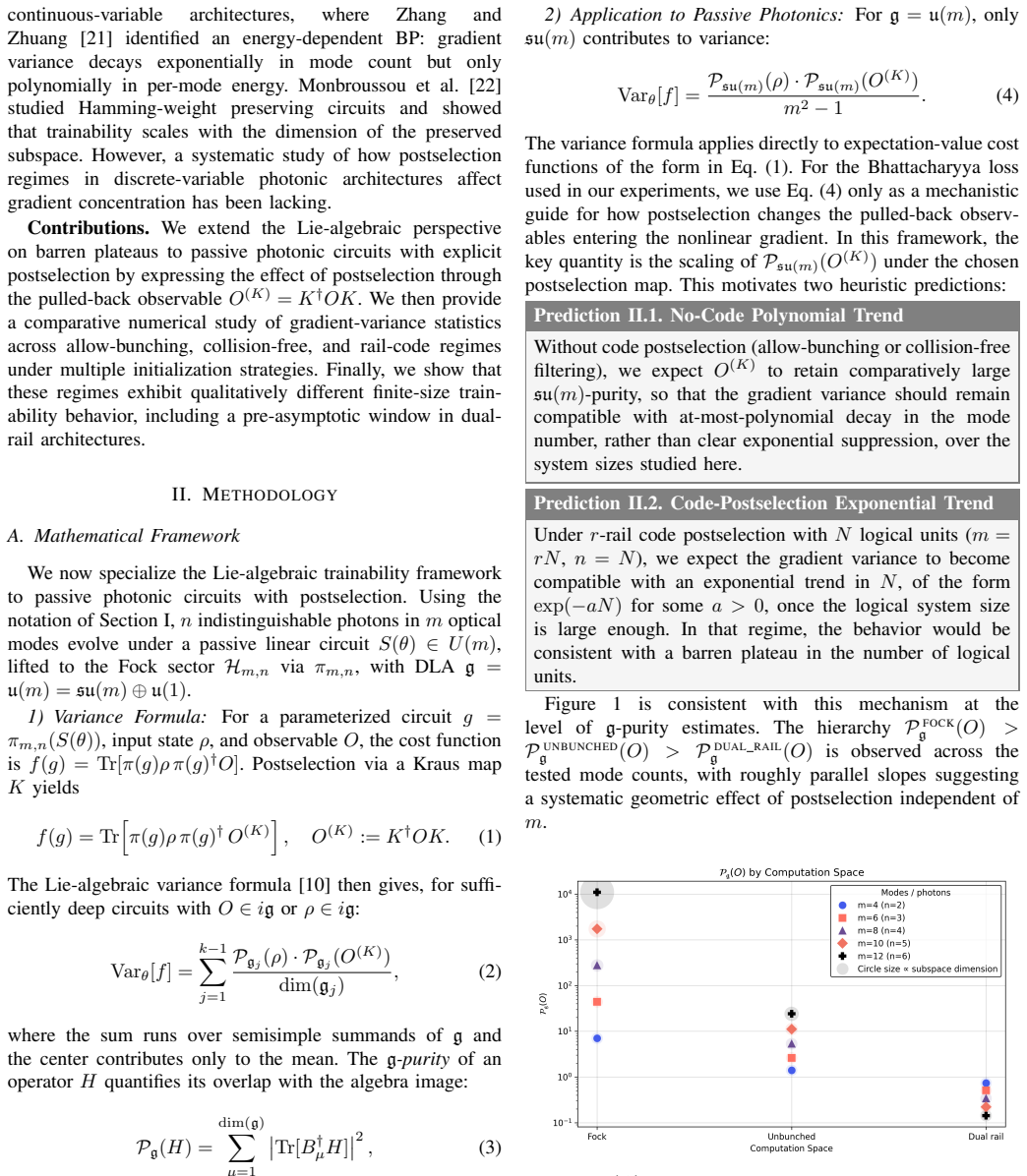
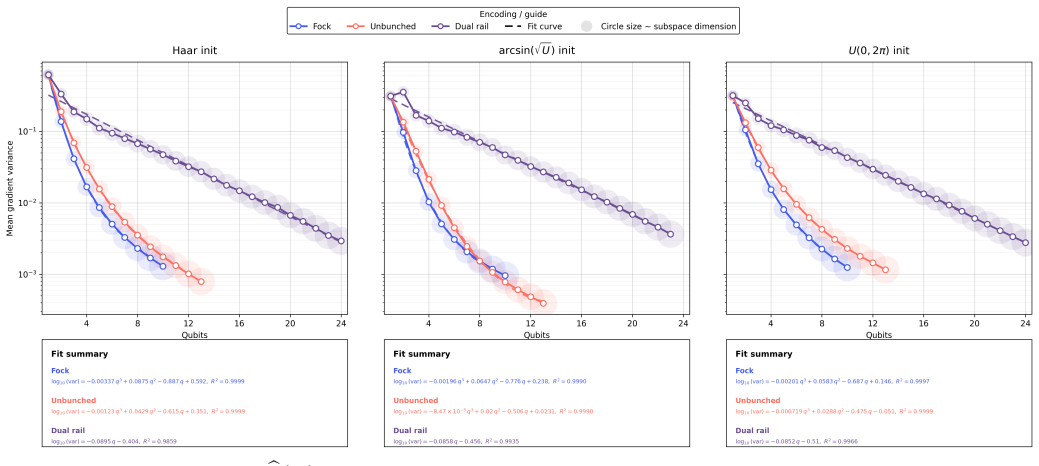
Gradient concentration in photonic variational circuits is governed by the interplay of passive linear-optical dynamics, postselection geometry, and task observables. Exact statevector simulations demonstrate that allow-bunching and collision-free postselection produce gradient variances consistent with polynomial decay over the tested system sizes and across three initialization ensembles, while dual-rail postselection induces exponential concentration beyond moderate sizes.
What carries the argument
Postselection regimes that reshape the effective observable under passive linear-optical dynamics whose Lie algebra dimension scales quadratically with mode number.
If this is right
- Photonic variational algorithms can remain trainable at moderate scales when allow-bunching or collision-free postselection is used.
- Postselection choice provides a practical lever to control gradient concentration without altering the underlying linear-optical circuit.
- Dual-rail encodings face earlier trainability limits and may need compensating strategies at scale.
- Near-term photonic variational architectures should favor postselection methods that preserve polynomial gradient scaling.
Where Pith is reading between the lines
- The same postselection distinction could guide design in other bosonic or continuous-variable variational algorithms.
- Hybrid circuits that switch postselection rules depending on layer depth might extend the trainable regime further.
- Testing the same regimes on hardware with realistic loss and noise would reveal how far the simulated polynomial scaling survives.
Load-bearing premise
The three postselection regimes and three initialization ensembles tested capture the pre-asymptotic behavior that matters for practical photonic variational algorithms.
What would settle it
A simulation or experiment that finds exponential decay of gradient variance in the allow-bunching regime at system sizes larger than those already tested would falsify the reported pre-asymptotic trainability.
Figures


read the original abstract
Barren plateaus in variational quantum circuits are commonly attributed to strong mixing dynamics that cause gradient variance to vanish exponentially with system size. Passive photonic circuits, central to linear optical quantum computing, challenge this picture: although their Hilbert space can be exponentially large, their dynamics are constrained to a Lie algebra whose dimension scales as the square of the number of modes. In photonic systems, postselection also plays a central role, with gradient concentration governed not by the Hilbert-space dimension but by how it reshapes the effective observable. Through exact statevector simulations, we compare allow-bunching evolution, collision-free filtering, and dual-rail postselection. In the allow-bunching and collision-free regimes, gradient variance remains consistent with polynomial rather than exponential decay over the tested system sizes. By contrast, dual-rail postselection induces exponential concentration beyond moderate system sizes, robustly across three initialization ensembles. These results indicate that photonic barren plateaus are governed by the interplay between passive linear-optical dynamics, postselection geometry, and task observables, offering practical guidance for designing near-term photonic variational architectures.
Editorial analysis
A structured set of objections, weighed in public.
Referee Report
Summary. The manuscript claims that barren plateaus in variational photonic circuits are not inevitable and instead depend on postselection geometry rather than Hilbert-space dimension. Passive linear-optical dynamics are constrained to a Lie algebra whose dimension scales quadratically with the number of modes. Exact statevector simulations across allow-bunching, collision-free, and dual-rail postselection regimes, together with three initialization ensembles, show polynomial decay of gradient variance in the first two regimes and exponential concentration under dual-rail postselection, even at moderate system sizes.
Significance. If the reported distinction holds, the work supplies concrete, architecture-specific guidance for avoiding trainability issues in near-term photonic variational algorithms. The emphasis on pre-asymptotic regimes and the Lie-algebraic constraint offers a useful counterpoint to generic barren-plateau arguments. A clear strength is the reliance on exact statevector simulations, which supplies reliable numerical evidence without approximation error for the sizes examined.
major comments (2)
- [§4] §4 (Numerical results): the central claim that gradient variance is 'consistent with polynomial rather than exponential decay' in the allow-bunching and collision-free regimes is presented without error bars, without the precise range of system sizes (modes/photons) tested, and without any comparison to analytic scaling predictions derived from the Lie-algebra argument; this leaves the quantitative distinction only partially supported.
- [§5] §5 (Discussion and conclusions): the assertion that the results 'offer practical guidance for designing near-term photonic variational architectures' rests on the representativeness of the three postselection regimes and three initialization ensembles; the manuscript provides no justification or sensitivity analysis showing that these choices capture the relevant pre-asymptotic behavior for other common postselection schemes (e.g., partial photon-number filtering or mode-dependent losses).
minor comments (2)
- [Abstract] Abstract: the phrase 'tested sizes' is too vague; the main text should state the exact maximum number of modes or photons used in the simulations.
- [Figures] Figure captions: labels for the three initialization ensembles and the three postselection regimes should be added to every relevant figure for immediate readability.
Simulated Author's Rebuttal
We thank the referee for their constructive review and positive assessment of the work's significance. We address each major comment point by point below, with revisions made to strengthen the manuscript where the concerns are valid.
read point-by-point responses
-
Referee: [§4] §4 (Numerical results): the central claim that gradient variance is 'consistent with polynomial rather than exponential decay' in the allow-bunching and collision-free regimes is presented without error bars, without the precise range of system sizes (modes/photons) tested, and without any comparison to analytic scaling predictions derived from the Lie-algebra argument; this leaves the quantitative distinction only partially supported.
Authors: We agree that these details would improve the rigor of the presentation. In the revised manuscript we have added error bars to all gradient-variance plots in §4, computed from 50 independent random initializations per data point. We now explicitly list the tested system sizes (4–12 modes with 2–4 photons, depending on regime and postselection). We have also inserted a direct comparison of the observed scaling to the analytic expectation from the Lie-algebra dimension, which grows quadratically with the number of modes; the numerical results remain consistent with this polynomial bound and are clearly distinguished from the exponential decay seen under dual-rail postselection. revision: yes
-
Referee: [§5] §5 (Discussion and conclusions): the assertion that the results 'offer practical guidance for designing near-term photonic variational architectures' rests on the representativeness of the three postselection regimes and three initialization ensembles; the manuscript provides no justification or sensitivity analysis showing that these choices capture the relevant pre-asymptotic behavior for other common postselection schemes (e.g., partial photon-number filtering or mode-dependent losses).
Authors: We accept that a brief justification is warranted. The revised §5 now explains why the three regimes were chosen: allow-bunching represents unrestricted bosonic statistics, collision-free filtering captures the common experimental constraint of suppressing multi-photon events, and dual-rail postselection corresponds to standard qubit encodings. The three initialization ensembles (Haar-random, Gaussian, and structured) were selected to probe both generic and architecture-specific starting points. While an exhaustive sensitivity study across every conceivable postselection variant lies beyond the scope of the present work, we have added a short paragraph arguing that the governing factor is postselection geometry rather than the specific filter details, with a qualitative mapping of partial photon-number filtering and mode-dependent loss to the tested categories. This preserves the claimed practical guidance while acknowledging the limitation. revision: partial
Circularity Check
No significant circularity detected
full rationale
The paper derives its central claims on pre-asymptotic gradient variance directly from exact statevector simulations across three postselection regimes and three initialization ensembles. No derivation chain reduces the reported polynomial decay (allow-bunching, collision-free) or exponential concentration (dual-rail) to fitted parameters, self-defined quantities, or prior self-citations by construction. The Lie-algebra dimension scaling is invoked as a standard property of passive linear optics to contextualize why Hilbert-space growth need not imply barren plateaus, but this does not load-bear the numerical distinctions or create a self-referential loop. The results are self-contained against external benchmarks via direct computation rather than ansatz smuggling or renaming of known patterns.
Axiom & Free-Parameter Ledger
axioms (1)
- domain assumption Passive photonic circuits are constrained to a Lie algebra whose dimension scales as the square of the number of modes.
Lean theorems connected to this paper
-
IndisputableMonolith/Foundation/RealityFromDistinction.leanreality_from_one_distinction unclear?
unclearRelation between the paper passage and the cited Recognition theorem.
gradient variance remains consistent with polynomial rather than exponential decay... dual-rail postselection induces exponential concentration
-
IndisputableMonolith/Cost/FunctionalEquation.leanwashburn_uniqueness_aczel unclear?
unclearRelation between the paper passage and the cited Recognition theorem.
Lie-algebraic variance formula... Psu(m)(O(K)) / (m²-1)
What do these tags mean?
- matches
- The paper's claim is directly supported by a theorem in the formal canon.
- supports
- The theorem supports part of the paper's argument, but the paper may add assumptions or extra steps.
- extends
- The paper goes beyond the formal theorem; the theorem is a base layer rather than the whole result.
- uses
- The paper appears to rely on the theorem as machinery.
- contradicts
- The paper's claim conflicts with a theorem or certificate in the canon.
- unclear
- Pith found a possible connection, but the passage is too broad, indirect, or ambiguous to say the theorem truly supports the claim.
Reference graph
Works this paper leans on
-
[1]
A variational eigenvalue solver on a photonic quantum processor,
A. Peruzzoet al., “A variational eigenvalue solver on a photonic quantum processor,”Nature Communications, vol. 5, p. 4213, 2014
work page 2014
-
[2]
Variational quantum algorithms,
M. Cerezoet al., “Variational quantum algorithms,”Nature Reviews Physics, vol. 3, pp. 625–644, 2021
work page 2021
-
[3]
Noisy intermediate-scale quantum algorithms,
K. Bhartiet al., “Noisy intermediate-scale quantum algorithms,”Reviews of Modern Physics, vol. 94, no. 1, p. 015004, 2022
work page 2022
-
[4]
Barren plateaus in quantum neural network training landscapes,
J. R. McCleanet al., “Barren plateaus in quantum neural network training landscapes,”Nature Communications, vol. 9, p. 4812, Nov 2018
work page 2018
-
[5]
Connecting ansatz expressibility to gradient magni- tudes and barren plateaus,
Z. Holmeset al., “Connecting ansatz expressibility to gradient magni- tudes and barren plateaus,”PRX Quantum, vol. 3, p. 010313, 2022
work page 2022
-
[6]
Cost function dependent barren plateaus in shal- low parametrized quantum circuits,
M. Cerezoet al., “Cost function dependent barren plateaus in shal- low parametrized quantum circuits,”Nature Communications, vol. 12, p. 1791, 2021
work page 2021
-
[7]
Noise-induced barren plateaus in variational quantum algorithms,
S. Wanget al., “Noise-induced barren plateaus in variational quantum algorithms,”Nature Communications, vol. 12, p. 6961, 2021
work page 2021
-
[8]
Barren plateaus in variational quantum computing,
M. Laroccaet al., “Barren plateaus in variational quantum computing,” Nature Reviews Physics, vol. 7, p. 174–189, Mar. 2025
work page 2025
-
[9]
Investigating and mitigating barren plateaus in variational quantum circuits: A survey,
J. Cunningham and J. Zhuang, “Investigating and mitigating barren plateaus in variational quantum circuits: A survey,” 2025
work page 2025
-
[10]
A lie algebraic theory of barren plateaus for deep parameterized quantum circuits,
M. Ragoneet al., “A lie algebraic theory of barren plateaus for deep parameterized quantum circuits,”Nature Communications, vol. 15, p. 7172, Aug 2024
work page 2024
-
[11]
Characterizing barren plateaus in quantum ans ¨atze with the adjoint representation,
E. Fontanaet al., “Characterizing barren plateaus in quantum ans ¨atze with the adjoint representation,”Nature Communications, vol. 15, p. 7171, 2024
work page 2024
-
[12]
A versatile single-photon-based quantum computing platform,
N. Maringet al., “A versatile single-photon-based quantum computing platform,”Nature Photonics, vol. 18, pp. 603–609, Jun 2024
work page 2024
-
[13]
Four-qubit variational algorithms in silicon photonics with integrated entangled photon sources,
A. Baldazziet al., “Four-qubit variational algorithms in silicon photonics with integrated entangled photon sources,”npj Quantum Information, vol. 11, p. 107, Jul 2025
work page 2025
-
[14]
Quantum remeshing and efficient encoding for fracture mechanics,
U. Remondet al., “Quantum remeshing and efficient encoding for fracture mechanics,”arXiv preprint arXiv:2510.14746, 2025
-
[15]
Experimental realization of any discrete unitary operator,
M. Recket al., “Experimental realization of any discrete unitary operator,”Phys. Rev. Lett., vol. 73, pp. 58–61, July 1994
work page 1994
-
[16]
Optimal design for universal multiport interfer- ometers,
W. R. Clementset al., “Optimal design for universal multiport interfer- ometers,”Optica, vol. 3, no. 12, pp. 1460–1465, 2016
work page 2016
-
[17]
Comprehensive model of mzi-based circuits for photonic computing applications,
A. Marchisioet al., “Comprehensive model of mzi-based circuits for photonic computing applications,”Communications Physics, vol. 8, p. 277, Jul 2025
work page 2025
-
[18]
Linear optical quantum computing with photonic qubits,
P. Koket al., “Linear optical quantum computing with photonic qubits,” Rev. Mod. Phys., vol. 79, pp. 135–174, Jan 2007
work page 2007
-
[19]
A scheme for efficient quantum computation with linear optics,
E. Knillet al., “A scheme for efficient quantum computation with linear optics,”Nature, vol. 409, pp. 46–52, 2001
work page 2001
-
[20]
Quantum gates using linear optics and postselection,
E. Knill, “Quantum gates using linear optics and postselection,”Physical Review A, vol. 66, p. 052306, 2002
work page 2002
-
[21]
Energy-dependent barren plateau in bosonic variational quantum circuits,
B. Zhang and Q. Zhuang, “Energy-dependent barren plateau in bosonic variational quantum circuits,”Quantum Science and Technology, vol. 10, p. 015009, Oct. 2024
work page 2024
-
[22]
Trainability and expressivity of hamming- weight preserving quantum circuits for machine learning,
L. Monbroussouet al., “Trainability and expressivity of hamming- weight preserving quantum circuits for machine learning,”Quantum, vol. 9, p. 1745, May 2025
work page 2025
-
[23]
The computational complexity of linear optics,
S. Aaronsonet al., “The computational complexity of linear optics,” inProceedings of the forty-third annual ACM symposium on Theory of computing, STOC ’11, (New York, NY , USA), pp. 333–342, Association for Computing Machinery, 2011
work page 2011
-
[24]
Quantum computational advantage using photons,
H.-S. Zhonget al., “Quantum computational advantage using photons,” Science, vol. 370, no. 6523, pp. 1460–1463, 2020
work page 2020
-
[25]
A. Bhattacharyya, “On a measure of divergence between two statistical populations defined by their probability distributions,”Bulletin of the Calcutta Mathematical Society, vol. 35, pp. 99–110, 1943
work page 1943
-
[26]
Cryptographic distinguishability measures for quantum-mechanical states,
C. A. Fuchset al., “Cryptographic distinguishability measures for quantum-mechanical states,”IEEE Transactions on Information Theory, vol. 45, no. 4, pp. 1216–1227, 1999
work page 1999
-
[27]
MerLin: A Discovery Engine for Photonic and Hybrid Quantum Machine Learning
C. Nottonet al., “Merlin: A discovery engine for photonic and hybrid quantum machine learning,”arXiv preprint arXiv:2602.11092, 2026
work page internal anchor Pith review Pith/arXiv arXiv 2026
-
[28]
Exploiting symmetry in variational quantum machine learning,
J. J. Meyeret al., “Exploiting symmetry in variational quantum machine learning,”PRX Quantum, vol. 4, p. 010328, 2023. APPENDIXA COMPUTATION OFg-PURITY VIAFOCK-SPACELIFTED ALGEBRABASES This appendix details the step-by-step procedure for com- puting theg-purityP g(O)of a photonic observable. Given an observableOacting on the Fock space and an or- thonorma...
work page 2023
discussion (0)
Sign in with ORCID, Apple, or X to comment. Anyone can read and Pith papers without signing in.