Recognition: 2 theorem links
· Lean TheoremCritical Dynamics of Non-Reciprocally Coupled Conserved Systems
Pith reviewed 2026-05-13 04:40 UTC · model grok-4.3
The pith
Non-reciprocal nonlinear couplings in conserved critical dynamics become irrelevant for n at least 4, restoring detailed balance at large scales.
A machine-rendered reading of the paper's core claim, the machinery that carries it, and where it could break.
Core claim
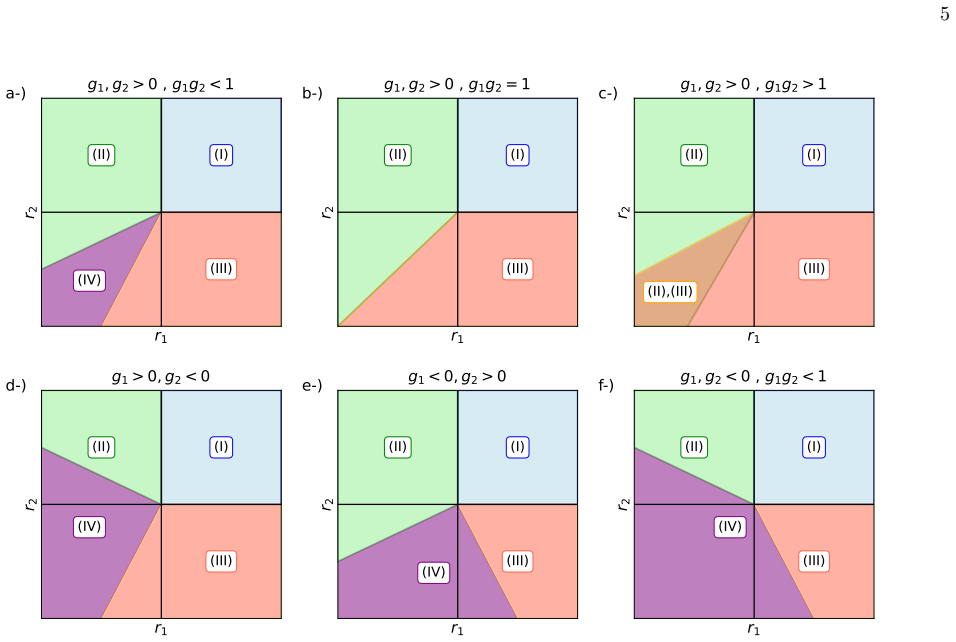
We perform a one-loop field-theoretic renormalization group analysis of the critical conserved dynamics of two n-component order parameter fields that interact non-reciprocally via nonlinear couplings. The resulting flow equations show that critical properties depend on bare microscopic values. For n greater than or equal to 4 we identify a fixed point at which the dynamics asymptotically satisfy detailed balance, indicating that the large-scale behavior becomes independent of the microscopic non-reciprocity. In addition, the conserved character of the dynamics reduces the number of independent scaling exponents.
What carries the argument
The one-loop renormalization group flow functions and fixed-point analysis for the non-reciprocal nonlinear coupling strength in the conserved two-field model.
If this is right
- For n greater than or equal to 4 the asymptotic critical dynamics obey detailed balance and become independent of the microscopic non-reciprocity.
- The conserved dynamics reduces the number of independent scaling exponents relative to the non-conserved case.
- At one-loop level the critical behavior varies with the bare microscopic values of the coupling parameters.
- For smaller n the non-reciprocal character can persist in the large-scale dynamics.
Where Pith is reading between the lines
- In multi-component materials or fluids, non-reciprocal driving may produce no observable time-dependent patterns at criticality.
- Direct comparison of simulations for n=3 and n=4 could test whether the crossover to detailed-balance behavior occurs at the predicted component number.
- Conservation laws may generically screen non-reciprocal effects in other driven critical systems, limiting the range of accessible non-equilibrium steady states.
Load-bearing premise
The one-loop renormalization group calculation fully determines the fixed-point structure without missing relevant operators generated by the non-reciprocal coupling.
What would settle it
Numerical simulation of the stochastic equations for n=4 that measures the critical exponents and checks whether they match the equilibrium conserved model or retain non-equilibrium signatures from the non-reciprocity.
Figures
read the original abstract
Non-reciprocal systems have been shown to sustain time-dependent patterns, most prominently travelling waves. The transition into these time-dependent states generally breaks time-translational invariance, representing a clear deviation from equilibrium dynamics. Though common implementations of non-reciprocity lead to such phenomenology, these spatio-temporal patterns are absent in other models. In the same vein, the ensuing scaling behaviour also depends on the precise way non-reciprocity is implemented. To better understand the effects of different non-reciprocal interactions, we study the critical conserved dynamics of non-reciprocally coupled spin systems. Specifically, we consider the dynamics of two $n$-component order parameter fields $\boldsymbol{\phi}_i$ with $i \in\{1,2\}$. Unlike the common implementations of non-reciprocal interactions, we introduce the non-reciprocity solely through the non-linear interaction between the distinct species. Using the field-theoretic renormalisation group (RG) procedure, we perform a one-loop analysis and show that at one-loop level, the critical behaviour depends on the microscopic value of certain quantities. Using the flow functions, we elucidate the behaviour of the fixed points for different bare microscopic values. We also show that for $n \geq 4$, there is a fixed point where the ensuing critical dynamics asymptotically obey detailed-balance, implying the emergent dynamics are agnostic to the microscopic non-reciprocity on large scales. Finally, we show that the conserved dynamics reduces the number of independent scaling exponents, mimicking the effect of a standard fluctuation-dissipation relation.
Editorial analysis
A structured set of objections, weighed in public.
Referee Report
Summary. The paper examines the critical conserved dynamics of two n-component order-parameter fields coupled via nonlinear non-reciprocal interactions. It performs a one-loop field-theoretic renormalization-group analysis and reports that the critical behavior depends on the bare microscopic values of certain parameters. For n ≥ 4 the flow equations are claimed to admit a stable fixed point at which all non-reciprocal couplings become irrelevant, so that the long-wavelength dynamics asymptotically obey detailed balance. The conserved character of the dynamics is further shown to reduce the number of independent scaling exponents, mimicking the effect of a fluctuation-dissipation relation.
Significance. If the one-loop fixed-point structure is confirmed, the work supplies a concrete example in which microscopic non-reciprocity becomes irrelevant at large scales for a particular class of conserved models, thereby restoring equilibrium-like scaling. The observation that conservation laws alone can reduce the number of independent exponents is a useful parallel to the equilibrium case and may guide future studies of non-reciprocal critical phenomena.
major comments (2)
- [RG analysis (abstract and main text)] The manuscript states that a one-loop RG analysis was performed and that the fixed-point structure is read off from the flow functions, yet no explicit beta functions, renormalization constants, or flow equations are displayed anywhere in the text. Without these expressions the central claim—that a stable detailed-balance fixed point exists for n ≥ 4—cannot be verified or reproduced.
- [Fixed-point analysis] The one-loop truncation is used to conclude that non-reciprocal couplings flow to zero for n ≥ 4. No argument is given that the chosen operator basis remains closed under renormalization or that no new relevant operators appear at two-loop order that could destabilize the fixed point. This truncation is load-bearing for the asymptotic obedience to detailed balance.
minor comments (2)
- The phrase “microscopic value of certain quantities” is used repeatedly without an explicit identification of which bare parameters are meant or how they enter the flow equations.
- Notation for the two n-component fields and the nonlinear non-reciprocal vertex should be introduced with a clear table or diagram early in the text.
Simulated Author's Rebuttal
We thank the referee for the careful reading and constructive comments on our manuscript. We appreciate the positive assessment of the potential significance of the results. We address each major comment below and will revise the manuscript to improve clarity and reproducibility.
read point-by-point responses
-
Referee: [RG analysis (abstract and main text)] The manuscript states that a one-loop RG analysis was performed and that the fixed-point structure is read off from the flow functions, yet no explicit beta functions, renormalization constants, or flow equations are displayed anywhere in the text. Without these expressions the central claim—that a stable detailed-balance fixed point exists for n ≥ 4—cannot be verified or reproduced.
Authors: We agree that the explicit one-loop expressions are necessary for independent verification. In the revised manuscript we will add an appendix containing the full set of beta functions for the couplings (including the non-reciprocal ones) together with the renormalization constants Z_φ and the flow equations obtained from the one-loop diagrams. These expressions will directly demonstrate the existence of the stable fixed point at which non-reciprocal couplings vanish for n ≥ 4. revision: yes
-
Referee: [Fixed-point analysis] The one-loop truncation is used to conclude that non-reciprocal couplings flow to zero for n ≥ 4. No argument is given that the chosen operator basis remains closed under renormalization or that no new relevant operators appear at two-loop order that could destabilize the fixed point. This truncation is load-bearing for the asymptotic obedience to detailed balance.
Authors: Our conclusions are explicitly limited to one-loop order. At this perturbative order the Feynman diagrams generated by the nonlinear non-reciprocal vertices do not produce operators outside the original basis of quadratic, cubic and quartic terms consistent with the symmetries and conservation laws of the model; we will add a short paragraph explaining this diagrammatic closure. We acknowledge, however, that a two-loop calculation would be required to check whether new relevant operators appear at higher orders. We will include a clarifying statement in the discussion section that the emergent detailed balance is established within the one-loop approximation. revision: partial
- Confirmation that no destabilizing operators appear at two-loop order or higher, which would require an explicit multi-loop calculation beyond the scope of the present work.
Circularity Check
No significant circularity in the RG derivation chain
full rationale
The paper defines a specific model of two n-component conserved fields with nonlinear non-reciprocal couplings and applies standard one-loop field-theoretic RG to compute the beta functions and fixed-point structure. The n≥4 detailed-balance fixed point and the reduction in independent scaling exponents both emerge directly from the resulting flow equations rather than being imposed by definition, fitted inputs renamed as predictions, or load-bearing self-citations. The derivation is self-contained against external benchmarks of RG methodology and does not reduce any central claim to its own inputs by construction.
Axiom & Free-Parameter Ledger
free parameters (1)
- bare microscopic values of certain quantities
axioms (2)
- domain assumption Non-reciprocity is introduced solely through the non-linear interaction between the two species
- domain assumption One-loop renormalization-group analysis suffices to determine the fixed-point structure and large-scale behavior
Lean theorems connected to this paper
-
IndisputableMonolith/Foundation/ArithmeticFromLogic.leanabsolute_floor_iff_bare_distinguishability unclearWe also show that for n ≥ 4, there is a fixed point where the ensuing critical dynamics asymptotically obey detailed-balance... the conserved dynamics reduces the number of independent scaling exponents, mimicking the effect of a standard fluctuation-dissipation relation.
-
IndisputableMonolith/Cost/FunctionalEquation.leanwashburn_uniqueness_aczel unclearZΓi Z²_˜ϕi = 1... even though the system is out of equilibrium, the conserved dynamics ensures the anomalous exponents of correlation and response function to be the same
Reference graph
Works this paper leans on
-
[1]
M. Fruchart, R. Hanai, P. B. Littlewood, and V. Vitelli, Non-reciprocal phase transitions, Nature592, 363 (2021)
work page 2021
-
[2]
Z. You, A. Baskaran, and M. C. Marchetti, Nonreciprocity as a generic route to traveling states, Proc. Natl. Acad. Sci. U.S.A.117, 19767 (2020)
work page 2020
-
[3]
S. Saha, S. Ramaswamy, and R. Golestanian, Pairing, waltzing and scattering of chemotactic active colloids, New J. Phys. 21, 063006 (2019)
work page 2019
-
[4]
D. Yllanes, M. Leoni, and M. C. Marchetti, How many dissenters does it take to disorder a flock?, New J. Phys.19, 103026 (2017)
work page 2017
-
[5]
S. Shankar, A. Souslov, M. J. Bowick, M. C. Marchetti, and V. Vitelli, Topological active matter, Nat. Rev. Phys.4, 380 (2022)
work page 2022
- [6]
- [7]
- [8]
-
[9]
M. J. Bowick, N. Fakhri, M. C. Marchetti, and S. Ramaswamy, Symmetry, thermodynamics, and topology in active matter, Phys. Rev. X12, 010501 (2022)
work page 2022
-
[10]
F. Brauns and M. C. Marchetti, Nonreciprocal pattern formation of conserved fields, Phys. Rev. X14, 021014 (2024)
work page 2024
-
[11]
T. Reichenbach, M. Mobilia, and E. Frey, Mobility promotes and jeopardizes biodiversity in rock–paper–scissors games, Nature448, 1046 (2007)
work page 2007
-
[12]
C. Scheibner, A. Souslov, D. Banerjee, P. Sur´ owka, W. T. M. Irvine, and V. Vitelli, Odd elasticity, Nat. Phys.16, 475 (2020)
work page 2020
-
[13]
G. Garcia Lorenzana, A. Altieri, G. Biroli, M. Fruchart, and V. Vitelli, Nonreciprocal spin-glass transition and aging, Phys. Rev. Lett.135, 187402 (2025)
work page 2025
-
[14]
Z.-Y. Liu, B. Zheng, L.-L. Nian, and L. Xiong, Dynamic approach to the two-dimensional nonreciprocal xy model with vision cone interactions, Phys. Rev. E111, 014131 (2025)
work page 2025
-
[15]
L. P. Dadhichi, J. Kethapelli, R. Chajwa, S. Ramaswamy, and A. Maitra, Nonmutual torques and the unimportance of motility for long-range order in two-dimensional flocks, Phys. Rev. E101, 052601 (2020)
work page 2020
-
[16]
Y. Avni, M. Fruchart, D. Martin, D. Seara, and V. Vitelli, Nonreciprocal ising model, Phys. Rev. Lett.134, 117103 (2025)
work page 2025
-
[17]
S. A. Loos, S. H. Klapp, and T. Martynec, Long-Range Order and Directional Defect Propagation in the Nonreciprocal XY Model with Vision Cone Interactions, Phys. Rev. Lett.130, 198301 (2023)
work page 2023
-
[18]
Y. Rouzaire, D. J. G. Pearce, I. Pagonabarraga, and D. Levis, Nonreciprocal interactions reshape topological defect annihilation, Phys. Rev. Lett.134, 167101 (2025)
work page 2025
-
[19]
Y. Avni, M. Fruchart, D. Martin, D. Seara, and V. Vitelli, Dynamical phase transitions in the nonreciprocal ising model, Phys. Rev. E111, 034124 (2025)
work page 2025
-
[20]
S. Saha, J. Agudo-Canalejo, and R. Golestanian, Scalar Active Mixtures: The Nonreciprocal Cahn-Hilliard Model, Phys. Rev. X10, 041009 (2020)
work page 2020
-
[21]
V. Garc´ ıa-Morales and K. Krischer, The complex Ginzburg–Landau equation: an introduction, Contemp. Phys.53, 79 (2012)
work page 2012
-
[22]
G. Pisegna, S. Saha, and R. Golestanian, Emergent polar order in nonpolar mixtures with nonreciprocal interactions, Proc. Natl. Acad. Sci. U.S.A.121(2024)
work page 2024
-
[23]
M. K. Johnsrud and R. Golestanian, State diagram of the non-reciprocal Cahn–Hilliard model and the effects of symmetry, J. Stat. Mech.2025, 123204 (2025)
work page 2025
-
[24]
J. T. Young, A. V. Gorshkov, M. Foss-Feig, and M. F. Maghrebi, Nonequilibrium fixed points of coupled ising models, Phys. Rev. X10, 011039 (2020)
work page 2020
-
[25]
J. T. Young, A. V. Gorshkov, and M. Maghrebi, Nonequilibrium universality of the nonreciprocally coupledo(n 1)×o(n 2) model, Phys. Rev. E113, 034132 (2026)
work page 2026
-
[26]
U. C. T¨ auber and S. Diehl, Perturbative Field-Theoretical Renormalization Group Approach to Driven-Dissipative Bose- Einstein Criticality, Phys. Rev. X4, 021010 (2014)
work page 2014
-
[27]
L. Sieberer, S. Huber, E. Altman, and S. Diehl, Nonequilibrium functional renormalization for driven-dissipative bose- einstein condensation, Phys. Rev. B89, 134310 (2014)
work page 2014
-
[28]
B. I. Halperin, P. C. Hohenberg, and S.-k. Ma, Calculation of Dynamic Critical Properties Using Wilson’s Expansion Methods, Phys. Rev. Lett.29, 1548 (1972)
work page 1972
-
[29]
G. Pisegna, N. Rana, R. Golestanian, and S. Saha, Nonreciprocal mixtures in suspension: The role of hydrodynamic interactions, Phys. Rev. Lett.135, 108301 (2025)
work page 2025
-
[30]
P. Calabrese, A. Pelissetto, and E. Vicari, Multicritical phenomena in O(n 1) L O(n2)-symmetric theories, Phys. Rev. B 67, 054505 (2003)
work page 2003
-
[31]
R. Folk, Y. Holovatch, and G. Moser, Field theory of bicritical and tetracritical points. i. statics, Phys. Rev. E78, 041124 (2008)
work page 2008
-
[32]
R. Folk, Y. Holovatch, and G. Moser, Field theory of bicritical and tetracritical points. ii. relaxational dynamics, Phys. Rev. E78, 041125 (2008)
work page 2008
-
[33]
A. Eichhorn, D. Mesterh´ azy, and M. M. Scherer, Multicritical behavior in models with two competing order parameters, Phys. Rev. E88, 042141 (2013)
work page 2013
-
[34]
N. Rana and R. Golestanian, Defect solutions of the nonreciprocal cahn-hilliard model: Spirals and targets, Phys. Rev. Lett.133, 078301 (2024)
work page 2024
-
[35]
Migliorini, The Critical Properties of Two-dimensional Oscillator Arrays, J
G. Migliorini, The Critical Properties of Two-dimensional Oscillator Arrays, J. Phys. A: Math. Theor.41, 324021 (2008)
work page 2008
-
[36]
P. C. Hohenberg and B. I. Halperin, Theory of dynamic critical phenomena, Revs. Mod. Phys.49, 435 (1977)
work page 1977
-
[37]
U. C. T¨ auber,Critical Dynamics: A Field Theory Approach to Equilibrium and Non-Equilibrium Scaling Behavior(Cam- bridge University Press, Cambridge, 2014)
work page 2014
-
[38]
Zinn-Justin,Quantum Field Theory and Critical Phenomena, 4th ed
J. Zinn-Justin,Quantum Field Theory and Critical Phenomena, 4th ed. (Oxford University Press, Oxford, 2002)
work page 2002
-
[39]
Le Bellac,Quantum and Statistical Field Theory(Oxford University Press, Oxford, 1992)
M. Le Bellac,Quantum and Statistical Field Theory(Oxford University Press, Oxford, 1992)
work page 1992
-
[40]
D. J. Amit and V. Martin-Mayor,Field Theory, the Renormalization Group, and Critical Phenomena: Graphs to Com- puters, 3rd ed. (World Scientific, Singapore, 2005)
work page 2005
-
[41]
H.-K. Janssen, On a Lagrangean for classical field dynamics and renormalization group calculations of dynamical critical properties, Z. Phys. B23, 377 (1976). 22
work page 1976
- [42]
-
[43]
Janssen, Renormalized field theory of the critical dynamics of o(n)-symmetric systems, Z
H.-K. Janssen, Renormalized field theory of the critical dynamics of o(n)-symmetric systems, Z. Phys. B26, 187 (1977)
work page 1977
-
[44]
H. K. Janssen, On the renormalized field theory of nonlinear critical relaxation, inFrom Phase Transitions to Chaos: Topics in Modern Statistical Physics, edited by G. Gy¨ orgyi, I. Kondor, L. Sasv´ ari, and T. T´ el (World Scientific, Singapore,
-
[45]
P. C. Martin, E. D. Siggia, and H. A. Rose, Statistical dynamics of classical systems, Phys. Rev. A8, 423 (1973)
work page 1973
-
[46]
C. De Dominicis, Techniques de renormalisation de la th´ eorie des champs et dynamique des ph´ enom` enes critiques, J. Phys. Colloq.37, C1 (1976)
work page 1976
- [47]
-
[48]
L. Cocconi, H. Alston, and T. Bertrand, Active bound states arising from transiently nonreciprocal pair interactions, Phys. Rev. Res.5, 043032 (2023). Appendix A: Details of the Loop Calculation In this section, we list and evaluate the amputated loop diagrams that renormalise the relevant vertices. The field theory defined by Eqs. (19) and (20) is closed...
work page 2023
discussion (0)
Sign in with ORCID, Apple, or X to comment. Anyone can read and Pith papers without signing in.