Recognition: no theorem link
Fast Computation of Conditional Probabilities in MDPs and Markov Chain Families
Pith reviewed 2026-05-14 20:43 UTC · model grok-4.3
The pith
An alternative algorithm computes optimal conditional reachability probabilities in MDPs by sidestepping the creation of hard cyclic problems.
A machine-rendered reading of the paper's core claim, the machinery that carries it, and where it could break.
Core claim
The authors develop an alternative, practically efficient procedure that computes optimal conditional reachability probabilities directly while preserving numerical stability and optimality, avoiding the cyclic MDPs produced by prior reductions; the procedure decides threshold problems in linear time on acyclic MDPs, performs comparably to standard reachability, and supports an abstraction-refinement framework capable of analysing millions of Markov chains simultaneously.
What carries the argument
The alternative computation procedure that obtains optimal conditional probabilities without constructing or solving the cyclic MDP that arises from the standard reduction.
If this is right
- Threshold questions are decided in linear time on acyclic MDPs.
- Runtime remains comparable to ordinary reachability queries on general MDPs.
- The procedure integrates directly into abstraction-refinement loops.
- Large families containing millions of Markov chains become feasible to analyse together.
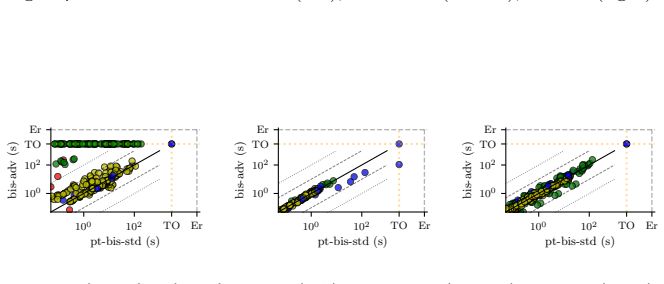
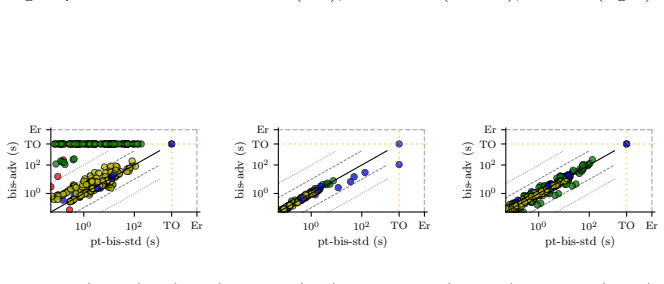
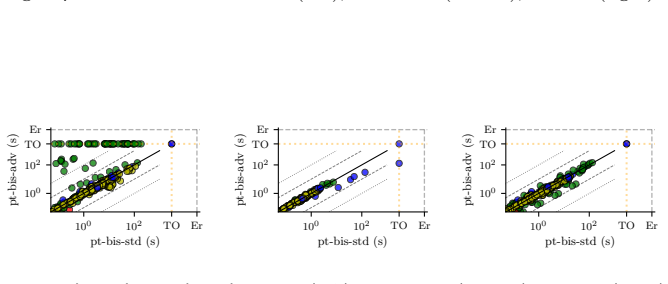
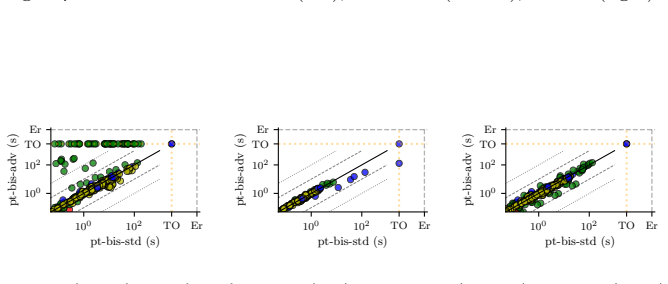
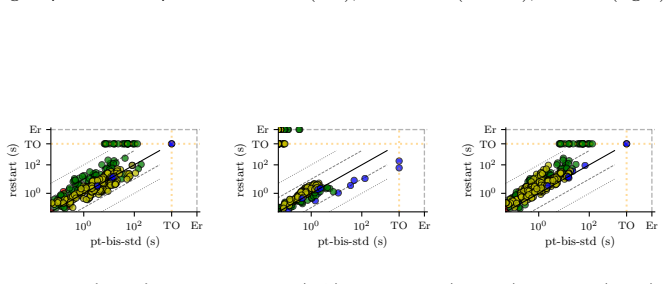
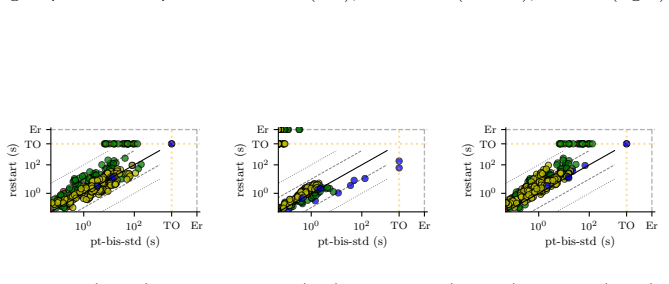
- Benchmarks drawn from Bayesian networks, probabilistic programs, and runtime monitoring exhibit speed-ups of multiple orders of magnitude.
Where Pith is reading between the lines
- The linear-time guarantee on acyclic models could support incremental or online verification tasks where the state space grows gradually.
- Embedding the method inside abstraction-refinement opens the possibility of analysing parametric or infinite families of chains without enumerating them explicitly.
- Because the procedure avoids cyclic blow-up, it may extend to related conditional problems such as expected rewards or long-run averages under conditioning.
Load-bearing premise
The new procedure produces exactly the same optimal values as the standard reduction on every input.
What would settle it
An MDP instance on which the new method returns a conditional probability that differs from the exact optimum obtained by solving the reduced cyclic MDP to machine precision.
Figures






read the original abstract
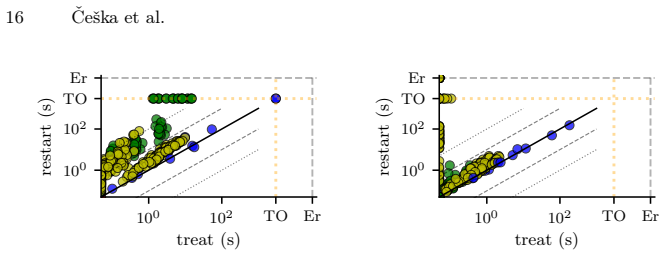
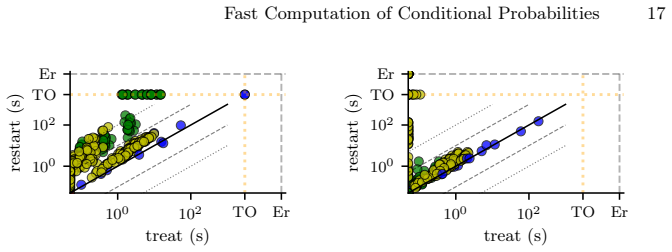
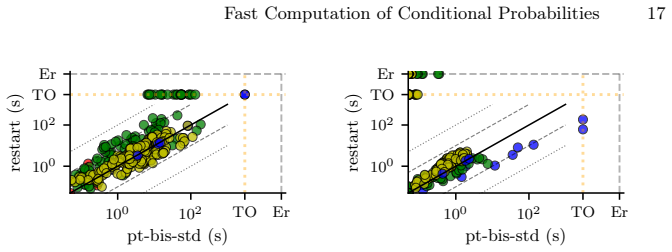
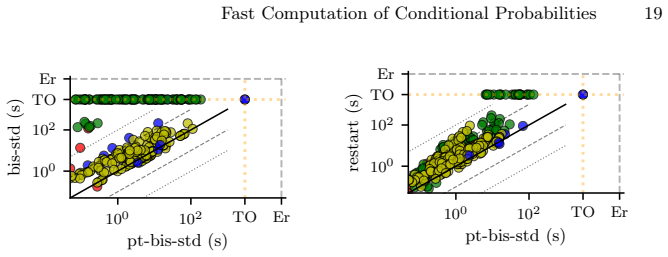
Computing optimal conditional reachability probabilities in Markov decision processes (MDPs) is tractable by a reduction to reachability probabilities. Yet, this reduction yields cyclic, challenging MDPs that are often notoriously hard to solve. We present an alternative, practically efficient method to compute optimal conditional reachabilities. This new method is numerically stable, can decide the threshold problem in linear time on acyclic MDPs, and yields performance comparable to standard reachability queries. We also integrate the method in an abstraction-refinement framework to analyse millions of Markov chains at once. We demonstrate the efficacy of the new methods on benchmarks from Bayesian network analysis, probabilistic programs, and runtime monitoring and show speed-ups up to multiple orders of magnitude.
Editorial analysis
A structured set of objections, weighed in public.
Referee Report
Summary. The manuscript presents an alternative algorithm for computing optimal conditional reachability probabilities in Markov decision processes (MDPs) and families of Markov chains. It claims this method avoids the cyclic MDPs arising from the standard reduction to reachability, is numerically stable, decides threshold problems in linear time on acyclic MDPs, achieves performance comparable to standard reachability queries, and integrates into an abstraction-refinement loop to analyze millions of chains simultaneously. Empirical results on benchmarks from Bayesian networks, probabilistic programs, and runtime monitoring report speed-ups of multiple orders of magnitude.
Significance. If the equivalence to optimal conditional probabilities is rigorously established without hidden approximations or policy restrictions, the work would provide a practically significant advance in probabilistic verification. The linear-time threshold decision on acyclic MDPs and the scalable abstraction-refinement integration are particularly valuable for large-scale applications in monitoring and analysis of model families.
major comments (2)
- [Main algorithmic section (likely §4 or §5)] The central equivalence claim—that the new procedure computes exactly the same optimal conditional reachability values as the standard reduction to reachability, without implicit restrictions on the policy space or post-hoc normalizations—requires a detailed formal argument. This is load-bearing for the linear-time result on acyclic MDPs and the reported speed-ups; the abstract asserts it but the provided text does not contain an explicit proof or reduction showing preservation of optimality.
- [Numerical stability discussion] Numerical stability is asserted but not demonstrated via concrete analysis (e.g., condition numbers or comparison to exact arithmetic on small instances). This must be addressed to support the claim that the method avoids the hardness of cyclic reductions without introducing instability.
minor comments (2)
- [Preliminaries] Clarify the precise definition of 'conditional reachability' early in the preliminaries to avoid ambiguity with standard reachability.
- [Experimental evaluation] The benchmark tables would benefit from explicit columns reporting both the new method's values and a reference exact method on a subset of instances to visually confirm equivalence.
Simulated Author's Rebuttal
We thank the referee for the constructive comments and for recognizing the potential practical impact of our algorithm for conditional reachability in MDPs and Markov chain families. We address each major comment below and will revise the manuscript accordingly to strengthen the formal and empirical support.
read point-by-point responses
-
Referee: [Main algorithmic section (likely §4 or §5)] The central equivalence claim—that the new procedure computes exactly the same optimal conditional reachability values as the standard reduction to reachability, without implicit restrictions on the policy space or post-hoc normalizations—requires a detailed formal argument. This is load-bearing for the linear-time result on acyclic MDPs and the reported speed-ups; the abstract asserts it but the provided text does not contain an explicit proof or reduction showing preservation of optimality.
Authors: We agree that an explicit formal argument is necessary. The manuscript establishes equivalence by deriving the same optimality equations as the standard reduction (via the conditional probability fixed-point characterization) but solving them directly on the original MDP without introducing auxiliary states or cycles. The policy space is unrestricted, as the algorithm considers all schedulers in the original model, and no post-hoc normalization is performed. To address the concern, we will add a dedicated theorem and complete proof in the revised manuscript (new subsection in §4) that formally reduces our procedure to the standard LP formulation, thereby rigorously supporting both the optimality claim and the linear-time threshold decision on acyclic instances. revision: yes
-
Referee: [Numerical stability discussion] Numerical stability is asserted but not demonstrated via concrete analysis (e.g., condition numbers or comparison to exact arithmetic on small instances). This must be addressed to support the claim that the method avoids the hardness of cyclic reductions without introducing instability.
Authors: We acknowledge that the current discussion of numerical stability is primarily qualitative. In the revised manuscript we will add a new subsection providing concrete support: (i) derivation of condition-number bounds for the linear systems arising in our direct formulation (which avoid the ill-conditioned cycles of the standard reduction), and (ii) empirical validation on small benchmark instances using exact rational arithmetic, showing that floating-point results match the exact values to machine precision. These additions will substantiate that the method remains stable while sidestepping the hardness of cyclic MDPs. revision: yes
Circularity Check
No circularity detected; derivation is self-contained algorithmic alternative
full rationale
The paper introduces an alternative method for optimal conditional reachability in MDPs, presented as numerically stable and linearly solvable on acyclic cases without relying on the cyclic reduction. No equations, self-citations, or reductions in the abstract or described claims equate the new procedure to its inputs by construction, fitted parameters renamed as predictions, or load-bearing self-referential definitions. The central claims rest on independent algorithmic design that can be verified externally against standard reachability benchmarks, yielding a self-contained derivation with no detectable circular steps.
Axiom & Free-Parameter Ledger
Reference graph
Works this paper leans on
-
[1]
de Alfaro, L.: Formal verification of probabilistic systems. Ph.D. thesis, Stanford University, USA (1997)
work page 1997
-
[2]
Andrés, M.E., van Rossum, P.: Conditional probabilities over probabilistic and nondeterministic systems. In: TACAS. pp. 157–172. Lecture Notes in Computer Science, Springer (2008).https://doi.org/10.1007/978-3-540-78800-3_12
-
[3]
Andriushchenko, R., Ceska, M., Macák, F., Junges, S., Katoen, J.: An oracle-guided approach to constrained policy synthesis under uncertainty. J. Artif. Intell. Res.82, 433–469 (2025).https://doi.org/10.1613/JAIR.1.16593
-
[4]
Badings, T., Sim~ao, T.D., Suilen, M., Jansen, N.: Decision-making under uncer- tainty: beyond probabilities. Int. J. Softw. Tools Technol. Transf.25(3), 375–391 (2023).https://doi.org/10.1007/S10009-023-00704-3
-
[5]
Badings,T.,Volk,M.,Junges,S.,Stoelinga,M.,Jansen,N.:CTMCswithimprecisely timed observations. In: TACAS (2). pp. 258–278. Lecture Notes in Computer Science, Springer (2024).https://doi.org/10.1007/978-3-031-57249-4_13
-
[6]
MIT Press (2008).https: //doi.org/10.1007/978-3-031-97439-7_7
Baier, C., Katoen, J.: Principles of model checking. MIT Press (2008).https: //doi.org/10.1007/978-3-031-97439-7_7
-
[7]
Baier, C., Klein, J., Klüppelholz, S., Märcker, S.: Computing conditional probabili- ties in markovian models efficiently. In: TACAS. pp. 515–530. Lecture Notes in Com- puter Science, Springer (2014).https://doi.org/10.1007/978-3-642-54862-8_ 43
-
[8]
Baier, C., Klein, J., Klüppelholz, S., Wunderlich, S.: Maximizing the conditional expected reward for reaching the goal. In: TACAS (2). pp. 269–285. Lecture Notes in Computer Science (2017).https://doi.org/10.1007/978-3-662-54580-5_16
-
[9]
Bartocci, E., Deshmukh, J.V., Donzé, A., Fainekos, G., Maler, O., Nickovic, D., Sankaranarayanan, S.: Specification-based monitoring of cyber-physical systems: A survey on theory, tools and applications. In: Lectures on Runtime Verification, pp. 135–175. Lecture Notes in Computer Science, Springer (2018).https://doi.org/ 10.1007/978-3-319-75632-5_5
-
[10]
Batz, K., Chen, M., Junges, S., Kaminski, B.L., Katoen, J., Matheja, C.: Prob- abilistic program verification via inductive synthesis of inductive invariants. In: TACAS (2). pp. 410–429. Lecture Notes in Computer Science, Springer (2023). https://doi.org/10.1007/978-3-031-30820-8_25
-
[11]
fast computation of conditional probabilities in MDPs and Markov chain families
Ceska, M., Junges, S., van der Maas, L., Macák, F., Quatmann, T.: Artifact of "fast computation of conditional probabilities in MDPs and Markov chain families" (May 2026).https://doi.org/10.5281/zenodo.19739061
-
[12]
In: 25 Years of Model Checking
Chatterjee, K., Henzinger, T.A.: Value iteration. In: 25 Years of Model Checking. pp. 107–138. Lecture Notes in Computer Science, Springer (2008).https://doi. org/10.1007/978-3-540-69850-0_7
-
[13]
Cho, M., Gouwar, J., Holtzen, S.: Scaling optimization over uncertainty via com- pilation. Proc. ACM Program. Lang.9(OOPSLA1), 1546–1574 (2025).https: //doi.org/10.1145/3720500
-
[14]
Etessami, K., Kwiatkowska, M.Z., Vardi, M.Y., Yannakakis, M.: Multi-objective model checking of markov decision processes. Log. Methods Comput. Sci.4(4) (2008).https://doi.org/10.2168/LMCS-4(4:8)2008
- [15]
-
[16]
Gerlach, L., Winkler, T., Ábrahám, E., Bonakdarpour, B., Junges, S.: Efficient probabilistic model checking for relational reachability. In: CAV (1). pp. 127–147. Lecture Notes in Computer Science, Springer (2025).https://doi.org/10.1007/ 978-3-031-98668-0_6
work page 2025
-
[17]
Graham, R.L., Knuth, D.E., Patashnik, O.: Concrete Mathematics: A Foundation for Computer Science, 2nd Ed. Addison-Wesley (1994)
work page 1994
-
[18]
Gürtler, T., Kaminski, B.L.: noDice: Inference for discrete probabilistic programs with nondeterminism and conditioning. Proc. ACM Program. Lang.10(OOPSLA1) (Apr 2026).https://doi.org/10.1145/3798215
-
[19]
Haddad, S., Monmege, B.: Interval iteration algorithm for MDPs and IMDPs. Theor. Comput. Sci.735, 111–131 (2018).https://doi.org/10.1016/J.TCS.2016. 12.003
-
[20]
Hartmanns, A., Junges, S., Quatmann, T., Weininger, M.: A practitioner’s guide to MDPmodelcheckingalgorithms.In:TACAS(1).pp.469–488.LectureNotesinCom- puter Science, Springer (2023).https://doi.org/10.1007/978-3-031-30823-9_ 24
-
[21]
Heck, L., Macák, F., Ceska, M., Junges, S.: Constrained and robust policy synthesis with satisfiability-modulo-probabilistic-model-checking. In: AAAI. pp. 36253–36261. AAAI Press (2026).https://doi.org/10.1609/AAAI.V40I43.40944
-
[22]
Hensel, C., Junges, S., Katoen, J., Quatmann, T., Volk, M.: The probabilistic model checker storm. Int. J. Softw. Tools Technol. Transf.24(4), 589–610 (2022). https://doi.org/10.1007/S10009-021-00633-Z
-
[23]
Holtzen, S., den Broeck, G.V., Millstein, T.D.: Scaling exact inference for discrete probabilistic programs. Proc. ACM Program. Lang.4(OOPSLA), 140:1–140:31 (2020).https://doi.org/10.1145/3428208
-
[24]
Junges, S., Torfah, H., Seshia, S.A.: Runtime monitors for markov decision processes. In: CAV (2). pp. 553–576. Lecture Notes in Computer Science, Springer (2021). https://doi.org/10.1007/978-3-030-81688-9_26
-
[25]
van der Maas, L., Junges, S.: Learning verified monitors for hidden markov models. In: ATVA. pp. 180–203. Lecture Notes in Computer Science, Springer (2025). https://doi.org/10.1007/978-3-032-08707-2_9
-
[26]
Märcker, S., Baier, C., Klein, J., Klüppelholz, S.: Computing conditional probabili- ties: Implementation and evaluation. In: SEFM. pp. 349–366. Lecture Notes in Com- puter Science, Springer (2017).https://doi.org/10.1007/978-3-319-66197-1_ 22
-
[27]
Mathur, U., Bauer, M.S., Chadha, R., Sistla, A.P., Viswanathan, M.: Exact quanti- tative probabilistic model checking through rational search. Formal Methods Syst. Des.56(1), 90–126 (2020).https://doi.org/10.1007/S10703-020-00348-Y
-
[28]
Norman, G., Parker, D., Kwiatkowska, M.Z., Shukla, S.K., Gupta, R.K.: Formal analysis and validation of continuous-time markov chain based system level power management strategies. In: HLDVT. pp. 45–50. IEEE Computer Society (2002). https://doi.org/10.1109/HLDVT.2002.1224427
-
[29]
Wiley Series in Probability and Statistics, Wiley (1994)
Puterman, M.L.: Markov Decision Processes: Discrete Stochastic Dynamic Pro- gramming. Wiley Series in Probability and Statistics, Wiley (1994). https: //doi.org/10.1002/9780470316887
-
[30]
Quatmann, T., Katoen, J.: Multi-objective optimization of long-run average and total rewards. In: TACAS (1). pp. 230–249. Lecture Notes in Computer Science, Springer (2021).https://doi.org/10.1007/978-3-030-72016-2_13
-
[31]
Salmani, B., Katoen, J.: Bayesian inference by symbolic model checking. In: QEST. pp. 115–133. Lecture Notes in Computer Science, Springer (2020).https://doi. org/10.1007/978-3-030-59854-9_9 Fast Computation of Conditional Probabilities 23
-
[32]
Salmani, B., Katoen, J.: Automatically finding the right probabilities in bayesian networks. J. Artif. Intell. Res.77, 1637–1696 (2023).https://doi.org/10.1613/ JAIR.1.14044
work page 2023
- [33]
-
[34]
Stoller, S.D., Bartocci, E., Seyster, J., Grosu, R., Havelund, K., Smolka, S.A., Zadok, E.: Runtime verification with state estimation. In: RV. pp. 193–207. Lec- ture Notes in Computer Science, Springer (2011). https://doi.org/10.1007/ 978-3-642-29860-8_15 24 Češka et al. A Proofs A.1 Proofs for Section 3 Proof for Theorem 1Forσ∈Σ M,E we get Prσ M(♢G|♢E)∼...
work page 2011
discussion (0)
Sign in with ORCID, Apple, or X to comment. Anyone can read and Pith papers without signing in.