Recognition: 2 theorem links
· Lean TheoremThe Future of Scholarly Blogs: Scholarly Bloggers' Perspectives on Long-Term Preservation
Pith reviewed 2026-05-13 04:18 UTC · model grok-4.3
The pith
No single centralized infrastructure can adequately preserve scholarly blogs long-term.
A machine-rendered reading of the paper's core claim, the machinery that carries it, and where it could break.
Core claim
The analysis reveals three connected themes. First, bloggers perceive a structural deficit in institutional responsibility and support: the long-term preservation of blogs is not systematically assumed by libraries, universities, or platforms, while bloggers are not sufficiently supported by their affiliated institutions. Second, bloggers articulate heterogeneous requirements like persistent identifiers, structured metadata, technical interoperability, and organizational sustainability. Third, governance preferences are characterized by distrust toward commercial and public infrastructures, compounded by concerns about geopolitical dependencies on non-European platforms. These findings show,
What carries the argument
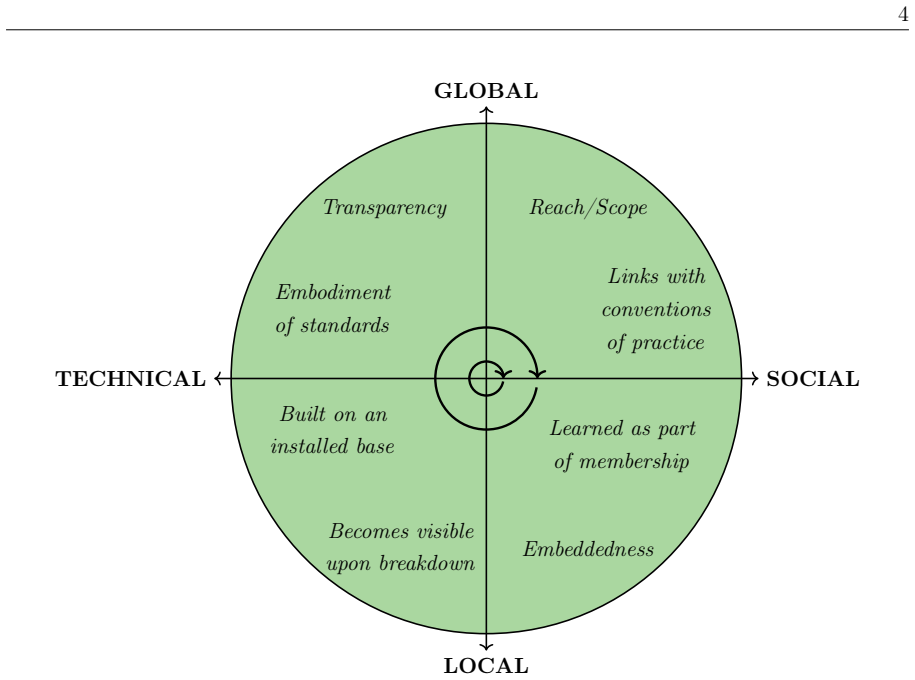
Star and Ruhleder's dimensions of information infrastructure applied as a theoretical lens to analyze the interview data and identify why centralized solutions fall short.
If this is right
- Information infrastructure facilities should prioritize tools for persistent identifiers and structured metadata tailored to blogs.
- Platform providers must ensure technical interoperability and long-term organizational sustainability of their services.
- Research performing organizations should assume greater responsibility and provide direct support to bloggers for preservation.
- Bloggers themselves would benefit from clearer guidelines on archiving and governance options.
Where Pith is reading between the lines
- A decentralized model could extend to preserving other informal scholarly outputs such as academic social media posts or podcasts.
- Pilot implementations of decentralized blog archives might reveal practical governance issues not visible in the initial interviews.
- Greater use of such infrastructure could increase the citability of blog content within formal academic literature over time.
Load-bearing premise
The perspectives gathered from thirteen German scholarly bloggers via semi-structured interviews are representative enough to support broad recommendations for infrastructure design, and that Star and Ruhleder's dimensions fully capture the relevant preservation challenges without significant omitted factors.
What would settle it
If a centralized blog preservation service were built and widely adopted by scholarly bloggers from different countries with high satisfaction and no reported gaps in meeting their needs, that would challenge the claim that decentralization is required.
Figures
read the original abstract
Scholarly blogs have become an important venue for scholarly communication, yet they remain insufficiently integrated into digital research and information infrastructures, which places their long-term preservation and citability at risk. This study investigates what challenges German scholarly bloggers perceive concerning blog preservation and what requirements they articulate for a sustainable information infrastructure. Drawing on Star and Ruhleder's (1996) dimensions of information infrastructure as a theoretical lens, we conducted and qualitatively analyzed 13 semi-structured interviews with scholarly bloggers. The analysis reveals three connected themes. First, bloggers perceive a structural deficit in institutional responsibility and support: the long-term preservation of blogs is not systematically assumed by libraries, universities, or platforms, while bloggers are not sufficiently supported by their affiliated institutions. Second, bloggers articulate heterogeneous requirements like persistent identifiers, structured metadata, technical interoperability, and organizational sustainability. Third, governance preferences are characterized by distrust toward commercial and public infrastructures, compounded by concerns about geopolitical dependencies on non-European platforms. These findings demonstrate that no single centralized infrastructure can adequately address the diverse and context-dependent needs of bloggers. We argue for a decentralized information infrastructure for scholarly blogs and offer concrete recommendations for information infrastructure facilities, platform providers, bloggers and research performing organizations.
Editorial analysis
A structured set of objections, weighed in public.
Referee Report
Summary. The paper presents findings from 13 semi-structured interviews with German scholarly bloggers, thematically analyzed through Star and Ruhleder's (1996) dimensions of information infrastructure. It identifies a perceived structural deficit in institutional responsibility for long-term blog preservation, heterogeneous blogger requirements (persistent identifiers, metadata, interoperability, sustainability), and governance preferences marked by distrust of commercial and non-European platforms. From these, the authors conclude that no single centralized infrastructure can meet the diverse needs and therefore advocate for a decentralized scholarly blog infrastructure, accompanied by targeted recommendations for facilities, platforms, bloggers, and research organizations.
Significance. If the core empirical themes hold, the study offers valuable exploratory insights into an under-examined corner of scholarly communication and digital preservation. The direct grounding in participant perspectives and the application of an established theoretical framework provide a solid basis for identifying gaps in current support structures. The work could usefully inform infrastructure design discussions, though its policy-level recommendations rest on a narrow empirical foundation.
major comments (1)
- [Abstract and Discussion] Abstract and Discussion (final paragraph): The claim that the interview data 'demonstrate that no single centralized infrastructure can adequately address the diverse and context-dependent needs of bloggers' is not supported by the evidence. The observed heterogeneity in requirements and distrust of existing platforms among 13 German participants does not logically entail that a flexible, well-designed centralized system is impossible; the data are compatible with the alternative that a centralized facility could accommodate variation through modular services or governance options. A major revision should either collect additional evidence (e.g., from other countries or disciplines) or substantially qualify the claim to reflect the exploratory, non-generalizable nature of the sample.
minor comments (2)
- [Methods] Methods: The description of participant recruitment and selection criteria should be expanded to allow readers to assess potential self-selection bias (e.g., bloggers already concerned about preservation).
- [Results] Results: When reporting the three themes, include a brief table or summary listing the specific requirements mentioned by participants (PIDs, metadata, etc.) with the number of interviewees referencing each, to make the heterogeneity claim more transparent.
Simulated Author's Rebuttal
We thank the referee for the constructive and detailed feedback on our manuscript. The comments help us better calibrate the strength of our claims given the exploratory nature of the study. We address the major comment point by point below and indicate where revisions will be made.
read point-by-point responses
-
Referee: [Abstract and Discussion] Abstract and Discussion (final paragraph): The claim that the interview data 'demonstrate that no single centralized infrastructure can adequately address the diverse and context-dependent needs of bloggers' is not supported by the evidence. The observed heterogeneity in requirements and distrust of existing platforms among 13 German participants does not logically entail that a flexible, well-designed centralized system is impossible; the data are compatible with the alternative that a centralized facility could accommodate variation through modular services or governance options. A major revision should either collect additional evidence (e.g., from other countries or disciplines) or substantially qualify the claim to reflect the exploratory, non-generalizable nature of the sample.
Authors: We agree that the wording in the abstract and final discussion paragraph overstates the logical reach of our findings. The study is based on 13 semi-structured interviews with German scholarly bloggers and is explicitly positioned as exploratory. While the data reveal substantial heterogeneity in technical and metadata requirements together with pronounced governance concerns (including distrust of commercial and non-European centralized platforms), these observations do not constitute proof that no centralized system could ever be designed to accommodate variation. We will therefore revise the relevant passages to replace 'demonstrate that no single centralized infrastructure can adequately address...' with more cautious phrasing such as 'indicate that a decentralized infrastructure may be better positioned to accommodate...' and to add explicit language underscoring the sample limitations and the suggestive character of the conclusions. We do not plan to expand the empirical scope at this stage, as the current design is qualitative and context-specific; the revisions will instead strengthen the alignment between claims and evidence. revision: partial
Circularity Check
No circularity: claims grounded in primary interview data via external lens
full rationale
The paper conducts a qualitative study: 13 semi-structured interviews analyzed thematically through Star and Ruhleder's 1996 external dimensions of information infrastructure. The three themes (institutional deficit, heterogeneous requirements, governance distrust) and the resulting argument for decentralized infrastructure are presented as direct outputs of that analysis. No equations, fitted parameters, predictions, or self-citations appear in the derivation chain; the central claim does not reduce to its inputs by construction and remains self-contained against the reported participant data.
Axiom & Free-Parameter Ledger
axioms (1)
- domain assumption Star and Ruhleder's (1996) dimensions of information infrastructure serve as the theoretical lens for analyzing interview data
Lean theorems connected to this paper
-
IndisputableMonolith/Foundation/AbsoluteFloorClosure.leanreality_from_one_distinction unclearDrawing on Star and Ruhleder’s (1996) dimensions of information infrastructure as a theoretical lens, we conducted and qualitatively analyzed 13 semi-structured interviews...
-
IndisputableMonolith/Foundation/BranchSelection.leanbranch_selection unclearThese findings demonstrate that no single centralized infrastructure can adequately address the diverse and context-dependent needs of bloggers.
Reference graph
Works this paper leans on
-
[1]
Bader, Anita and Fritz, Gerd and Gloning, Thomas , title =
-
[2]
Proceedings of the American Society for Information Science and Technology , date =
Bar-Ilan, Judit , title =. Proceedings of the American Society for Information Science and Technology , date =. doi:10.1002/meet.1450410114 , language =
-
[3]
and Star, Susan Leigh and Merkel, Cecelia and Ignacio, Emily and Sandusky, Robert J
Bishop, Ann Peterson and Neumann, Laura J. and Star, Susan Leigh and Merkel, Cecelia and Ignacio, Emily and Sandusky, Robert J. , title =. Journal of the American Society for Information Science , year =. doi:10.1002/(SICI)1097-4571(2000)51:4<394::AID-ASI8>3.0.CO;2-Q , language =
- [4]
-
[5]
and Baker, Karen and Millerand, Florence and Ribes, David , title =
Bowker, Geoffrey C. and Baker, Karen and Millerand, Florence and Ribes, David , title =. International. 2010 , doi =
work page 2010
-
[6]
Brügger, Niels , title =
-
[7]
Bundestagswahl 2025:
work page 2025
- [8]
-
[9]
doi:https://doi.org/10.13016/dt8e-rkdj , language =
Carpenter, Lindsay and Baxter, Isabella and Frank, Cindy , title =. doi:https://doi.org/10.13016/dt8e-rkdj , language =
-
[10]
Corrall, Sheila and Kennan, Mary Anne and Afzal, Waseem , title =. 2013 , volume =
work page 2013
-
[11]
de.hypotheses , title =
-
[12]
Edwards, Paul N. and Jackson, Steven J. and Bowker, Geoffrey C. and Knobel, Cory Philip , title =
-
[13]
Edwards, Paul N. and Jackson, Steven J. and Bowker, Geoffrey C. and Williams, Robin , title =. Journal of the Association for Information Systems , publisher =. 2009 , pages =
work page 2009
-
[14]
and Beaulieu, Anne and Borgman, Christine L
Edwards, Paul N. and Beaulieu, Anne and Borgman, Christine L. and Carse, Ashley and Jackson, Steven J. and Williams, Robin and Silvast, Antti , title =. Elgar. 2024 , pages =
work page 2024
-
[15]
Centre pour l'édition électronique ouverte -. EHESS , month = dec, year =
-
[16]
EHESS , month = aug, year =
-
[17]
Biologie in unserer Zeit , month = oct, year =
Fenner, Martin , title =. Biologie in unserer Zeit , month = oct, year =. doi:10.1002/biuz.200890080 , number =
-
[18]
Front Matter , month = dec, year =
Fenner, Martin , title =. Front Matter , month = dec, year =
-
[19]
Front Matter , month = jun, year =
Fenner, Martin , title =. Front Matter , month = jun, year =
-
[20]
Front Matter , month = jul, year =
Fenner, Martin , title =. Front Matter , month = jul, year =
-
[21]
Front Matter , month = apr, year =
Fenner, Martin , title =. Front Matter , month = apr, year =
-
[22]
Front Matter , month = nov, year =
Fenner, Martin , title =. Front Matter , month = nov, year =
-
[23]
Internet Archive Blogs , month = may, year =
Freeland, Chris , title =. Internet Archive Blogs , month = may, year =
-
[24]
Field Methods , month = feb, date =
Guest, Greg and Bunce, Arwen and Johnson, Laura , title =. Field Methods , month = feb, date =. doi:10.1177/1525822X05279903 , language =
-
[25]
PLOS ONE , month = may, date =
Guest, Greg and Namey, Emily and Chen, Mario , title =. PLOS ONE , month = may, date =. doi:10.1371/journal.pone.0232076 , language =
- [26]
-
[27]
Kalb, Hendrik and Lazaridou, Paraskevi and Banos, Vangelis and Kasioumis, Nikos and Trier, Matthias , title =. 2013 , booktitle =
work page 2013
- [28]
-
[29]
Journal of Research of the National Institute of Standards and Technology , year =
Lee, Kyong-Ho and Slattery, Oliver and Lu, Richang and Tang, Xiao and McCrary, Victor , title =. Journal of Research of the National Institute of Standards and Technology , year =. doi:10.6028/jres.107.010 , number =
-
[30]
Littek, Manon Sarah , title =
-
[31]
Liu, Ivy L.B. and Cheung, Christy M.K. and Lee, Matthew K.O. , title =. Journal of the Association for Information Science and Technology , year =. doi:10.1002/asi.23371 , language =
-
[32]
Written Communication , volume =
Luzón, María José , title =. Written Communication , volume =. 2013 , doi =
work page 2013
- [33]
-
[34]
Nentwich, Michael and König, René , title =
-
[35]
Information Research an International Electronic Journal, , year =
Ochsner, Catharina and Pampel, Heinz , title =. Information Research an International Electronic Journal, , year =. doi:10.47989/ir31iConf64176 , volume =
-
[36]
doi:10.1515/bfp-2025-0028 , date =
Ochsner, Catharina and Pampel, Heinz and H\"ofting, Jonas and Rothfritz, Laura , title =. doi:10.1515/bfp-2025-0028 , date =
-
[37]
Ochsner, Catharina and Pampel, Heinz and H\"ofting, Jonas and Rothfritz, Laura , title =. 2025 , doi =
work page 2025
-
[38]
Journal of Documentation , month = oct, year =
Ochsner, Catharina and Pampel, Heinz and H\"ofting, Jonas and Rothfritz, Laura , title =. Journal of Documentation , month = oct, year =. doi:10.1108/JD-02-2025-0053 , number =
-
[39]
OpenEdition , title =
-
[40]
Puschmann, Cornelius , title =. Opening. 2014 , doi =
work page 2014
- [41]
-
[42]
Communitys durchsuchen , url =
-
[43]
Frequently asked questions , url =
- [44]
-
[45]
Journal of the Association for Information Science and Technology , year =
Shema, Hadas and Bar-Ilan, Judit and Thelwall, Mike , title =. Journal of the Association for Information Science and Technology , year =. doi:10.1002/asi.23037 , language =
-
[46]
Information Systems Research , publisher =
Star, Susan Leigh and Ruhleder, Karen , title =. Information Systems Research , publisher =. 1996 , pages =. doi:10.1287/isre.7.1.111 , number =
- [47]
- [48]
-
[49]
Wissenschaftsblogs und wissenschaftliche
Wenninger, Andreas , address =. Wissenschaftsblogs und wissenschaftliche. Perspektiven der. 2017 , pages =
work page 2017
- [50]
discussion (0)
Sign in with ORCID, Apple, or X to comment. Anyone can read and Pith papers without signing in.