Recognition: 1 theorem link
· Lean TheoremAir entrainment by an inclined smooth water jet
Pith reviewed 2026-05-13 05:05 UTC · model grok-4.3
The pith
Inclined water jets pull air into bubbles when asymmetric flow detachment creates a shear layer that destabilizes waves at the cavity interface.
A machine-rendered reading of the paper's core claim, the machinery that carries it, and where it could break.
Core claim
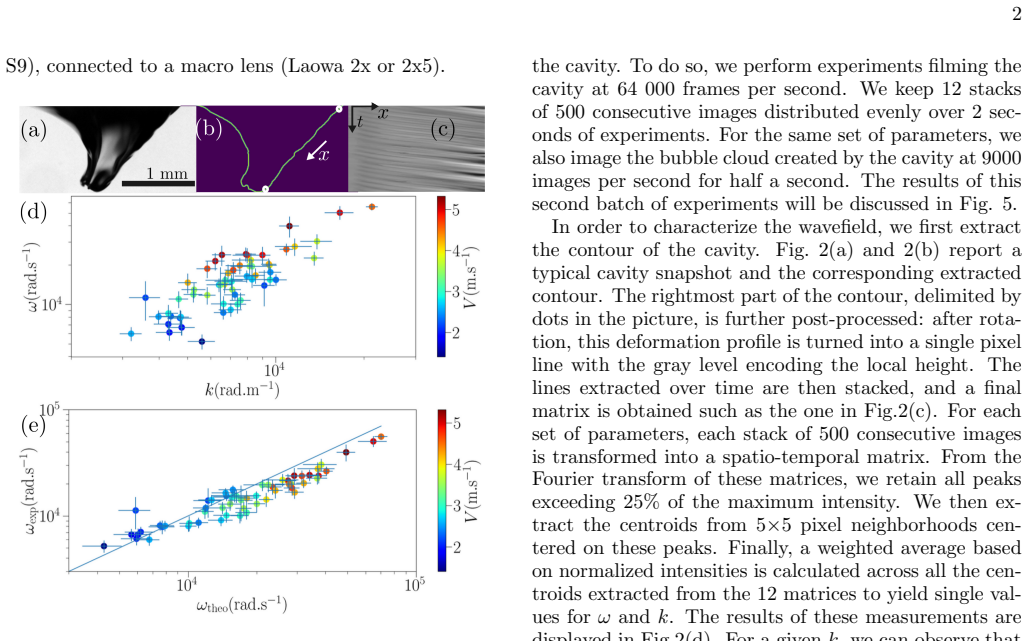
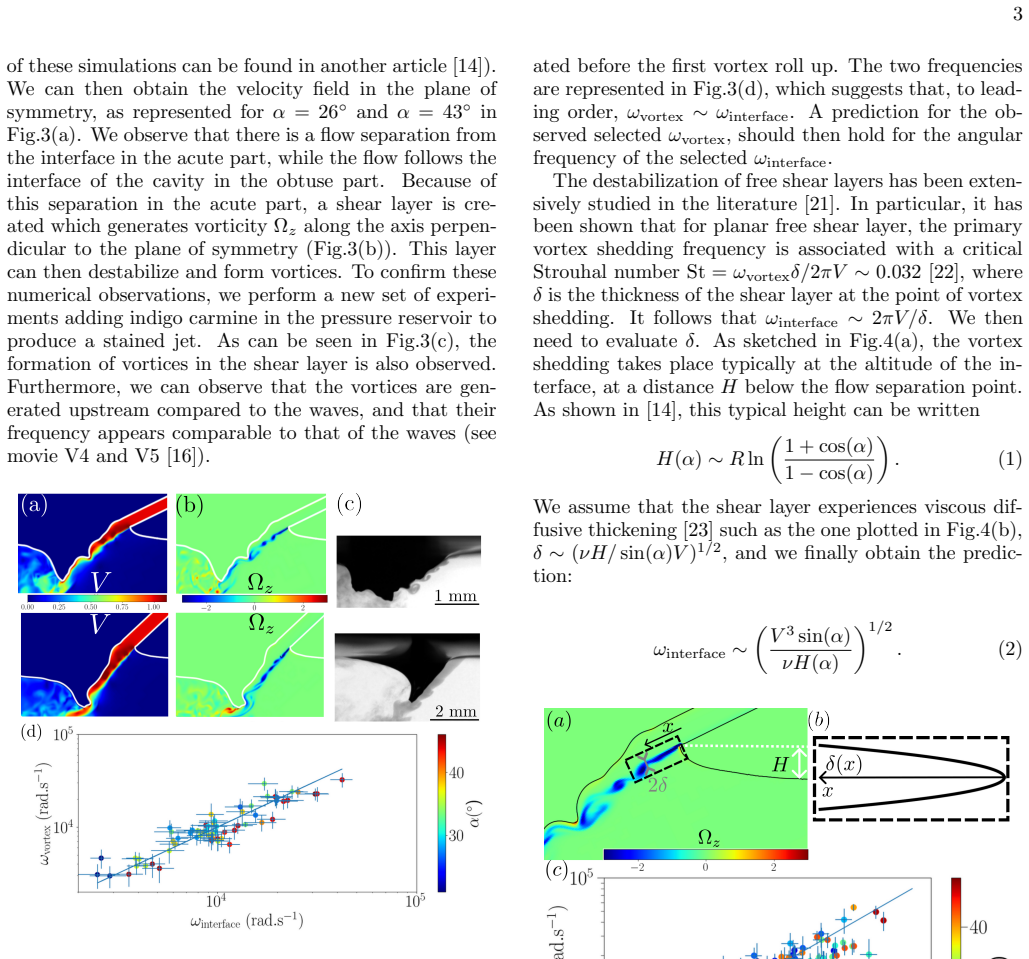
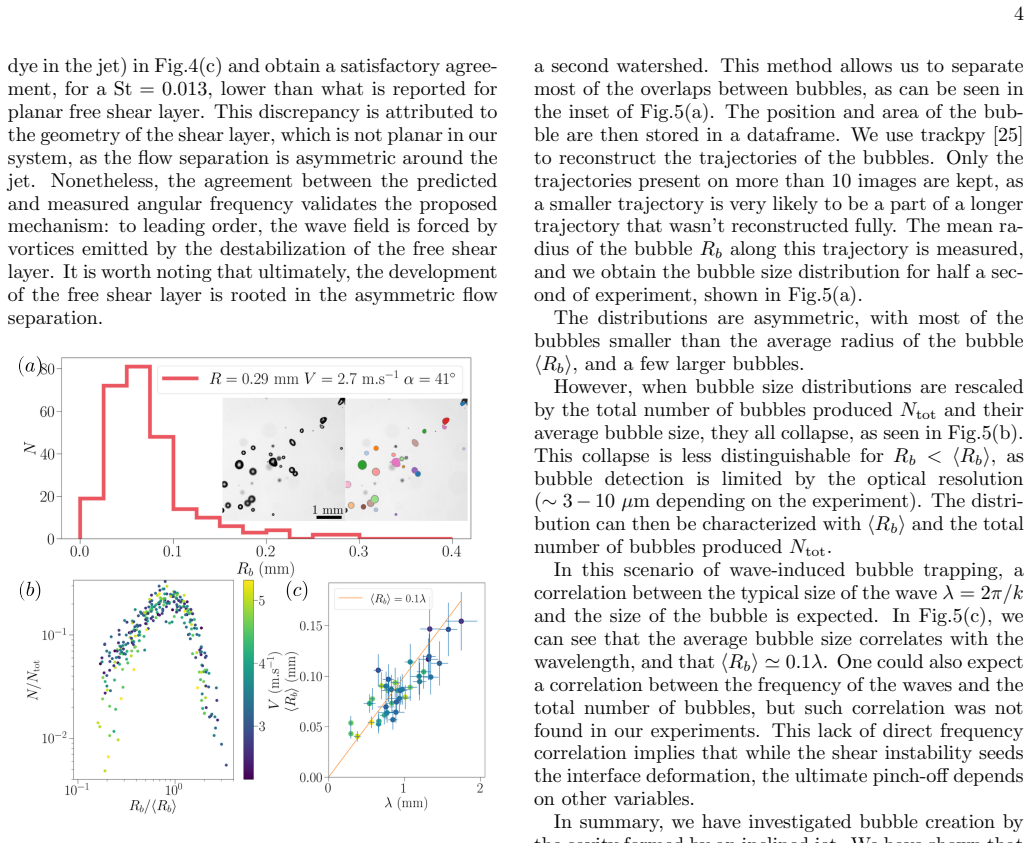
We establish a link between the geometry and the dynamics of the cavity observed when an inclined impinging jet impacts a water interface and the resulting bubble cloud. We show that the bubbles result from the destabilization of the wavefield developing at the interface of the cavity. The origin of this wave field is the creation of a shear layer, due to the asymmetric detachment of the flow field from the interface.
What carries the argument
Shear layer created by asymmetric detachment of the flow from the cavity interface, which generates the wavefield that breaks into bubbles.
Load-bearing premise
The wavefield destabilization at the cavity interface is the dominant process that produces the observed bubble cloud.
What would settle it
High-speed images or velocity fields showing bubble production continuing at the same rate after the wavefield or shear layer has been suppressed or removed.
Figures


read the original abstract
Air entrainment can occur when a water jet impacts a water/air interface, a process central in various real systems, ranging from dam spills to breaking waves. Despite its prevalence, a comprehensive description of the mechanism controlling bubble size distribution remains elusive. Here, we establish a link between the geometry and the dynamics of the cavity observed when an inclined impinging jet impacts a water interface and the resulting bubble cloud. We show that the bubbles result from the destabilization of the wavefield developing at the interface of the cavity. The origin of this wave field is the creation of a shear layer, due to the asymmetric detachment of the flow field from the interface.
Editorial analysis
A structured set of objections, weighed in public.
Referee Report
Summary. The manuscript examines air entrainment by an inclined smooth water jet impinging on a water/air interface. It links the observed cavity geometry and interface dynamics to the resulting bubble cloud, arguing that bubbles arise from destabilization of a wavefield at the cavity interface; this wavefield is traced to a shear layer generated by asymmetric detachment of the flow from the interface.
Significance. If the proposed sequence holds, the work supplies a geometric and dynamic account of bubble production that could clarify size distributions in jet-driven entrainment, with direct relevance to breaking waves and dam spills. The parameter-free character of the geometric argument and the absence of competing mechanisms that reproduce the reported cavity shape are noted strengths.
major comments (1)
- The central claim that wavefield destabilization is the dominant bubble-production mechanism is load-bearing yet rests on observational inference from cavity geometry and timing. The manuscript should supply quantitative support (e.g., measured wave amplitudes correlated with bubble production rates or growth rates) to demonstrate that this process dominates over other possible entrainment routes at the reported parameter values.
minor comments (2)
- Notation for the cavity interface and shear-layer quantities should be defined explicitly on first use and kept consistent between text and figures.
- Figure captions should state the jet inclination angle, impact velocity, and Reynolds number for each panel so that the reported cavity shapes can be reproduced.
Simulated Author's Rebuttal
We thank the referee for their positive assessment and constructive comment on our manuscript. We address the major comment point by point below.
read point-by-point responses
-
Referee: The central claim that wavefield destabilization is the dominant bubble-production mechanism is load-bearing yet rests on observational inference from cavity geometry and timing. The manuscript should supply quantitative support (e.g., measured wave amplitudes correlated with bubble production rates or growth rates) to demonstrate that this process dominates over other possible entrainment routes at the reported parameter values.
Authors: We agree that additional quantitative metrics would strengthen the presentation of the wavefield destabilization mechanism. Our existing high-speed imaging sequences already capture the evolution of interface waves on the cavity and the subsequent bubble detachment events, with clear temporal ordering: wave growth precedes and directly leads to air pocket formation. To address the request explicitly, the revised manuscript will incorporate extracted measurements of wave amplitude (defined as the maximum radial perturbation of the cavity interface) plotted against time, together with the instantaneous bubble production rate derived from the same image sequences. These data will be presented in a new supplementary figure showing the correlation between wave growth rate and entrainment onset. We will also note that alternative routes (e.g., direct entrainment at the stagnation point or symmetric vortex shedding) are inconsistent with the observed cavity asymmetry and the absence of bubbles along the jet axis, as already documented by the geometric model. This addition supplies the requested quantitative support at the reported parameter values while leaving the core conclusions unchanged. revision: yes
Circularity Check
No significant circularity identified
full rationale
The manuscript is an experimental fluid-dynamics study whose central claim links observed cavity geometry, asymmetric flow detachment, shear-layer formation, and subsequent wavefield destabilization to bubble production. No equations, derivations, fitted parameters, or quantitative predictions appear in the provided abstract or reader summary. The argument rests on direct visualization and geometric/dynamical inference rather than any reduction of outputs to inputs by construction, self-citation chains, or ansatz smuggling. Consequently the derivation chain contains no load-bearing circular steps of the enumerated kinds.
Axiom & Free-Parameter Ledger
Reference graph
Works this paper leans on
-
[1]
K. T. Kiger and J. H. Duncan, Air-entrainment mecha- nisms in plunging jets and breaking waves, Annual Re- view of Fluid Mechanics44, 563 (2012). 5
work page 2012
-
[2]
´E. Lorenceau, D. Qu´ er´ e, and J. Eggers, Air entrainment by a viscous jet plunging into a bath, Physical review letters93, 254501 (2004)
work page 2004
-
[3]
A. K. Bi´ n, Gas entrainment by plunging liquid jets, Chemical Engineering Science48, 3585 (1993)
work page 1993
-
[4]
Koga, Bubble entrainment in breaking wind waves, Tellus34, 481 (1982)
M. Koga, Bubble entrainment in breaking wind waves, Tellus34, 481 (1982)
work page 1982
- [5]
-
[6]
J.-T. Jeong and H. Moffatt, Free-surface cusps associ- ated with flow at low reynolds number, Journal of fluid mechanics241, 1 (1992)
work page 1992
-
[7]
Eggers, Air entrainment through free-surface cusps, Physical review letters86, 4290 (2001)
J. Eggers, Air entrainment through free-surface cusps, Physical review letters86, 4290 (2001)
work page 2001
-
[8]
E. Lorenceau, F. Restagno, and D. Qu´ er´ e, Fracture of a viscous liquid, Physical review letters90, 184501 (2003)
work page 2003
-
[9]
Y. Zhu, H. N. O˘ guz, and A. Prosperetti, On the mech- anism of air entrainment by liquid jets at a free surface, Journal of Fluid Mechanics404, 151 (2000)
work page 2000
- [10]
-
[11]
E. McKeogh and D. Ervine, Air entrainment rate and diffusion pattern of plunging liquid jets, Chemical Engi- neering Science36, 1161 (1981)
work page 1981
-
[12]
D. Chirichella, R. Gomez Ledesma, K. Kiger, and J. Dun- can, Incipient air entrainment in a translating axisym- metric plunging laminar jet, Physics of Fluids14, 781 (2002)
work page 2002
-
[13]
S. Miwa, Y. G. Xiao, Y. Saito, and T. Hibiki, Exper- imental study of air entrainment rates due to inclined liquid jets, Chemical Engineering & Technology42, 1059 (2019)
work page 2019
-
[14]
Shape of an interface hit by an oblique jet
T. Gaichies, A. Salonen, A. Antkowiak, and E. Rio, Shape of an interface hit by an oblique jet (2026), arXiv:2604.12788 [physics.flu-dyn]
work page internal anchor Pith review Pith/arXiv arXiv 2026
-
[15]
R. M. Detsch and R. N. Sharma, The critical angle for gas bubble entrainment by plunging liquid jets, The Chemi- cal Engineering Journal44, 157 (1990)
work page 1990
-
[16]
See supplemental material at [url]] for additional plots of the experimental data with color encoding different parameters and movies of the observed phenomena
-
[17]
M. Rabaud and F. Moisy, The kelvin–helmholtz instabil- ity, a useful model for wind-wave generation?, Comptes Rendus. M´ ecanique348, 489 (2020)
work page 2020
-
[18]
W. Mostert, S. Popinet, and L. Deike, High-resolution direct simulation of deep water breaking waves: transi- tion to turbulence, bubbles and droplets production, J. Fluid Mech.942(2022)
work page 2022
-
[19]
A. Rivi` ere, D. J. Ruth, W. Mostert, L. Deike, and S. Per- rard, Capillary driven fragmentation of large gas bubbles in turbulence, Physical Review Fluids7, 083602 (2022)
work page 2022
-
[20]
S. Popinet, An accurate adaptive solver for surface- tension-driven interfacial flows, Journal of Computa- tional Physics228, 5838 (2009)
work page 2009
- [21]
-
[22]
See Fig.2(a) of the review article [21]
-
[23]
L. D. Landau and E. M. Lifshitz, Fluid Mechanics: Volume 6, Vol. 6 (Elsevier, 1987)
work page 1987
-
[24]
S. Van der Walt, J. L. Sch¨ onberger, J. Nunez-Iglesias, F. Boulogne, J. D. Warner, N. Yager, E. Gouillart, and T. Yu, scikit-image: image processing in python, PeerJ 2, e453 (2014)
work page 2014
-
[25]
D. B. Allan, T. Caswell, N. C. Keim, C. M. van der Wel, and R. W. Verweij, Trackpy v0.5.0, Zenodo https://doi.org/10.5281/zenodo.4682814 (2021)
-
[26]
R. Ni, Deformation and breakup of bubbles and drops in turbulence, Annual Review of Fluid Mechanics56, 319 (2024)
work page 2024
-
[27]
A. Riviere, W. Mostert, S. Perrard, and L. Deike, Sub- hinze scale bubble production in turbulent bubble break- up, Journal of Fluid Mechanics917, A40 (2021)
work page 2021
discussion (0)
Sign in with ORCID, Apple, or X to comment. Anyone can read and Pith papers without signing in.