Recognition: 2 theorem links
· Lean TheoremAdaptive RSMA-OMA for Resilient MIMO Networks Under Imperfect CSI and SIC
Pith reviewed 2026-05-13 04:57 UTC · model grok-4.3
The pith
A degeneracy-aware framework adjusts RSMA power splits and switches to OMA to keep MIMO networks feasible under imperfect CSI and SIC errors.
A machine-rendered reading of the paper's core claim, the machinery that carries it, and where it could break.
Core claim
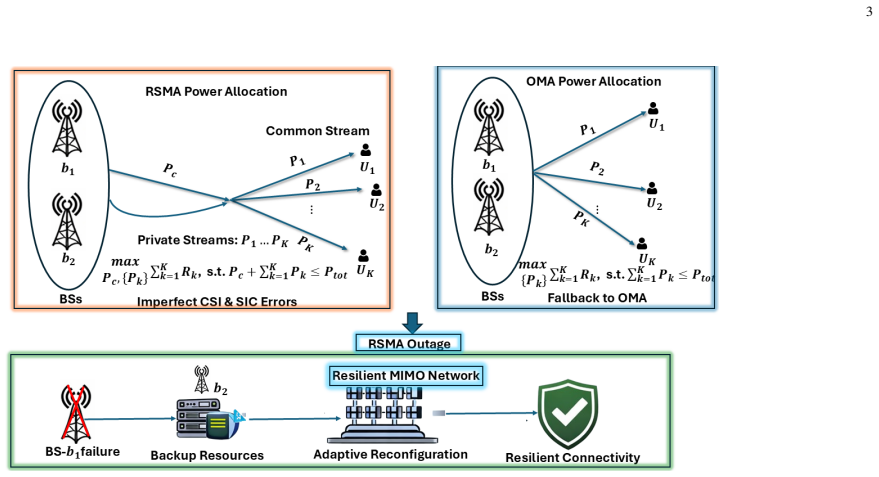
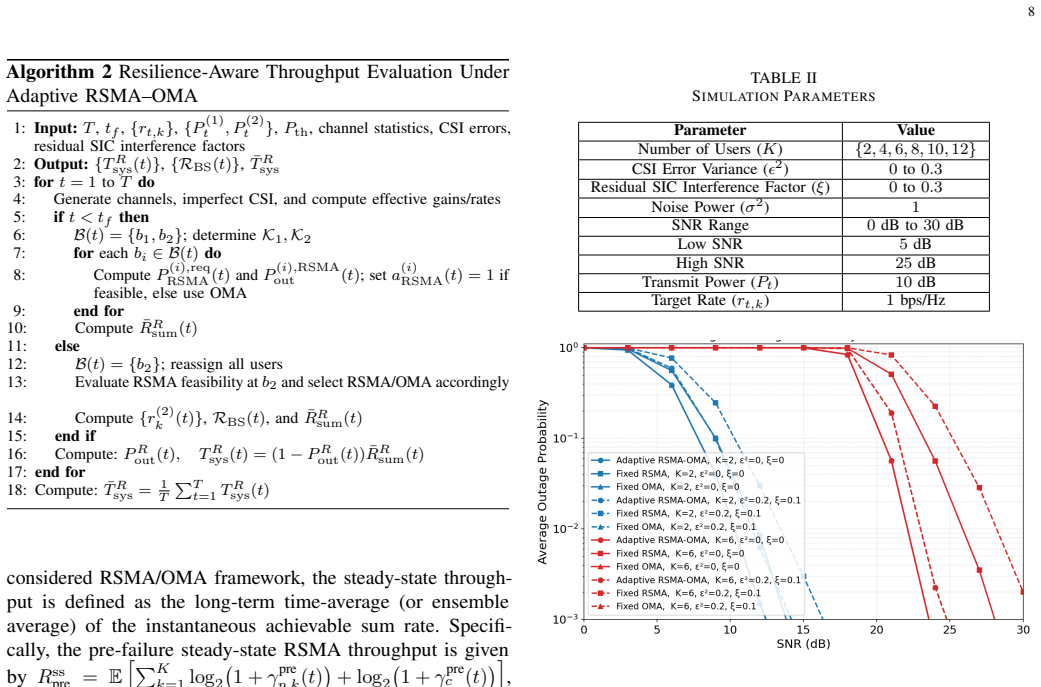
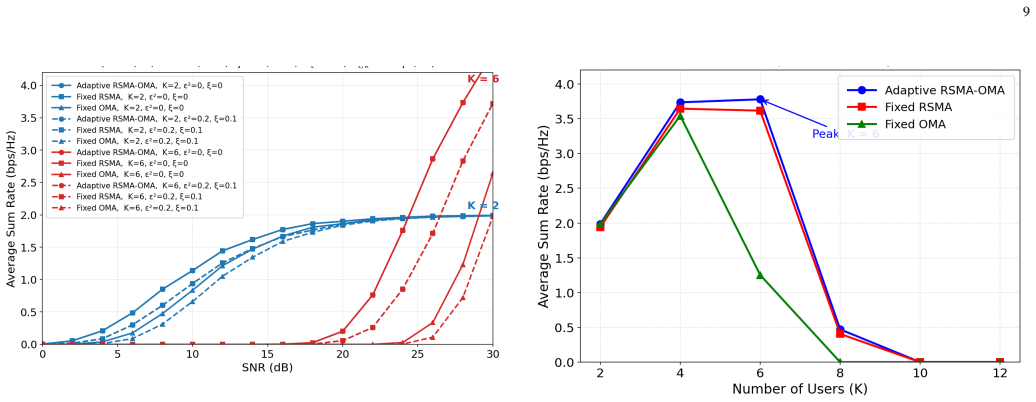
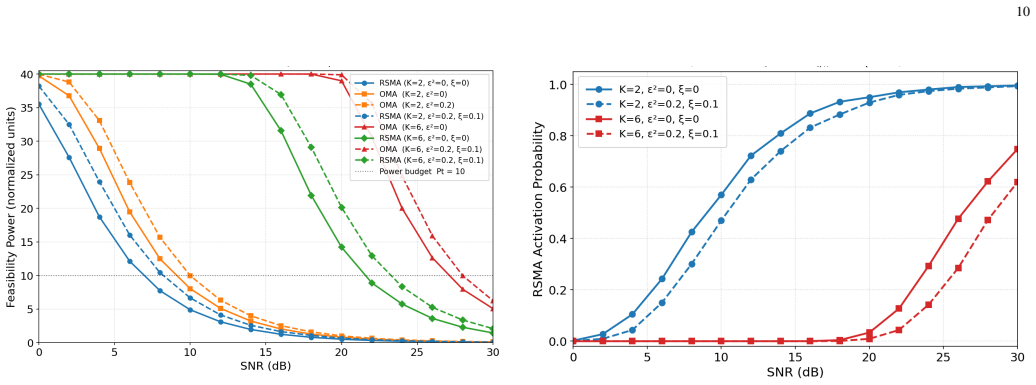
The paper establishes that a degeneracy-aware framework adaptively adjusts the power allocation between common and private streams in RSMA for downlink MIMO networks and incorporates a dynamic switching mechanism to RSMA-OMA, ensuring system feasibility and resilience despite CSI uncertainty, residual SIC errors, and spatial correlation, with results indicating improved power efficiency and reduced outage probability.
What carries the argument
The degeneracy-aware framework that monitors approach to infeasibility, reallocates power between streams, and triggers RSMA-to-OMA switching.
If this is right
- Power efficiency improves because power is steered away from streams that would otherwise fail under channel uncertainty.
- Outage probability drops as the system avoids operating in regions where common or private rates cannot be met.
- Overall robustness increases by maintaining feasibility across a wider range of impairment strengths.
- RSMA becomes a practical option for networks where perfect CSI and ideal SIC cannot be assumed.
Where Pith is reading between the lines
- The switching logic could be combined with user scheduling or beamforming updates to handle time-varying channels.
- Overhead costs of the detection step might be quantified in terms of extra pilot symbols or feedback bits.
- The same degeneracy metric might apply to uplink RSMA or to multi-cell coordination settings.
Load-bearing premise
The detection of approaching infeasibility from imperfect CSI and residual SIC errors can trigger real-time power reallocation and access-mode switching without creating new errors or excessive overhead.
What would settle it
Simulations or measurements that show the adaptive scheme produces higher outage probability or worse power efficiency than fixed RSMA under the same levels of CSI error and SIC imperfection would falsify the claim.
Figures


read the original abstract
This paper addresses the challenge of power control in Rate-Splitting Multiple Access (RSMA) systems for downlink Multi-Input Multi-Output (MIMO) networks under practical impairments such as spatial correlation, imperfect Channel State Information (CSI), and residual Successive Interference Cancellation (SIC) errors. We propose a novel degeneracyaware framework that adaptively adjusts the power allocation between the common and private streams, ensuring optimal performance despite CSI uncertainty and imperfect SIC. Our approach incorporates a dynamic switching mechanism between RSMA and Orthogonal Multiple Access (OMA) to maintain system feasibility and resilience in the face of these impairments. Extensive analytical and simulation results demonstrate that the proposed framework significantly enhances power efficiency, mitigates outage probability, and improves overall system robustness, making RSMA a viable and efficient solution for modern wireless networks with realistic CSI and SIC conditions.
Editorial analysis
A structured set of objections, weighed in public.
Referee Report
Summary. The manuscript proposes a degeneracy-aware adaptive framework for RSMA-OMA in downlink MIMO networks under spatial correlation, imperfect CSI, and residual SIC errors. It dynamically adjusts power allocation between common and private streams and switches between RSMA and OMA modes to maintain feasibility, claiming via analytical derivations and simulations to deliver substantial gains in power efficiency, reduced outage probability, and improved robustness over non-adaptive baselines.
Significance. If the performance claims are substantiated with rigorous analysis, the work could advance practical RSMA deployment in realistic 5G/6G MIMO settings by providing a resilience mechanism absent in static RSMA or pure OMA. The adaptive switching and power reallocation under impairments represent a potentially useful contribution if the core detector is shown to be reliable.
major comments (1)
- [Degeneracy-aware framework and detection mechanism] The central claim requires that the degeneracy-aware detector reliably flags approaching infeasibility from CSI errors and residual SIC, enabling timely RSMA-OMA switching and power reallocation. No error bounds on detection (false-positive/negative rates), sensitivity analysis, or propagation of detection errors into outage/power-efficiency metrics are provided. This is load-bearing because all claimed adaptive benefits flow through this step (see framework description and performance analysis sections).
minor comments (2)
- [Abstract] The abstract states that 'extensive analytical and simulation results' support the claims but provides no equations, key metrics, or quantitative comparisons, making it difficult to assess the magnitude or conditions of the reported gains.
- [Abstract] The compound term 'degeneracyaware' appears without a hyphen in the abstract; consistent hyphenation as 'degeneracy-aware' would improve readability.
Simulated Author's Rebuttal
We thank the referee for the constructive feedback on our manuscript. We address the major comment point by point below, providing an honest assessment of what can be strengthened in revision.
read point-by-point responses
-
Referee: [Degeneracy-aware framework and detection mechanism] The central claim requires that the degeneracy-aware detector reliably flags approaching infeasibility from CSI errors and residual SIC, enabling timely RSMA-OMA switching and power reallocation. No error bounds on detection (false-positive/negative rates), sensitivity analysis, or propagation of detection errors into outage/power-efficiency metrics are provided. This is load-bearing because all claimed adaptive benefits flow through this step (see framework description and performance analysis sections).
Authors: We agree that the reliability of the degeneracy-aware detector is central to the adaptive switching and power reallocation mechanism. The manuscript validates the overall framework through extensive Monte Carlo simulations that incorporate the detector's decisions under varying levels of spatial correlation, CSI estimation error, and residual SIC error, showing consistent gains in power efficiency and outage probability compared to non-adaptive baselines. However, we acknowledge that the manuscript does not include analytical error bounds on false-positive or false-negative rates for the detector, nor a formal sensitivity analysis or explicit propagation study of detection errors into the end-to-end metrics. Deriving closed-form bounds is analytically intractable given the combined effects of the impairments and the degeneracy condition. In the revised manuscript we will add simulation-based sensitivity analysis (varying detection thresholds and impairment levels) and quantify the impact of misdetections on outage and power-efficiency curves; these additions will appear in the performance analysis section. revision: partial
- Analytical derivation of error bounds (false-positive/negative rates) on the degeneracy-aware detector and formal propagation analysis of detection errors into outage/power-efficiency metrics
Circularity Check
No circularity detected; derivation chain self-contained
full rationale
The paper proposes a degeneracy-aware adaptive framework for RSMA-OMA switching and power allocation under imperfect CSI and SIC, supported by analytical and simulation results. No equations, derivation steps, fitted parameters presented as predictions, or self-citations are visible in the abstract or described content that reduce any claim to its inputs by construction. The central claims of improved power efficiency and robustness rest on independent analysis rather than self-definitional or load-bearing reductions. This is the expected outcome for a proposal paper without visible circular patterns.
Axiom & Free-Parameter Ledger
Lean theorems connected to this paper
-
IndisputableMonolith/Cost/FunctionalEquation.leanwashburn_uniqueness_aczel unclearminimum-power RSMA design ... P⋆_k(t) = Γ_p,k(t)/g_k,k(t) * (sum interference + ξ_k P_c + σ²) ... feasibility condition P⋆_c + sum P⋆_k ≤ P_t
Reference graph
Works this paper leans on
-
[1]
Framework and overall objectives of the future development of IMT for 2030 and beyond,
ITU-R, “Framework and overall objectives of the future development of IMT for 2030 and beyond,” International Telecommunication Union, Geneva, Switzerland, Tech. Rep. Recommendation ITU-R M.2160, 2023
work page 2030
-
[2]
Toward 6G networks: Use cases and technologies,
D. Feng, M. Saad, M. Bennis, and M. Debbah, “Toward 6G networks: Use cases and technologies,”IEEE Communications Magazine, vol. 58, no. 4, pp. 84–90, 2020
work page 2020
-
[3]
Secure and energy-efficient smart building architecture with emerging technology IoT,
A. Kumar, S. Sharma, N. Goyal, A. Singh, X. Cheng, and P. Singh, “Secure and energy-efficient smart building architecture with emerging technology IoT,”Computer Communications, vol. 176, no. 1, pp. 207– 217, Aug. 2021
work page 2021
-
[4]
Wireless channel dynamics and robustness for ultra-reliable low-latency commu- nications,
V . N. Swamy, P. Rigge, G. Ranade, B. Nikoli ´c, and A. Sahai, “Wireless channel dynamics and robustness for ultra-reliable low-latency commu- nications,”IEEE Journal on Selected Areas in Communications, vol. 37, no. 4, pp. 705–720, 2019
work page 2019
-
[5]
A comparison between RSMA, SDMA, and OMA in multibeam LEO satellite systems,
A. Schr ¨oder, M. R ¨oper, D. W ¨ubben, B. Matthiesen, P. Popovski, and A. Dekorsy, “A comparison between RSMA, SDMA, and OMA in multibeam LEO satellite systems,” inWSA & SCC 2023; 26th International ITG Workshop on Smart Antennas and 13th Conference on Systems, Communications, and Coding, Feb. 2023, pp. 1–6
work page 2023
-
[6]
Rate-splitting multiple access for 6G—part I: Principles, applications and future works,
A. Mishra, Y . Mao, O. Dizdar, and B. Clerckx, “Rate-splitting multiple access for 6G—part I: Principles, applications and future works,”IEEE Communications Letters, vol. 26, no. 10, pp. 2232–2236, Jul. 2022
work page 2022
-
[7]
Rate-splitting multiple access: Fundamentals, survey, and future research trends,
Y . Mao, O. Dizdar, B. Clerckx, R. Schober, P. Popovski, and H. V . Poor, “Rate-splitting multiple access: Fundamentals, survey, and future research trends,”IEEE Communications Surveys & Tutorials, vol. 24, no. 4, pp. 2073–2126, 2022
work page 2073
-
[8]
Robust transmission in downlink multiuser MISO systems: A rate-splitting approach,
H. Joudeh and B. Clerckx, “Robust transmission in downlink multiuser MISO systems: A rate-splitting approach,”IEEE Transactions on Signal Processing, vol. 64, no. 23, pp. 6227–6242, 2016
work page 2016
-
[9]
Y . Mao, B. Clerckx, and V . O. K. Li, “Rate-splitting for multi-antenna non-orthogonal unicast and multicast transmission: Spectral and energy efficiency analysis,”IEEE Transactions on Communications, vol. 67, no. 12, pp. 8754–8770, 2019
work page 2019
-
[10]
Energy efficiency in rate-splitting multiple access with mixed criticality,
R. Reifert, S. Roth, A. A. Ahmad, and A. Sezgin, “Energy efficiency in rate-splitting multiple access with mixed criticality,” inProc. IEEE Int. Conf. Commun. Workshops (ICC Workshops). IEEE, May 2022, pp. 681–686
work page 2022
-
[11]
Power minimization via rate splitting in downlink Cloud-Radio Access Networks,
A. A. Ahmad, H. Dahrouj, A. Chaaban, A. Sezgin, T. Y . Al-Naffouri, and M.-S. Alouini, “Power minimization via rate splitting in downlink Cloud-Radio Access Networks,” in2020 IEEE International Conference on Communications Workshops (ICC Workshops). IEEE, Jun. 2020, pp. 1–6
work page 2020
-
[12]
Comeback kid: Resilience for mixed-critical wireless network resource management,
R.-J. Reifert, S. Roth, A. A. Ahmad, and A. Sezgin, “Comeback kid: Resilience for mixed-critical wireless network resource management,” IEEE Transactions on Communications, vol. 70, no. 11, pp. 7350–7365, Nov. 2022
work page 2022
-
[13]
B. Clerckx, Y . Mao, R. Schober, and E. A. Jorswieck, “Rate-splitting multiple access for downlink communication systems: Bridging, general- izing, and outperforming SDMA and NOMA,”IEEE Transactions on Communications, vol. 67, no. 10, pp. 7037–7052, Oct. 2019
work page 2019
-
[14]
Resilience of 5G mobile communication systems to massive disruptions,
T. Cinkler, A. Ladanyi, J. Rak, C. Esposito, and G. Rizzo, “Resilience of 5G mobile communication systems to massive disruptions,” in Guide to Disaster-Resilient Communication Networks. Cham: Springer International Publishing, 2020, pp. 699–719
work page 2020
-
[15]
Resilience of 5G networks in the presence of unlicensed spectrum and non-terrestrial networks,
R. Abhishek, D. Tipper, and D. Medhi, “Resilience of 5G networks in the presence of unlicensed spectrum and non-terrestrial networks,” in2020 16th International Conference on the Design of Reliable Communication Networks (DRCN). IEEE, Mar. 2020, pp. 1–6
work page 2020
-
[16]
Degeneracy estimation in interference models on wireless networks,
N. McBride, J. Bulava, C. Galiotto, N. Marchetti, I. Macaluso, and L. Doyle, “Degeneracy estimation in interference models on wireless networks,”Physica A: Statistical Mechanics and its Applications, vol. 469, pp. 540–550, Mar. 2017
work page 2017
-
[17]
Improving in-network computing in IoT through degeneracy,
M. Dzaferagic, N. McBride, R. Thomas, I. Macaluso, and N. Marchetti, “Improving in-network computing in IoT through degeneracy,”IEEE Systems Journal, vol. 15, no. 1, pp. 238–244, Mar. 2020
work page 2020
-
[18]
Measures of degeneracy and redundancy in biological networks,
G. Tononi, O. Sporns, and G. M. Edelman, “Measures of degeneracy and redundancy in biological networks,”Proceedings of the National Academy of Sciences, vol. 96, no. 6, pp. 3257–3262, Mar. 1999
work page 1999
-
[19]
G. Chopra, S. Rani, and G. Srivastava, “ACGMA: Adaptive channel gain multiple access scheme for data rate improvement in ultra-dense networks,”IEEE Transactions on Network Science and Engineering, vol. 11, no. 2, pp. 2204–2214, Dec. 2023
work page 2023
-
[20]
On the robustness of RSMA to adversarial BD-RIS- induced interference,
A. S. de Sena, J. Kibilda, N. H. Mahmood, A. Gomes, L. A. DaSilva, and M. Latva-aho, “On the robustness of RSMA to adversarial BD-RIS- induced interference,”arXiv preprint arXiv:2505.20146, May 2025
-
[21]
Y . Guo, D. Zhong, H. Sun, Z. Jiang, L. Ye, Z. Deng, and H. Liu, “SemiAMR: Semi-supervised automatic modulation recognition with corrected pseudo-label and consistency regularization,”IEEE Transac- tions on Cognitive Communications and Networking, vol. 10, no. 1, pp. 107–121, 2024
work page 2024
-
[22]
D. H. Tashman, S. Cherkaoui, and W. Hamouda, “Maximizing reliability in overlay radio networks with time switching and power splitting energy harvesting,”IEEE Transactions on Cognitive Communications and Networking, vol. 10, no. 4, pp. 1307–1316, 2024
work page 2024
-
[23]
G. Zhou, Y . Mao, and B. Clerckx, “Rate-splitting multiple access for multi-antenna downlink communication systems: Spectral and energy efficiency tradeoff,”IEEE Transactions on Wireless Communications, vol. 21, no. 7, pp. 4816–4828, Dec. 2021
work page 2021
discussion (0)
Sign in with ORCID, Apple, or X to comment. Anyone can read and Pith papers without signing in.