Recognition: 2 theorem links
· Lean TheoremVersatile probe state preparation via generalized measurements for quantum sensing and thermometry
Pith reviewed 2026-05-13 05:09 UTC · model grok-4.3
The pith
Fine-tuning two generalized measurements prepares optimized probe states for quantum sensing and thermometry.
A machine-rendered reading of the paper's core claim, the machinery that carries it, and where it could break.
Core claim
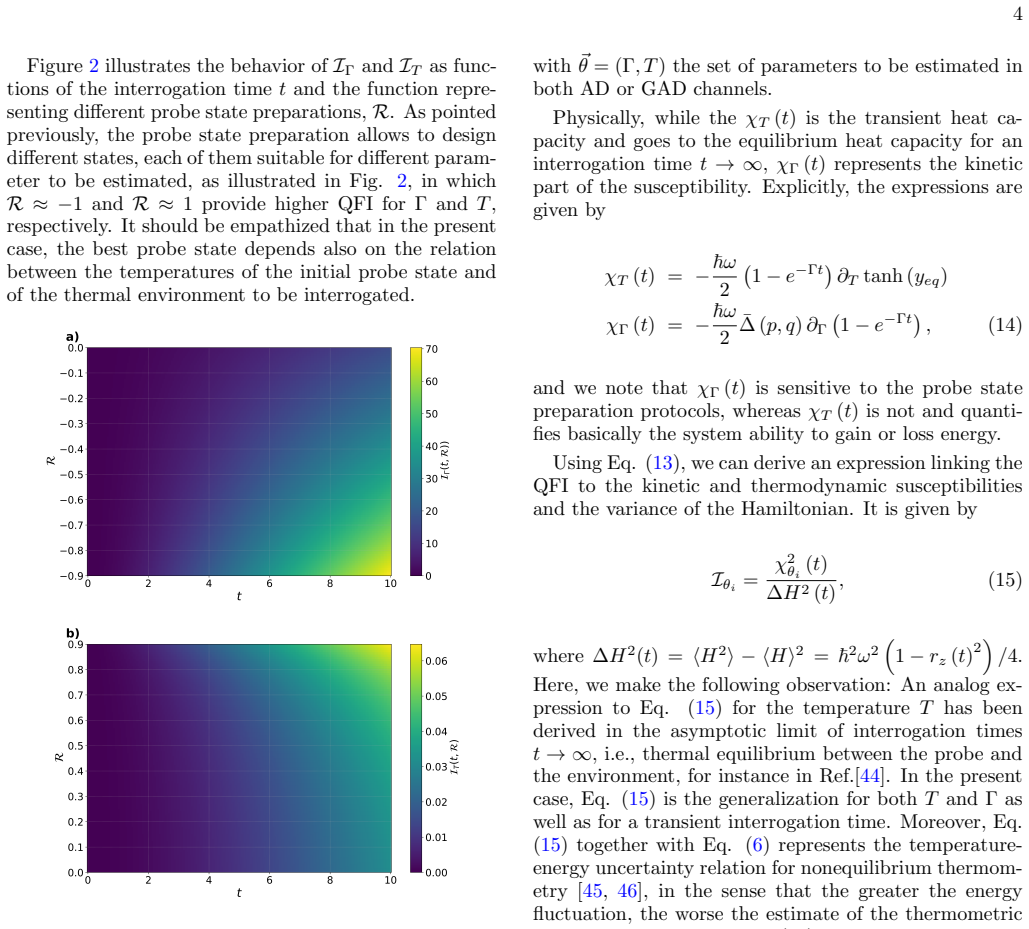
We derive a general analytical relationship between the quantum Fisher information, thermodynamic susceptibilities, and Hamiltonian variance, valid even in the transient regime. Our results show that the preparation protocol significantly modulates the quantum Fisher information for both parameters.
What carries the argument
The protocol of applying two non-selective generalized quantum measurements with tunable strengths to a thermal qubit state, which generates a family of probe states optimized for parameter estimation tasks.
If this is right
- The quantum Fisher information for estimating the decay rate and temperature of the damping channel can be modulated by choosing different measurement strengths.
- The relationship between quantum Fisher information and thermodynamic quantities provides insight into the role of energy fluctuations and response in metrological precision.
- The analytical connection holds in the transient regime, extending beyond steady-state assumptions.
- A quantum circuit implementation using nuclear magnetic resonance techniques is feasible for experimental realization.
Where Pith is reading between the lines
- The preparation method may generalize to other open quantum system models or estimation problems involving multiple parameters.
- Verification through the proposed NMR experiment could confirm the modulation effect and the derived relationship.
- This approach might inspire similar measurement-based preparation techniques in other quantum systems for enhanced sensing.
Load-bearing premise
The assumption that fine-tuning the two measurement strengths is sufficient to produce a broad, optimizable class of probe states without hidden constraints from the physical realization of the generalized measurements or from the specific form of the damping channel.
What would settle it
A direct calculation or measurement of the quantum Fisher information for specific measurement strengths, compared against the value computed from the thermodynamic susceptibilities and Hamiltonian variance at a chosen transient time; any systematic discrepancy would indicate the relationship does not hold as stated.
Figures



read the original abstract
We investigate a probe state preparation protocol based on two non-selective generalized quantum measurements to enhance parameter estimation in single-qubit systems. By fine-tuning the measurement strengths, we demonstrate the ability to design a broad class of probe states, initially prepared in a thermal state, which can be optimized for specific estimation tasks. We apply this framework to characterize the decay rate and the temperature of a generalized amplitude damping channel. Our results show that the preparation protocol significantly modulates the quantum Fisher information for both parameters. Furthermore, we derive a general analytical relationship between the quantum Fisher information, thermodynamic susceptibilities, and Hamiltonian variance, valid even in the transient regime. This connection highlights the role of energy fluctuations and kinetic response in determining metrological precision. Finally, we briefly discuss a quantum circuit for experimental implementation using nuclear magnetic resonance techniques.
Editorial analysis
A structured set of objections, weighed in public.
Referee Report
Summary. The manuscript describes a probe state preparation method using two non-selective generalized quantum measurements applied to a thermal state in single-qubit systems. By adjusting the measurement strengths, a broad class of probe states is generated and optimized for estimating the decay rate and temperature parameters of a generalized amplitude damping channel. The authors derive an analytical relationship linking the quantum Fisher information to thermodynamic susceptibilities and Hamiltonian variance, valid in the transient regime, and outline a quantum circuit for NMR implementation.
Significance. If the central results hold, this provides a flexible approach to state preparation for quantum metrology tasks, particularly thermometry, and establishes a connection between metrological precision and thermodynamic quantities that could inform the design of sensing protocols in open systems. The inclusion of a potential experimental implementation adds practical value.
major comments (2)
- The claim that fine-tuning the two measurement strengths produces a broad class of optimizable probe states (as stated in the abstract) requires explicit demonstration that the post-measurement states span a sufficiently high-dimensional parameter space. Without the explicit Kraus operators for the generalized measurements and the structure of the damping channel, it is unclear whether algebraic constraints limit the reachable states, potentially undermining the reported significant modulation of the QFI for both parameters.
- The general analytical relationship between QFI, thermodynamic susceptibilities, and Hamiltonian variance is presented as derived from quantum mechanics and valid in the transient regime, but the manuscript asserts this without providing the full step-by-step derivation, intermediate equations, or checks against post-hoc parameter choices. This is load-bearing for the central claim, as the support cannot be fully verified from the given presentation.
minor comments (2)
- The specific form of the generalized amplitude damping channel should be defined with equations early in the manuscript for reader clarity.
- Consider adding more details on the quantum circuit implementation, such as explicit gate sequences or pulse parameters, to make the experimental discussion more concrete.
Simulated Author's Rebuttal
We thank the referee for their careful reading and constructive comments, which have helped clarify several aspects of our work. We address each major comment below and have revised the manuscript to improve rigor and verifiability.
read point-by-point responses
-
Referee: The claim that fine-tuning the two measurement strengths produces a broad class of optimizable probe states (as stated in the abstract) requires explicit demonstration that the post-measurement states span a sufficiently high-dimensional parameter space. Without the explicit Kraus operators for the generalized measurements and the structure of the damping channel, it is unclear whether algebraic constraints limit the reachable states, potentially undermining the reported significant modulation of the QFI for both parameters.
Authors: We thank the referee for this point. The Kraus operators for the two non-selective generalized measurements are explicitly given in the manuscript (Eqs. (3)-(4) in Section II), along with the generalized amplitude damping channel (Eq. (7)). In the revised version, we have added an explicit calculation of the post-measurement state in the Bloch representation, demonstrating that the two measurement strengths independently control the transverse and longitudinal components within the physical bounds of the Bloch ball. This yields a two-parameter family of states (a surface in the 3D Bloch space) starting from the initial thermal state. We further show through direct computation that this family allows significant QFI modulation for both parameters without additional algebraic constraints from the channel structure beyond the standard positivity requirements. A new figure has been included to visualize the reachable states and their QFI values. revision: yes
-
Referee: The general analytical relationship between QFI, thermodynamic susceptibilities, and Hamiltonian variance is presented as derived from quantum mechanics and valid in the transient regime, but the manuscript asserts this without providing the full step-by-step derivation, intermediate equations, or checks against post-hoc parameter choices. This is load-bearing for the central claim, as the support cannot be fully verified from the given presentation.
Authors: We agree that the derivation was presented too concisely, making independent verification difficult. In the revised manuscript, we have expanded the main text discussion and added a full step-by-step derivation in a new Appendix A. The derivation begins from the definition of the quantum Fisher information via the symmetric logarithmic derivative for the parameter-dependent evolved state, proceeds through the linear response of the relevant observable to the parameter (yielding the susceptibility), and connects it to the Hamiltonian variance using the fluctuation-dissipation relation adapted to the transient regime of the open-system dynamics. We have also added explicit numerical checks comparing the analytical formula to direct QFI computations for multiple parameter choices, confirming agreement within the transient time window. These changes make the central analytical relationship fully transparent and verifiable. revision: yes
Circularity Check
No significant circularity: QFI-susceptibility-variance relation derived independently from QM principles
full rationale
The paper presents a derivation of an analytical relationship between quantum Fisher information, thermodynamic susceptibilities, and Hamiltonian variance that holds in the transient regime. This is framed as following from standard quantum mechanics without reduction to fitted parameters or self-referential definitions. The probe preparation protocol (via two non-selective generalized measurements) is used to modulate QFI for decay rate and temperature estimation, but the central relation is not constructed from or equivalent to the protocol outputs by definition. No load-bearing self-citation chains, ansatz smuggling, or renaming of known results are evident in the provided claims. The derivation chain remains self-contained against external quantum information benchmarks.
Axiom & Free-Parameter Ledger
free parameters (1)
- measurement strengths
axioms (1)
- domain assumption Single-qubit systems subject to a generalized amplitude damping channel
Reference graph
Works this paper leans on
-
[1]
M. Rademacher, J. Millen, and Y. L. Li, Quantum sens- ing with nanoparticles for gravimetry: when bigger is better, Advanced Optical Technologies9, 227 (2020)
work page 2020
-
[2]
J. Wei, J. Huang, and C. Lee, Adaptive robust high- precision atomic gravimetry, Phys. Rev. Res.7, L012064 (2025)
work page 2025
-
[3]
J. Guyomard, P. Clad´ e, and S. Reynaud, Single-bounce quantum gravimeter to measure the free-fall of anti- hydrogen (2025), arXiv:2505.04771 [quant-ph]
-
[4]
C. Cassens, B. Meyer-Hoppe, E. Rasel, and C. Klempt, Entanglement-enhanced atomic gravimeter, Phys. Rev. X15, 011029 (2025)
work page 2025
-
[5]
S. Das, H. Mazumdar, K. R. Khondakar, Y. K. Mishra, and A. Kaushik, Review—quantum biosensors: Princi- ples and applications in medical diagnostics, ECS Sens. Plus3, 025001 (2024)
work page 2024
- [6]
- [7]
-
[8]
G. W. Biedermann, X. Wu, L. Deslauriers, S. Roy, C. Ma- hadeswaraswamy, and M. A. Kasevich, Testing gravity with cold-atom interferometers, Phys. Rev. A91, 033629 (2015)
work page 2015
-
[9]
G. Fraz˜ ao, M. Pezzutto, Y. Omar, E. Zambrini Cruzeiro, 7 and S. Gherardini, Coherence-enhanced single-qubit thermometry out of equilibrium, Entropy26, 568 (2024)
work page 2024
-
[10]
J. F. G. Santos, Enhanced frequency and temperature estimation by aPT-symmetric quantum oscillator, Phys. Rev. A112, 012220 (2025)
work page 2025
-
[11]
J. C. P. Porto, C. H. S. Vieira, I. G. da Paz, P. R. Dieguez, and L. S. Marinho, Temperature and non-markovian pa- rameter estimation in quantum brownian motion, Phys. Rev. A112, 042424 (2025)
work page 2025
- [12]
-
[13]
M. Mehboudi, A. Sanpera, and L. A. Correa, Thermom- etry in the quantum regime: recent theoretical progress, J. Phys. A Math. Theor.52, 303001 (2019)
work page 2019
-
[14]
C. L. Degen, F. Reinhard, and P. Cappellaro, Quantum sensing, Rev. Mod. Phys.89, 035002 (2017)
work page 2017
-
[15]
G. Fraz˜ ao, M. Pezzutto, Y. Omar, E. Zambrini Cruzeiro, and S. Gherardini, Coherence-Enhanced Single-Qubit thermometry out of equilibrium, Entropy (Basel)26, 568 (2024)
work page 2024
-
[16]
J. F. G. Santos, C. H. S. Vieira, and W. R. Cardoso, Im- proving parameter estimation in gaussian channels using quantum coherence, Phys. Rev. A111, 052404 (2025)
work page 2025
-
[17]
L. Pezz´ e and A. Smerzi, Entanglement, nonlinear dy- namics, and the Heisenberg limit, Phys. Rev. Lett.102, 100401 (2009)
work page 2009
-
[18]
V. Giovannetti, S. Lloyd, and L. Maccone, Quantum metrology, Phys. Rev. Lett.96, 010401 (2006)
work page 2006
- [19]
-
[20]
I. K. Kominis, Quantum thermodynamic derivation of the energy resolution limit in magnetometry, Phys. Rev. Lett.133, 263201 (2024)
work page 2024
- [21]
-
[22]
A. Delakouras, D. Rodr´ ıguez, and J. Cerrillo, Production of fock mixtures in trapped ions for motional metrology, Quantum Sci. Technol.9, 015006 (2024)
work page 2024
-
[23]
Y.-J. Wang, J. Zhang, Z.-Y. Zhang, S.-Y. Shao, Q. Li, H.-C. Chen, Y. Ma, T.-Y. Han, Q.-F. Wang, J.-D. Nan, Y.-M. Yin, D.-Y. Zhu, Q.-Q. Fang, C. Yu, X. Liu, G.- C. Guo, B. Liu, L.-H. Zhang, D.-S. Ding, and B.-S. Shi, Quantum enhanced metrology based on flipping trajec- tory of cold Rydberg gases, Nat. Commun. (2026)
work page 2026
- [24]
-
[25]
R. Liu, X. Yang, X. Lv, X. Long, H. Liu, D. Lu, Y. Dong, and J. Li, Experimental realization of quantum Zeno dy- namics for robust quantum metrology, Phys. Rev. Lett. 135, 250805 (2025)
work page 2025
-
[26]
C. W. Helstrom, Quantum detection and estimation the- ory, Journal of Statistical Physics1, 231 (1969)
work page 1969
-
[27]
A. S. Holevo,Probabilistic and statistical aspects of quan- tum theory, Publications of the Scuola Normale Superiore (Scuola Normale Superiore, Pisa, Italy, 2011)
work page 2011
-
[28]
V. Giovannetti, S. Lloyd, and L. Maccone, Advances in quantum metrology, Nature Photonics5, 222 (2011)
work page 2011
-
[29]
J. Liu, H. Yuan, X.-M. Lu, and X. Wang, Quantum fisher information matrix and multiparameter estimation, J. Phys. A Math. Theor.53, 023001 (2020)
work page 2020
-
[30]
W. Ding, X. Wang, and S. Chen, Fundamental sensitiv- ity limits for non-hermitian quantum sensors, Phys. Rev. Lett.131, 160801 (2023)
work page 2023
-
[31]
J. Jae, J. Lee, M. S. Kim, K.-G. Lee, and J. Lee, Contex- tual quantum metrology, npj Quantum Information10, 68 (2024)
work page 2024
-
[32]
Anomaly to resource: The mpemba effect in quantum thermome- try,
P. Chattopadhyay, J. F. G. Santos, and A. Misra, Anomaly to resource: The mpemba effect in quantum thermometry (2026), arXiv:2601.05046 [quant-ph]
-
[33]
J. Yi, P. Talkner, and Y. W. Kim, Single-temperature quantum engine without feedback control, Phys. Rev. E 96, 022108 (2017)
work page 2017
-
[34]
V. F. Lisboa, P. R. Dieguez, J. R. Guimar˜ aes, J. F. G. Santos, and R. M. Serra, Experimental investigation of a quantum heat engine powered by generalized measure- ments, Phys. Rev. A106, 022436 (2022)
work page 2022
-
[35]
J. F. G. Santos and P. Chattopadhyay, PT-symmetry ef- fects in measurement-based quantum thermal machines, Physica A632, 129342 (2023)
work page 2023
-
[36]
P. R. Dieguez, V. F. Lisboa, and R. M. Serra, Thermal devices powered by generalized measurements with in- definite causal order, Phys. Rev. A107, 012423 (2023)
work page 2023
-
[37]
P. Mironowicz, M. Gr¨ unfeld, and M. Bourennane, Gener- alized measurements on qubits in quantum randomness certification and expansion, Phys. Rev. Appl.22, 044041 (2024)
work page 2024
-
[38]
D. Reitzner and J. Bouda, General measurements with limited resources and their application to quantum un- ambiguous state discrimination, Quantum Inf. Process. 23(2024)
work page 2024
-
[39]
L. Mancino, M. Sbroscia, E. Roccia, I. Gianani, F. Somma, P. Mataloni, M. Paternostro, and M. Barbieri, The entropic cost of quantum generalized measurements, NPJ Quantum Inf.4(2018)
work page 2018
-
[40]
Y. Pan, J. Zhang, E. Cohen, C.-W. Wu, P.-X. Chen, and N. Davidson, Weak-to-strong transition of quantum measurement in a trapped-ion system, Nat. Phys.16, 1206 (2020)
work page 2020
-
[41]
W. Zhong, Z. Sun, J. Ma, X. Wang, and F. Nori, Fisher information under decoherence in Bloch representation, Physical Review A - Atomic, Molecular, and Optical Physics87, 10.1103/PhysRevA.87.022337 (2013)
-
[42]
H.-P. Breuer and F. Petruccione,The theory of open quantum systems(OUP Oxford, 2002)
work page 2002
-
[43]
J. Prathik Cherian, S. Chakraborty, and S. Ghosh, On thermalization of two-level quantum systems, EPL (Eu- rophysics Letters)126, 40003 (2019)
work page 2019
-
[44]
L. A. Correa, M. Mehboudi, G. Adesso, and A. San- pera, Individual quantum probes for optimal thermome- try, Physical Review Letters114, 220405 (2015)
work page 2015
-
[45]
H. J. D. Miller and J. Anders, Energy-temperature uncer- tainty relation in quantum thermodynamics, Nat. Com- mun.9, 2203 (2018)
work page 2018
-
[46]
N. Zhang, S.-Y. Bai, and C. Chen, Temperature-heat un- certainty relation in nonequilibrium quantum thermom- etry, Phys. Rev. A110, 012211 (2024)
work page 2024
-
[47]
L. Davidovich and R. L. de Matos Filho, Quantum illu- mination strategy for parameter estimation, Phys. Rev. A108, 042612 (2023)
work page 2023
-
[48]
J. P. S. Peterson, T. B. Batalh˜ ao, M. Herrera, A. M. Souza, R. S. Sarthour, I. S. Oliveira, and R. M. Serra, Experimental characterization of a spin quantum heat engine, Phys. Rev. Lett.123, 240601 (2019)
work page 2019
discussion (0)
Sign in with ORCID, Apple, or X to comment. Anyone can read and Pith papers without signing in.