Recognition: 1 theorem link
· Lean TheoremTopological edge states of the hexagonal linear chain
Pith reviewed 2026-05-13 05:01 UTC · model grok-4.3
The pith
A hexagonal linear chain enters a topological phase with exponentially localized edge states when the hopping ratio falls below a critical value.
A machine-rendered reading of the paper's core claim, the machinery that carries it, and where it could break.
Core claim
The central claim is that the hexagonal linear chain supports a topological insulating phase when the ratio of the two alternating hopping amplitudes lies below a critical value. In this phase the bulk remains gapped, yet finite chains with open boundaries host mid-gap edge states that are exponentially localized at the chain termini. These states disappear in the trivial phase realized when the hopping ratio exceeds the critical value, where the open-boundary spectrum contains no additional in-gap levels.
What carries the argument
The ratio of the two alternating nearest-neighbor hopping parameters, which drives a gap-closing transition that separates the trivial and topological phases and controls the appearance of boundary-localized states under open boundary conditions.
If this is right
- The bulk spectrum contains both dispersive and flat bands whose character changes across the gap-closing point.
- The two insulating phases are distinguished solely by the hopping ratio, with the topological phase occurring below the critical value.
- Edge states appear only in the topological phase and are absent when the chain is treated under periodic boundary conditions.
- The transition is identified by the point at which the bulk gap closes and reopens with a change in the boundary spectrum.
Where Pith is reading between the lines
- Real molecular realizations would require the effective hopping ratio to be tunable, for example by strain or chemical substitution, to cross into the topological regime.
- The localized edge states could produce distinct signatures in local density of states or transport measurements on finite-length chains.
- The model geometry suggests that similar alternating-bond chains in other lattices might exhibit analogous transitions controlled by a single parameter ratio.
Load-bearing premise
The non-interacting tight-binding model with only nearest-neighbor alternating hoppings accurately captures the low-energy physics without longer-range terms or electron-electron interactions.
What would settle it
A direct measurement or calculation of the spectrum for a finite open hexagonal chain that shows no exponentially localized edge states when the effective hopping ratio is tuned below the critical value would falsify the topological phase.
Figures




read the original abstract
We study the eigenspectrum properties of a one-dimensional molecular chain composed of hexagonal unit cells. The system features two alternating hopping parameters, resulting in a rich energy spectrum with both dispersive and flat bands. By analyzing the model under periodic and open boundary conditions, we identify two insulating phases separated by a gap-closing transition controlled by the ratio of hopping amplitudes. In the topological phase, realized when the hopping ratio falls below a critical value, edge states emerge that are exponentially localized at the boundaries of finite chains.
Editorial analysis
A structured set of objections, weighed in public.
Referee Report
Summary. The manuscript studies the eigenspectrum of a one-dimensional chain of hexagonal unit cells with two alternating nearest-neighbor hopping parameters. Under periodic boundary conditions the bulk spectrum exhibits dispersive and flat bands; a gap-closing transition occurs at a critical value of the hopping ratio, separating two insulating phases. Under open boundary conditions, in-gap states that are exponentially localized at the chain ends appear precisely when the hopping ratio lies below this critical value, which the authors identify as the topological phase.
Significance. If the calculations are correct, the work demonstrates that a tight-binding model with a six-site hexagonal unit cell and staggered hoppings realizes a bulk-boundary correspondence with protected edge states, extending the Su-Schrieffer-Heeger paradigm to a geometry that also produces flat bands. The result is internally consistent with standard diagonalization of the finite open-chain Hamiltonian and comparison to the periodic bulk gap, but its broader impact is modest because the model remains non-interacting and nearest-neighbor only, with no connection to experimental molecular systems or interaction effects.
major comments (2)
- [bulk spectrum section] The explicit 6×6 Bloch Hamiltonian (or its matrix elements in terms of the two hopping amplitudes) is never written down, nor is the algebraic condition for gap closure at the critical ratio derived. Without this, the stated phase boundary and the assignment of which phase is topological cannot be independently verified from the text.
- [open-boundary analysis] No numerical spectra, wave-function plots, or decay-length fits are presented for finite open chains. The claim of exponential localization therefore rests on an unshown diagonalization; a single figure showing the in-gap states and their spatial decay for several system sizes would be required to substantiate the central result.
minor comments (2)
- [Introduction] The abstract and introduction refer to “molecular chain” without specifying whether the model is intended to describe a concrete molecule (e.g., polyacene or linked benzene rings) or is purely abstract; a short clarifying sentence would help readers.
- [model definition] Notation for the two hopping parameters is introduced but never consistently labeled in equations or figures; adopting t1 and t2 (or equivalent) throughout would improve readability.
Simulated Author's Rebuttal
We thank the referee for their careful reading of the manuscript and for identifying points where additional explicit detail would strengthen the presentation. We address each major comment below and will incorporate the requested elements in a revised version.
read point-by-point responses
-
Referee: [bulk spectrum section] The explicit 6×6 Bloch Hamiltonian (or its matrix elements in terms of the two hopping amplitudes) is never written down, nor is the algebraic condition for gap closure at the critical ratio derived. Without this, the stated phase boundary and the assignment of which phase is topological cannot be independently verified from the text.
Authors: We agree that the 6×6 Bloch Hamiltonian was not displayed in explicit matrix form. In the revised manuscript we will add the full Bloch Hamiltonian H(k) with matrix elements written in terms of the two alternating hopping amplitudes. We will also derive the gap-closing condition analytically by requiring that the determinant of H(k) vanishes at the high-symmetry points, thereby confirming the critical hopping ratio that separates the two insulating phases and the assignment of the topological phase. revision: yes
-
Referee: [open-boundary analysis] No numerical spectra, wave-function plots, or decay-length fits are presented for finite open chains. The claim of exponential localization therefore rests on an unshown diagonalization; a single figure showing the in-gap states and their spatial decay for several system sizes would be required to substantiate the central result.
Authors: We accept that direct numerical evidence for the open-boundary spectrum and edge-state localization is necessary. The revised manuscript will include a new figure that shows (i) the full energy spectrum versus system size for open chains, (ii) the spatial profile of the in-gap wave functions for representative values of the hopping ratio, and (iii) exponential-decay fits to the edge-state amplitudes. These additions will make the localization claim verifiable from the text. revision: yes
Circularity Check
No significant circularity identified
full rationale
The derivation consists of defining a nearest-neighbor tight-binding Hamiltonian on a 1D chain of hexagonal unit cells with two alternating hopping amplitudes, constructing the 6×6 Bloch Hamiltonian for periodic boundaries, locating the gap-closing point as a function of the input hopping ratio, and then diagonalizing the finite open-boundary matrix to obtain exponentially localized in-gap states precisely when the bulk gap is topologically nontrivial. All steps are direct algebraic consequences of the stated Hamiltonian; no parameters are fitted to data, no result is renamed as a prediction, and no load-bearing premise rests on self-citation. The phase boundary is simply the value of the ratio at which the bulk bands touch, which is an explicit eigenvalue condition of the model itself.
Axiom & Free-Parameter Ledger
free parameters (1)
- hopping ratio
axioms (1)
- domain assumption Electrons in the molecular chain are described by a nearest-neighbor tight-binding Hamiltonian with two alternating hopping amplitudes.
Lean theorems connected to this paper
-
IndisputableMonolith/Foundation/AbsoluteFloorClosure.leanreality_from_one_distinction unclear?
unclearRelation between the paper passage and the cited Recognition theorem.
We study the eigenspectrum properties of a one-dimensional molecular chain composed of hexagonal unit cells. The system features two alternating hopping parameters... gap-closing transition controlled by the ratio of hopping amplitudes... winding number ν = 1 if r² < 1
What do these tags mean?
- matches
- The paper's claim is directly supported by a theorem in the formal canon.
- supports
- The theorem supports part of the paper's argument, but the paper may add assumptions or extra steps.
- extends
- The paper goes beyond the formal theorem; the theorem is a base layer rather than the whole result.
- uses
- The paper appears to rely on the theorem as machinery.
- contradicts
- The paper's claim conflicts with a theorem or certificate in the canon.
- unclear
- Pith found a possible connection, but the passage is too broad, indirect, or ambiguous to say the theorem truly supports the claim.
Reference graph
Works this paper leans on
-
[1]
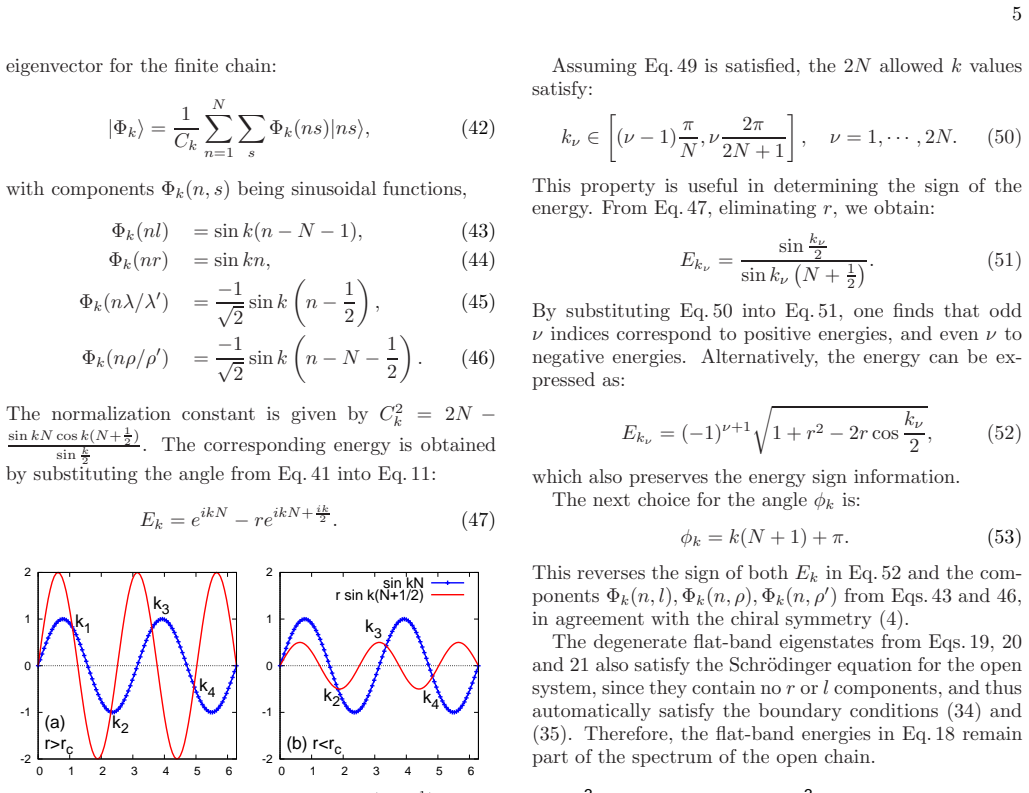
Substituting Eqs. 12 and 13 into Eq. 37 yields: Φ k(nr) = αe ikn + βe − ikn, (39) Φ k(nl) = αe ikn− iφ k + βe − ikn+iφ k . (40) From Eqs. 39 and 34, we find Φ k(0, r ) = α + β = 0, which implies α = − β . Substituting this into Eq. 40 gives Φ k(n, l ) = 2 iα sin(kn − φ k). Imposing the second boundary condition from Eq. 35 leads to the constraint sin[k(N +...
-
[2]
5 such that the system is in the topological phase (exhibiting both bulk and edge states)
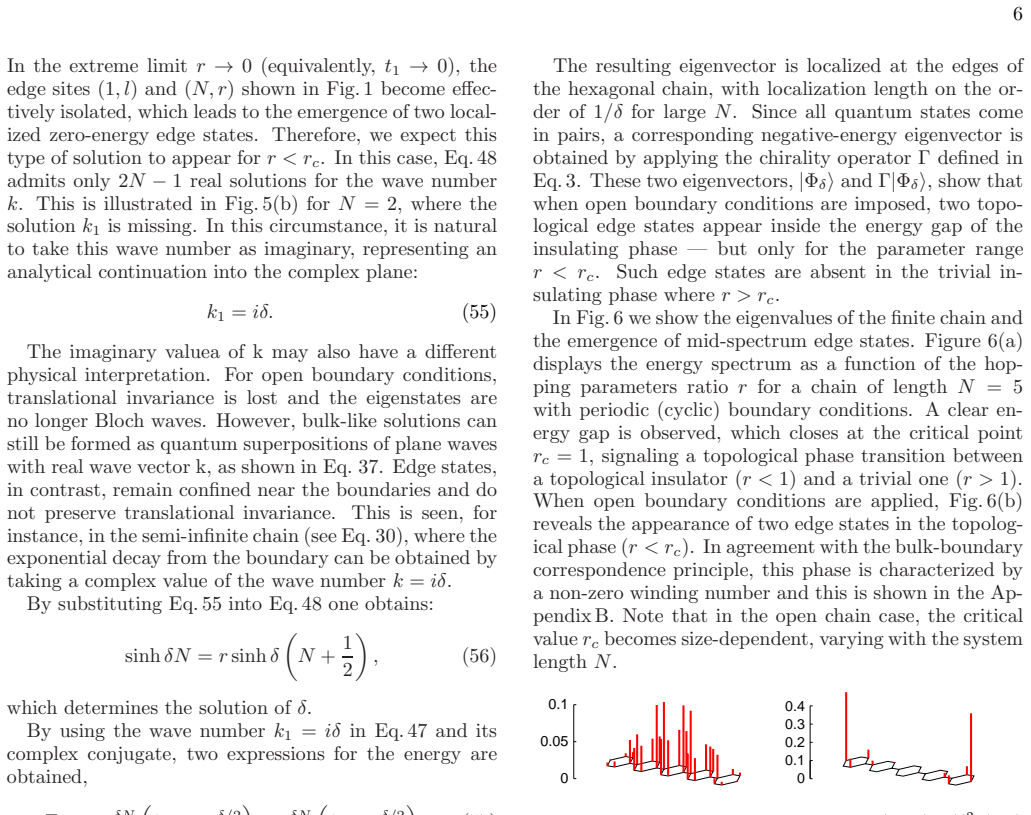
91 so one chooses r = 0. 5 such that the system is in the topological phase (exhibiting both bulk and edge states). The wave numbers equation Eq. 51 has 2 N − 1 solutions, k2, · · ·, k 10. The wave function |Φ kν (n, s )|2 from Eqs. 43- 46 for ν = 10 is shown in the left of the figure. It has the wave number k10 = 5 . 67 and energy from Eq. 52 is Ek10 = − ...
-
[3]
J. E. Lennard-Jones, The electronic structure of some polyenes and aromatic molecules i–the nature of the links by the method of molecular orbitals, Proceedings of the Royal Society of London. Series A - Mathematical and Physical Sciences 158, 280 (1937)
work page 1937
-
[4]
W. P. Su, J. R. Schrieffer, and A. J. Heeger, Soliton ex- citations in polyacetylene, Phys. Rev. B 22, 2099 (1980)
work page 2099
-
[5]
N. Batra and G. Sheet, Physics with coffee and dough- nuts: understanding the physics behind topological insu- lators through su-schrieffer-heeger model, Resonance 25, 765 (2020)
work page 2020
-
[6]
B. Ostahie and A. Aldea, Spectral analysis, chiral dis- order and topological edge states manifestation in open non-hermitian su-schrieffer-heeger chains, Physics Let- ters A 387, 127030 (2021)
work page 2021
-
[7]
V. Martinez Alvarez and M. Coutinho-Filho, Edge states in trimer lattices, Physical Review A 99 (2019)
work page 2019
-
[8]
A. Anastasiadis, G. Styliaris, R. Chaunsali, G. Theocharis, and F. K. Diakonos, Bulk-edge cor- respondence in the trimer su-schrieffer-heeger model, Phys. Rev. B 106, 085109 (2022)
work page 2022
- [9]
-
[10]
S. Verma and T. K. Ghosh, Bulk-boundary correspon- dence in extended trimer su-schrieffer-heeger model, Phys. Rev. B 110, 125424 (2024)
work page 2024
-
[11]
Q.-H. Guo, Y. Zhang, X.-H. Wan, and L.-Y. Zheng, Isospectral reduction of the trimer su-schrieffer-heeger lattice and its bulk-edge correspondence, Physical Re- view Applied 23 (2025)
work page 2025
-
[12]
R. Wielian, I. Toftul, and Y. Kivshar, Transfer matrix approach for topological edge states, Phys. Rev. B 111, 035151 (2025)
work page 2025
-
[13]
M. Ghuneim and R. W. Bomantara, Anomalous topo- logical edge modes in a periodically driven trimer lattice, Phys. Rev. B 111, 195424 (2025)
work page 2025
-
[14]
A. Coutant, A. Sivadon, L. Zheng, V. Achilleos, O. Ri- choux, G. Theocharis, and V. Pagneux, Acoustic su- schrieffer-heeger lattice: Direct mapping of acoustic waveguides to the su-schrieffer-heeger model, Phys. Rev. B 103, 224309 (2021)
work page 2021
-
[15]
Z. Lan, M. L. Chen, F. Gao, S. Zhang, and W. E. Sha, A brief review of topological photonics in one, two, and three dimensions, Reviews in Physics 9, 100076 (2022)
work page 2022
-
[16]
L.-C. Wang, Y. Chen, M. Gong, F. Yu, Q.-D. Chen, Z.-N. Tian, X.-F. Ren, and H.-B. Sun, Edge state, localization length, and critical exponent from survival probability in topological waveguides, Phys. Rev. Lett. 129, 173601 (2022)
work page 2022
-
[17]
G. C´ aceres-Aravena, B. Real, D. Guzm´ an-Silva, A. Amo, L. E. F. Foa Torres, and R. A. Vicencio, Experimental observation of edge states in ssh-stub photonic lattices, Phys. Rev. Res. 4, 013185 (2022)
work page 2022
-
[18]
Z. Guo, Y. Wang, S. Ke, X. Su, J. Ren, and H. Chen, 1d photonic topological insulators composed of split ring resonators: A mini review, Advanced Physics Research 3, 2300125 (2024)
work page 2024
-
[19]
A. Hotte-Kilburn and P. Bianucci, Integrated topological photonics in one dimension, Advances in Physics: X 10, 2476417 (2025)
work page 2025
- [20]
-
[21]
C. Volk, A. M. J. Zwerver, U. Mukhopadhyay, P. T. Een- debak, C. J. van Diepen, J. P. Dehollain, T. Hensgens, T. Fujita, C. Reichl, W. Wegscheider, and L. M. K. Van- dersypen, Loading a quantum-dot based “qubyte” regis- ter, npj Quantum Information 5, 29 (2019)
work page 2019
-
[22]
B. P´ erez-Gonz´ alez, M. Bello, G. Platero, and A. G´ omez- Le´ on, Simulation of 1d topological phases in driven quan- tum dot arrays, Phys. Rev. Lett. 123, 126401 (2019)
work page 2019
-
[23]
M. Kiczynski, S. K. Gorman, H. Geng, M. B. Donnelly, Y. Chung, Y. He, J. G. Keizer, and M. Y. Simmons, En- gineering topological states in atom-based semiconductor quantum dots, Nature 606, 694 (2022)
work page 2022
-
[24]
L. Malysheva and A. Onipko, Spectrum of π electrons in graphene as a macromolecule, Phys. Rev. Lett. 100, 186806 (2008)
work page 2008
-
[25]
A. Onipko, Spectrum of π electrons in graphene as an al- ternant macromolecule and its specific features in quan- tum conductance, Phys. Rev. B 78, 245412 (2008)
work page 2008
-
[26]
L. Malysheva, Electronic structure of conjugated oligomers that are building blocks for achiral and chi- ral graphene nanoribbons, Chemical Physics Letters 836, 141048 (2024)
work page 2024
-
[27]
M. Nit ¸˘ a, B. Ostahie, and A. Aldea, Spectral and trans- port properties of the two-dimensional lieb lattice, Phys. Rev. B 87, 125428 (2013)
work page 2013
- [28]
-
[29]
T. Bilitewski and R. Moessner, Disordered flat bands on the kagome lattice, Phys. Rev. B 98, 235109 (2018)
work page 2018
-
[30]
H.-C. Zeng, M.-D. Dai, X.-P. Liu, W.-W. Luo, and Y.-F. Wang, From degenerate flat bands to topological states with high chern numbers, Phys. Rev. B 111, 235130 (2025)
work page 2025
-
[31]
C.-S. Lee, A linear algebra-based approach to under- standing the relation between the winding number and zero-energy edge states, SciPost Phys. Core 7, 003 (2024)
work page 2024
discussion (0)
Sign in with ORCID, Apple, or X to comment. Anyone can read and Pith papers without signing in.