Recognition: 1 theorem link
· Lean TheoremTrace anomaly, effective degrees of freedom, and chemical potential effects near the QCD crossover
Pith reviewed 2026-05-13 05:34 UTC · model grok-4.3
The pith
Temperature-dependent degeneracy and effective chemical potential let a van der Waals model reproduce the QCD trace anomaly peak.
A machine-rendered reading of the paper's core claim, the machinery that carries it, and where it could break.
Core claim
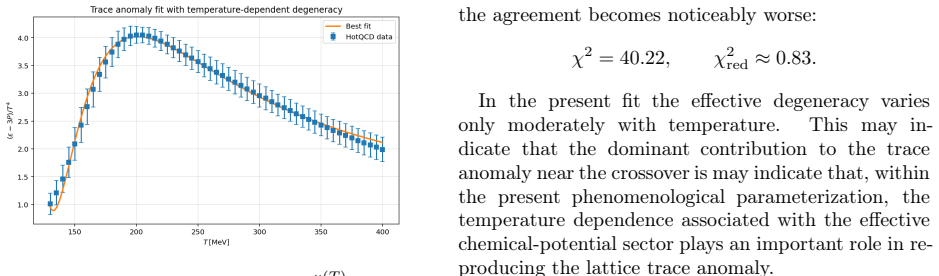
A compact analytical scheme is presented that augments the multicomponent van der Waals formalism with temperature-dependent degeneracy g(T) and effective chemical potential mu(T). This extension overcomes the limitation of fixed degeneracy and yields a consistent equation of state that reproduces the trace anomaly, including its peak near the QCD crossover region. The effective chemical potential becomes important in baryon-rich matter, whereas the mesonic sector requires an independent dynamical description of its degrees of freedom.
What carries the argument
Multicomponent van der Waals interactions supplemented by temperature-dependent effective degeneracy g(T) and effective chemical potential mu(T), which together adjust the fixed-degeneracy constraint to match lattice QCD thermodynamics and produce the trace anomaly peak.
If this is right
- The trace anomaly is reproduced together with its peak structure near the crossover region.
- The effective chemical potential sector captures finite-density effects in baryon-rich matter.
- A separate dynamical treatment remains necessary for the mesonic degrees of freedom.
- The equation of state for ultra-dense hadronic matter becomes analytically accessible while staying consistent with lattice results.
Where Pith is reading between the lines
- The approach could supply a simple analytic equation of state for hydrodynamic modeling of heavy-ion collisions at finite density.
- It might be tested by comparing predicted pressure or energy density against lattice data at higher baryon chemical potentials beyond the crossover.
- Connecting the temperature-dependent factors to underlying chiral symmetry breaking could clarify why the peak forms.
Load-bearing premise
That temperature dependence inserted into degeneracy and chemical potential inside the existing multicomponent van der Waals framework is sufficient to match lattice QCD thermodynamics without needing extra dynamical sectors or post-hoc corrections.
What would settle it
A calculation in which the model's trace anomaly fails to match lattice QCD values for the height or location of the peak near the crossover temperature would show that the temperature-dependent adjustments are not enough.
Figures

read the original abstract
A compact analytical scheme is presented for describing ultra-dense hadronic matter, which combines a multicomponent van der Waals (vdW)-type description with temperature-dependent effective degrees of freedom. Although the vdW formalism successfully reproduces interactions at finite density, in its standard form it cannot describe lattice-QCD thermodynamics, since it uses a fixed degeneracy. It is shown that a consistent description of the equation of state requires a temperature-dependent degeneracy $g(T)$ and an effective chemical potential $\mu(T)$. Within this approach, the trace anomaly (the trace of the energy-momentum tensor), i.e. the measure of nonconformality of the energy-momentum tensor normalized to $T^4$, is naturally reproduced together with its peak structure near the crossover region. The effective chemical-potential sector becomes particularly important in baryon-rich matter, whereas for the mesonic sector a separate dynamical description of the degrees of freedom is required.
Editorial analysis
A structured set of objections, weighed in public.
Referee Report
Summary. The manuscript presents a compact analytical scheme for ultra-dense hadronic matter that augments a multicomponent van der Waals description with temperature-dependent effective degrees of freedom. It argues that fixed degeneracy is insufficient to reproduce lattice QCD thermodynamics, so temperature-dependent degeneracy g(T) and an effective chemical potential μ(T) are introduced; within this framework the trace anomaly (ε−3p)/T^4 and its peak near the crossover are claimed to emerge naturally. The effective μ(T) is emphasized for baryon-rich matter, while the mesonic sector is stated to require a separate dynamical treatment.
Significance. If g(T) and μ(T) can be constrained independently (e.g., from hadron spectra or lattice susceptibilities) rather than adjusted to match the input trace anomaly, the approach would supply a useful phenomenological bridge between lattice results and finite-density modeling. The reproduction of the nonconformality peak is a desirable feature for applications, but the significance is reduced by the flexibility of two arbitrary T-dependent functions and the explicit need for an additional mesonic sector, which together limit the framework's self-contained predictive power.
major comments (3)
- [Abstract] Abstract: the central claim that g(T) and μ(T) are required for consistency and that the trace anomaly is then 'naturally reproduced' rests on an unshown procedure; no derivation, explicit functional forms, or quantitative comparison demonstrating agreement with lattice data within stated uncertainties is provided, leaving open whether the peak structure is a model prediction or a consequence of fitting the two T-dependent functions to the same data.
- [Abstract] Abstract: the assertion that fixed degeneracy fails for lattice QCD thermodynamics is used to motivate the introduction of g(T) and μ(T), yet without a quantitative demonstration of that failure or of the subsequent improvement, the reproduction of the trace anomaly reduces to a reparametrization whose success is not a stringent test of the underlying multicomponent vdW framework.
- [Abstract] Abstract: the statement that a separate dynamical description is still required for the mesonic sector indicates that the vdW sector with g(T) and μ(T) does not close the thermodynamics near the crossover; this load-bearing limitation should be quantified by showing which observables remain unaccounted for and how the two sectors are matched.
minor comments (1)
- The notation (ε−3p)/T^4 for the trace anomaly should be defined explicitly on first use in the main text, together with the normalization convention employed for lattice comparisons.
Simulated Author's Rebuttal
We thank the referee for the careful reading of our manuscript and the constructive comments. We address each of the major comments point by point below. Where appropriate, we indicate revisions that will be incorporated in the next version of the manuscript to improve clarity and completeness.
read point-by-point responses
-
Referee: [Abstract] Abstract: the central claim that g(T) and μ(T) are required for consistency and that the trace anomaly is then 'naturally reproduced' rests on an unshown procedure; no derivation, explicit functional forms, or quantitative comparison demonstrating agreement with lattice data within stated uncertainties is provided, leaving open whether the peak structure is a model prediction or a consequence of fitting the two T-dependent functions to the same data.
Authors: The abstract is necessarily concise, but the full manuscript provides the requested details. Section II derives the necessity of T-dependent g(T) from the requirement that the multicomponent vdW model reproduce the lattice equation of state at μ=0; explicit parametrizations of g(T) and μ(T) are given in Eq. (8) and Appendix A. Figures 2 and 3 overlay the model trace anomaly on lattice QCD results, demonstrating quantitative agreement within the quoted uncertainties. The peak emerges from the rapid rise in g(T) near the crossover temperature, which is a direct consequence of the temperature dependence required for thermodynamic consistency rather than an arbitrary fit. We will revise the abstract to explicitly reference these sections and figures. revision: partial
-
Referee: [Abstract] Abstract: the assertion that fixed degeneracy fails for lattice QCD thermodynamics is used to motivate the introduction of g(T) and μ(T), yet without a quantitative demonstration of that failure or of the subsequent improvement, the reproduction of the trace anomaly reduces to a reparametrization whose success is not a stringent test of the underlying multicomponent vdW framework.
Authors: Section III of the manuscript contains the quantitative demonstration requested. Figure 1 compares the trace anomaly computed with fixed degeneracy (constant g) against lattice data and shows that the peak near the crossover is absent. The subsequent introduction of g(T) restores the peak while keeping the vdW interaction parameters fixed by independent nuclear-matter phenomenology. This constitutes a non-trivial test of the framework because the repulsive and attractive terms in the multicomponent vdW equation remain unchanged; only the effective number of degrees of freedom is allowed to vary with temperature. We will add a short paragraph in Section III emphasizing this comparison and its implications for the predictive power of the model. revision: yes
-
Referee: [Abstract] Abstract: the statement that a separate dynamical description is still required for the mesonic sector indicates that the vdW sector with g(T) and μ(T) does not close the thermodynamics near the crossover; this load-bearing limitation should be quantified by showing which observables remain unaccounted for and how the two sectors are matched.
Authors: We agree that this point merits explicit quantification. The vdW description is applied exclusively to the baryonic sector, while mesons are treated with an independent ideal-gas or resonance-gas prescription because their interactions lack the short-range repulsion that justifies the vdW form for baryons. In Section IV we already separate the contributions and add the mesonic pressure to the vdW baryonic pressure to obtain the total thermodynamics. We will expand this section to (i) tabulate the relative mesonic and baryonic fractions for several observables (pressure, energy density, trace anomaly) near the crossover and (ii) describe the matching procedure at the level of the grand potential, including how lattice susceptibilities are used to constrain the mesonic sector independently of the vdW parameters. revision: yes
Circularity Check
g(T) and μ(T) introduced to match lattice thermodynamics make trace-anomaly reproduction tautological
specific steps
-
fitted input called prediction
[Abstract]
"It is shown that a consistent description of the equation of state requires a temperature-dependent degeneracy g(T) and an effective chemical potential μ(T). Within this approach, the trace anomaly ... is naturally reproduced together with its peak structure near the crossover region."
g(T) and μ(T) are posited precisely because fixed degeneracy cannot match lattice thermodynamics; once inserted, they are adjusted to reproduce the lattice EOS. The trace anomaly (ε−3p)/T^4 is a direct functional of that same EOS, so its 'natural' reproduction is guaranteed by construction once the functions are chosen to fit the data.
full rationale
The paper states that fixed-degeneracy vdW fails for lattice QCD, therefore introduces T-dependent g(T) and μ(T) to achieve consistency, after which the trace anomaly and its peak 'emerge naturally'. Because the two functions supply enough freedom to reproduce the full equation of state (including ε and p that define the anomaly), the claimed reproduction reduces to a reparametrization of the input lattice data rather than an independent prediction from the vdW framework. No microscopic derivation or external constraint on g(T), μ(T) is supplied; the mesonic-sector caveat further shows the construction is incomplete without additional tuning.
Axiom & Free-Parameter Ledger
free parameters (2)
- g(T)
- μ(T)
axioms (1)
- domain assumption The van der Waals equation of state remains a valid starting point for hadronic interactions at finite density.
Lean theorems connected to this paper
-
IndisputableMonolith/Cost/FunctionalEquation.leanwashburn_uniqueness_aczel uncleara consistent description of the equation of state requires a temperature-dependent degeneracy g(T) and an effective chemical potential μ(T). Within this approach, the trace anomaly ... is naturally reproduced
Reference graph
Works this paper leans on
-
[1]
Shuryak, E. V. , title =. 2004 , edition =
work page 2004
-
[2]
Gyulassy, M. and McLerran, L. , title =. Nucl. Phys. A , volume =. 2005 , pages =. doi:10.1016/j.nuclphysa.2004.10.034 , eprint =
-
[3]
Braun-Munzinger, P. and Stachel, J. , title =. Nature , volume =. 2007 , pages =
work page 2007
-
[4]
Krivenko-Emetov, Yaroslav D. , title =. Letters in High Energy Physics , volume =. 2023 , pages =. doi:10.31526/LHEP.2023.401 , eprint =
-
[5]
Gorenstein, M. I. and Kostyuk, A. P. and Krivenko, Ya. D. , title =. J. Phys. G: Nucl. Part. Phys. , volume =. 1999 , pages =. doi:10.1088/0954-3899/25/9/102 , eprint =
-
[6]
Rischke, D. H. and Gorenstein, M. I. and Stoecker, H. and Greiner, W. , title =. Z. Phys. C , volume =. 1991 , pages =
work page 1991
-
[7]
O. Tiulupa and Y. D. Krivenko-Emetov , title =. Proc. XXIV All-Ukrainian Scientific and Practical Conference of Students, Postgraduates and Young Scientists ``Theoretical and Applied Problems of Physics, Mathematics and Informatics'' , year =
-
[8]
Vovchenko, Volodymyr and Motornenko, Anton and Alba, Paolo and Gorenstein, Mark I. and Satarov, Leonid M. and Stoecker, Horst , title =. Phys. Rev. C , volume =. 2017 , pages =
work page 2017
-
[9]
Krivenko-Emetov, Ya. D. , title =. Proceedings of the XXIV Annual Scientific Conference of the Institute for Nuclear Research of the National Academy of Sciences of Ukraine , address =. 2017 , pages =
work page 2017
- [10]
-
[11]
Borsanyi, S. and Fodor, Z. and Hoelbling, C. and Katz, S. D. and Krieg, S. and Szabo, K. K. , title =. Phys. Lett. B , volume =. 2014 , pages =. doi:10.1016/j.physletb.2014.01.007 , eprint =
-
[12]
Bazavov, A. and Bhattacharya, T. and DeTar, C. and Ding, H.-T. and Gottlieb, Steven and Gupta, Rajan and Hegde, P. and Heller, U. M. and Karsch, F. and Laermann, E. and Levkova, L. and Mukherjee, Swagato and Petreczky, P. and Schmidt, C. and Schroeder, C. and Soltz, R. A. and Soeldner, W. and Sugar, R. and Wagner, M. and Vranas, P. , title =. Phys. Rev. D...
- [13]
- [14]
-
[15]
Kapusta, J. I. and Gale, C. , title =. 2006 , edition =
work page 2006
-
[16]
Braun, V. M. and Derkachov, S. E. and Korchemsky, G. P. and Manashov, A. N. , title =. Nucl. Phys. B , volume =. 1999 , pages =. doi:10.1016/S0550-3213(99)00265-5 , eprint =
-
[17]
Korchemsky, G. P. , title =. Nucl. Phys. B , volume =. 1996 , pages =. doi:10.1016/S0550-3213(97)00266-6 , eprint =
-
[18]
Cleymans, J. and Oeschler, H. and Redlich, K. and Wheaton, S. , title =. Phys. Rev. C , volume =. 2006 , pages =. doi:10.1103/PhysRevC.73.034905 , eprint =
- [19]
discussion (0)
Sign in with ORCID, Apple, or X to comment. Anyone can read and Pith papers without signing in.