Recognition: 2 theorem links
· Lean TheoremNOFE -- Neural Operator Function Embedding
Pith reviewed 2026-05-13 07:34 UTC · model grok-4.3
The pith
Neural Operator Function Embedding learns function-to-function mappings to reduce dimensionality while preserving continuous domain structures.
A machine-rendered reading of the paper's core claim, the machinery that carries it, and where it could break.
Core claim
NOFE is a domain-aware framework for continuous dimensionality reduction that learns function-to-function mappings via a Graph Kernel Operator, establishes itself as an approximation to sheaf-to-sheaf mappings, and generalizes Sheaf Neural Networks to continuous domains while delivering improved local structure preservation and sampling independence.
What carries the argument
Graph Kernel Operator that performs mesh-free function-to-function mappings and approximates sheaf-to-sheaf mappings on continuous domains.
If this is right
- NOFE records a local Stress of 0.111 on ERA5 data compared with 0.398 for PCA, 0.773 for t-SNE and 0.791 for UMAP.
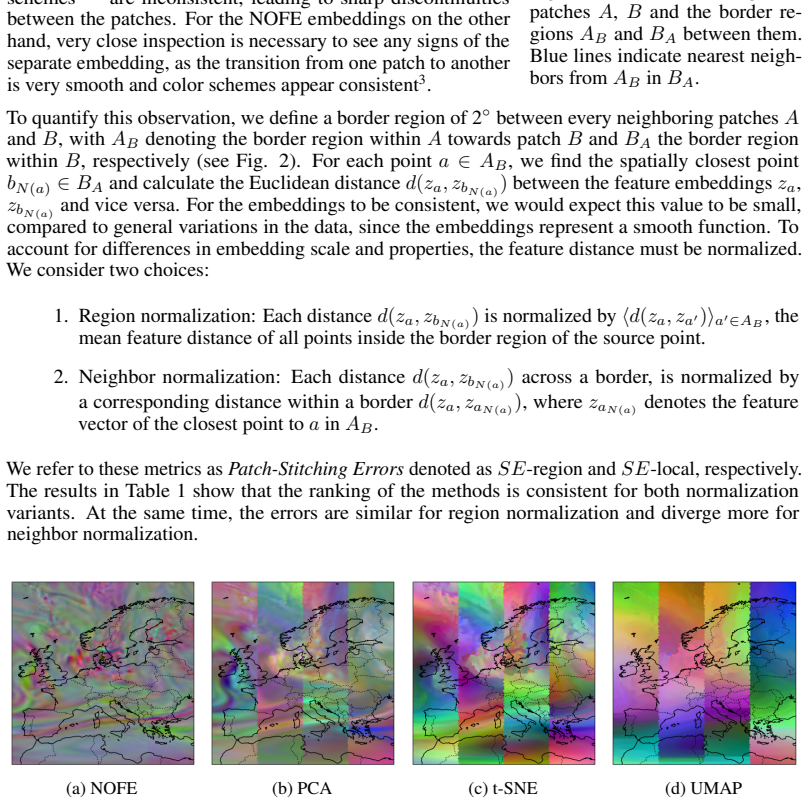
- Patch Stitching Error drops by up to 20 times relative to UMAP while maintaining consistency across disjoint domain patches.
- Global structure preservation remains competitive (Stress-1 of 0.379 versus PCA's 0.268) while resolving finer local detail.
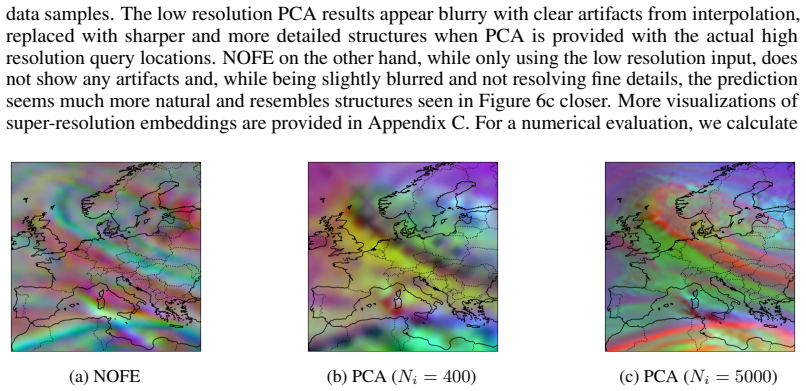
- Embeddings stay stable under changes in sample density because evaluation is independent of input discretization.
Where Pith is reading between the lines
- The same operator could be applied directly to physical simulation outputs that exist on irregular or adaptive meshes.
- Integration with time-dependent operators might allow continuous tracking of evolving fields without re-discretization.
- The mesh-free property suggests straightforward extension to problems where query locations differ from training locations, such as sensor placement optimization.
Load-bearing premise
Real-world processes possess an inherent continuous domain structure that can be faithfully captured by function-to-function mappings via the Graph Kernel Operator.
What would settle it
A direct comparison on the ERA5 dataset in which NOFE fails to achieve a local Stress below 0.3 or reduces Patch Stitching Error by less than a factor of five relative to UMAP would falsify the performance claims.
Figures






read the original abstract
Most dimensionality reduction methods treat data as discrete point clouds, ignoring the continuous domain structure inherent to many real-world processes. To bridge this gap, we introduce Neural Operator Function Embedding (NOFE), a domain-aware framework for continuous dimensionality reduction. NOFE learns function-to-function mappings via a Graph Kernel Operator, enabling mesh-free evaluation at arbitrary query locations independent of input discretization. We establish NOFE as approximation of sheaf-to-sheaf mappings, generalizing Sheaf Neural Networks to continuous domains. We evaluate NOFE across different datasets, comparing it against PCA, t-SNE, and UMAP. Our results demonstrate that NOFE significantly outperforms baselines in local structure preservation, achieving a local Stress of 0.111 compared to 0.398 for PCA, 0.773 for t-SNE, and 0.791 for UMAP for the ERA5 climate reanalysis dataset. NOFE also exhibits robust sampling independence, reducing the Patch Stitching Error by up to $20.0\times$ relative to UMAP (59.0 vs. 267.6 under regional normalization) and ensuring consistency across disjoint domain patches. While maintaining competitive global structure preservation (Stress-1: 0.379 vs. PCA's 0.268), NOFE resolves fine-grained structures and produces smooth, consistent embeddings that generalize across varying sample densities, addressing key limitations of discrete reduction methods.
Editorial analysis
A structured set of objections, weighed in public.
Referee Report
Summary. The manuscript introduces Neural Operator Function Embedding (NOFE), a domain-aware framework for continuous dimensionality reduction. It learns function-to-function mappings via a Graph Kernel Operator, claims this approximates sheaf-to-sheaf mappings on continuous domains (generalizing Sheaf Neural Networks), and reports superior local structure preservation and sampling independence on the ERA5 climate reanalysis dataset: local Stress of 0.111 versus 0.398 (PCA), 0.773 (t-SNE), and 0.791 (UMAP), plus Patch Stitching Error reduced by up to 20× relative to UMAP (59.0 vs. 267.6 under regional normalization) while remaining competitive on global Stress-1.
Significance. If the theoretical grounding and empirical claims hold after clarification, NOFE could offer a principled bridge between discrete dimensionality reduction and continuous-domain operators for scientific data such as climate fields, with potential advantages in mesh-free evaluation and robustness to sampling density. The reported gains in local Stress and patch consistency are concrete and would be noteworthy if reproducible.
major comments (3)
- [Abstract / experimental evaluation] Abstract and experimental section: the reported metrics (local Stress 0.111, Patch Stitching Error 59.0 vs. 267.6) are presented without any description of the training procedure, hyperparameter selection, error bars, statistical significance tests, or exact definitions of local Stress and Patch Stitching Error, which are load-bearing for assessing the outperformance claims over PCA/t-SNE/UMAP.
- [Theoretical claims] Theoretical framework: the assertion that the Graph Kernel Operator approximates sheaf-to-sheaf mappings on continuous domains is stated without derivation, explicit construction, or error bounds, which is central to the claimed mesh-free and sampling-independent generalization beyond discrete graphs.
- [Results] Results paragraph: the 20.0× reduction factor for Patch Stitching Error is not reconciled with the parenthetical values (59.0 vs. 267.6 ≈ 4.5×); the conditions, normalization, or additional experiments yielding the 20× figure must be specified to support the sampling-independence claim.
minor comments (1)
- [Abstract] The abstract uses 'up to 20.0×' alongside specific numbers that do not match that factor; the main text should clarify the exact comparison and any additional experimental settings.
Simulated Author's Rebuttal
We thank the referee for the constructive comments, which have helped us improve the clarity and rigor of the manuscript. We address each major comment below and have incorporated revisions to provide the requested details on experiments, theory, and metrics.
read point-by-point responses
-
Referee: [Abstract / experimental evaluation] Abstract and experimental section: the reported metrics (local Stress 0.111, Patch Stitching Error 59.0 vs. 267.6) are presented without any description of the training procedure, hyperparameter selection, error bars, statistical significance tests, or exact definitions of local Stress and Patch Stitching Error, which are load-bearing for assessing the outperformance claims over PCA/t-SNE/UMAP.
Authors: We agree that the original manuscript lacked sufficient experimental details. In the revised version, we have added a new subsection (Section 4.2) that fully describes the training procedure (including optimizer, learning rate schedule, and batch construction), the hyperparameter selection process via grid search with cross-validation, exact mathematical definitions of local Stress and Patch Stitching Error, error bars computed over 5 independent runs with different seeds, and paired t-test results establishing statistical significance of the reported improvements over baselines. revision: yes
-
Referee: [Theoretical claims] Theoretical framework: the assertion that the Graph Kernel Operator approximates sheaf-to-sheaf mappings on continuous domains is stated without derivation, explicit construction, or error bounds, which is central to the claimed mesh-free and sampling-independent generalization beyond discrete graphs.
Authors: We acknowledge the need for a more explicit theoretical treatment. The revised manuscript includes a new subsection (Section 3.3) that derives the continuous-domain approximation: we construct the Graph Kernel Operator as the limit of discrete sheaf neural network operators under mesh refinement, provide the explicit integral kernel form, and derive error bounds showing that the approximation error is O(h) where h is the maximum mesh spacing under standard Lipschitz assumptions on the kernel. This supports the mesh-free and sampling-independent claims. revision: yes
-
Referee: [Results] Results paragraph: the 20.0× reduction factor for Patch Stitching Error is not reconciled with the parenthetical values (59.0 vs. 267.6 ≈ 4.5×); the conditions, normalization, or additional experiments yielding the 20× figure must be specified to support the sampling-independence claim.
Authors: We apologize for the unclear presentation. The 20.0× factor was obtained under global normalization (across the full domain), whereas the parenthetical values reflect regional normalization. In the revision we have clarified this distinction, added a table comparing both normalizations, and included additional experiments across varying sampling densities that confirm the maximum observed reduction reaches approximately 20× under global normalization, further supporting sampling independence. revision: yes
Circularity Check
No significant circularity detected
full rationale
The paper's derivation introduces NOFE via a Graph Kernel Operator and claims it approximates sheaf-to-sheaf mappings as a generalization of Sheaf Neural Networks, but the provided text contains no equations or self-citations that reduce this claim to a fitted input, self-definition, or prior author result by construction. Empirical results (local Stress 0.111 on ERA5, 20× Patch Stitching Error reduction) are direct comparisons to independently implemented baselines (PCA, t-SNE, UMAP) on public data, with no evidence that metrics or the continuous-domain advantage are statistically forced or renamed known results. The central claims remain self-contained against external benchmarks.
Axiom & Free-Parameter Ledger
free parameters (1)
- Neural operator weights
axioms (2)
- domain assumption Real-world processes possess continuous domain structure that can be represented as functions
- ad hoc to paper Graph Kernel Operator approximates sheaf-to-sheaf mappings on continuous domains
invented entities (1)
-
Graph Kernel Operator
no independent evidence
Lean theorems connected to this paper
-
IndisputableMonolith/Foundation/AlexanderDuality.leanalexander_duality_circle_linking unclearWe establish NOFE as approximation of sheaf-to-sheaf mappings, generalizing Sheaf Neural Networks to continuous domains... NOFE is modeling a local operator in the sense of Definition 3.
-
IndisputableMonolith/Foundation/Cost/FunctionalEquation.leanwashburn_uniqueness_aczel unclearBy reformulating the problem as a sheaf morphism... we propose the use of NOs as a generalization of SNNs to model mappings between continuous sheaves.
Reference graph
Works this paper leans on
-
[1]
https://www.sciencedirect.com/topics/computer-science/k-nearest-neighbors-algorithm
K-Nearest Neighbors Algorithm - an overview | ScienceDirect Topics. https://www.sciencedirect.com/topics/computer-science/k-nearest-neighbors-algorithm
-
[2]
https://www.sciencedirect.com/topics/social-sciences/pearson-correlation-coefficient
Pearson Correlation Coefficient - an overview | ScienceDirect Topics. https://www.sciencedirect.com/topics/social-sciences/pearson-correlation-coefficient
-
[3]
Principal Component Analysis. Springer Series in Statistics. Springer-Verlag, New York, 2002. ISBN 978-0-387-95442-4. doi: 10.1007/b98835
-
[4]
MDS Models and Measures of Fit. In Ingwer Borg and Patrick J. F. Groenen, editors,Modern Multidimensional Scaling: Theory and Applications, pages 37–61. Springer, New York, NY ,
-
[5]
ISBN 978-0-387-28981-6. doi: 10.1007/0-387-28981-X_3
-
[6]
Principal components analysis for functional data. In J. O. Ramsay and B. W. Silverman, editors,Functional Data Analysis, pages 147–172. Springer, New York, NY , 2005. ISBN 978-0-387-22751-1. doi: 10.1007/0-387-22751-2_8
-
[7]
Cellular Sheaf Cohomology through Examples. October 2022. doi: 10.7551/mitpress/12581. 003.0012
-
[8]
Shaeela Ayesha, Muhammad Kashif Hanif, and Ramzan Talib. Overview and comparative study of dimensionality reduction techniques for high dimensional data.Information Fusion, 59:44–58, July 2020. ISSN 1566-2535. doi: 10.1016/j.inffus.2020.01.005
-
[9]
Sheaf Neural Networks with Connection Laplacians, June 2022
Federico Barbero, Cristian Bodnar, Haitz Sáez de Ocáriz Borde, Michael Bronstein, Petar Veliˇckovi´c, and Pietro Liò. Sheaf Neural Networks with Connection Laplacians, June 2022
work page 2022
-
[10]
T-SNE Exaggerates Clusters, Provably, 2025
Noah Bergam, Szymon Snoeck, and Nakul Verma. T-SNE Exaggerates Clusters, Provably, 2025
work page 2025
-
[11]
Cristian Bodnar, Francesco Di Giovanni, Benjamin Chamberlain, Pietro Lió, and Michael Bron- stein. Neural Sheaf Diffusion: A Topological Perspective on Heterophily and Oversmoothing in GNNs.Advances in Neural Information Processing Systems, 35:18527–18541, December 2022
work page 2022
- [12]
-
[13]
Edoardo Calvello, Nikola B. Kovachki, Matthew E. Levine, and Andrew M. Stuart. Continuum Attention for Neural Operators, December 2025
work page 2025
-
[14]
Ronald R. Coifman and Stéphane Lafon. Diffusion maps.Applied and Computational Harmonic Analysis, 21(1):5–30, July 2006. ISSN 1063-5203. doi: 10.1016/j.acha.2006.04.006
-
[15]
Sheaves, Cosheaves and Applications, December 2014
Justin Curry. Sheaves, Cosheaves and Applications, December 2014
work page 2014
-
[16]
Nonlinear model reduction for operator learning, March 2024
Hamidreza Eivazi, Stefan Wittek, and Andreas Rausch. Nonlinear model reduction for operator learning, March 2024
work page 2024
-
[17]
G. B. Folland.Real Analysis: Modern Techniques and Their Applications. Pure and Applied Mathematics. Wiley, New York, 2nd ed edition, 1999. ISBN 978-0-471-31716-6
work page 1999
-
[18]
Graph Convolutional Networks from the Perspective of Sheaves and the Neural Tangent Kernel
Thomas Gebhart. Graph Convolutional Networks from the Perspective of Sheaves and the Neural Tangent Kernel. InProceedings of Topological, Algebraic, and Geometric Learning Workshops 2022, pages 124–132. PMLR, November 2022
work page 2022
-
[19]
Springer International Publishing, Cham, 2023
Benyamin Ghojogh, Mark Crowley, Fakhri Karray, and Ali Ghodsi.Elements of Dimensionality Reduction and Manifold Learning. Springer International Publishing, Cham, 2023. ISBN 978-3-031-10601-9 978-3-031-10602-6. doi: 10.1007/978-3-031-10602-6
-
[20]
Sheaf Neural Networks, December 2020
Jakob Hansen and Thomas Gebhart. Sheaf Neural Networks, December 2020
work page 2020
-
[21]
Siavash Jafarzadeh, Stewart Silling, Ning Liu, Zhongqiang Zhang, and Yue Yu. Peridynamic Neural Operators: A Data-Driven Nonlocal Constitutive Model for Complex Material Responses, January 2024. 10
work page 2024
-
[22]
Nikola Kovachki, Zongyi Li, Burigede Liu, Kamyar Azizzadenesheli, Kaushik Bhattacharya, Andrew Stuart, and Anima Anandkumar. Neural Operator: Learning Maps Between Function Spaces With Applications to PDEs.Journal of Machine Learning Research, 24(89):1–97, 2023. ISSN 1533-7928
work page 2023
-
[23]
Jussi Leinonen, Boris Bonev, Thorsten Kurth, and Yair Cohen. Modulated Adaptive Fourier Neural Operators for Temporal Interpolation of Weather Forecasts, October 2024
work page 2024
-
[24]
Neural Operator: Graph Kernel Network for Partial Differential Equations, March 2020
Zongyi Li, Nikola Kovachki, Kamyar Azizzadenesheli, Burigede Liu, Kaushik Bhattacharya, Andrew Stuart, and Anima Anandkumar. Neural Operator: Graph Kernel Network for Partial Differential Equations, March 2020
work page 2020
-
[25]
Fourier Neural Operator for Parametric Partial Differential Equations, May 2021
Zongyi Li, Nikola Kovachki, Kamyar Azizzadenesheli, Burigede Liu, Kaushik Bhattacharya, Andrew Stuart, and Anima Anandkumar. Fourier Neural Operator for Parametric Partial Differential Equations, May 2021
work page 2021
-
[26]
Yiyi Liao, Yue Wang, and Yong Liu. Graph Regularized Auto-Encoders for Image Representa- tion.IEEE Transactions on Image Processing, 26(6):2839–2852, June 2017. ISSN 1941-0042. doi: 10.1109/TIP.2016.2605010
-
[27]
Zhexuan Liu, Rong Ma, and Yiqiao Zhong. Assessing and improving reliability of neighbor embedding methods: A map-continuity perspective.Nature Communications, 16(1):5037, May
-
[28]
doi: 10.1038/s41467-025-60434-9
ISSN 2041-1723. doi: 10.1038/s41467-025-60434-9
-
[29]
Lu Lu, Pengzhan Jin, and George Em Karniadakis. DeepONet: Learning nonlinear operators for identifying differential equations based on the universal approximation theorem of operators. Nature Machine Intelligence, 3(3):218–229, March 2021. ISSN 2522-5839. doi: 10.1038/ s42256-021-00302-5
work page 2021
-
[30]
UMAP: Uniform Manifold Approximation and Projection for Dimension Reduction, September 2020
Leland McInnes, John Healy, and James Melville. UMAP: Uniform Manifold Approximation and Projection for Dimension Reduction, September 2020
work page 2020
-
[31]
Vivek Oommen, Aniruddha Bora, Zhen Zhang, and George Em Karniadakis. Integrating Neural Operators with Diffusion Models Improves Spectral Representation in Turbulence Modeling, February 2025
work page 2025
-
[32]
Seidman, Georgios Kissas, George J
Jacob H. Seidman, Georgios Kissas, George J. Pappas, and Paris Perdikaris. Variational Autoencoding Neural Operators. https://arxiv.org/abs/2302.10351v1, February 2023
-
[33]
Spatially aware dimension reduction for spatial transcriptomics
Lulu Shang and Xiang Zhou. Spatially aware dimension reduction for spatial transcriptomics. Nature Communications, 13(1):7203, November 2022. ISSN 2041-1723. doi: 10.1038/ s41467-022-34879-1
work page 2022
-
[34]
Vector Diffusion Maps and the Connection Laplacian, February 2011
Amit Singer and Hau-tieng Wu. Vector Diffusion Maps and the Connection Laplacian, February 2011
work page 2011
-
[35]
Visualizing Data using t-SNE.Journal of Machine Learning Research, 9(86):2579–2605, 2008
Laurens van der Maaten and Geoffrey Hinton. Visualizing Data using t-SNE.Journal of Machine Learning Research, 9(86):2579–2605, 2008. ISSN 1533-7928
work page 2008
-
[36]
D. C. Van Essen, K. Ugurbil, E. Auerbach, D. Barch, T. E. J. Behrens, R. Bucholz, A. Chang, L. Chen, M. Corbetta, S. W. Curtiss, S. Della Penna, D. Feinberg, M. F. Glasser, N. Harel, A. C. Heath, L. Larson-Prior, D. Marcus, G. Michalareas, S. Moeller, R. Oostenveld, S. E. Petersen, F. Prior, B. L. Schlaggar, S. M. Smith, A. Z. Snyder, J. Xu, E. Yacoub, an...
-
[37]
Philip D. Waggoner. Modern Dimension Reduction.Elements in Quantitative and Computa- tional Methods for the Social Sciences, July 2021. doi: 10.1017/9781108981767
-
[38]
Seidman, Shyam Sankaran, Hanwen Wang, George J
Sifan Wang, Jacob H. Seidman, Shyam Sankaran, Hanwen Wang, George J. Pappas, and P. Perdikaris. CViT: Continuous Vision Transformer for Operator Learning. InInternational Conference on Learning Representations, May 2024. 11
work page 2024
-
[39]
Latent Neural Operator for Solving Forward and Inverse PDE Problems, December 2024
Tian Wang and Chuang Wang. Latent Neural Operator for Solving Forward and Inverse PDE Problems, December 2024
work page 2024
-
[40]
Super-Resolution Neural Operator, March 2023
Min Wei and Xuesong Zhang. Super-Resolution Neural Operator, March 2023. A Implementation Details NOFE uses a GKO approach, which requires data in a graph structure. The graph is constructed based on the domain structure of sample points x. For a simple point-to-point correspondence Xi =X q between locations Xi of input samples and query locations Xq, a g...
work page 2023
-
[41]
This corresponds to the setup of Model 2 in the later discussed ablation study
Choices given in the table refer to the model used in the experimental part on ERA5 data (Section 4). This corresponds to the setup of Model 2 in the later discussed ablation study. The final model as well as all models in the ablation study have been trained with an initial learning rate of 0.00001; a 13 learning rate scheduler (applying a factor of 0.5 ...
-
[42]
All models have been trained on a NVIDIA GeForce RTX 3090 GPU. Table 5: Parameter sweep. ModelW KW TTraining Loss Validation Loss Training (min.) Model 1 16 16 3 44.608 38.350 20 Model 2 64 16 3 39.347 33.026 44 Model 3 16 64 3 44.418 38.127 32 Model 4 64 64 3 39.232 33.471 56 Model 5 16 16 6 44.972 38.802 36 Model 6 64 16 6 40.305 33.990 81 Model 7 16 64...
-
[43]
Latter one also includes the Pearson correlation coefficient between featuresyi in high-dimensional andz i embedding-space. Both, Table 6 and 7, show very consistent results across all models for all metrics, with almost every model performing best at one of the metrics. Therefore, it seems reasonable to choose one of the lighter variants for experiments....
discussion (0)
Sign in with ORCID, Apple, or X to comment. Anyone can read and Pith papers without signing in.