Recognition: 2 theorem links
· Lean TheoremThe choice of variables in cosmological dynamical systems
Pith reviewed 2026-05-13 05:12 UTC · model grok-4.3
The pith
Different choices of variables when turning the Friedmann equations into dynamical systems determine how much information about cosmic evolution can be extracted.
A machine-rendered reading of the paper's core claim, the machinery that carries it, and where it could break.
Core claim
When the Friedmann equations for a given cosmological model are cast into autonomous form, the particular choice of normalized variables governs which equilibrium points appear, how their stability is classified, and what global information about the evolution can be read off the phase portrait. In the standard dark-matter-radiation-dark-energy case and in quintessence models, standard variable sets already work well, yet new choices for exponential potentials uncover additional fixed points. The same dependence on variable selection persists when the scalar field is coupled to other matter components through non-trivial interaction terms.
What carries the argument
The normalized dynamical variables that convert the Friedmann equations into an autonomous system of ordinary differential equations whose fixed points and stability can be analysed in the phase plane.
If this is right
- In the standard model, suitable variables allow a complete classification of the transition from radiation to matter to dark-energy domination.
- For quintessence with exponential potentials, revised variables can locate scaling solutions and late-time attractors that remain hidden in conventional choices.
- When scalar fields interact through intricate couplings, the right variables can reduce the system to a form where stability analysis becomes straightforward.
- Results reported in the literature on cosmological dynamics may therefore need re-checking whenever a different variable set is adopted.
Where Pith is reading between the lines
- The same variable-selection principle could be tested in modified-gravity theories to determine whether new acceleration mechanisms become easier or harder to detect.
- Authors of future dynamical-systems papers might benefit from stating explicitly why their chosen variables are optimal for the model under study.
- The observation links to a general feature of autonomous systems: coordinate choice on the phase space can alter the visibility of global invariants and heteroclinic orbits.
Load-bearing premise
The standard cosmological model together with quintessence and simple coupled scalar fields already covers the full range of behaviors in which variable choice matters.
What would settle it
A concrete counter-example in which two distinct variable sets applied to the same Friedmann system yield identical fixed-point locations, stability eigenvalues and global phase-space structure would show that variable choice does not affect the information that can be extracted.
Figures


read the original abstract
Dynamical systems techniques are a powerful tool to analyse systems of ordinary differential equations, written in an appropriate form. For a given theory of gravity, the cosmological field equations typically lead to a system of ordinary differential equations. Casting these cosmological equations into the form of a dynamical system requires a careful choice of the dynamical variables. Despite this being a critical step, relatively little is said about this process in the literature. We discuss how different variable choices affect the information that can be extracted from the Friedmann equations. We begin by reviewing the standard cosmological model with dark matter, radiation, and dark energy, and include quintessence models. We revisit well-known models with an exponential potential using new variables. This discussion is then extended to models with scalar fields and more intricate coupling terms.
Editorial analysis
A structured set of objections, weighed in public.
Referee Report
Summary. The paper discusses how different choices of dynamical variables affect the information that can be extracted from the Friedmann equations in cosmological models. It reviews the standard FLRW model with dark matter, radiation and dark energy, revisits quintessence models with exponential potentials using new variables, and extends the analysis to scalar fields with more intricate couplings.
Significance. If the examples hold, the work is a useful methodological contribution that draws attention to an under-discussed but critical step in applying dynamical systems techniques to cosmology. The concrete illustrations from standard models and the absence of new free parameters or circular constructions are strengths; the paper fulfills its stated claim through specific model examples without claiming universality.
minor comments (3)
- Abstract: the phrase 'using new variables' for the exponential-potential models is not accompanied by even a brief indication of what those variables are; a short parenthetical description would improve accessibility.
- The transition from the standard-model review to the quintessence section would benefit from an explicit statement of which information (e.g., fixed-point structure, stability criteria, or parameter constraints) becomes newly accessible with the alternative variables.
- In the coupled-scalar-field extension, the discussion of 'intricate coupling terms' remains at a general level; inclusion of one concrete example equation would make the claimed extension more tangible.
Simulated Author's Rebuttal
We thank the referee for their positive assessment of the manuscript, the recognition of its methodological focus, and the recommendation for minor revision. The absence of specific major comments means we have no individual points requiring detailed rebuttal at this stage. We will incorporate any minor suggestions from the editor in the revised version.
Circularity Check
No significant circularity; methodological discussion only
full rationale
The paper presents a review and discussion of variable choices in dynamical systems formulations of the Friedmann equations for standard FLRW cosmology, quintessence with exponential potentials, and coupled scalar fields. No new physical derivations, predictions, or theorems are claimed; the text revisits well-known models to illustrate how different coordinate choices affect extractable information. All examples draw from established literature without fitting parameters to data subsets or redefining inputs as outputs. No self-citation chains, ansatzes smuggled via prior work, or uniqueness theorems are invoked as load-bearing steps. The central claim is fulfilled by explicit comparison of variable sets on standard models, remaining self-contained against external benchmarks.
Axiom & Free-Parameter Ledger
axioms (1)
- domain assumption The Friedmann equations provide an accurate description of homogeneous isotropic cosmology in the models considered.
Lean theorems connected to this paper
-
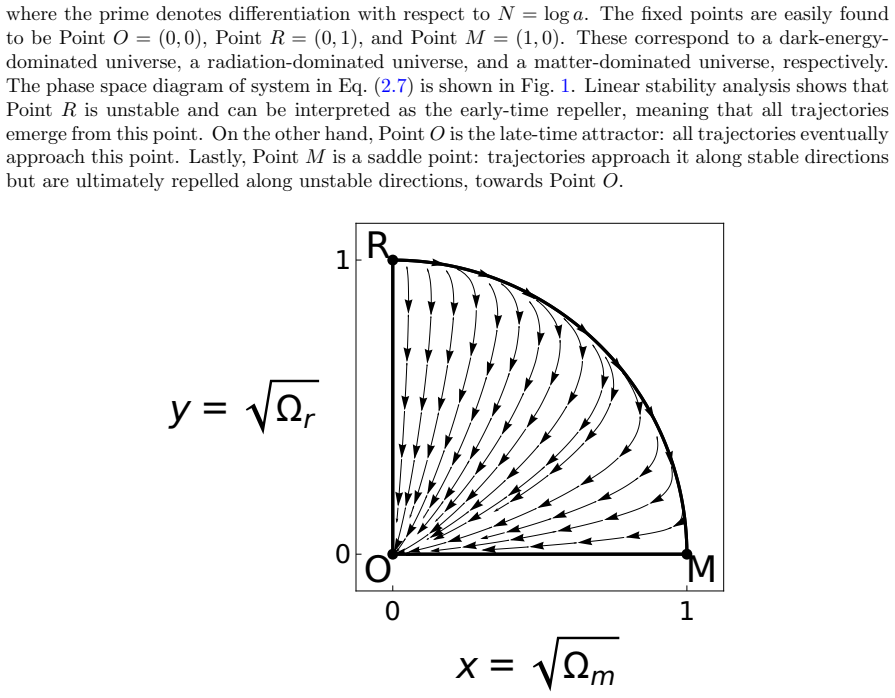
IndisputableMonolith/Foundation/RealityFromDistinction.leanreality_from_one_distinction unclearIn these variables... the dynamical equations read x′=½x(3x²+4y²−3), y′=½y(3x²+4y²−4)
Reference graph
Works this paper leans on
-
[1]
Wiggins S. 2003.Introduction to Applied Nonlinear Dynamical Systems and Chaos, 2nd ed., Texts in Applied Mathematics, vol. 2, Springer, New York
work page 2003
-
[2]
2024.Nonlinear dynamics and chaos: with applications to physics, biology, chemistry, and engineering
Strogatz SH. 2024.Nonlinear dynamics and chaos: with applications to physics, biology, chemistry, and engineering. 3rd ed. Boca Raton, FL: CRC Press. See https://doi.org/10.1201/9780429398490
-
[3]
1997.Dynamical Systems in Cosmology
Wainwright J, Ellis GFR (eds.). 1997.Dynamical Systems in Cosmology. Cambridge, UK: Cam- bridge University Press
work page 1997
-
[4]
2003.Dynamical Systems and Cosmology
Coley AA. 2003.Dynamical Systems and Cosmology. Dordrecht: Springer
work page 2003
-
[5]
2011.Cosmological Dynamical Systems
Leon G, Fadragas CR. 2011.Cosmological Dynamical Systems. Saarbr¨ ucken: LAP Lambert Aca- demic Publishing
work page 2011
-
[6]
2018.Dynami- cal Systems Applied to Cosmology: Dark Energy and Modified Gravity
Bahamonde A, B¨ ohmer CG, Carloni S, Copeland EJ, Fang W, Tamanini N. 2018.Dynami- cal Systems Applied to Cosmology: Dark Energy and Modified Gravity. Cham: Springer. See https://doi.org/10.1016/j.physrep.2018.09.001
-
[7]
Planck Collaboration VI. 2020 Planck 2018 results. VI. Cosmological parameters.Astron. Astro- phys.641, A6. See https://doi.org/10.1051/0004-6361/201833910
-
[8]
Efstathiou G, Gratton S. 2020. The evidence for a spatially flat Universe.Mon. Not. R. Astron. Soc.496, 1, pages L91–L95. See https://doi.org/10.1093/mnrasl/slaa093
-
[9]
2017.Introduction to General Relativity and Cosmology, World Scientific Publishing, Singapore
B¨ ohmer CG. 2017.Introduction to General Relativity and Cosmology, World Scientific Publishing, Singapore
work page 2017
-
[10]
B¨ ohmer CG, Chan N. 2017. Dynamical systems in cosmology. InDynamical and Complex Sys- tems(eds S Bullett, T Fearn, F Vivaldi), ch. 4, pp. 121–156. London, UK: World Scientific. See https://doi.org/10.1142/9781786341044 0004
-
[11]
Perez J, F¨ uzfa A, Carletti T, Heghran L, Petit G. 2014. The Jungle Universe: coupled cosmological models in a Lotka–Volterra framework.Gen. Relativ. Gravit.46, 1753. See https://doi.org/10.1007/s10714-014-1753-8
-
[12]
Amendola L. 2000. Coupled quintessence.Phys Rev D.62, 043511. See https://doi.org/10.1103/PhysRevD.62.043511
-
[13]
Copeland EJ, Sami M, Tsujikawa S. 2006. Dynamics of dark energy.Int. J. Mod. Phys. D.15,
work page 2006
-
[14]
See https://doi.org/10.1142/S021827180600942X
-
[15]
Copeland EJ, Liddle AR, Wands D. 1998. Exponential potentials and cosmological scaling solu- tions.Phys Rev D. 57, 4686. See https://doi.org/10.1103/PhysRevD.57.4686
-
[16]
B¨ ohmer CG, d’Alfonso del Sordo A. 2024. Cosmological fluids with boundary term couplings. Gen. Relativ. Gravit.56, 75. See https://doi.org/10.1007/s10714-024-03260-6
-
[17]
Ashi HA, B¨ ohmer CG, d’Alfonso del Sordo A, Jensko E. 2025. Cosmological dynamical sys- tems of non-minimally coupled fluids and scalar fields.Gen. Relativ. Gravit.57, 167. See https://doi.org/10.1007/s10714-025-03502-1
-
[18]
2025.Special Functions and Dynamical Systems in Cosmology
d’Alfonso del Sordo A. 2025.Special Functions and Dynamical Systems in Cosmology. Ph.D. thesis, University College London. See https://discovery.ucl.ac.uk/id/eprint/10214939/
-
[19]
Brown JD. 1993. Action functionals for relativistic perfect fluids.Class. Quantum Grav.10, 1579. See https://doi.org/10.1088/0264-9381/10/8/017. 15
-
[20]
B¨ ohmer CG, Caldera-Cabral G, Lazkoz R, Maartens R. 2008. Dynamics of dark energy with a cou- pling to dark matter.Phys. Rev. D.78, 023505. See https://doi.org/10.1103/PhysRevD.78.023505
-
[21]
B¨ ohmer CG, Caldera-Cabral G, Lazkoz R, Maartens R. 2010. Quintessence with quadratic cou- pling to dark matter.Phys. Rev. D.81, 083003. See https://doi:10.1103/PhysRevD.81.083003 16
discussion (0)
Sign in with ORCID, Apple, or X to comment. Anyone can read and Pith papers without signing in.