Recognition: 2 theorem links
· Lean TheoremIntermittent two-phase flow in porous media: insights from pore-scale direct numerical simulation
Pith reviewed 2026-05-13 04:45 UTC · model grok-4.3
The pith
Intermittency in two-phase porous media flow organizes into connected conduits within a stable backbone of fixed pathways, enhancing overall fluid mobility.
A machine-rendered reading of the paper's core claim, the machinery that carries it, and where it could break.
Core claim
The paper establishes that intermittent elements organize into connected conduits embedded within a stable backbone of fixed flow pathways. This network-coupled intermittency appears as periodic drainage and imbibition displacements triggered by local pressure fluctuations. The organization is confirmed by topology-aware snap-off detection together with spectral and network-connectivity analyses. As a result the macroscopic pressure-gradient versus capillary-number relation transitions from linear Darcy scaling to sub-linear scaling, which improves the overall mobility of the fluid phases.
What carries the argument
Topology-aware snap-off detection combined with spectral, local-geometry, and network-connectivity analyses that identify the spatial organization of intermittent elements into connected conduits inside a fixed backbone.
If this is right
- The spatial extent of intermittency increases with capillary number.
- The transition from linear to sub-linear pressure-gradient scaling occurs as the amount of intermittency grows.
- Phases remain predominantly in fixed pathways in the Darcy regime with little intermittency.
- Macroscopic mobility of both fluid phases increases once intermittency becomes network-coupled.
Where Pith is reading between the lines
- Upscaling models for multiphase flow in porous media would need to incorporate network-level coupling of intermittency rather than treating events as purely local.
- The same conduit organization could be examined in other rock geometries or at different viscosity ratios to test how general the backbone-plus-conduits structure is.
- The mobility gain from intermittency may lower residual saturations during displacement processes compared with predictions that assume only fixed pathways.
Load-bearing premise
The finite-volume DNS on the chosen micro-CT geometry with the selected capillary numbers and interface-capturing scheme reproduces physical intermittency without dominant numerical artifacts or boundary-condition bias.
What would settle it
A high-resolution X-ray imaging experiment at the same capillary numbers that maps the spatial patterns of intermittency and pressure fluctuations against the simulated conduits and backbone would test whether the network-coupled organization is physical.
Figures




read the original abstract
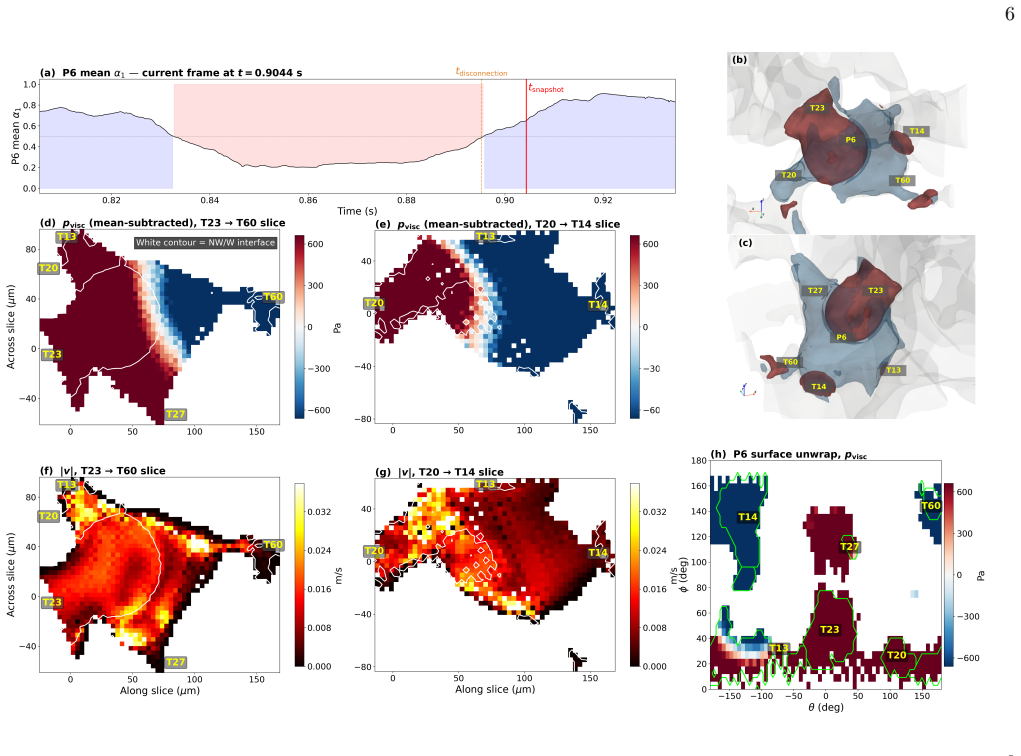
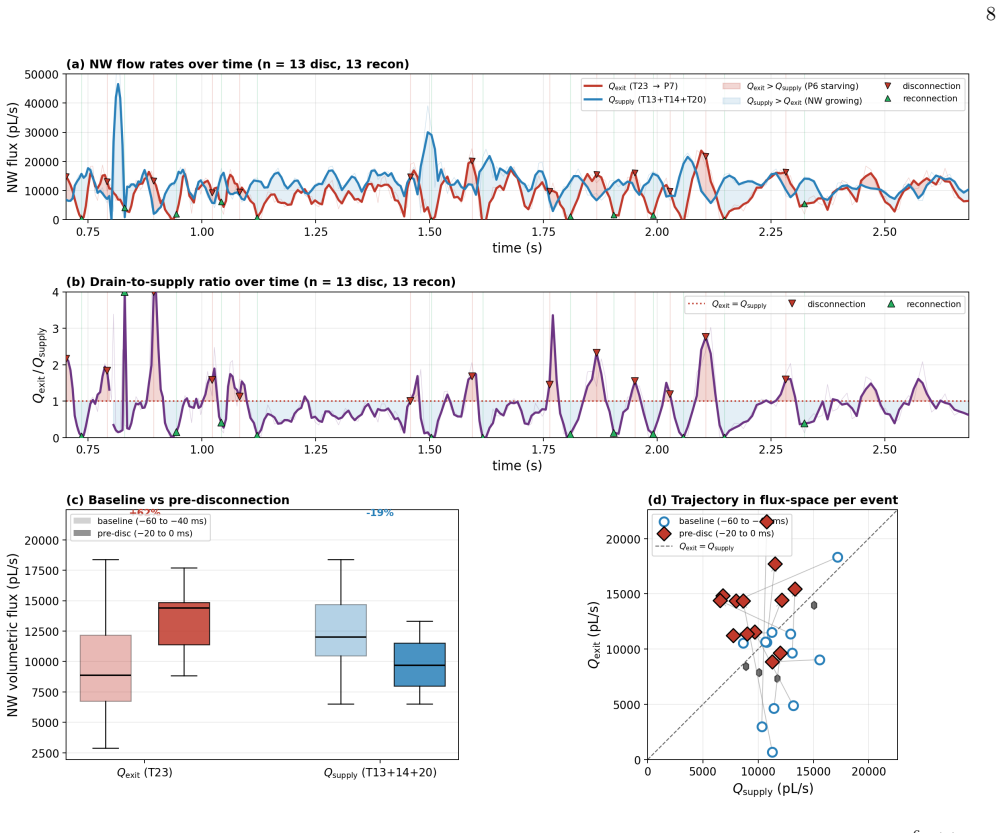
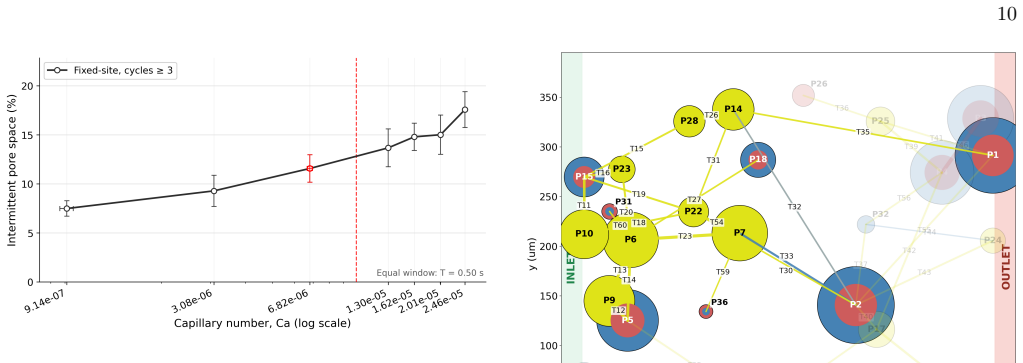
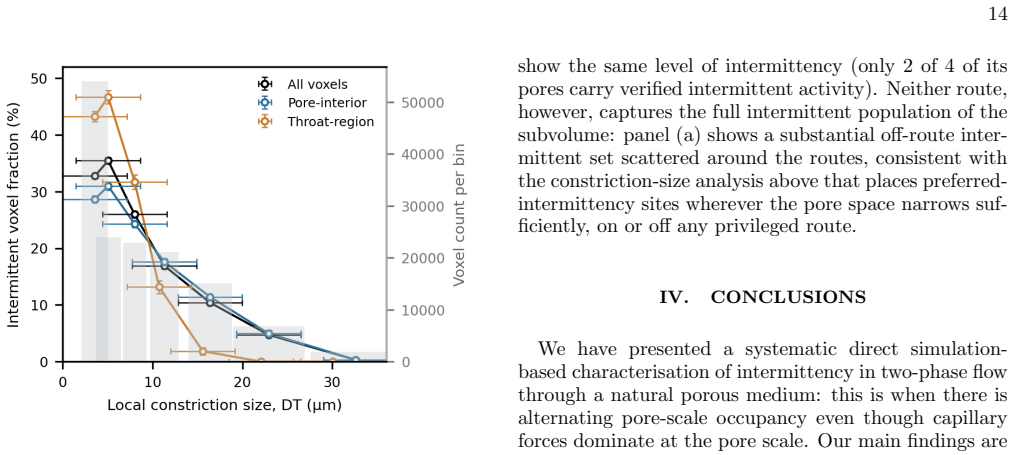
Recent X-ray imaging experiments have revealed that multiphase flow through porous media involves transient fluctuations in local occupancy, even under fixed macroscopic steady-state conditions where capillary forces dominate at the pore scale. To examine how intermittency manifests at the pore scale we perform direct numerical finite volume simulations (DNS) of immiscible two-phase flow through a micro-CT-derived Bentheimer sandstone geometry at capillary numbers in the Darcy and intermittent flow regimes. We show that intermittent disconnection and reconnection are accompanied by strongly coupled local pressure redistribution and non-wetting phase flow. This behaviour contrasts with the Darcy flow regime, in which the phases remain predominantly in fixed pathways. Macroscopically the computed pressure-gradient-capillary-number relationship ($\nabla P$-Ca) recovers both the linear Darcy and the sub-linear intermittent scaling regimes consistent with previous experimental measurements. We show how an increase in intermittency leads to the transition from the linear to the sub-linear regime. Using topology-aware snap-off detection, we show that the spatial extent of intermittency increases with capillary number. Spectral, local-geometry, and network-connectivity analyses provide further evidence that the intermittent elements organise into connected conduits embedded within a stable backbone of fixed flow pathways: intermittency is a network-coupled rather than purely local process. This work characterises the pore-scale manifestation of intermittency as a periodic sequence of drainage and imbibition displacements triggered by local pressure fluctuations whose macroscopic consequence is to improve the overall mobility of the fluid phases.
Editorial analysis
A structured set of objections, weighed in public.
Referee Report
Summary. The manuscript reports direct numerical finite-volume simulations of immiscible two-phase flow through a micro-CT-derived Bentheimer sandstone geometry at capillary numbers spanning the Darcy and intermittent regimes. The simulations reveal that intermittency consists of periodic drainage-imbibition events driven by local pressure fluctuations, with non-wetting phase flow strongly coupled to these events. In contrast to the fixed pathways of the Darcy regime, the intermittent elements are shown via topology-aware snap-off detection, spectral analysis, local-geometry metrics, and network-connectivity graphs to organize into connected conduits embedded in a stable backbone of fixed flow pathways. Macroscopically, the computed ∇P–Ca relation recovers both the linear Darcy regime and the sub-linear intermittent regime, consistent with prior experiments, and the increase in intermittency is linked to the observed scaling transition. The authors conclude that intermittency is a network-coupled process whose macroscopic consequence is improved overall mobility of the fluid phases.
Significance. If the numerical results prove robust, the work supplies a mechanistic pore-scale explanation for the transition between Darcy and intermittent scaling regimes in porous media. The identification of a stable backbone with embedded intermittent conduits offers a concrete network-level picture that could inform upscaled models for multiphase transport in geological and engineering applications. The consistency of the macroscopic ∇P–Ca curves with experiment is a clear strength, and the use of realistic micro-CT geometry allows direct contact with imaging data.
major comments (3)
- [Methods] Methods section: The finite-volume discretization, interface-capturing scheme, and grid resolution relative to the micro-CT voxel size and smallest pore throats are described, but no mesh-convergence study, spurious-current quantification, or sensitivity tests to interface parameters are reported. Because the central claim—that intermittency organizes into connected conduits within a stable backbone—rests entirely on post-processed topology and connectivity metrics that can be altered by numerical snap-off or diffusion at under-resolved throats, this omission is load-bearing.
- [Results] Results section (network-connectivity and spectral analyses): The assertion that intermittency is network-coupled rather than purely local is supported by connectivity graphs and spectral peaks, yet no quantitative pore-scale validation against the cited X-ray imaging experiments is provided for the spatial organization or backbone stability. Only the macroscopic ∇P–Ca scaling is compared; without this check, it remains possible that the reported conduit structure is influenced by the chosen capillary-number range or boundary conditions.
- [Discussion] Discussion: The causal link between increasing intermittency and the transition to sub-linear ∇P–Ca scaling is presented as a consequence of the connected conduits, but the study does not explore robustness with respect to the free parameters (viscosity ratio and interfacial tension) listed in the axiom ledger. Additional simulations varying these parameters would test whether the backbone stability and mobility improvement persist or are specific to the selected fluid properties.
minor comments (3)
- [Abstract] The abstract introduces 'topology-aware snap-off detection' without a short description or citation; a brief parenthetical explanation would improve accessibility.
- [Figures] Figures displaying network graphs would benefit from explicit annotations or color coding that distinguishes the stable backbone from the intermittent conduits.
- [Methods] Notation for the pressure gradient (∇P) and capillary number (Ca) is used consistently, but the precise definition of the reference length and velocity used to non-dimensionalize Ca should be stated once in the methods for clarity.
Simulated Author's Rebuttal
We thank the referee for the thorough and constructive review. We address each major comment below and indicate the revisions that will be incorporated.
read point-by-point responses
-
Referee: [Methods] Methods section: The finite-volume discretization, interface-capturing scheme, and grid resolution relative to the micro-CT voxel size and smallest pore throats are described, but no mesh-convergence study, spurious-current quantification, or sensitivity tests to interface parameters are reported. Because the central claim—that intermittency organizes into connected conduits within a stable backbone—rests entirely on post-processed topology and connectivity metrics that can be altered by numerical snap-off or diffusion at under-resolved throats, this omission is load-bearing.
Authors: We agree that explicit verification of numerical robustness is essential when topological post-processing underpins the central claims. In the revised manuscript we will add a dedicated subsection presenting mesh-convergence results for saturation, pressure drop, snap-off frequency, and the extracted backbone connectivity. We will also quantify the magnitude of spurious currents throughout the simulations and demonstrate that they remain well below levels that could induce artificial snap-off or alter the reported conduit structure. A limited sensitivity test to the interface thickness and mobility parameters will be included in the supplementary material, confirming that the qualitative organization into intermittent conduits embedded in a stable backbone is preserved. revision: yes
-
Referee: [Results] Results section (network-connectivity and spectral analyses): The assertion that intermittency is network-coupled rather than purely local is supported by connectivity graphs and spectral peaks, yet no quantitative pore-scale validation against the cited X-ray imaging experiments is provided for the spatial organization or backbone stability. Only the macroscopic ∇P–Ca scaling is compared; without this check, it remains possible that the reported conduit structure is influenced by the chosen capillary-number range or boundary conditions.
Authors: We acknowledge that quantitative pore-scale validation against the cited experiments would be desirable. However, the available X-ray datasets do not supply the complete time-resolved three-dimensional occupancy fields under identical geometric and flow conditions required for such a direct comparison. In the revised manuscript we will expand the discussion to include a detailed qualitative comparison of intermittency locations and pathway stability with the patterns described in the experimental literature. The network-coupled character of intermittency is substantiated by the internal consistency of four independent analyses (spectral, topological, geometric, and graph-based) performed on the same simulation data; the macroscopic ∇P–Ca agreement with experiment further supports that the observed structures are representative of the physical regime. revision: partial
-
Referee: [Discussion] Discussion: The causal link between increasing intermittency and the transition to sub-linear ∇P–Ca scaling is presented as a consequence of the connected conduits, but the study does not explore robustness with respect to the free parameters (viscosity ratio and interfacial tension) listed in the axiom ledger. Additional simulations varying these parameters would test whether the backbone stability and mobility improvement persist or are specific to the selected fluid properties.
Authors: A systematic exploration of viscosity ratio and interfacial tension lies beyond the scope of the present study, which was designed to reproduce the specific fluid properties under which the sub-linear scaling regime has been experimentally documented. The mechanism we identify—periodic drainage–imbibition cycles driven by local pressure fluctuations within a fixed pore-network topology—relies primarily on the capillary-dominated regime and is expected to remain qualitatively unchanged for viscosity ratios of order unity. In the revised discussion we will clarify the rationale for the chosen parameters, emphasize that the scaling transition correlates directly with the measured increase in intermittency, and note the consistency of our macroscopic results with the experimental ∇P–Ca data obtained under comparable conditions. revision: no
Circularity Check
No circularity: DNS observations of intermittency organization are independent of inputs
full rationale
The paper performs standard finite-volume DNS of immiscible two-phase flow on a micro-CT Bentheimer sandstone geometry at specified capillary numbers. The central claim—that intermittent elements organize into connected conduits within a stable backbone, with macroscopic mobility benefits—is obtained via post-processing of the computed velocity and pressure fields (topology-aware snap-off detection, spectral analysis, local-geometry metrics, and network-connectivity graphs). These steps are observational and do not reduce any reported result to a fitted parameter, self-definition, or self-citation chain by construction. Macroscopic ∇P–Ca scaling is shown to match prior experiments but is not invoked to derive or force the pore-scale network findings. No ansatz, uniqueness theorem, or renaming of known results is load-bearing. The derivation chain is self-contained as a numerical experiment whose outputs are not equivalent to its inputs.
Axiom & Free-Parameter Ledger
free parameters (2)
- capillary number range
- fluid viscosity ratio and interfacial tension
axioms (2)
- standard math Incompressible Navier-Stokes equations with sharp-interface or volume-of-fluid tracking govern the pore-scale flow
- domain assumption Constant interfacial tension and no mass transfer between phases
Lean theorems connected to this paper
-
IndisputableMonolith/Foundation/ArithmeticFromLogic.leanembed_strictMono_of_one_lt unclearUsing topology-aware snap-off detection, we show that the spatial extent of intermittency increases with capillary number. Spectral, local-geometry, and network-connectivity analyses provide further evidence that the intermittent elements organise into connected conduits embedded within a stable backbone of fixed flow pathways
-
IndisputableMonolith/Foundation/BlackBodyRadiationDeep.leanblackBodyRadiationDeepCert unclearthe computed pressure-gradient-capillary-number relationship (∇P-Ca) recovers both the linear Darcy and the sub-linear intermittent scaling regimes
Reference graph
Works this paper leans on
-
[1]
Multiphase Flow in Permeable Media: A Pore-Scale Perspective , author=. 2017 , publisher=
work page 2017
- [2]
-
[3]
Datta, Sujit S. and Ramakrishnan, T. S. and Weitz, David A. , title =. Physics of Fluids , volume =. 2014 , month =
work page 2014
-
[4]
Reynolds and Hannah Menke and Matthew Andrew and Martin J
Catriona A. Reynolds and Hannah Menke and Matthew Andrew and Martin J. Blunt and Samuel Krevor , title =. Proceedings of the National Academy of Sciences , volume =. 2017 , doi =
work page 2017
-
[5]
Gao, Ying and Lin, Qingyang and Bijeljic, Branko and Blunt, Martin J. , title =. Water Resources Research , volume =. doi:https://doi.org/10.1002/2017WR021736 , year =
-
[6]
Physical Review Fluids , year = 2020, month = jan, volume =
Pore-scale dynamics and the multiphase Darcy law. Physical Review Fluids , year = 2020, month = jan, volume =
work page 2020
-
[7]
The development of intermittent multiphase fluid flow pathways through a porous rock , journal =. 2021 , issn =. doi:https://doi.org/10.1016/j.advwatres.2021.103868 , author =
-
[8]
Relations between seepage velocities in immiscible, incompressible two-phase flow in porous media , author=. Transp. Porous Media , volume=
-
[9]
Flow-area relations in immiscible two-phase flow in porous media , author=. Front. Phys. , volume=
-
[10]
Thermodynamic basis of capillary pressure in porous media , author=. Water Resour. Res. , volume=
-
[11]
Zhang, Yihuai and Bijeljic, Branko and Gao, Ying and Lin, Qingyang and Blunt, Martin J. , title =. Geophysical Research Letters , volume =. doi:https://doi.org/10.1029/2020GL090477 , year =
-
[12]
A continuum method for modeling surface tension , journal =. 1992 , issn =. doi:https://doi.org/10.1016/0021-9991(92)90240-Y , author =
-
[13]
Pore-network extraction from micro-computerized-tomography images , author=. Phys. Rev. E , volume=
-
[14]
Generalized network modeling: Network extraction as a coarse-scale discretization of the void space of porous media , author =. Phys. Rev. E , volume =. 2017 , month =
work page 2017
-
[15]
Network Extraction Codes , year =
-
[16]
Modelling two-phase flow in porous media at the pore scale using the volume-of-fluid method , journal =. 2012 , issn =. doi:https://doi.org/10.1016/j.jcp.2012.04.011 , author =
-
[17]
A numerical model of two-phase flow at the micro-scale using the volume-of-fluid method , journal =. 2018 , issn =. doi:https://doi.org/10.1016/j.jcp.2017.12.027 , author =
-
[18]
Direct simulations of two-phase flow on micro-CT images of porous media and upscaling of pore-scale forces , journal =. 2014 , issn =. doi:https://doi.org/10.1016/j.advwatres.2014.08.012 , author =
-
[19]
Micro-CT Images and Networks , year =
- [20]
-
[21]
From interface dynamics to Darcy scale description of multiphase flow in porous media , journal =. 2026 , issn =. doi:https://doi.org/10.1016/j.cis.2026.103791 , author =
-
[22]
Using energy balance to determine pore-scale wettability , journal =. 2020 , issn =. doi:https://doi.org/10.1016/j.jcis.2020.03.074 , author =
-
[23]
Pickell, J. J. and Swanson, B. F. and Hickman, W. B. , title=. Soc. Pet. Eng. J. , volume=
-
[24]
Lenormand, R. and Zarcone, C. and Sarr, A. , title=. J. Fluid Mech. , volume=
-
[25]
Welch, P. D. , title=. IEEE Trans. Audio Electroacoust. , volume=. 1967 , doi=
work page 1967
-
[26]
2019 , howpublished =
work page 2019
-
[27]
Reynolds Number Calculation Method for Aerobic Biological Porous Packed Reactors , volume =
Suja, Fatihah and Donnelly, Tom , journal =. Reynolds Number Calculation Method for Aerobic Biological Porous Packed Reactors , volume =. 2006 , month =
work page 2006
-
[28]
Delshad, Mojdeh and Umurzakov, Yelnur and Sepehrnoori, Kamy and Eichhubl, Peter and Batista Fernandes, Bruno Ramon , title =. Energies , volume =. 2022 , number =
work page 2022
-
[29]
An experimental and numerical investigation on the cross flow through gas diffusion layer in a PEM fuel cell with a serpentine flow channel , journal =. 2007 , issn =. doi:https://doi.org/10.1016/j.jpowsour.2006.09.083 , author =
-
[30]
Dijkstra, E. W. , title =. 1959 , issue_date =. doi:10.1007/BF01386390 , journal =
discussion (0)
Sign in with ORCID, Apple, or X to comment. Anyone can read and Pith papers without signing in.