Recognition: 2 theorem links
· Lean TheoremFormulations for scalar boundedness in simulations of turbulent compressible multi-component flows using high-order finite-difference methods
Pith reviewed 2026-05-13 04:39 UTC · model grok-4.3
The pith
Formulations for high-order finite-difference schemes preserve scalar boundedness without predefined bounds in turbulent compressible multi-component flows.
A machine-rendered reading of the paper's core claim, the machinery that carries it, and where it could break.
Core claim
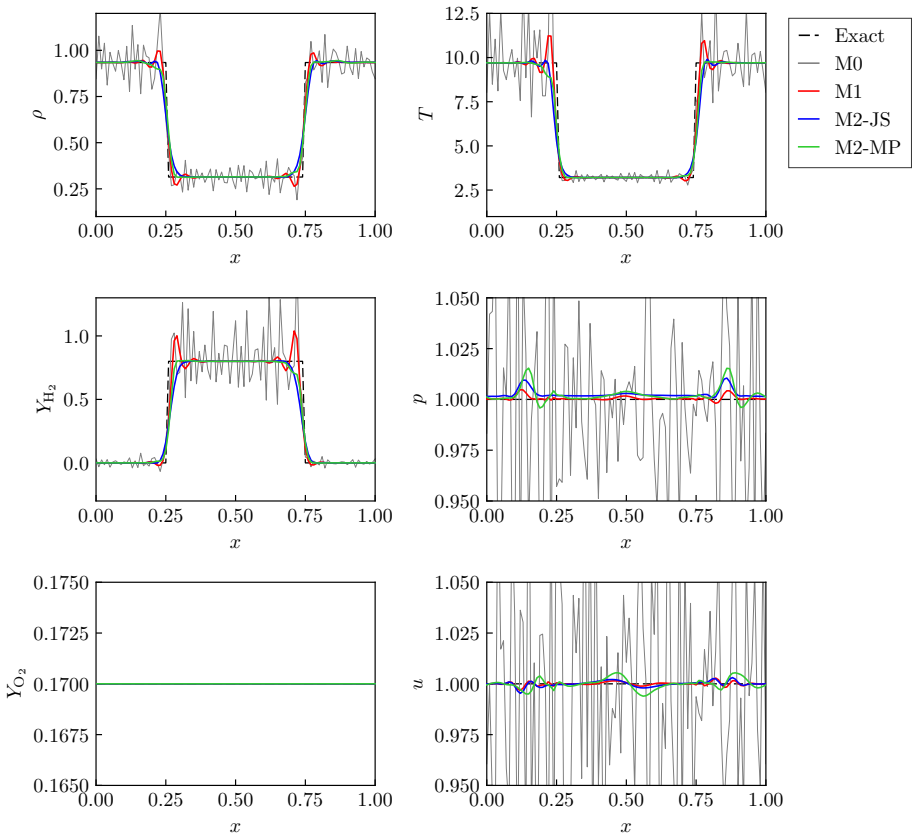
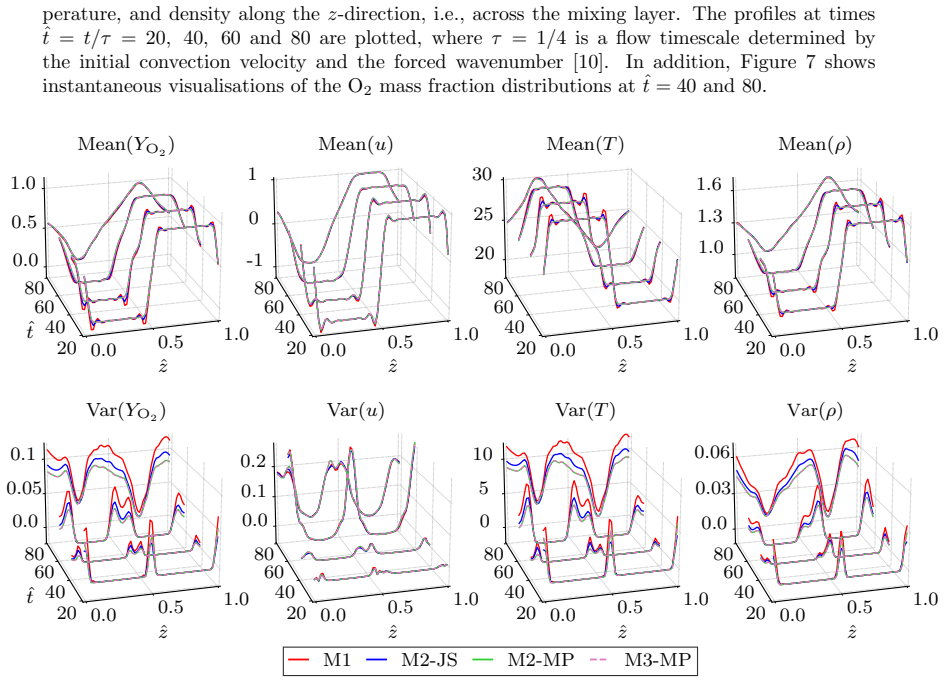
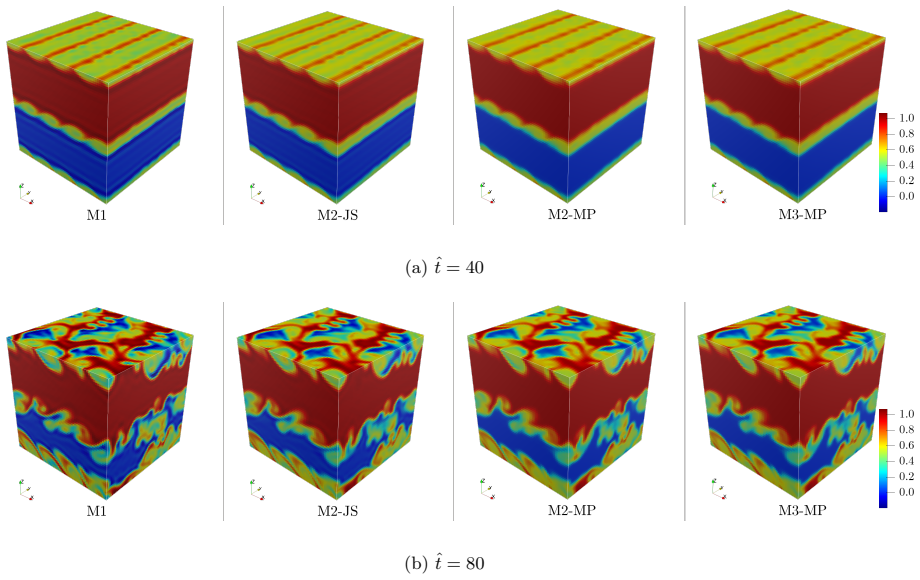
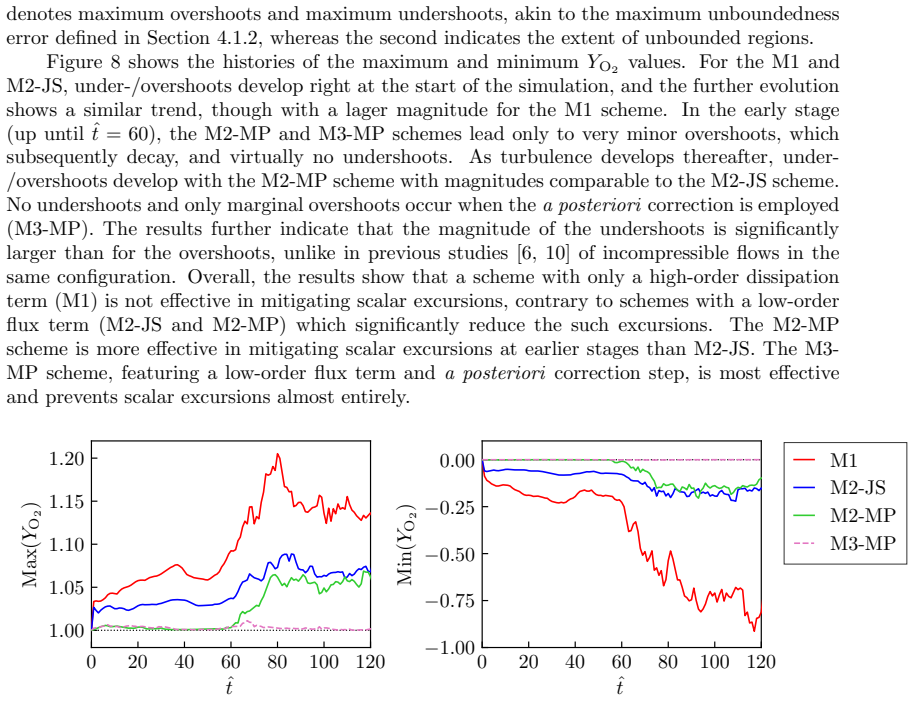
By augmenting the non-dissipative numerical flux of a high-order central-difference scheme with an explicit dissipative numerical flux that adaptively switches between high-order and low-order formulations, scalar boundedness can be preserved without predefined bounds while maintaining high accuracy and low numerical dissipation. Two concrete realizations are constructed, one based on Jameson's artificial viscosity and one on a monotonicity-preserving limiter; the latter demonstrates superior performance in accuracy, boundedness of species mass fractions, and numerical diffusivity when applied to one-dimensional scalar advection and three-dimensional temporal turbulent mixing-layer flows.
What carries the argument
Adaptive dissipative numerical flux that switches between high-order and low-order formulations, constructed on top of a chosen non-dissipative central-difference flux, implemented either via Jameson's artificial viscosity or a monotonicity-preserving limiter.
If this is right
- Unphysical negative mass fractions and simulation instabilities are avoided in multi-component compressible turbulence calculations.
- High-order accuracy and low dissipation are retained even when grids cannot resolve all small-scale gradients.
- The monotonicity-preserving limiter version outperforms the artificial-viscosity version on the tested advection and mixing-layer cases.
- Sharp scalar interfaces can be handled without global order reduction or excessive smearing.
Where Pith is reading between the lines
- The same adaptive-flux idea could be combined with other high-order spatial discretizations or time integrators used in combustion or atmospheric modeling.
- Because bounds are enforced locally and without user-specified limits, the method may reduce the need for ad-hoc clipping or renormalization steps in production codes.
- Extension to unstructured meshes or adaptive mesh refinement would require only re-derivation of the switching sensor on the new stencil geometry.
Load-bearing premise
The adaptive switching between high-order and low-order dissipative formulations will control dispersion-induced oscillations in highly under-resolved turbulence without adding excessive numerical diffusivity or lowering accuracy.
What would settle it
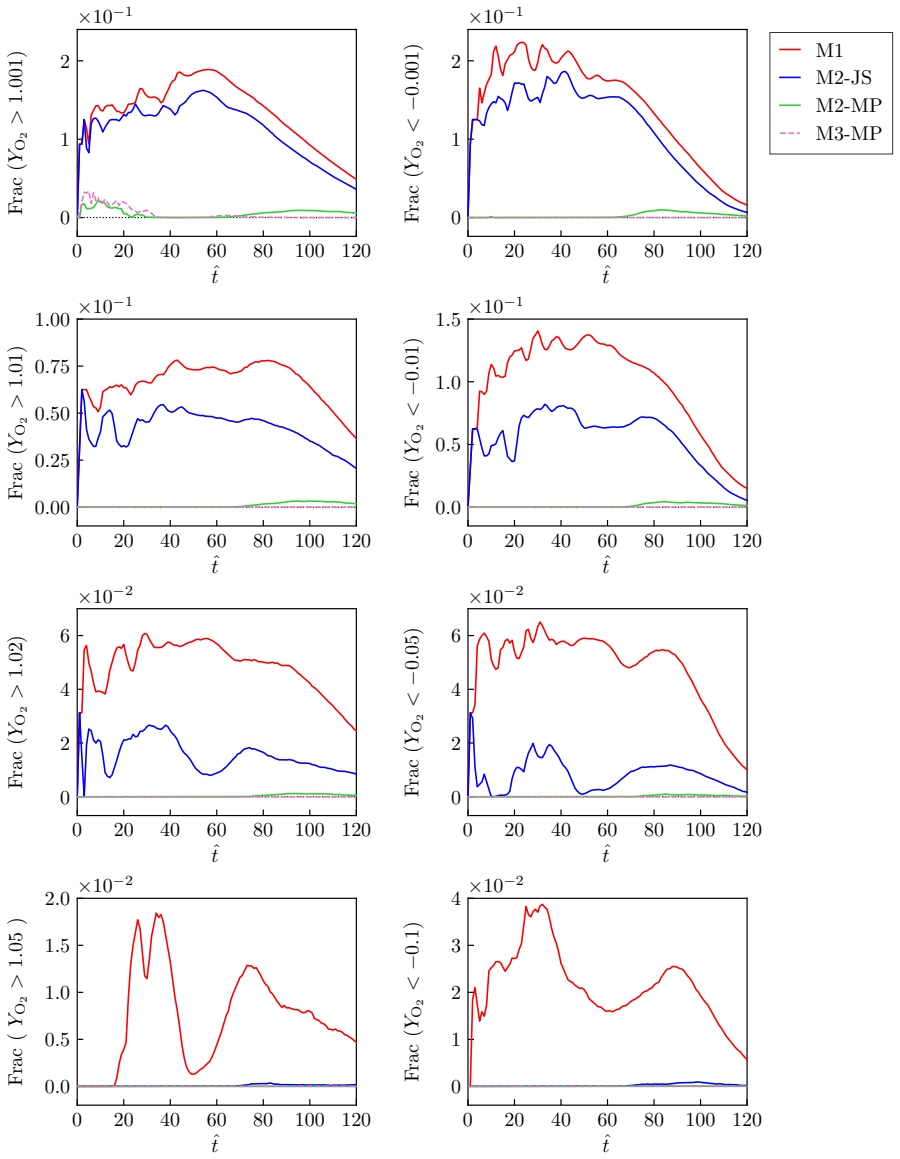
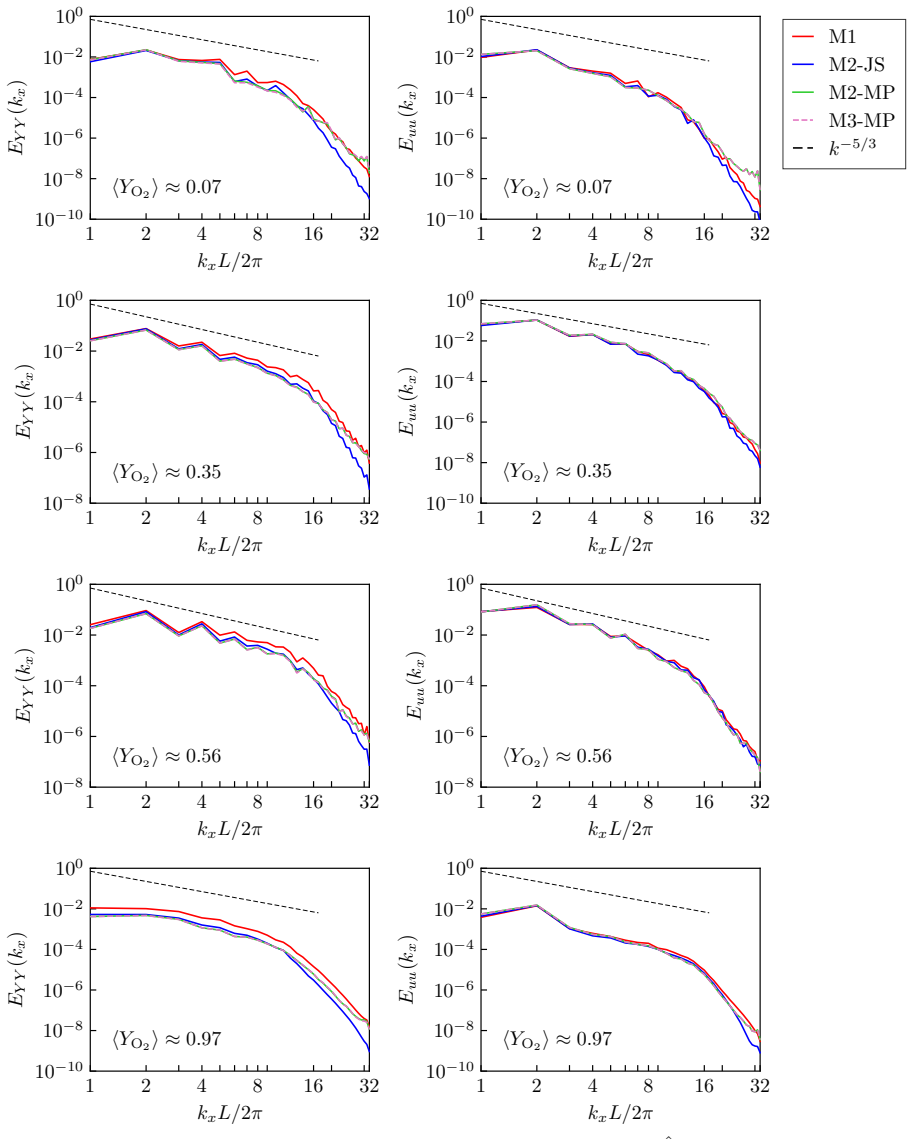
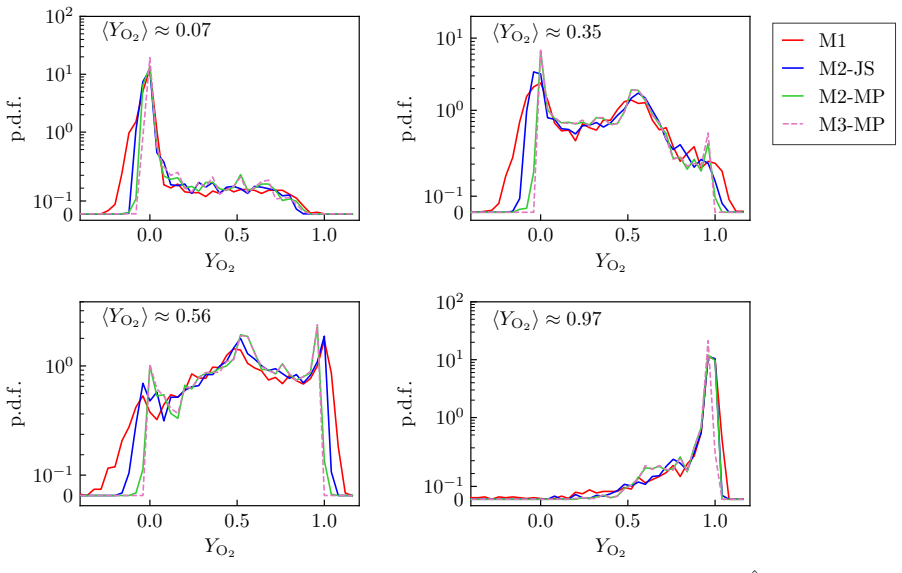
Perform the three-dimensional temporal turbulent mixing-layer simulation with the proposed schemes on the same under-resolved grid and check whether species mass fractions remain strictly between zero and one while the resolved turbulent kinetic energy and scalar spectra stay close to a reference high-resolution run.
Figures



read the original abstract
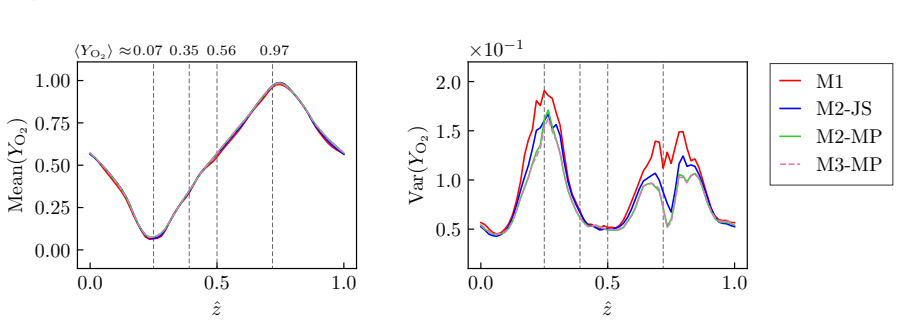
Preserving scalar boundedness is important for numerical schemes used in turbulent compressible multi-component flow simulations to prevent unphysical results and unstable simulations. However, ensuring scalar boundedness for high-order, low-dissipation numerical schemes poses challenges in highly under-resolved conditions due to inherent dispersion errors that generate spurious oscillations. Numerical dissipation is needed to mitigate these oscillations, but excessive dissipation negatively affects resolution. In this work, we propose formulations for high-order finite-difference schemes to preserve scalar boundedness without predefined bounds, while maintaining high accuracy and low numerical dissipation. The proposed formulations augment a non-dissipative numerical flux of a high-order central-difference scheme with an explicit dissipative numerical flux that adaptively switches between high-order and low-order formulations. Building on a deliberate choice of the non-dissipative flux, we construct two schemes using Jameson's artificial viscosity method and a monotonicity-preserving limiter as the dissipative flux. We examine the schemes in one-dimensional scalar advection problems and a three-dimensional temporal turbulent mixing-layer case involving sharp scalar gradients and under-resolved conditions, evaluating their accuracy, boundedness of species mass fractions, and numerical diffusivity. The scheme with the monotonicity-preserving limiter demonstrates superior performance.
Editorial analysis
A structured set of objections, weighed in public.
Referee Report
Summary. The paper proposes two formulations that augment a non-dissipative high-order central finite-difference flux with an adaptive dissipative flux to enforce boundedness of scalar mass fractions in compressible multi-component turbulent flows without supplying a priori bounds. One formulation uses Jameson's artificial viscosity; the other employs a monotonicity-preserving limiter. Both are evaluated on 1D scalar advection problems and a 3D temporal turbulent mixing layer with sharp gradients and under-resolved turbulence, with quantitative assessment of accuracy, boundedness, and numerical diffusivity; the MP-limiter variant is reported to be superior on all three metrics.
Significance. If the numerical evidence holds, the work supplies practical, high-order schemes that maintain scalar boundedness while keeping added dissipation low enough to preserve resolution in under-resolved multi-species turbulence. This directly addresses a recurring obstacle in high-fidelity simulations of reacting flows and multi-component aerodynamics, where unphysical scalar values can destabilize computations or degrade accuracy.
minor comments (3)
- §3.2 and §4.1: the precise definition of the adaptive sensor (including any threshold values) should be stated explicitly in the text rather than only in the algorithm box, to allow immediate reproduction.
- Figure 7 and Table 2: the error norms and boundedness violation counts for the MP-limiter scheme are shown only for selected times; adding a single summary table of time-averaged metrics across all tested resolutions would strengthen the cross-case comparison.
- The manuscript cites the original Jameson and MP-limiter references but does not discuss how the present adaptive switching differs from prior boundedness-preserving limiters in the compressible-flow literature; a short paragraph in the introduction would clarify novelty.
Simulated Author's Rebuttal
We thank the referee for the positive summary of our manuscript, the recognition of its practical relevance to high-fidelity multi-component flow simulations, and the recommendation for minor revision. We appreciate that the referee accurately captured the core contributions of the two proposed formulations for enforcing scalar boundedness while preserving high-order accuracy and low dissipation.
Circularity Check
No significant circularity; derivation is self-contained
full rationale
The paper proposes two explicit augmentations (Jameson artificial viscosity and MP limiter) to a chosen non-dissipative central flux, with an adaptive switch defined by a sensor. These are standard techniques drawn from external literature rather than fitted to the target boundedness property or derived from self-referential definitions. The 1-D advection tests and 3-D mixing-layer results serve as independent numerical verification of boundedness, accuracy, and diffusivity; no equation reduces to a prior result by construction, no parameter is renamed as a prediction, and no load-bearing uniqueness theorem is imported via self-citation. The construction therefore remains externally falsifiable and non-circular.
Axiom & Free-Parameter Ledger
axioms (1)
- standard math Established properties of central-difference schemes, Jameson's artificial viscosity, and monotonicity-preserving limiters apply directly to compressible multi-component flows.
Lean theorems connected to this paper
-
IndisputableMonolith/Cost/FunctionalEquation.leanwashburn_uniqueness_aczel unclearaugment a non-dissipative numerical flux of a high-order central-difference scheme with an explicit dissipative numerical flux that adaptively switches between high-order and low-order formulations
-
IndisputableMonolith/Foundation/RealityFromDistinction.leanreality_from_one_distinction unclearmonotonicity-preserving limiter due to Suresh and Huynh
Reference graph
Works this paper leans on
-
[1]
F. Ducros et al. “High-order fluxes for conservative skew-symmetric-like schemes in struc- tured meshes: Application to compressible flows”. In:Journal of Computational Physics 161.1 (2000), pp. 114–139.issn: 00219991.doi:10.1006/jcph.2000.6492
-
[2]
Yohei Morinishi. “Skew-symmetric form of convective terms and fully conservative finite dif- ference schemes for variable density low-Mach number flows”. In:Journal of Computational Physics229.2 (2010), pp. 276–300.issn: 00219991.doi:10.1016/j.jcp.2009.09.021
-
[3]
Generalized conservative approximations of split convective derivative operators
Sergio Pirozzoli. “Generalized conservative approximations of split convective derivative operators”. In:Journal of Computational Physics229.19 (2010), pp. 7180–7190.issn: 00219991.doi:10.1016/j.jcp.2010.06.006
-
[4]
Scalar conservation and boundedness in simulations of compressible flow
Pramod K. Subbareddy, Anand Kartha, and Graham V. Candler. “Scalar conservation and boundedness in simulations of compressible flow”. In:Journal of Computational Physics 348 (2017), pp. 827–846.issn: 00219991.doi:10.1016/j.jcp.2017.08.001
-
[5]
M. Herrmann, G. Blanquart, and V. Raman. “Flux corrected finite volume scheme for preserving scalar boundedness in reacting large-eddy simulations”. In:AIAA Journal44.12 (2006), pp. 2879–2886.issn: 0001-1452 1533-385X.doi:10.2514/1.18235
-
[6]
Scalar excursions in large-eddy simulations
Georgios Matheou and Paul E. Dimotakis. “Scalar excursions in large-eddy simulations”. In:Journal of Computational Physics327 (2016), pp. 97–120.issn: 00219991.doi:10. 1016/j.jcp.2016.08.035
work page 2016
-
[7]
An entropy-stable hybrid scheme for simulations of transcritical real-fluid flows
Peter C. Ma, Yu Lv, and Matthias Ihme. “An entropy-stable hybrid scheme for simulations of transcritical real-fluid flows”. In:Journal of Computational Physics340 (2017), pp. 330– 357.issn: 00219991.doi:10.1016/j.jcp.2017.03.022
-
[8]
Enforcing realizability in explicit multi- component species transport
Randall J. McDermott and Jason E. Floyd. “Enforcing realizability in explicit multi- component species transport”. In:Fire safety journal78 (2015), pp. 180–187.issn: 0379- 7112.doi:10.1016/j.firesaf.2015.09.005
-
[9]
Communication-aware robotics: Exploiting motion for communication,
Sergio Pirozzoli. “Numerical methods for high-speed flows”. In:Annual Review of Fluid Mechanics43.1 (2011), pp. 163–194.issn: 0066-4189 1545-4479.doi:10.1146/annurev- fluid-122109-160718
-
[10]
Mixing, scalar boundedness, and numerical dissipation in large-eddy simulations
Nek Sharan, Georgios Matheou, and Paul E. Dimotakis. “Mixing, scalar boundedness, and numerical dissipation in large-eddy simulations”. In:Journal of Computational Physics369 (2018), pp. 148–172.issn: 00219991.doi:10.1016/j.jcp.2018.05.005
-
[11]
Flux-corrected transport. I. SHASTA, a fluid transport algorithm that works
Jay P. Boris and David L. Book. “Flux-corrected transport. I. SHASTA, a fluid transport algorithm that works”. In:Journal of Computational Physics11.1 (1973), pp. 38–69.issn: 0021-9991.doi:10.1016/0021-9991(73)90147-2
-
[12]
Fully multidimensional flux-corrected transport algorithms for fluids
Steven T. Zalesak. “Fully multidimensional flux-corrected transport algorithms for fluids”. In:Journal of Computational Physics31.3 (1979), pp. 335–362.issn: 0021-9991.doi:10. 1016/0021-9991(79)90051-2. 29
work page 1979
-
[13]
Towards the ultimate conservative difference scheme I. The quest of mono- tonicity
Bram van Leer. “Towards the ultimate conservative difference scheme I. The quest of mono- tonicity”. In:Proceedings of the Third International Conference on Numerical Methods in Fluid Mechanics. Ed. by Henri Cabannes and Roger Temam. Berlin, Heidelberg: Springer Berlin Heidelberg, 1973, pp. 163–168.isbn: 978-3-540-38377-2
work page 1973
-
[14]
On maximum-principle-satisfying high order schemes for scalar conservation laws
Xiangxiong Zhang and Chi-Wang Shu. “On maximum-principle-satisfying high order schemes for scalar conservation laws”. In:Journal of Computational Physics229.9 (2010), pp. 3091–3120.issn: 00219991.doi:10.1016/j.jcp.2009.12.030
-
[15]
An improved bounded semi-Lagrangian scheme for the turbulent transport of passive scalars
Siddhartha Verma, Y. Xuan, and G. Blanquart. “An improved bounded semi-Lagrangian scheme for the turbulent transport of passive scalars”. In:Journal of Computational Physics 272 (2014), pp. 1–22.issn: 0021-9991.doi:10.1016/j.jcp.2014.03.062
-
[16]
Antony Jameson, Wolfgang Schmidt, and Eli Turkel. “Numerical solution of the Euler equations by finite volume methods using Runge Kutta time stepping schemes”. In:14th fluid and plasma dynamics conference. 1981, p. 1259.doi:10.2514/6.1981-1259
-
[17]
Artificial fluid properties for large-eddy simulation of compressible turbulent mixing
Andrew W. Cook. “Artificial fluid properties for large-eddy simulation of compressible turbulent mixing”. In:Physics of Fluids19.5 (2007), p. 055103.issn: 1070-6631.doi: 10.1063/1.2728937
-
[18]
Localized artificial diffusivity scheme for discontinuity capturing on curvilinear meshes
S. Kawai and S. K. Lele. “Localized artificial diffusivity scheme for discontinuity capturing on curvilinear meshes”. In:Journal of Computational Physics227.22 (2008), pp. 9498– 9526.issn: 00219991.doi:10.1016/j.jcp.2008.06.034
-
[19]
A discrete-adjoint framework for optimizing high-fidelity simulations of turbulent reacting flows
Ali Kord and Jesse Capecelatro. “A discrete-adjoint framework for optimizing high-fidelity simulations of turbulent reacting flows”. In:Proceedings of the Combustion Institute39.4 (2023), pp. 5375–5384.issn: 15407489.doi:10.1016/j.proci.2022.06.021
-
[20]
A stable and accurate convective modelling procedure based on quadratic upstream interpolation
Brian P Leonard. “A stable and accurate convective modelling procedure based on quadratic upstream interpolation”. In:Computer methods in applied mechanics and engi- neering19.1 (1979), pp. 59–98.issn: 0045-7825.doi:10.1016/0045-7825(79)90034-3
-
[21]
Structure of a high Karlovitz n- C7H16 premixed turbulent flame
Bruno Savard, Brock Bobbitt, and Guillaume Blanquart. “Structure of a high Karlovitz n- C7H16 premixed turbulent flame”. In:Proceedings of the Combustion Institute35.2 (2015), pp. 1377–1384.issn: 1540-7489.doi:10.1016/j.proci.2014.06.133
-
[22]
Aaron J. Fillo et al. “A fast, low-memory, and stable algorithm for implementing multicom- ponent transport in direct numerical simulations”. In:Journal of Computational Physics 406 (2020), p. 109185.issn: 0021-9991.doi:10.1016/j.jcp.2019.109185
-
[23]
A minimum entropy principle in the gas dynamics equations
Eitan Tadmor. “A minimum entropy principle in the gas dynamics equations”. In:Applied Numerical Mathematics2.3-5 (1986), pp. 211–219.issn: 0168-9274.doi:10.1016/0168- 9274(86)90029-2
-
[24]
Xu-dong Liu and Stanley Osher. “Nonoscillatory high order accurate self-similar maximum principle satisfying shock capturing schemes I”. In:SIAM Journal on Numerical Analysis 33.2 (1996), pp. 760–779.doi:10.1137/0733038
-
[25]
How to preserve the mass fractions positivity when computing compressible multi-component flows
Bernard Larrouturou. “How to preserve the mass fractions positivity when computing compressible multi-component flows”. In:Journal of Computational Physics95.1 (1991), pp. 59–84.issn: 0021-9991.doi:10.1016/0021-9991(91)90253-H
-
[26]
Jie Du and Yang Yang. “High-order bound-preserving discontinuous Galerkin methods for multicomponent chemically reacting flows”. In:Journal of Computational Physics469 (2022), p. 111548.issn: 0021-9991.doi:10.1016/j.jcp.2022.111548. 30
-
[27]
Accurate monotonicity-preserving schemes with Runge–Kutta time stepping
A. Suresh and H.T. Huynh. “Accurate monotonicity-preserving schemes with Runge–Kutta time stepping”. In:Journal of Computational Physics136.1 (1997), pp. 83–99.issn: 0021- 9991.doi:10.1006/jcph.1997.5745
-
[28]
High resolution schemes and the entropy con- dition
Stanley Osher and Sukumar Chakravarthy. “High resolution schemes and the entropy con- dition”. In:SIAM Journal on Numerical Analysis21.5 (1984), pp. 955–984.doi:10.1137/ 0721060
work page 1984
-
[29]
A method for the numerical calculation of hydro- dynamic shocks
J. von Neumann and R. D. Richtmyer. “A method for the numerical calculation of hydro- dynamic shocks”. In:Journal of Applied Physics21.3 (1950), pp. 232–237.issn: 0021-8979 1089-7550.doi:10.1063/1.1699639
-
[30]
Adaptive energy stable artificial dissipation for preserving scalar boundedness in turbulent flows
Ali Kord and Jesse Capecelatro. “Adaptive energy stable artificial dissipation for preserving scalar boundedness in turbulent flows”. In:Computers & Fluids254 (2023), p. 105776.issn: 0045-7930.doi:10.1016/j.compfluid.2023.105776
-
[31]
Stable and accurate artificial dissi- pation
Ken Mattsson, Magnus Sv¨ ard, and Jan Nordstr¨ om. “Stable and accurate artificial dissi- pation”. In:Journal of Scientific Computing21.1 (2004), pp. 57–79.issn: 0885-7474.doi: 10.1023/B:JOMP.0000027955.75872.3f
-
[32]
Simulation and Analysis of Turbulent Multiphase Combustion Processes at High Pressures
Joseph Charles Oefelein. “Simulation and Analysis of Turbulent Multiphase Combustion Processes at High Pressures”. Thesis. 1997
work page 1997
-
[34]
Luca Sciacovelli et al. “Assessment of a high-order shock-capturing central-difference scheme for hypersonic turbulent flow simulations”. In:Computers & Fluids230 (2021), p. 105134.issn: 0045-7930.doi:10.1016/j.compfluid.2021.105134
-
[35]
Conservative hybrid compact-WENO schemes for shock-turbulence in- teraction
Sergio Pirozzoli. “Conservative hybrid compact-WENO schemes for shock-turbulence in- teraction”. In:Journal of Computational Physics178.1 (2002), pp. 81–117.issn: 00219991. doi:10.1006/jcph.2002.7021
-
[36]
Bernardo Cockburn, San-Yih Lin, and Chi-Wang Shu. “TVB Runge-Kutta local projection discontinuous Galerkin finite element method for conservation laws III: One-dimensional systems”. In:Journal of Computational Physics84.1 (1989), pp. 90–113.issn: 0021-9991. doi:10.1016/0021-9991(89)90183-6
-
[37]
A characteristic-wise hybrid compact- WENO scheme for solving hyperbolic conservation laws
Yu-Xin Ren, Miao’er Liu, and Hanxin Zhang. “A characteristic-wise hybrid compact- WENO scheme for solving hyperbolic conservation laws”. In:Journal of Computational Physics192.2 (2003), pp. 365–386.issn: 00219991.doi:10.1016/j.jcp.2003.07.006
-
[38]
Ye Wang, Armin Wehrfritz, and Evatt R. Hawkes. “Physically consistent formulations of split convective terms for turbulent compressible multi-component flows”. In:Journal of Computational Physics540 (2025), p. 114269.issn: 0021-9991.doi:10.1016/j.jcp.2025. 114269
-
[39]
Peter Lax and Burton Wendroff. “Systems of conservation laws”. In:Communications on Pure and Applied Mathematics13.2 (1960), pp. 217–237.issn: 0010-3640.doi:10.1002/ cpa.3160130205
work page 1960
-
[40]
Several new numerical methods for compressible shear-layer simulations
Christopher A. Kennedy and Mark H. Carpenter. “Several new numerical methods for compressible shear-layer simulations”. In:Applied Numerical Mathematics14.4 (1994), pp. 397–433.issn: 0168-9274.doi:10.1016/0168-9274(94)00004-2. 31
-
[41]
A high-wavenumber viscosity for high-resolution numerical methods
Andrew W. Cook and William H. Cabot. “A high-wavenumber viscosity for high-resolution numerical methods”. In:Journal of Computational Physics195.2 (2004), pp. 594–601.issn: 0021-9991.doi:10.1016/j.jcp.2003.10.012
-
[42]
Praveen Chandrashekar. “Kinetic energy preserving and entropy stable finite volume schemes for compressible Euler and Navier–Stokes equations”. In:Communications in Computational Physics14.5 (2015), pp. 1252–1286.issn: 1815-2406 1991-7120.doi: 10.4208/cicp.170712.010313a
-
[43]
Comparison of some entropy conservative numerical fluxes for the Euler equations
Hendrik Ranocha. “Comparison of some entropy conservative numerical fluxes for the Euler equations”. In:Journal of Scientific Computing76.1 (2017), pp. 216–242.issn: 0885-7474 1573-7691.doi:10.1007/s10915-017-0618-1
-
[44]
A fully discrete, kinetic energy consistent finite-volume scheme for compressible flows
Pramod K. Subbareddy and Graham V. Candler. “A fully discrete, kinetic energy consistent finite-volume scheme for compressible flows”. In:Journal of Computational Physics228.5 (2009), pp. 1347–1364.issn: 00219991.doi:10.1016/j.jcp.2008.10.026
-
[45]
Approximate Riemann solvers, parameter vectors, and difference schemes
Philip L. Roe. “Approximate Riemann solvers, parameter vectors, and difference schemes”. In:Journal of computational physics43.2 (1981), pp. 357–372.issn: 0021-9991.doi:10. 1016/0021-9991(81)90128-5
work page 1981
-
[46]
Randall J LeVeque and Randall J Leveque.Numerical methods for conservation laws. Vol. 214. Springer, 1992
work page 1992
-
[47]
The effect of the formulation of nonlinear terms on aliasing errors in spectral methods
G.A. Blaisdell, E.T. Spyropoulos, and J.H. Qin. “The effect of the formulation of nonlinear terms on aliasing errors in spectral methods”. In:Applied Numerical Mathematics21.3 (1996), pp. 207–219.issn: 0168-9274.doi:10.1016/0168-9274(96)00005-0
-
[48]
WJ Feiereisen, WC Reynolds, and JH Ferziger. “Numerical simulation of a compressible, homogeneous, turbulent shear flow. Report TF-13, Thermosciences Division”. In:Mechan- ical Engineering, Stanford University(1981), p. 759
work page 1981
-
[49]
Christopher A Kennedy and Andrea Gruber. “Reduced aliasing formulations of the con- vective terms within the Navier–Stokes equations for a compressible fluid”. In:Journal of Computational Physics227.3 (2008), pp. 1676–1700.issn: 00219991.doi:10.1016/j.jcp. 2007.09.020
-
[50]
Numerically stable formulations of convective terms for turbulent compressible flows
Gennaro Coppola et al. “Numerically stable formulations of convective terms for turbulent compressible flows”. In:Journal of Computational Physics382 (2019), pp. 86–104.issn: 00219991.doi:10.1016/j.jcp.2019.01.007
-
[51]
Kinetic energy and entropy preserving schemes for compressible flows by split convective forms
Yuichi Kuya, Kosuke Totani, and Soshi Kawai. “Kinetic energy and entropy preserving schemes for compressible flows by split convective forms”. In:Journal of Computational Physics375 (2018), pp. 823–853.issn: 00219991.doi:10.1016/j.jcp.2018.08.058
-
[52]
Nao Shima et al. “Preventing spurious pressure oscillations in split convective form dis- cretization for compressible flows”. In:Journal of Computational Physics427 (2021), p. 110060.issn: 00219991.doi:10.1016/j.jcp.2020.110060
-
[53]
The calculation of the interaction of non-stationary shock waves and obstacles
Vladimir Vasil’evich Rusanov. “The calculation of the interaction of non-stationary shock waves and obstacles”. In:USSR Computational Mathematics and Mathematical Physics 1.2 (1962), pp. 304–320.issn: 0041-5553.doi:10.1016/0041-5553(62)90062-9
-
[54]
Gregor J. Gassner, Andrew R. Winters, and David A. Kopriva. “Split form nodal discon- tinuous Galerkin schemes with summation-by-parts property for the compressible Euler equations”. In:Journal of Computational Physics327 (2016), pp. 39–66.issn: 00219991. doi:10.1016/j.jcp.2016.09.013. 32
-
[55]
Effect of numerical dissipation on the predicted spectra for compressible turbulence
J. Larsson, S.K. Lele, and P. Moin. “Effect of numerical dissipation on the predicted spectra for compressible turbulence”. In:Annual research briefs(2007), pp. 47–57
work page 2007
-
[56]
Large-eddy simulation and multiscale modelling of a Richtmyer–Meshkov instability with reshock
D. J. Hill, C. Pantano, and D. I. Pullin. “Large-eddy simulation and multiscale modelling of a Richtmyer–Meshkov instability with reshock”. In:Journal of Fluid Mechanics557 (2006), pp. 29–61.issn: 0022-1120 1469-7645.doi:10.1017/s0022112006009475
-
[57]
Numerical viscosity and the entropy condition for conservative difference schemes
Eitan Tadmor. “Numerical viscosity and the entropy condition for conservative difference schemes”. In:Mathematics of Computation43.168 (1984), pp. 369–381.doi:10 . 2307 / 2008282
work page 1984
-
[58]
Efficient implementation of essentially non-oscillatory shock-capturing schemes
Chi-Wang Shu and Stanley Osher. “Efficient implementation of essentially non-oscillatory shock-capturing schemes”. In:Journal of computational physics77.2 (1988), pp. 439–471. issn: 0021-9991.doi:10.1016/0021-9991(88)90177-5
-
[59]
Computations of compressible multifluids
R´ emi Abgrall and Smadar Karni. “Computations of compressible multifluids”. In:Journal of Computational Physics169.2 (2001), pp. 594–623.issn: 00219991.doi:10.1006/jcph. 2000.6685
-
[60]
Eric Johnsen and Frank Ham. “Preventing numerical errors generated by interface- capturing schemes in compressible multi-material flows”. In:Journal of Computational Physics231.17 (2012), pp. 5705–5717.issn: 00219991.doi:10.1016/j.jcp.2012.04.048
-
[61]
Soshi Kawai, Hiroshi Terashima, and Hideyo Negishi. “A robust and accurate numerical method for transcritical turbulent flows at supercritical pressure with an arbitrary equation of state”. In:Journal of Computational Physics300 (2015), pp. 116–135.issn: 00219991. doi:10.1016/j.jcp.2015.07.047
-
[62]
Turbulent shear-layer mixing: initial conditions, and direct-numerical and large-eddy simulations
Nek Sharan, Georgios Matheou, and Paul E. Dimotakis. “Turbulent shear-layer mixing: initial conditions, and direct-numerical and large-eddy simulations”. In:Journal of Fluid Mechanics877 (2019), pp. 35–81.issn: 0022-1120 1469-7645.doi:10.1017/jfm.2019.591
-
[63]
Olivier Desjardins et al. “High order conservative finite difference scheme for variable density low Mach number turbulent flows”. In:Journal of Computational Physics227.15 (2008), pp. 7125–7159.issn: 00219991.doi:10.1016/j.jcp.2008.03.027
-
[64]
Large-eddy simulation and experiments on non-premixed highly turbulent opposed jet flows
M.W.A. Pettit et al. “Large-eddy simulation and experiments on non-premixed highly turbulent opposed jet flows”. In:Proceedings of the Combustion Institute33.1 (2011), pp. 1391–1399.issn: 1540-7489.doi:10.1016/j.proci.2010.06.140
-
[65]
New insights into large eddy simulation
Jay P. Boris et al. “New insights into large eddy simulation”. In:Fluid Dynamics Research 10.4-6 (1992), p. 199.doi:10.1016/0169-5983(92)90023-P
-
[66]
Kolmogorov-like spectra in decaying three-dimensional supersonic flows
David H. Porter, A. Pouquet, and Paul R. Woodward. “Kolmogorov-like spectra in decaying three-dimensional supersonic flows”. In:Physics of Fluids6.6 (1994), pp. 2133–2142.issn: 1070-6631.doi:10.1063/1.868217
-
[67]
Monotonically integrated large eddy simulation of free shear flows
C. Fureby and F. F. Grinstein. “Monotonically integrated large eddy simulation of free shear flows”. In:AIAA Journal37.5 (1999), pp. 544–556.doi:10.2514/2.772
-
[68]
On the implicit large eddy simu- lations of homogeneous decaying turbulence
Ben Thornber, Andrew Mosedale, and Dimitris Drikakis. “On the implicit large eddy simu- lations of homogeneous decaying turbulence”. In:Journal of Computational Physics226.2 (2007), pp. 1902–1929.issn: 00219991.doi:10.1016/j.jcp.2007.06.030. 33
discussion (0)
Sign in with ORCID, Apple, or X to comment. Anyone can read and Pith papers without signing in.