Recognition: no theorem link
Observation of Magnetically-Induced atomic transitions of the Cs 6S_{1/2} rightarrow 7P_{3/2} line at 456 nm
Pith reviewed 2026-05-13 03:52 UTC · model grok-4.3
The pith
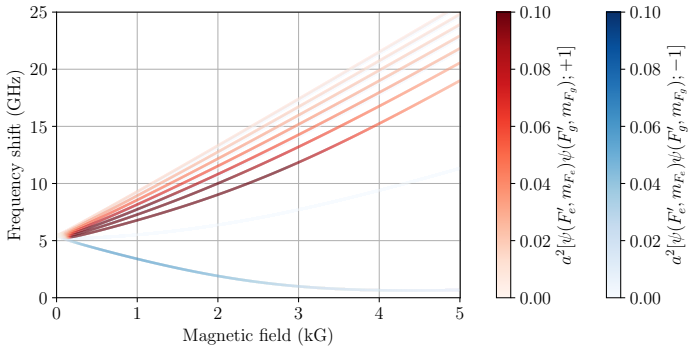
Magnetically induced transitions on the cesium 456 nm line reach higher intensity than conventional ones and shift by up to 17 GHz in fields of 0.2-3 kG.
A machine-rendered reading of the paper's core claim, the machinery that carries it, and where it could break.
Core claim
Seven MI transitions (Fg = 3 to Fe = 5) of the Cs 6²S1/2 → 7²P3/2 line at 456 nm reach maximum intensity above that of conventional transitions in magnetic fields from 0.2 to 3 kG and exhibit frequency shifts reaching approximately 17 GHz with respect to the unperturbed hyperfine transitions at about 3 kG; the measured positions, intensities, and shifts agree closely with theoretical predictions obtained by diagonalizing the Zeeman Hamiltonian.
What carries the argument
Magnetically induced (MI) transitions of the specific Fg=3 to Fe=5 group, which gain oscillator strength through magnetic-field-induced mixing of hyperfine states as computed by diagonalization of the Zeeman Hamiltonian.
If this is right
- The MI lines can serve as optical frequency references in the blue spectral region.
- They enable construction of magnetometers capable of sub-micron spatial resolution.
- The large frequency shifts separate these lines from conventional hyperfine transitions, simplifying selective detection.
- Intensity maxima above those of allowed transitions improve signal-to-noise for spectroscopic applications.
Where Pith is reading between the lines
- Similar MI transitions on other cesium lines or in other alkali species could be explored for visible-wavelength references or sensors.
- The sub-micron resolution potential suggests applications in mapping local magnetic fields near surfaces or in microscopic samples.
- Integration with compact blue laser sources might yield portable devices that exploit both the intensity advantage and the field-induced shift.
Load-bearing premise
The observed spectral features are correctly identified as the targeted Fg=3 to Fe=5 magnetically induced transitions without significant overlap from other lines or artifacts, and the magnetic field strength is accurately calibrated.
What would settle it
Repeating the absorption or fluorescence scan in the same vapor cell and field geometry but finding that the candidate lines do not exceed the intensity of nearby allowed transitions or deviate from the calculated positions and 17 GHz shift at 3 kG.
Figures


read the original abstract
It has recently been demonstrated that magnetically induced (MI) transitions, a class of transitions forbidden at zero magnetic field, of the Cs 6$^2$S$_{1/2} \rightarrow 6^2$P$_{3/2}$ (D$_2$) line, exhibit promising features for high-resolution physics applications in the near-infrared range. In this work, we study a group of seven MI transitions ($F_g = 3 \rightarrow F_e = 5$) of the Cs $6^2$S$_{1/2} \rightarrow 7^2$P$_{3/2}$ line at $\lambda = 456$ nm. The experimental measurements are in very good agreement with theoretical predictions based on the diagonalization of the Zeeman Hamiltonian. In magnetic fields ranging from $0.2-3$ kG, these transitions reach a maximum intensity above that of conventional transitions. Another noteworthy property is their large frequency shift, reaching approximately $17~\mathrm{GHz}$ with respect to the unperturbed hyperfine transitions in magnetic fields of about $3~\mathrm{kG}$. These interesting properties may prove useful for the realization of optical frequency references or magnetometers with sub-micron spatial resolution in the blue region of the spectrum.
Editorial analysis
A structured set of objections, weighed in public.
Referee Report
Summary. The paper reports experimental observation of seven magnetically-induced (MI) transitions (F_g=3 to F_e=5) of the Cs 6²S_{1/2} → 7²P_{3/2} line at 456 nm. These zero-field-forbidden transitions are measured in fields 0.2–3 kG and compared to predictions obtained by direct diagonalization of the Zeeman Hamiltonian. The MI lines are stated to reach intensities exceeding those of conventional transitions and to exhibit frequency shifts up to ~17 GHz relative to the unperturbed hyperfine components at 3 kG. Potential applications to optical frequency references and sub-micron-resolution magnetometry in the blue are suggested.
Significance. If the peak assignments and field calibration hold, the work extends the study of MI transitions from the near-IR D2 line to the blue 456 nm transition, adding a new wavelength range where these lines combine high intensity with large, predictable Zeeman shifts. The direct, parameter-free comparison to Zeeman-Hamiltonian diagonalization is a methodological strength that supports falsifiability. Such lines could enable compact blue-wavelength references or spatially resolved magnetometers, provided the experimental mapping is robust.
major comments (1)
- The central claim that the observed spectral features are the specific F_g=3 → F_e=5 MI transitions (with the reported intensities and ~17 GHz shifts) rests on accurate local B-field calibration and unambiguous identification. The manuscript must specify the independent method used to determine B (e.g., Hall probe, NMR, or reference transitions unrelated to the claimed MI lines), quantify uncertainties from probe placement or field inhomogeneity, and show that alternative assignments to nearby conventional or other MI components are excluded within the stated field range.
minor comments (1)
- [Abstract] Abstract: the statement of 'very good agreement' would be more informative if accompanied by quantitative measures (RMS deviation, reduced χ², or error bars on the extracted shifts and relative intensities).
Simulated Author's Rebuttal
We thank the referee for their careful reading of the manuscript and for the constructive major comment. We agree that explicit documentation of the magnetic-field calibration and exclusion of alternative line assignments is necessary to support the central claims. We have revised the manuscript to address this point in detail.
read point-by-point responses
-
Referee: The central claim that the observed spectral features are the specific F_g=3 → F_e=5 MI transitions (with the reported intensities and ~17 GHz shifts) rests on accurate local B-field calibration and unambiguous identification. The manuscript must specify the independent method used to determine B (e.g., Hall probe, NMR, or reference transitions unrelated to the claimed MI lines), quantify uncertainties from probe placement or field inhomogeneity, and show that alternative assignments to nearby conventional or other MI components are excluded within the stated field range.
Authors: We agree that the manuscript should provide a self-contained description of the B-field determination and assignment validation. In the revised version we have added a dedicated paragraph in the experimental section stating that the local magnetic field was measured with a calibrated Hall probe (Lake Shore 410) whose reading was cross-checked against an NMR gaussmeter (Metrolab PT2025) at the same location prior to each data run. The probe was positioned immediately adjacent to the atomic beam path; we now report the estimated uncertainty arising from probe placement and residual field inhomogeneity over the 1 mm interaction length as ±0.03 kG. We have also inserted a new supplementary figure that overlays the measured line centers versus applied current (converted to B) against the theoretical Zeeman shifts obtained from direct diagonalization for the claimed F_g=3 → F_e=5 MI components as well as for all nearby conventional hyperfine transitions and other possible MI lines. The data follow only the predicted MI trajectories and deviate systematically from every conventional component by amounts exceeding the combined experimental and theoretical uncertainty. Consequently, alternative assignments are ruled out within the 0.2–3 kG range examined. These additions appear in the revised Methods and Results sections together with the updated figure. revision: yes
Circularity Check
No significant circularity in derivation chain
full rationale
The paper's central claim rests on direct experimental spectra of seven MI transitions compared against independent theoretical line positions and intensities obtained by diagonalizing the Zeeman Hamiltonian for the Cs 6S1/2 to 7P3/2 manifold. This diagonalization is a standard, parameter-free application of quantum mechanics using known hyperfine constants and Landé g-factors; it is not fitted to the present data, not defined in terms of the observed intensities or shifts, and not justified by self-citation chains. No load-bearing step reduces the claimed agreement to a tautology or to a fitted parameter renamed as a prediction. B-field values are treated as measured inputs for the comparison rather than derived from the MI lines themselves.
Axiom & Free-Parameter Ledger
axioms (1)
- domain assumption The Zeeman effect in the intermediate magnetic field regime for hyperfine levels of Cs is accurately described by numerical diagonalization of the Hamiltonian matrix.
Reference graph
Works this paper leans on
-
[1]
A. Fabricant, I. Novikova, G. Bison, How to build a magnetometer with thermal atomic vapor: a tutorial, New Journal of Physics 25 (2) (2023) 025001.doi:10.1088/1367-2630/acb840
-
[2]
D. Uhland, H. Dillmann, Y. Wang, I. Gerhardt, How to build an optical filter with an atomic vapor cell, New Journal of Physics 25 (12) (2023) 125001.doi:10.1088/1367-2630/ad0fa8
-
[3]
M. M¨ ausezahl, F. Munkes, R. L¨ ow, Tutorial on laser locking techniques and the manufacturing of vapor cells for spectroscopy, New Journal of Physics 26 (10) (2024) 105002.doi:10.1088/1367-2630/ad42c6
-
[4]
P. Tremblay, A. Michaud, M. Levesque, S. Th´ eriault, M. Breton, J. Beaubien, N. Cyr, Absorption profiles of alkali-metal D lines in the presence of a static magnetic field, Physical Review A 42 (5) (1990) 2766–2773.doi:10.1103/PhysRevA.42.2766
-
[5]
S. Scotto, D. Ciampini, C. Rizzo, E. Arimondo, Four-level N-scheme crossover resonances in Rb saturation spectroscopy in magnetic fields, Physical Review A 92 (6) (2015).doi:10.1103/PhysRevA.92.063810
-
[6]
H. Stærkind, K. Jensen, J. H. M¨ uller, V. O. Boer, E. S. Polzik, E. T. Petersen, High-field optical cesium magnetometer for magnetic reso- nance imaging, PRX Quantum 5 (2) (2024) 020320.doi:10.1103/ PRXQuantum.5.020320. 11
work page 2024
-
[7]
S. Scotto, D. Ciampini, R. Battesti, C. Rizzo, E. Arimondo, Rb vapour Zeeman optical spectroscopy in a self-calibrated magnetic field, The European Physical Journal D 80 (1) (2026).doi:10.1140/epjd/ s10053-025-01112-9
-
[8]
R. Momier, A. V. Papoyan, C. Leroy, Sub-doppler spectra of sodium D lines in a wide range of magnetic field: Theoretical study, Journal of Quantitative Spectroscopy and Radiative Transfer 272 (2021) 107780. doi:10.1016/j.jqsrt.2021.107780
-
[9]
A. Tonoyan, A. Sargsyan, R. Momier, C. Leroy, D. Sarkisyan, Formation of narrow atomic lines of Rb in the uv region using a magnetic field, Optical Memory and Neural Networks 32 (S3) (2023) S343–S348.doi: 10.3103/s1060992x23070196
-
[10]
Pattern Recognition 127 (2022), 108611
A. Sargsyan, E. Klinger, A. Amiryan, D. Sarkisyan, Features of al- kali D2 line magnetically-induced transitions excited underπ-polarized laser radiation, Physics Letters A 539 (2025) 130372.doi:10.1016/j. physleta.2025.130372
work page doi:10.1016/j 2025
-
[11]
J. Han, S. Chen, W. Xiao, X. Peng, H. Guo, Optical-beat-frequency measurement of strong magnetic field using a cs micron-thick cell, Phys- ical Review A 111 (3) (2025).doi:10.1103/physreva.111.032813
-
[12]
Z. Tian, S. Huang, Y. Li, J. Li, S. Ma, Z. Tang, W. Li, Z. Wu, Y. Yang, C. Chen, Y. Zou, Effect of the magnetic-field-induced transition on the intensity ratios of the 3S→2P lines in Ne-like ions, Physics Letters A 562 (2025) 131007.doi:10.1016/j.physleta.2025.131007
-
[13]
A. Tonoyan, A. Sargsyan, E. Klinger, G. Hakhumyan, C. Leroy, M. Auzinsh, A. Papoyan, D. Sarkisyan, Circular dichroism of magneti- cally induced transitions for D 2 lines of alkali atoms, EPL (Europhysics Letters) 121 (5) (2018) 53001.doi:10.1209/0295-5075/121/53001
-
[14]
A. Sargsyan, A. Amiryan, A. Tonoyan, E. Klinger, D. Sarkisyan, Co- herent optical processes on cs D 2 line magnetically induced transitions, Physics Letters A 434 (2022) 128043.doi:10.1016/j.physleta.2022. 128043. 12
-
[15]
W. D. Williams, M. T. Herd, W. B. Hawkins, Spectroscopic study of the 7p 1/2 and 7p 3/2 states in cesium-133, Laser Physics Letters 15 (9) (2018) 095702.doi:10.1088/1612-202x/aac97e
-
[16]
M. S. Safronova, U. I. Safronova, C. W. Clark, Magic wavelengths, ma- trix elements, polarizabilities, and lifetimes of cs, Physical Review A 94 (1) (2016).doi:10.1103/physreva.94.012505
-
[17]
G. Toh, N. Chalus, A. Burgess, A. Damitz, P. Imany, D. E. Leaird, A. M. Weiner, C. E. Tanner, D. S. Elliott, Measurement of the lifetimes of the 7p 2p3/2 and 7p 2p1/2 states of atomic cesium, Physical Review A 100 (5) (2019).doi:10.1103/physreva.100.052507
-
[18]
A. Sargsyan, R. Momier, D. Sarkisyan, Doppler-free selective reflection spectroscopy of the 6s 7p transition of caesium using an optical nanocell, Journal of Physics B: Atomic, Molecular and Optical Physics 58 (19) (2025) 195001.doi:10.1088/1361-6455/ae0a98
-
[19]
A. Sargsyan, E. Klinger, R. Boudot, D. Sarkisyan, Doppler-free spec- troscopy of the Cs 6S 1/2 →7P 3/2 atomic transition at 456 nm in a nanometric-thick vapor layer, Optics Letters 50 (10) (2025) 3229. doi:10.1364/ol.558536
-
[20]
E. Klinger, A. Mursa, C. M. Rivera-Aguilar, R. Vicarini, N. Passilly, R. Boudot, Sub-doppler spectroscopy of the cs atom 6s 1/2–7p1/2 tran- sition at 459 nm in a microfabricated vapor cell, Optics Letters 49 (8) (2024) 1953.doi:10.1364/ol.514866
-
[21]
J. Miao, T. Shi, J. Zhang, J. Chen, Compact 459-nm cs cell optical frequency standard with 2.1×10 −13/√τshort-term stability, Physical Review Applied 18 (2) (Aug. 2022).doi:10.1103/physrevapplied. 18.024034
-
[22]
E. Klinger, C. M. Rivera-Aguilar, A. Mursa, Q. A. A. Tanguy, N. Pas- silly, R. Boudot, Cs microcell optical reference at 459 nm with short-term frequency stability below 2×10 −13, Applied Physics Letters 126 (12) (2025).doi:10.1063/5.0261771
-
[23]
A. Weis, V. A. Sautenkov, T. W. H¨ ansch, Observation of ground-state Zeeman coherences in the selective reflection from cesium vapor, Phys- 13 ical Review A 45 (11) (1992) 7991–7996.doi:10.1103/physreva.45. 7991
-
[24]
T. A. Vartanyan, D. L. Lin, Enhanced selective reflection from a thin layer of a dilute gaseous medium, Physical Review A 51 (3) (1995) 1959– 1964.doi:10.1103/physreva.51.1959
-
[25]
G. Dutier, S. Saltiel, D. Bloch, M. Ducloy, Revisiting optical spec- troscopy in a thin vapor cell: mixing of reflection and transmission as a Fabry–Perot microcavity effect, Journal of the Optical Society of Amer- ica B 20 (5) (2003) 793.doi:10.1364/josab.20.000793
-
[26]
H. Failache, S. Saltiel, M. Fichet, D. Bloch, M. Ducloy, Resonant van der Waals repulsion between excited Cs atoms and sapphire sur- face, Physical Review Letters 83 (26) (1999) 5467–5470.doi:10.1103/ physrevlett.83.5467
work page 1999
-
[27]
A. Laliotis, B.-S. Lu, M. Ducloy, D. Wilkowski, Atom-surface physics: A review, AVS Quantum Science 3 (4) (2021) 043501.doi:10.1116/5. 0063701
work page doi:10.1116/5 2021
-
[28]
V. Sautenkov, S. Saakyan, A. Bobrov, L. Khalutornykh, B. B. Ze- lener, Spectroscopy of resonantly saturated selective reflection from high-density rubidium vapor using the pump-probe technique, Journal of Quantitative Spectroscopy and Radiative Transfer 328 (2024) 109153. doi:10.1016/j.jqsrt.2024.109153
-
[29]
V. Sautenkov, S. Saakyan, A. Bobrov, B. B. Zelener, Optical-field- induced dips and splits in nonlinear spectra of selective reflection from high-density atomic vapor, Journal of Quantitative Spectroscopy and Radiative Transfer 351 (2026) 109796.doi:10.1016/j.jqsrt.2025. 109796
-
[30]
B. A. Olsen, B. Patton, Y.-Y. Jau, W. Happer, Optical pumping and spectroscopy of cs vapor at high magnetic field, Physical Review A 84 (6) (2011).doi:10.1103/physreva.84.063410
-
[31]
H. Stærkind, K. Jensen, J. H. M¨ uller, V. O. Boer, E. T. Petersen, E. S. Polzik, Precision measurement of the excited state land´ e g-factor and diamagnetic shift of the cesium d 2 line, Physical Review X 13 (2) (2023) 021036.doi:10.1103/PhysRevX.13.021036. 14
-
[32]
M. A. Zentile, J. Keaveney, L. Weller, D. J. Whiting, C. S. Adams, I. G. Hughes, Elecsus: A program to calculate the electric susceptibility of an atomic ensemble, Computer Physics Communications 189 (2015) 162–174.doi:10.1016/j.cpc.2014.11.023
-
[33]
A. Sargsyan, A. Amiryan, E. Klinger, D. Sarkisyan, Features of magnetically-induced atomic transitions of the RbD 1 line studied by a Doppler-free method based on the second derivative of the absorption spectra, Journal of Physics B: Atomic, Molecular and Optical Physics 53 (18) (2020) 185002.doi:10.1088/1361-6455/ab9f0a
-
[34]
F. Li, B. Zhao, J. Wei, P. Jin, H. Lu, K. Peng, Continuously tunable single-frequency 455 nm blue laser for high-state excitation transition of cesium, Optics Letters 44 (15) (2019) 3785.doi:10.1364/ol.44. 003785
-
[35]
G. Dutier, A. Yarovitski, S. Saltiel, A. Papoyan, D. Sarkisyan, D. Bloch, M. Ducloy, Collapse and revival of a dicke-type coherent narrowing in a sub-micron thick vapor cell transmission spectroscopy, Europhysics Letters 63 (1) (2003) 35.doi:10.1209/epl/i2003-00474-0
-
[36]
A. Sargsyan, A. Gogyan, D. Sarkisyan, Features of the van der waals interaction on the cesium 6s1/2 →7p 3/2 transition in an optical nanocell, Spectrochimica Acta Part B: Atomic Spectroscopy 239 (2026) 107493. doi:https://doi.org/10.1016/j.sab.2026.107493
-
[37]
C. Andreeva, S. Cartaleva, L. Petrov, S. M. Saltiel, D. Sarkisyan, T. Varzhapetyan, D. Bloch, M. Ducloy, Saturation effects in the sub- Doppler spectroscopy of cesium vapor confined in an extremely thin cell, Physical Review A 76 (1) (2007).doi:10.1103/physreva.76.013837
-
[38]
F. S. Ponciano-Ojeda, F. D. Logue, I. G. Hughes, Absorption spec- troscopy and stokes polarimetry in a 87Rb vapour in the voigt ge- ometry with a 1.5 T external magnetic field, Journal of Physics B: Atomic, Molecular and Optical Physics 54 (1) (2020) 015401.doi: 10.1088/1361-6455/abc7ff
-
[39]
A. Urvoy, Large bandwidth excitation of Rydberg atoms in thermal vapor: Fast dynamics and strong interaction effects, Ph.D. thesis, Dis- sertation, Stuttgart, Universit¨ at Stuttgart, 2016 (2016).doi:10.18419/ opus-8852. 15
work page 2016
-
[40]
J. Liang, T. M. Fuchs, R. Sch¨ afer, V. V. Kresin, Strong permanent magnet gradient deflector for Stern–Gerlach-type experiments on molec- ular beams, Review of Scientific Instruments 91 (5) (2020).doi: 10.1063/5.0007602. 16
discussion (0)
Sign in with ORCID, Apple, or X to comment. Anyone can read and Pith papers without signing in.