Recognition: 2 theorem links
· Lean TheoremStatistical Potential for Identical Fermions: Emergent Attraction and Pauli Crystal Formation
Pith reviewed 2026-05-13 04:05 UTC · model grok-4.3
The pith
The thermodynamics of identical fermions maps exactly onto classical distinguishable particles interacting via a collective statistical potential.
A machine-rendered reading of the paper's core claim, the machinery that carries it, and where it could break.
Core claim
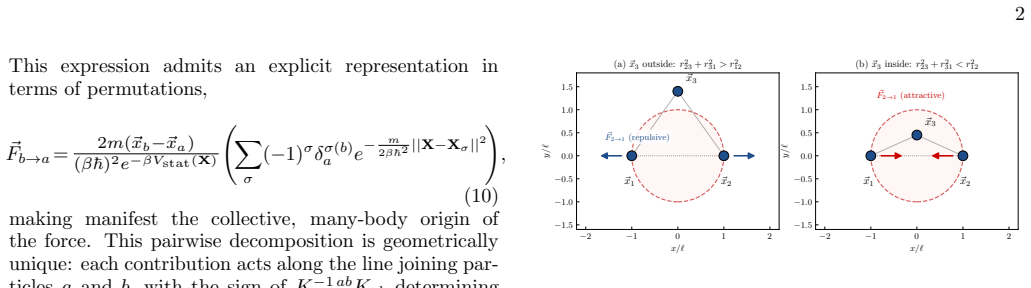
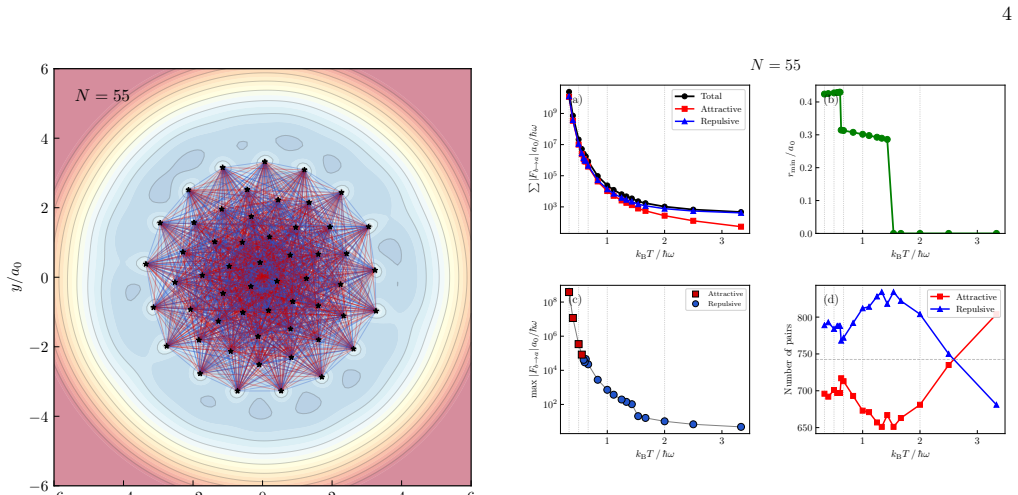
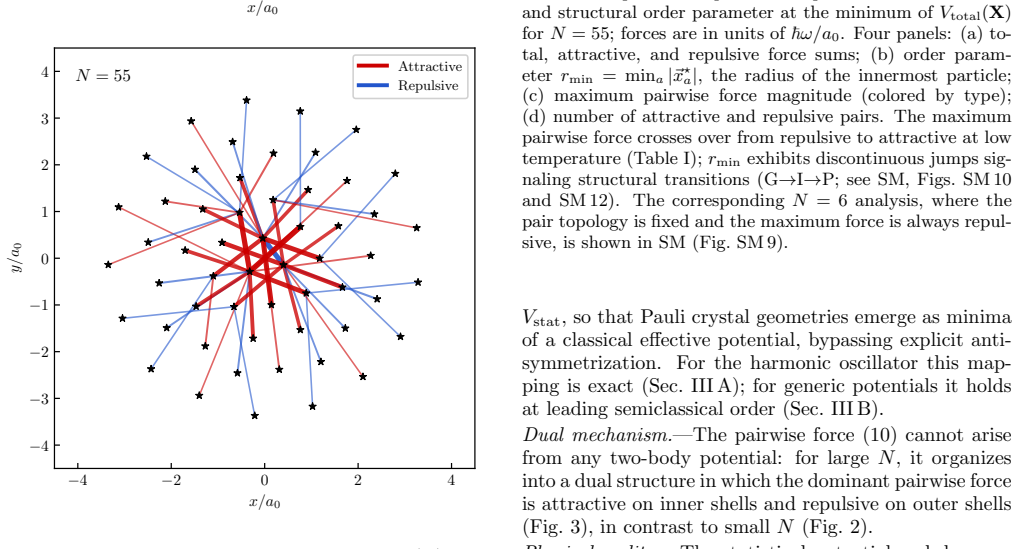
We show that the thermodynamics of N identical fermions maps onto that of distinguishable particles governed by a collective statistical potential -- the microscopic origin of degeneracy pressure. Known to be purely repulsive for N=2, this potential develops attractive contributions for N≥3. Its minima coincide with Pauli crystal configurations, providing the energetic origin of these structures. For large N, the dominant force is attractive on inner shells and repulsive on outer ones -- not of two-body origin. The global minimum undergoes discrete melting transitions at specific temperatures.
What carries the argument
Collective statistical potential: a single effective potential for distinguishable particles that encodes the entire thermodynamic effect of fermion antisymmetrization and generates both repulsion and attraction depending on particle number.
If this is right
- Pauli crystals appear as the energetic minima of the effective potential, explaining their stability without extra interactions.
- For large N the potential produces net attraction among inner particles and repulsion among outer ones, automatically generating shell structure.
- The lowest-energy configuration changes through discrete jumps as temperature rises, implying a series of melting transitions.
- Degeneracy pressure is recovered as the repulsive part of the same potential that also creates the attractions.
Where Pith is reading between the lines
- Classical molecular-dynamics simulations using this potential could reproduce fermion thermodynamics for system sizes where direct quantum calculations remain intractable.
- The same mapping procedure might be applied to bosons or to particles with mixed statistics to test whether emergent attractions appear in those cases as well.
- If the potential minima remain robust under weak perturbations, the approach could be used to predict crystal formation in trapped ultracold Fermi gases.
Load-bearing premise
The full thermodynamics of the quantum fermionic system can be reproduced exactly by classical distinguishable particles interacting only through the derived statistical potential, with no residual quantum corrections required.
What would settle it
Compute the exact quantum partition function for N=3 fermions in a harmonic trap and compare it to the classical partition function obtained from the statistical potential; any systematic deviation at finite temperature would falsify the exact mapping.
Figures


read the original abstract
We show that the thermodynamics of $N$ identical fermions maps onto that of distinguishable particles governed by a collective statistical potential -- the microscopic origin of degeneracy pressure. Known to be purely repulsive for ${N=2}$, this potential develops attractive contributions for ${N\geq 3}$. Its minima coincide with Pauli crystal configurations, providing the energetic origin of these structures. For large $N$, the dominant force is attractive on inner shells and repulsive on outer ones -- not of two-body origin. The global minimum undergoes discrete melting transitions at specific temperatures.
Editorial analysis
A structured set of objections, weighed in public.
Referee Report
Summary. The manuscript claims that the thermodynamics of N identical fermions maps exactly onto distinguishable particles interacting via a single collective statistical potential V_stat, which is the microscopic origin of degeneracy pressure. For N=2 this potential is purely repulsive, but for N≥3 it develops attractive contributions whose minima coincide with Pauli crystal configurations. For large N the dominant forces are attractive on inner shells and repulsive on outer shells (not of two-body origin), and the global minimum undergoes discrete melting transitions at specific temperatures.
Significance. If the mapping is exact, T-independent, and free of post-hoc adjustments or truncated exchange terms, the result would supply a classical effective-potential picture of fermionic statistics, degeneracy pressure, and the energetic stabilization of Pauli crystals. The emergence of attraction for N≥3 purely from the antisymmetrization requirement, together with the shell-dependent force structure, would be a notable conceptual contribution to statistical mechanics of identical particles.
major comments (2)
- [Derivation of the collective statistical potential] The central claim rests on an exact equivalence between the fermionic partition function (sum over antisymmetric states) and the classical partition function ∫ d{r_i} exp(−β V_stat({r_i})) for distinguishable particles. The derivation of V_stat for N≥3 must be shown explicitly (including all exchange terms) to confirm that V_stat is strictly T-independent and contains no hidden temperature dependence or truncation; otherwise the reported attractive wells and their coincidence with Pauli-crystal geometries become effective rather than exact.
- [Pauli crystal minima and large-N shell structure] The assertion that minima of V_stat coincide with Pauli crystal configurations (and thereby provide their energetic origin) requires explicit numerical or analytic minimization of V_stat for at least N=3 and N=4, followed by direct comparison of the resulting geometries to the known nodal surfaces or probability maxima of the corresponding antisymmetric wave functions.
minor comments (2)
- The abstract states that the global minimum undergoes discrete melting transitions, but the main text should define the order parameter or observable (e.g., specific heat, pair-correlation function, or shell occupancy) used to identify these transitions and report the temperatures at which they occur.
- Notation for the collective potential V_stat({r_i}) should be introduced with an explicit functional form or integral expression early in the text, and any relation to prior constructions of statistical potentials (e.g., via Slater determinants or high-T expansions) should be referenced.
Simulated Author's Rebuttal
We thank the referee for the positive assessment of the significance of our work and for the detailed comments that will help improve the manuscript. We respond to the major comments below and plan to submit a revised version incorporating the suggested additions.
read point-by-point responses
-
Referee: The central claim rests on an exact equivalence between the fermionic partition function (sum over antisymmetric states) and the classical partition function ∫ d{r_i} exp(−β V_stat({r_i})) for distinguishable particles. The derivation of V_stat for N≥3 must be shown explicitly (including all exchange terms) to confirm that V_stat is strictly T-independent and contains no hidden temperature dependence or truncation; otherwise the reported attractive wells and their coincidence with Pauli-crystal geometries become effective rather than exact.
Authors: The referee correctly notes that an explicit derivation is required for full transparency. In the revised manuscript we will expand Section II to present the complete derivation of V_stat for general N, with the full sum over all permutations (including signs) written out explicitly for the cases N=3 and N=4. This will demonstrate that V_stat is obtained directly from the antisymmetrizer acting on the configuration-space integral and is strictly temperature-independent, with all temperature dependence residing only in the underlying Boltzmann factor and with no truncation of exchange contributions. revision: yes
-
Referee: The assertion that minima of V_stat coincide with Pauli crystal configurations (and thereby provide their energetic origin) requires explicit numerical or analytic minimization of V_stat for at least N=3 and N=4, followed by direct comparison of the resulting geometries to the known nodal surfaces or probability maxima of the corresponding antisymmetric wave functions.
Authors: We will add a dedicated subsection with explicit numerical minimization of V_stat for N=3 and N=4. For N=3 the global minimum is found at the equilateral-triangle geometry; for N=4 it occurs at the tetrahedral arrangement. These coordinates will be compared directly to the probability-density maxima obtained from the corresponding Slater determinants, confirming that the minima of V_stat coincide with the Pauli-crystal configurations. revision: yes
Circularity Check
No significant circularity detected in the derivation chain
full rationale
The paper presents a mapping from the fermionic partition function to an effective classical potential for distinguishable particles. Without access to explicit equations showing that V_stat is defined by fiat to enforce equality (rather than derived from an independent starting point such as the antisymmetrized density matrix or high-T expansion), no reduction by construction can be exhibited. The abstract and skeptic summary describe the mapping as a result to be shown, not as a definitional renaming. Self-citations, if present, are not load-bearing for the central claim per the provided text. The derivation appears self-contained against external benchmarks such as known N=2 repulsion and Pauli exclusion, warranting a score of 0.
Axiom & Free-Parameter Ledger
axioms (2)
- standard math Identical fermions obey Fermi-Dirac statistics and the Pauli exclusion principle
- domain assumption The thermodynamics of N identical fermions can be exactly mapped onto an effective potential for distinguishable particles
invented entities (1)
-
Collective statistical potential
no independent evidence
Lean theorems connected to this paper
-
IndisputableMonolith/Cost/FunctionalEquation.leanwashburn_uniqueness_aczel unclearVstat(β,X)=−β⁻¹ ln Det[exp(−m/2βℏ² (x_a−x_b)²)]_{N×N} (Eq. 1); minima coincide with Pauli crystal configurations
-
IndisputableMonolith/Foundation/AbsoluteFloorClosure.leanreality_from_one_distinction unclearexact mapping for harmonic traps via Mehler kernel; leading semiclassical for generic V (Eqs. 16,19)
Reference graph
Works this paper leans on
-
[1]
M. Gajda, J. Mostowski, T. Sowi´ nski, and M. Za luska- Kotur,Single shot imaging of trapped Fermi gas, EPL 115, 20012 (2016); doi:10.1209/0295-5075/115/20012
-
[2]
D. Rakshit, J. Mostowski, T. Sowi´ nski, M. Za luska- Kotur, and M. Gajda,On the observability of Pauli crys- tals in experiments with ultracold trapped Fermi gases, Sci. Rep.7, 15004 (2017); doi:10.1038/s41598-017-14952- 2
-
[3]
M. Holten, L. Bayha, K. Subramanian, C. Heintze, P. M. Preiss, and S. Jochim,Observation of Pauli Crystals, Phys. Rev. Lett.126, 020401 (2021); doi:10.1103/PhysRevLett.126.020401
-
[4]
Wigner,On the Interaction of Elec- trons in Metals, Phys
E. Wigner,On the Interaction of Elec- trons in Metals, Phys. Rev.46, 1002 (1934); doi:10.1103/PhysRev.46.1002
-
[5]
F. Serwaneet al.,Deterministic Preparation of a Tun- able Few-Fermion System, Science332, 336 (2011); doi:10.1126/science.1201351
-
[6]
S. Murmannet al.,Two Fermions in a Double Well: Exploring a Fundamental Building Block of the Hub- bard Model, Phys. Rev. Lett.114, 080402 (2015); doi:10.1103/PhysRevLett.114.080402
-
[7]
L. W. Cheuket al.,Quantum-Gas Microscope for Fermionic Atoms, Phys. Rev. Lett.114, 193001 (2015); doi:10.1103/PhysRevLett.114.193001
-
[8]
S. Brandstetter, C. Heintze, P. Hill, P. M. Preiss, M. Ga lka, and S. Jochim,Magnifying the Wave Func- tion of Interacting Fermionic Atoms, Phys. Rev. Lett. 135, 103401 (2025); doi:10.1103/wdjr-m2hg
-
[9]
T. de Jongh, J. Verstraten, M. Dixmerias, C. Daix, B. Peaudecerf, and T. Yefsah,Quantum Gas Microscopy of Fermions in the Continuum, Phys. Rev. Lett.134, 183403 (2025); doi:10.1103/PhysRevLett.134.183403
-
[10]
R. Yao, S. Chi, M. Wang, R. J. Fletcher, and M. Zwierlein,Measuring Pair Correlations in Bose and Fermi Gases via Atom-Resolved Mi- croscopy, Phys. Rev. Lett.134, 183402 (2025); doi:10.1103/PhysRevLett.134.183402
-
[11]
D. Ortu˜ no-Gonz´ alez, R. Lin, J. Stefaniak, A. Baumg¨ artner, G. Natale, T. Donner, and R. Chitra, Pauli Crystal Superradiance, Phys. Rev. Lett.136, 083405 (2026); doi:10.1103/g5fp-ws7z
-
[12]
G. E. Uhlenbeck and L. Gropper,The Equation of State of a Non-Ideal Einstein-Bose or Fermi-Dirac Gas, Phys. 6 Rev.41, 79 (1932); doi:10.1103/PhysRev.41.79
-
[13]
Huang,Statistical Mechanics, 2nd ed
K. Huang,Statistical Mechanics, 2nd ed. (Wiley, New York, 1987)
work page 1987
-
[14]
R. P. Feynman and A. R. Hibbs,Quantum Mechanics and Path Integrals(McGraw-Hill, New York, 1965)
work page 1965
-
[15]
H. Kleinert,Path Integrals in Quantum Mechanics, Statistics, Polymer Physics, and Financial Markets, 5th ed. (World Scientific, Singapore, 2009)
work page 2009
-
[16]
On the quantum correction for thermodynamic equ ilibrium,
E. Wigner,On the Quantum Correction For Ther- modynamic Equilibrium, Phys. Rev.40, 749 (1932); doi:10.1103/PhysRev.40.749
-
[17]
J. G. Kirkwood,Quantum Statistics of Almost Classical Assemblies, Phys. Rev.44, 31 (1933); doi:10.1103/PhysRev.44.31
-
[18]
Y. Fujiwara, T. A. Osborn, and S. F. J. Wilk,Wigner- Kirkwood expansions, Phys. Rev. A25, 14 (1982); doi:10.1103/PhysRevA.25.14
-
[19]
J. Xiang, P. Molignini, M. B¨ uttner, and A. U. J. Lode,Pauli crystal melting in shaken optical traps, SciPost Phys.14, 003 (2023); doi:10.21468/SciPostPhys.14.1.003
-
[20]
J.-H. Park and S. W. Kim,Thermodynamic in- stability and first-order phase transition in an ideal Bose gas, Phys. Rev. A81, 063636 (2010); doi:10.1103/PhysRevA.81.063636
-
[21]
W. Cho, S. W. Kim, and J.-H. Park,Two-dimensional Bose-Einstein condensate under pressure, New J. Phys. 17, 013038 (2015); doi:10.1088/1367-2630/17/1/013038
-
[22]
Statistical Potential for Identical Fermions: Emergent Attraction and Pauli Crystal Formation
K. Lee, S. Oh, Y. W. Choi, and J.-H. Park, Code for “Statistical Potential for Identical Fermions: Emergent Attraction and Pauli Crystal Formation” (2026);https: //github.com/Jeong24th/statistical_potential. i Supplemental Material (SM) Statistical Potential for Identical F ermions: Emergent Attraction and Pauli Crystal F ormation Kawon Lee, Sangeun Oh, Y...
work page 2026
-
[23]
EachNexhibits a distinct transition pattern. Fluctuations near transition temperatures reflect competing minima with nearly degenerate energies in the nonconvexV total landscape. xii G. Distance Dependence of the Statistical Force Figure SM 13 shows the distribution of attractive and repulsive pair forces as a function of interparticle distance forN= 55 a...
discussion (0)
Sign in with ORCID, Apple, or X to comment. Anyone can read and Pith papers without signing in.