Recognition: 2 theorem links
· Lean TheoremThermodynamic value of CHSH-induced side-information channels in a Szilard engine
Pith reviewed 2026-05-13 04:55 UTC · model grok-4.3
The pith
CHSH-induced side information in a Szilard engine yields feedback work bounded by mutual information I(X:G) between the thermal microstate and controller bit.
A machine-rendered reading of the paper's core claim, the machinery that carries it, and where it could break.
Core claim
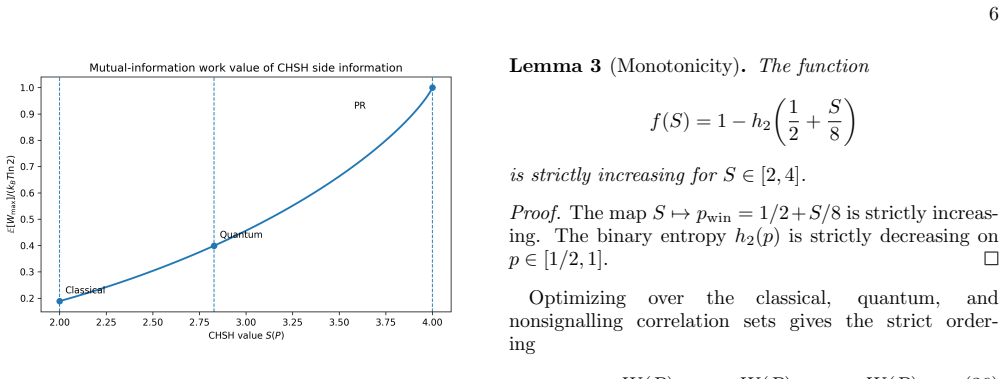
A thermal two-level system supplies a uniformly random physical microstate X, and a trusted referee encoding together with a nonsignalling correlation resource induces a controller bit G that acts as side information about X. The maximal average feedback work satisfies ⟨W_max⟩ ≤ k_B T ln 2 ⋅ I(X:G), with equality achievable in the ideal quasistatic limit. For the CHSH embedding the induced channel X → G is binary symmetric with success probability p_win = 1/2 + S(P)/8, where S(P) is the CHSH value. The corresponding reversible feedback work is k_B T ln 2 ⋅ [1 − h_2(p_win)], yielding a strict ordering of the optimal classical, quantum, and nonsignalling cases.
What carries the argument
The binary symmetric channel from the thermal microstate X to the controller bit G induced by the CHSH correlation resource, with success probability set by the CHSH value S(P).
Load-bearing premise
The controller receives only the compressed bit G while the thermodynamic costs of implementing the referee, the correlation resource, and auxiliary preprocessing are excluded from the accounting.
What would settle it
Measuring the average work extracted in a quasistatic Szilard cycle driven by correlations of known CHSH value S(P) and checking whether the result equals k_B T ln 2 times [1 minus the binary entropy of (1/2 + S(P)/8)].
Figures

read the original abstract
We study the thermodynamic value of side-information channels induced by Bell-type correlations through a CHSH prediction task embedded into a Szilard-type feedback engine. A thermal two-level system supplies a uniformly random physical microstate $X$, and a trusted referee encoding together with a nonsignalling correlation resource induces a controller bit $G$ that acts as side information about $X$. We show that the maximal average feedback work satisfies $\langle W_{\max}\rangle \le k_B T \ln 2 , I(X:G)$, with equality achievable in the ideal quasistatic limit. For the CHSH embedding considered here, the induced channel $X \to G$ is binary symmetric with success probability $p_{\rm win}=1/2+S(P)/8$, where $S(P)$ is the CHSH value. The corresponding reversible feedback work is $k_B T \ln 2 ,[1-h_2(p_{\rm win})]$, yielding a strict ordering of the optimal classical, quantum, and nonsignalling cases. The result should be interpreted as a thermodynamic valuation of CHSH-induced side information available to the controller, not as evidence that Bell nonlocality itself is a source of free energy. The analysis assumes that the controller receives only the compressed bit $G$ and does not include the thermodynamic cost of implementing the referee, the correlation resource, or the auxiliary preprocessing. A full-cycle analysis including controller-memory reset gives non-positive net work, consistent with the second law.
Editorial analysis
A structured set of objections, weighed in public.
Referee Report
Summary. The manuscript embeds a CHSH prediction task into a Szilard feedback engine: a thermal two-level system supplies a uniform random bit X, a trusted referee and nonsignaling correlation resource produce a controller bit G, and the induced channel X→G is shown to be binary-symmetric with success probability p_win=1/2+S(P)/8. The central result is the bound ⟨W_max⟩≤k_B T ln2⋅I(X;G) with quasistatic equality, which for this channel evaluates to k_B T ln2⋅(1−h_2(p_win)), producing a strict ordering of extractable work for classical, quantum, and nonsignaling resources. The authors explicitly note that referee, resource, and preprocessing costs are omitted and that a complete cycle with memory reset yields non-positive net work.
Significance. If the derivation holds, the paper supplies a concrete, parameter-free thermodynamic valuation of CHSH-induced side information within an established information-thermodynamic framework. It demonstrates that the CHSH value directly parametrizes the reversible work extractable from the induced BSC without introducing new free-energy sources, and the full-cycle non-positivity result reinforces consistency with the second law. The work therefore offers a clean bridge between Bell-game resource theory and feedback thermodynamics while avoiding over-interpretation of nonlocality as a work resource.
minor comments (3)
- [§2] §2, paragraph following Eq. (3): the encoding map from the CHSH game outputs to the physical bit G is described only in prose; an explicit 2×2 table or circuit diagram would eliminate ambiguity about which measurement outcomes are mapped to which controller bit.
- [Eq. (7)] Eq. (7) and the sentence immediately below: the quasistatic equality is stated to hold 'in the ideal limit,' but the precise conditions on the feedback protocol (e.g., slow variation of the potential or infinite-time limit) are not restated here; a one-sentence reminder referencing the standard Szilard derivation would improve readability.
- [Figure 1] Figure 1 caption and §4.2: the plotted curves for classical, quantum, and PR-box cases are not labeled with the corresponding CHSH values (S=2, 2√2, 4); adding these labels would make the ordering immediately visible without consulting the text.
Simulated Author's Rebuttal
We thank the referee for their careful reading, positive summary, and recommendation of minor revision. The report accurately captures the manuscript's scope and conclusions. No specific major comments were raised, so we have no points requiring detailed rebuttal or revision at this stage. We will address any minor editorial suggestions in the revised version.
Circularity Check
No significant circularity detected
full rationale
The derivation applies the standard thermodynamic bound ⟨W_max⟩ ≤ k_B T ln 2 ⋅ I(X:G) (with quasistatic equality) to the binary-symmetric channel induced by embedding a CHSH prediction task into the Szilard engine. The channel parameter p_win = 1/2 + S(P)/8 follows directly from the definition of the CHSH correlator S(P) under the stated encoding, and I(X:G) = 1 − h_2(p_win) is the exact mutual information for that BSC; neither quantity is fitted inside the paper nor defined in terms of the work bound itself. No self-citations, uniqueness theorems, or ansatzes from prior work by the same authors are invoked as load-bearing steps, and the manuscript explicitly flags omitted costs and second-law consistency. The central claim therefore remains independent of its own outputs.
Axiom & Free-Parameter Ledger
axioms (2)
- domain assumption Maximal average feedback work in a Szilard-type engine is bounded by k_B T ln 2 ⋅ I(X:G) with equality in the quasistatic limit
- domain assumption The CHSH value S(P) determines the winning probability of the embedded game via p_win = 1/2 + S(P)/8
Lean theorems connected to this paper
-
IndisputableMonolith/Cost/FunctionalEquation.leanwashburn_uniqueness_aczel unclear?
unclearRelation between the paper passage and the cited Recognition theorem.
E[W_max] = k_B T ln 2 [1 - h_2(1/2 + S(P)/8)] (Theorem 3)
-
IndisputableMonolith/Foundation/RealityFromDistinction.leanreality_from_one_distinction unclear?
unclearRelation between the paper passage and the cited Recognition theorem.
full-cycle net work W_net ≤ -k_B T ln 2 H(G|X) ≤ 0 (Theorem 4)
What do these tags mean?
- matches
- The paper's claim is directly supported by a theorem in the formal canon.
- supports
- The theorem supports part of the paper's argument, but the paper may add assumptions or extra steps.
- extends
- The paper goes beyond the formal theorem; the theorem is a base layer rather than the whole result.
- uses
- The paper appears to rely on the theorem as machinery.
- contradicts
- The paper's claim conflicts with a theorem or certificate in the canon.
- unclear
- Pith found a possible connection, but the passage is too broad, indirect, or ambiguous to say the theorem truly supports the claim.
Reference graph
Works this paper leans on
-
[1]
(31) =k BTln 2I(X:G).(32) Theorem 2(Achievability).The information-to-work bound of Theorem 1 is tight in the ideal reversible feedback limit. It is achieved by the branch protocol in which the conditional Hamiltonian assignment and the quasistatic isothermal return are both included in the branch work balance. D. Reversible computation of the controller ...
work page 2021
-
[2]
Szil´ ard, Zeitschrift f¨ ur Physik53, 840 (1929)
L. Szil´ ard, Zeitschrift f¨ ur Physik53, 840 (1929)
work page 1929
- [3]
- [4]
-
[5]
J. F. Clauser, M. A. Horne, A. Shimony, and R. A. Holt, Physical Review Letters23, 880 (1969)
work page 1969
-
[6]
B. S. Tsirelson, Letters in Mathematical Physics4, 93 (1980)
work page 1980
- [7]
-
[8]
M. Paw lowski, T. Paterek, D. Kaszlikowski, V. Scarani, A. Winter, and M. ˙Zukowski, Nature461, 1101 (2009)
work page 2009
-
[9]
M. Navascu´ es and H. Wunderlich, Proceedings of the Royal Society A466, 881 (2010)
work page 2010
- [10]
-
[11]
P. Skrzypczyk, A. J. Short, and S. Popescu, Nature Com- munications5, 4185 (2014)
work page 2014
-
[12]
M. Brunelli, M. A. Ciampini, P. Mataloni, and V. Gio- vannetti, npj Quantum Information4, 26 (2018), arXiv:1601.06796, arXiv:1601.06796 [quant-ph]
- [13]
- [14]
-
[15]
Battery-Explicit Energetic Witnesses of CHSH Post-Quantumness
P. ´Cwikli´ nski, Battery-explicit energetic witnesses of chsh post-quantumness (2026), arXiv:2605.09149 [quant-ph]
work page internal anchor Pith review Pith/arXiv arXiv 2026
-
[16]
J. M. R. Parrondo, J. M. Horowitz, and T. Sagawa, Na- ture Physics11, 131 (2015)
work page 2015
- [17]
- [18]
-
[19]
G. E. Crooks, Phys. Rev. Lett.99, 100602 (2007)
work page 2007
- [20]
discussion (0)
Sign in with ORCID, Apple, or X to comment. Anyone can read and Pith papers without signing in.