Recognition: 2 theorem links
· Lean TheoremA Phenomenological Study of Semileptonic B^+ and B_s⁰ Decays into Axial-Vector Mesons big(D₁(2420),\, D₁^prime(2430),\, D_{s1}(2460),\, and D_{s1}^prime(2536)big) within the Standard Model
Pith reviewed 2026-05-13 05:03 UTC · model grok-4.3
The pith
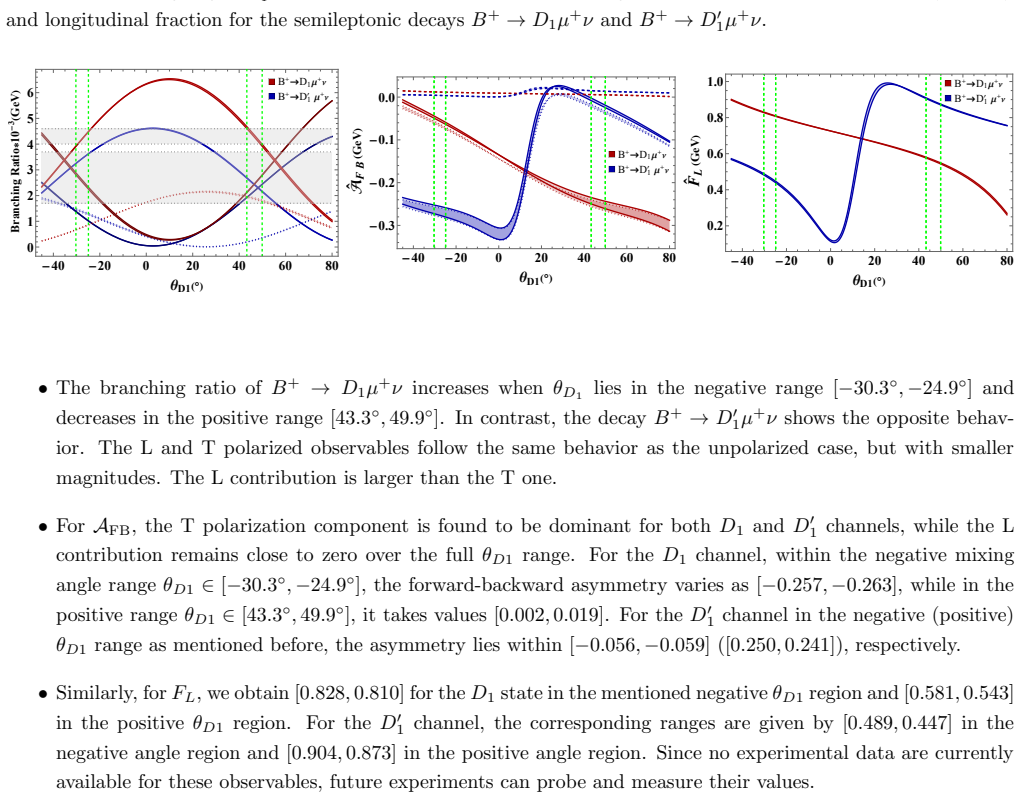
Branching ratios in semileptonic B decays to axial-vector mesons vary with the mixing angle between light angular momentum states.
A machine-rendered reading of the paper's core claim, the machinery that carries it, and where it could break.
Core claim
Treating the axial-vector mesons as mixtures of j_ℓ=1/2 and j_ℓ=3/2 states parametrized by the mixing angle θ_D1 and using form factors from the covariant light-front quark model, the analysis finds that polarized and unpolarized branching ratios, the lepton forward-backward asymmetry, the longitudinal polarization fraction, and lepton flavor universality ratios all depend on θ_D1. Predictions are given for both muon and tau modes over experimentally motivated and broader ranges of the mixing angle, together with correlations among the observables.
What carries the argument
The mixing angle θ_D1 that parametrizes the admixture of the j_ℓ=1/2 and j_ℓ=3/2 heavy-quark basis states inside the axial-vector meson wave functions.
If this is right
- Branching ratios for the listed decays change appreciably with the mixing angle.
- The lepton forward-backward asymmetry and longitudinal polarization fraction supply independent information on the mixing.
- Lepton flavor universality ratios stay near one but still vary with the mixing angle.
- Correlations between observables can help isolate the value of the mixing angle.
- The computed values serve as Standard Model benchmarks for comparison with data from future B-factory and LHCb measurements.
Where Pith is reading between the lines
- Confirmation of a specific mixing angle from these channels would give a direct experimental handle on the 1/2 versus 3/2 composition of the excited charm mesons.
- The same mixing description could be tested for consistency in other heavy-meson decay modes not studied here.
- Deviations from the predicted correlations among observables could indicate contributions beyond the Standard Model.
Load-bearing premise
The form factors taken from the covariant light-front quark model correctly describe transitions to these axial-vector states, and the single mixing angle captures the dominant distinction between the two classes of states.
What would settle it
A measurement of the branching ratio for B+ to D1(2420) muon neutrino that lies outside the full range of values computed for every possible mixing angle would show that the dependence on mixing does not hold.
Figures



read the original abstract
We study semileptonic $B$ meson decays $B^+ \to D_1^{(\prime)}\ell^+\nu_\ell$ and $B_s^0 \to D_{s1}^{-(\prime)}\ell^+\nu_\ell$, where $\ell=\mu,\tau$. The final state axial vector mesons are treated as mixtures of the heavy quark basis states with light degree of freedom angular momenta $j_\ell=1/2$ and $j_\ell=3/2$, parametrized by the mixing angle $\theta_{D_1}$. Using form factors obtained in the covariant light front quark model, we analyze the dependence of various observables on $\theta_{D_1}$ such as polarized and unpolarized branching ratios, the lepton forward-backward asymmetry, the longitudinal polarization fraction, and the lepton flavor universality ratios. In addition, we also discuss correlations among different observables. We study these observables in the experimentally motivated mixing angle regions as well as over a wider range of $\theta_{D_1}$. Our results show that branching ratios and other observables are sensitive to the axial-vector mixing structure. These predictions provide useful Standard Model benchmarks for future measurements of semileptonic $B_{(s)}$ decays into orbitally excited mesons and may help to clarify the long standing $1/2$ vs. $3/2$ puzzle in semileptonic $B$ decays.
Editorial analysis
A structured set of objections, weighed in public.
Referee Report
Summary. The paper performs a phenomenological analysis of semileptonic B^+ → D_1^{(′)} ℓ^+ ν_ℓ and B_s^0 → D_{s1}^{-(′)} ℓ^+ ν_ℓ decays (ℓ = μ, τ) in the Standard Model. Axial-vector final states are treated as mixtures of j_ℓ = 1/2 and j_ℓ = 3/2 heavy-quark basis states parametrized by a single mixing angle θ_{D1}. Form factors are taken from the covariant light-front quark model (CLFQM) and linearly combined according to the mixing; the resulting observables (unpolarized and polarized branching ratios, forward-backward asymmetry A_FB, longitudinal polarization fraction F_L, lepton-flavor-universality ratios, and correlations among them) are computed as functions of θ_{D1} over both experimentally motivated and wider ranges.
Significance. If the CLFQM form factors remain reliable after mixing, the explicit mapping of observables onto θ_{D1} supplies concrete SM benchmarks that can be confronted with future LHCb and Belle II data, potentially helping to resolve the long-standing 1/2-versus-3/2 puzzle. The correlation plots between different observables add practical value for experimental design. The approach is standard for phenomenological studies but inherits the model dependence of the underlying quark-model form factors.
major comments (3)
- [§2] §2 (Form factors): The physical-state form factors are obtained by the linear superposition F^{phys} = cos θ_{D1} F^{1/2} + sin θ_{D1} F^{3/2} using CLFQM results for the pure j_ℓ states; no re-derivation, parameter retuning, or comparison to lattice QCD or QCD sum-rule calculations is performed for the mixed D_1(2420), D_1'(2430), D_{s1}(2460), and D_{s1}'(2536) states. Because the central claim is that observables are sensitive to the mixing and provide robust SM benchmarks, the absence of independent validation for the mixed states is load-bearing.
- [§3.2] §3.2 and Figs. 3–5: Branching ratios and A_FB are presented as functions of θ_{D1} without propagation of the CLFQM model parameters (e.g., the harmonic-oscillator parameter β or constituent quark masses) into uncertainty bands; only the variation with θ_{D1} is shown. This makes it impossible to judge whether the reported sensitivity exceeds the intrinsic model uncertainty.
- [§4] §4 (Discussion): The claim that the results “may help to clarify the long-standing 1/2 vs. 3/2 puzzle” rests on the assumption that the CLFQM mixing prescription captures the dominant effect; no quantitative comparison is made with existing experimental upper limits on the branching fractions or with other theoretical approaches that treat the same final states.
minor comments (3)
- [Abstract and §2] Notation for the mixing angle is inconsistent between the abstract (theta_D1) and the body (θ_{D1}); a uniform symbol should be adopted.
- [Table 1] Table 1 (or equivalent numerical summary) lists central values but omits the reference values of the CLFQM parameters used; these should be stated explicitly for reproducibility.
- [§3.1] The lepton-mass dependence in the τ modes is treated only through the kinematic limits; a brief statement on the size of the τ-mass corrections relative to the μ modes would improve clarity.
Simulated Author's Rebuttal
We thank the referee for the careful reading of our manuscript and the constructive comments. We address each major point below, indicating the revisions we intend to make to strengthen the presentation while remaining within the scope of this phenomenological study.
read point-by-point responses
-
Referee: [§2] §2 (Form factors): The physical-state form factors are obtained by the linear superposition F^{phys} = cos θ_{D1} F^{1/2} + sin θ_{D1} F^{3/2} using CLFQM results for the pure j_ℓ states; no re-derivation, parameter retuning, or comparison to lattice QCD or QCD sum-rule calculations is performed for the mixed D_1(2420), D_1'(2430), D_{s1}(2460), and D_{s1}'(2536) states. Because the central claim is that observables are sensitive to the mixing and provide robust SM benchmarks, the absence of independent validation for the mixed states is load-bearing.
Authors: We agree that independent validation of the mixed-state form factors would be desirable. The linear superposition is the standard phenomenological treatment of the 1/2–3/2 mixing in the heavy-quark basis, as employed in numerous prior studies of these decays. Our focus is the resulting sensitivity of observables to θ_{D1} within the CLFQM. In the revised manuscript we will expand the discussion in §2 to explicitly state the limitations of this approach, cite existing lattice-QCD and QCD-sum-rule results for the physical D_1 and D_{s1} states, and note where our predictions lie relative to those benchmarks. revision: partial
-
Referee: [§3.2] §3.2 and Figs. 3–5: Branching ratios and A_FB are presented as functions of θ_{D1} without propagation of the CLFQM model parameters (e.g., the harmonic-oscillator parameter β or constituent quark masses) into uncertainty bands; only the variation with θ_{D1} is shown. This makes it impossible to judge whether the reported sensitivity exceeds the intrinsic model uncertainty.
Authors: The referee is correct that we have not displayed uncertainty bands arising from variation of the CLFQM parameters. The figures were constructed to isolate the dependence on the mixing angle. In the revision we will add a dedicated paragraph in §3.2 that quotes the typical ranges of β and constituent masses used in the CLFQM literature, estimates the resulting spread in branching ratios and A_FB, and shows that the variation with θ_{D1} over the experimentally motivated interval remains larger than this model uncertainty for the key observables. revision: partial
-
Referee: [§4] §4 (Discussion): The claim that the results “may help to clarify the long-standing 1/2 vs. 3/2 puzzle” rests on the assumption that the CLFQM mixing prescription captures the dominant effect; no quantitative comparison is made with existing experimental upper limits on the branching fractions or with other theoretical approaches that treat the same final states.
Authors: We acknowledge that direct numerical comparisons would improve the discussion. In the revised §4 we will insert a table (or set of plots) that confronts our predictions for representative values of θ_{D1} with the existing experimental upper limits on the relevant branching fractions and with selected results from other approaches (light-cone sum rules, relativistic quark models). This will allow readers to assess how the θ_{D1} dependence relates to the 1/2-versus-3/2 puzzle. revision: yes
- A complete re-derivation of the form factors directly for the physical mixed states inside the CLFQM or a dedicated lattice-QCD calculation of those form factors, both of which lie outside the phenomenological scope of the present work.
Circularity Check
No significant circularity; model inputs treated as external
full rationale
The derivation takes form factors for the j_ℓ=1/2 and j_ℓ=3/2 basis states directly from the covariant light-front quark model (cited as prior literature) and forms linear combinations via the external mixing angle θ_D1, which is varied over motivated ranges rather than fitted to the target observables. Branching ratios, asymmetries, and ratios are then computed from these combinations; none of the reported predictions reduce by construction to a re-fit of the same inputs or to a self-citation chain that itself lacks independent support. The paper remains a standard model-dependent phenomenological study whose central sensitivity claim follows directly from the linear mixing ansatz without circular redefinition.
Axiom & Free-Parameter Ledger
free parameters (1)
- mixing angle theta_D1
axioms (1)
- domain assumption Form factors computed in the covariant light-front quark model are reliable for these semileptonic transitions.
Lean theorems connected to this paper
-
IndisputableMonolith/Foundation/DimensionForcing.leanalexander_duality_circle_linking unclear?
unclearRelation between the paper passage and the cited Recognition theorem.
The physical axial-vector states are obtained from the mixing of the j_ℓ=1/2 and j_ℓ=3/2 basis states, parametrized by a single mixing angle θ_D1
What do these tags mean?
- matches
- The paper's claim is directly supported by a theorem in the formal canon.
- supports
- The theorem supports part of the paper's argument, but the paper may add assumptions or extra steps.
- extends
- The paper goes beyond the formal theorem; the theorem is a base layer rather than the whole result.
- uses
- The paper appears to rely on the theorem as machinery.
- contradicts
- The paper's claim conflicts with a theorem or certificate in the canon.
- unclear
- Pith found a possible connection, but the passage is too broad, indirect, or ambiguous to say the theorem truly supports the claim.
Reference graph
Works this paper leans on
-
[1]
Observable for the decay ofB + →D 1ℓ+νℓ. FIG. 3: The polarized and unpolarized branching ratio, lepton forward backward asymmetry, and the longitudinal fraction as a function ofq 2 forB + →D 1µ+νtransition. dβ/dq2 dβL/dq2 dβT/dq2 0 2 4 6 8 0.0 0.2 0.4 0.6 0.8 1.0 1.2 q2[GeV2] dβ(B+D1μ+ν)/dq2×10-4 ℓ=μ, θD1 = [-30.3°, -24.9°] (a) FB FBL FBT 0 2 4 6 8 -0...
-
[2]
Observable for the decay ofB + →D ′ 1ℓ+νℓ. FIG. 5: The polarized and unpolarized branching ratio, lepton forward backward asymmetry, and the longitudinal fraction as a function ofq 2 forB + →D ′ 1µ+νtransition. dβ/dq2 dβL/dq2 dβT/dq2 0 2 4 6 8 0.0 0.1 0.2 0.3 0.4 0.5 q2[GeV2] dβ(B+D1 ′ μ+ν)/dq2×10-4 ℓ=μ, θD1 = [-30.3°, -24.9°] (a) FB FBL FBT 0 2 4 6 8...
-
[3]
Observable for the decay ofB 0 s →D − s1ℓ+νℓ. FIG. 7: The polarized and unpolarized branching ratio, lepton forward backward asymmetry, and the longitudinal fraction as a function ofq 2 forB + →D s1µ+νtransition. dβ/dq2 dβL/dq2 dβT/dq2 0 2 4 6 8 0.0 0.2 0.4 0.6 0.8 1.0 1.2 1.4 q2[GeV2] dβ(Bs 0Ds1 - μ+ν)/dq2×10-4 ℓ=μ, θD1 = [-30.3°, -24.9°] (a) FB FBL ...
-
[4]
Observable for the decay ofB 0 s →D −′ s1 ℓ+νℓ. FIG. 9: The polarized and unpolarized branching ratio, lepton forward backward asymmetry, and the longitudinal fraction as a function ofq 2 forB + →D ′ s1µ+νtransition. dβ/dq2 dβL/dq2 dβT /dq2 0 2 4 6 8 0.0 0.1 0.2 0.3 0.4 0.5 q2[GeV2] dβ(Bs 0Ds1 ′-μ+ν)/dq2×10-4 ℓ=μ, θD1 = [-30.3°, -24.9°] (a) FB FBL FBT...
-
[5]
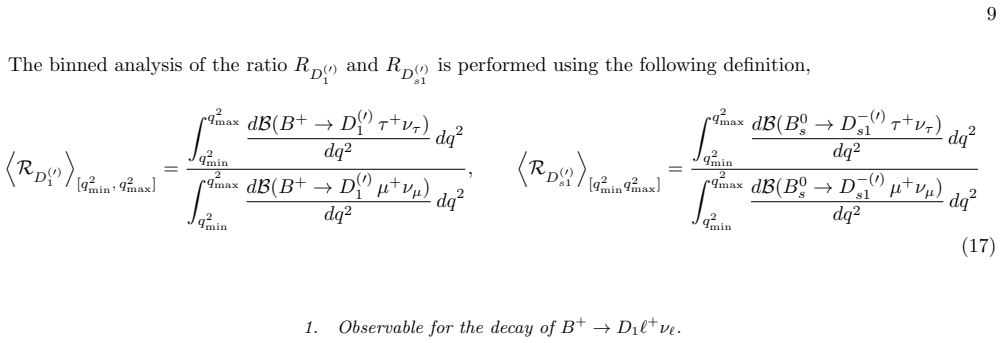
Therefore, in this work, we extend the study ofR D(′) 1 andR D(′) s1 observables define in Eq
The Ratio of Branching Fraction Ratios of branching fractions such asR (D) [79–81] andR (D∗) [80, 82, 83] have been studied in both experimental and theoretical literature as sensitive probes of LFU [84–87]. Therefore, in this work, we extend the study ofR D(′) 1 andR D(′) s1 observables define in Eq. (12) as a complementary check on LFU. 17 FIG. 11: The ...
-
[6]
D. Becirevic, A. Le Yaouanc, L. Oliver, J.-C. Raynal, P. Roudeau, and J. Serrano,Proposal to studyB s → ¯DsJ transitions,Phys. Rev. D87(2013), no. 5 054007, [arXiv:1206.5869]
- [7]
-
[8]
N. Alomayrah, J. S. Alzahrani, and M. S. Al-Buriahi,Study on the semileptonic transition ofB s →D s2(2900)ℓνℓ in QCD: Promising case for the standard model,Nucl. Phys. A1027(2022) 122512
work page 2022
-
[9]
T. Barakat,The semi-leptonicB s →D s2ℓνℓ transition to tensor meson of negative parity in the QCD sum rules approach,Nucl. Phys. B983(2022) 115915
work page 2022
-
[10]
C.-W. Hwang and Z.-T. Wei,Covariant light-front approach for heavy quarkonium: decay constants,P→γγand V→P γ,J. Phys. G34(2007) 687–702, [hep-ph/0609036]
- [11]
- [12]
- [13]
- [14]
- [15]
-
[16]
F.-L. Wang, X.-L. Chen, D.-H. Lu, S.-L. Zhu, and W.-Z. Deng,Decays ofD ∗ sj(2317)andD sj(2460)Mesons in the Quark Model,HEPNP30(2006) 1041–1047, [hep-ph/0604090]
- [17]
-
[18]
Y.-Y. Yang, Z.-Q. Zhang, and H. Yang,SemileptonicB (s) meson decays toD ∗ 0(2300),D ∗ s0(2317),D s1(2460),D s1(2536), D1(2420), andD 1(2430)within the covariant light-front approach,Phys. Rev. D111(2025), no. 7 076006
work page 2025
-
[19]
S. Godfrey and N. Isgur,Mesons in a Relativized Quark Model with Chromodynamics,Phys. Rev. D32(1985) 189–231
work page 1985
-
[20]
S. Godfrey and R. Kokoski,The Properties of p Wave Mesons with One Heavy Quark,Phys. Rev. D43(1991) 1679–1687. [16]BelleCollaboration, K. Abe et al.,Study ofB→D ∗∗ 0 π−(D∗∗ 0 →D (∗)+π−)decays,Phys. Rev. D69(2004) 112002, [hep-ex/0307021]. [17]BaBarCollaboration, B. Aubert et al.,Dalitz Plot Analysis ofB − →D +π−π−,Phys. Rev. D79(2009) 112004, [arXiv:0901.1291]
- [21]
-
[22]
V. Morenas, A. Le Yaouanc, L. Oliver, O. Pene, and J. C. Raynal,Quantitative predictions for B semileptonic decays into D, D* and the orbitally excited D** in quark models a la Bakamjian-Thomas,Phys. Rev. D56(1997) 5668–5680, [hep-ph/9706265]
-
[23]
D. Scora and N. Isgur,Semileptonic meson decays in the quark model: An update,Phys. Rev. D52(1995) 2783–2812, [hep-ph/9503486]
-
[24]
P. Colangelo, F. De Fazio, and N. Paver,Universalτ 1/2(y)Isgur–Wise function at the next-to-leading order in QCD sum rules,Phys. Rev. D58(1998) 116005, [hep-ph/9804377]
-
[25]
F.-W. Zhang and Z.-X. Zhao,Weak decays of singly heavy baryons: the1/2→3/2case, [arXiv:2508.13648]. [23]BelleCollaboration, F. Meier et al.,First observation ofB→ ¯D1(→ ¯Dπ+π−)ℓ+νℓ and measurement of the B→ ¯D(∗)πℓ+νℓ andB→ ¯D(∗)π+π−ℓ+νℓ branching fractions with hadronic tagging at Belle,Phys. Rev. D107(2023), no. 9 092003, [arXiv:2211.09833]
- [26]
-
[27]
J. Hofmann and M. F. M. Lutz,Open charm meson resonances with negative strangeness,Nucl. Phys. A733(2004) 142–152, [hep-ph/0308263]
-
[28]
H.-Y. Cheng and W.-S. Hou,B decays as spectroscope for charmed four quark states,Phys. Lett. B566(2003) 193–200, [hep-ph/0305038]
- [29]
- [30]
- [31]
-
[32]
Y.-Q. Chen and X.-Q. Li,A Comprehensive Four-Quark Interpretation ofD s(2317),D s(2457)andD s(2632),Phys. Rev. Lett.93(2004) 232001, [hep-ph/0407062]
- [33]
- [34]
- [35]
- [36]
-
[37]
Z.-G. Wang and S.-L. Wan,D s0(2317)as a tetraquark state with QCD sum rules in the heavy quark limit,Nucl. Phys. A 778(2006) 22–29, [hep-ph/0602080]
-
[38]
J. Vijande, F. Fernandez, and A. Valcarce,Open-charm meson spectroscopy,Phys. Rev. D73(2006) 034002, [hep-ph/0601143]. [Erratum: Phys.Rev.D 74, 059903 (2006)]
- [39]
- [40]
-
[41]
c.-J. Xiao, D.-Y. Chen, and Y.-L. Ma,Radiative and pionic transitions from theD s1(2460)to theD ∗ s0(2317),Phys. Rev. D93(2016), no. 9 094011, [arXiv:1601.06399]
-
[42]
W. Wang, Y.-L. Shen, and C.-D. Lu,The study ofB − c →X(3872)π −(K −)decays in the covariant light-front approach, Eur. Phys. J. C51(2007) 841–847, [arXiv:0704.2493]
-
[43]
H.-Y. Cheng, C.-K. Chua, and C.-W. Hwang,Covariant light front approach for s wave and p wave mesons: Its application to decay constants and form-factors,Phys. Rev. D69(2004) 074025, [hep-ph/0310359]
-
[44]
Y.-Y. Yang, Z.-Q. Zhang, H. Yang, Z.-J. Sun, and M.-X. Xie,Study ofB (s) meson decays toD ∗ 0(2300),D ∗ s0(2317), Ds1(2460)andD s1(2536)within the covariant light-front approach,Phys. Rev. D110(2024), no. 3 033006, [arXiv:2405.00496]
-
[45]
H.-Y. Cheng and C.-K. Chua,Covariant Light-Front Approach forB→K ∗γ,K 1γ,K ∗ 2 γDecays,Phys. Rev. D69 (2004) 094007, [hep-ph/0401141]. [Erratum: Phys.Rev.D 81, 059901 (2010)]
- [46]
-
[47]
Wuenqi, R.-H. Li, and Z.-X. Zhao,Semileptonic and nonleptonic ¯Bs →D sJ decays in covariant light-front approach, Eur. Phys. J. C85(2025), no. 9 1023, [arXiv:2504.15056]
-
[48]
Cheng,Hadronic B decays involving even parity charmed mesons,Phys
H.-Y. Cheng,Hadronic B decays involving even parity charmed mesons,Phys. Rev. D68(2003) 094005, [hep-ph/0307168]
-
[49]
Y.-b. Dai and M.-q. Huang,Semileptonic B decays into excited charmed mesons from QCD sum rules,Phys. Rev. D59 (1999) 034018, [hep-ph/9807461]
-
[50]
M.-q. Huang and Y.-b. Dai,Subleading Isgur–Wise form factors andO(1/m Q)corrections to the semileptonic decays B→D 1ℓ¯νandB→D ∗ 2 ℓ¯ν,Phys. Rev. D64(2001) 014034, [hep-ph/0102299]
- [51]
-
[52]
N. Gubernari, A. Khodjamirian, R. Mandal, and T. Mannel,B→D 1(2420)andB→D ′ 1(2430)form factors from QCD light-cone sum rules,JHEP05(2022) 029, [arXiv:2203.08493]
- [53]
- [54]
- [55]
-
[56]
F. U. Bernlochner, Z. Ligeti, and S. Turczyk,New ways to search for right-handed currents,Phys. Rev. D96(2017) 091503
work page 2017
- [57]
- [58]
-
[59]
T. Yasmeen, I. Ahmed, S. Shafaq, M. Arslan, and M. J. Aslam,Probing New Physics in Light of Recent Developments in b→cℓv Transitions,PTEP2024(2024), no. 7 073B07, [arXiv:2401.02334]
-
[60]
R. Dutta and N. Rajeev,Signature of lepton flavor universality violation inB s →D sτ νsemileptonic decays,Phys. Rev. D97(2018), no. 9 095045, [arXiv:1803.03038]
- [61]
-
[62]
Y. Sakaki, M. Tanaka, A. Tayduganov, and R. Watanabe,Testing leptoquark models in ¯B→D (∗)τ¯ν,Phys. Rev. D88 (2013), no. 9 094012, [arXiv:1309.0301]. [61]F ermilab Lattice, MILCCollaboration, J. A. Bailey et al.,Update of|V cb|from the ¯B→D ∗ℓ¯νform factor at zero recoil with three-flavor lattice QCD,Phys. Rev. D89(2014), no. 11 114504, [arXiv:1403.0635]
-
[63]
Z. Ligeti, M. Papucci, and D. J. Robinson,New Physics in the Visible Final States ofB→D (∗)τ ν,JHEP01(2017) 083, [arXiv:1610.02045]. [63]BelleCollaboration, A. Abdesselam et al.,Measurement of theD ∗− polarization in the decayB 0 →D ∗−τ +ντ, in10th International Workshop on the CKM Unitarity Triangle, 3, 2019.arXiv:1903.03102. [64]BelleCollaboration, A. A...
- [64]
-
[65]
P. Colangelo and F. De Fazio,Tension in the inclusive versus exclusive determinations of|V cb|: a possible role of new physics,Phys. Rev. D95(2017), no. 1 011701, [arXiv:1611.07387]
- [66]
- [67]
- [68]
-
[69]
Wei et al.,Dark matter search with a resonantly-coupled hybrid spin system,Rept
K. Wei et al.,Dark matter search with a resonantly-coupled hybrid spin system,Rept. Prog. Phys.88(2025), no. 5 057801, [arXiv:2306.08039]
-
[70]
S. Karmakar, S. Chattopadhyay, and A. Dighe,Identifying physics beyond SMEFT in the angular distribution of Λb →Λ c(→Λπ)τ¯ντdecay,Phys. Rev. D110(2024), no. 1 015010, [arXiv:2305.16007]
-
[71]
J.-H. Sheng, Q.-Y. Hu, R.-M. Wang, and J. Zhu,Phenomenology analysis of ¯B∗ →V τ −¯ντ decays in and beyond the Standard Model,Eur. Phys. J. C82(2022), no. 8 768
work page 2022
- [72]
- [73]
- [74]
-
[75]
S. Zafar, Q. M. U. Salam, R. Khan, I. Ahmed, and R. Khalid,Chirality structure of vector like new physics operators in charged current transitions,Eur. Phys. J. Plus140(2025), no. 12 1167, [arXiv:2507.23721]. [78]Particle Data GroupCollaboration, S. Navas et al.,Review of particle physics,Phys. Rev. D110(2024), no. 3 030001
-
[76]
D. Bigi and P. Gambino,RevisitingB→Dℓν,Phys. Rev. D94(2016), no. 9 094008, [arXiv:1606.08030]
-
[77]
F. U. Bernlochner, Z. Ligeti, M. Papucci, and D. J. Robinson,Combined analysis of semileptonicbdecays todandD ∗: r(D(∗)),|V cb|, and new physics,Phys. Rev. D95(Jun, 2017) 115008
work page 2017
-
[78]
S. Jaiswal, S. Nandi, and S. K. Patra,Extraction of|V cb|fromB→D (∗)ℓνℓ and the Standard Model predictions of R(D(∗)),JHEP12(2017) 060, [arXiv:1707.09977]
-
[79]
S. Jaiswal, S. Nandi, and S. K. Patra,Updates on extraction of|V cb|and SM prediction ofR(D ∗)inB→D ∗ℓνℓ decays, JHEP06(2020) 165, [arXiv:2002.05726]
-
[80]
P. Gambino, M. Jung, and S. Schacht,The vcb puzzle: An update,Physics Letters B795(2019) 386–390
work page 2019
discussion (0)
Sign in with ORCID, Apple, or X to comment. Anyone can read and Pith papers without signing in.