Recognition: 1 theorem link
· Lean TheoremEnhanced Impact Mitigation via 3D-Multilayered Material Architectures
Pith reviewed 2026-05-13 04:49 UTC · model grok-4.3
The pith
Multilayered materials alternating monolithic and octet lattice layers dissipate over 50% more impact energy per unit mass than uniform lattices under supersonic particle strikes.
A machine-rendered reading of the paper's core claim, the machinery that carries it, and where it could break.
Core claim
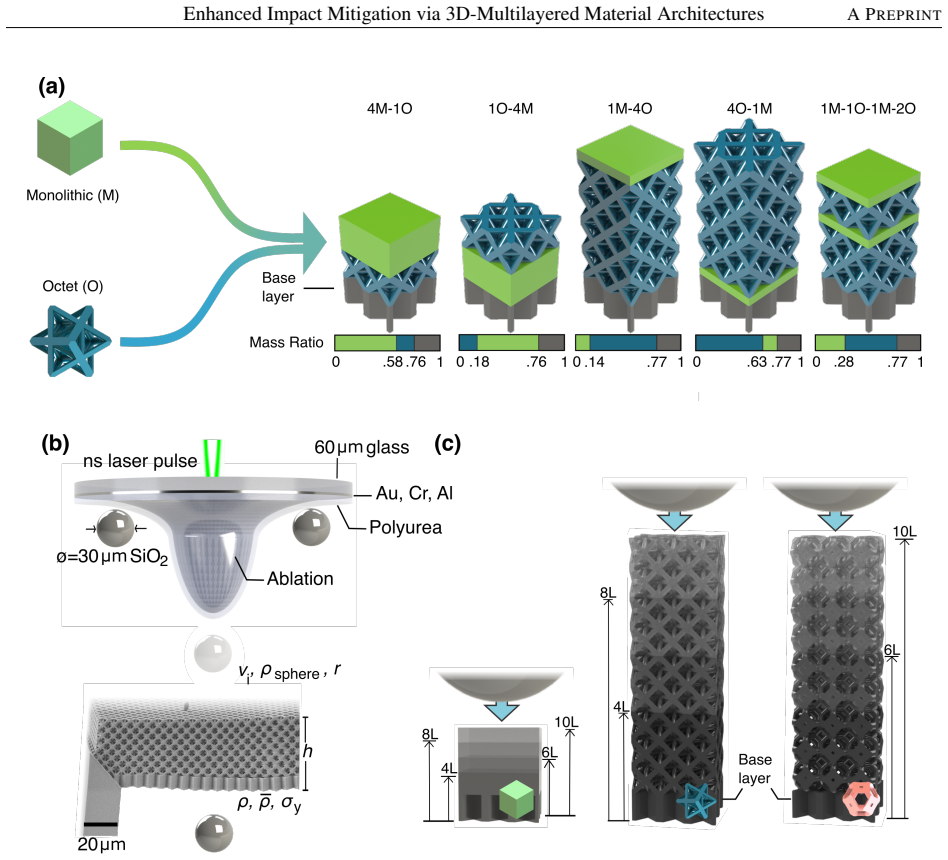
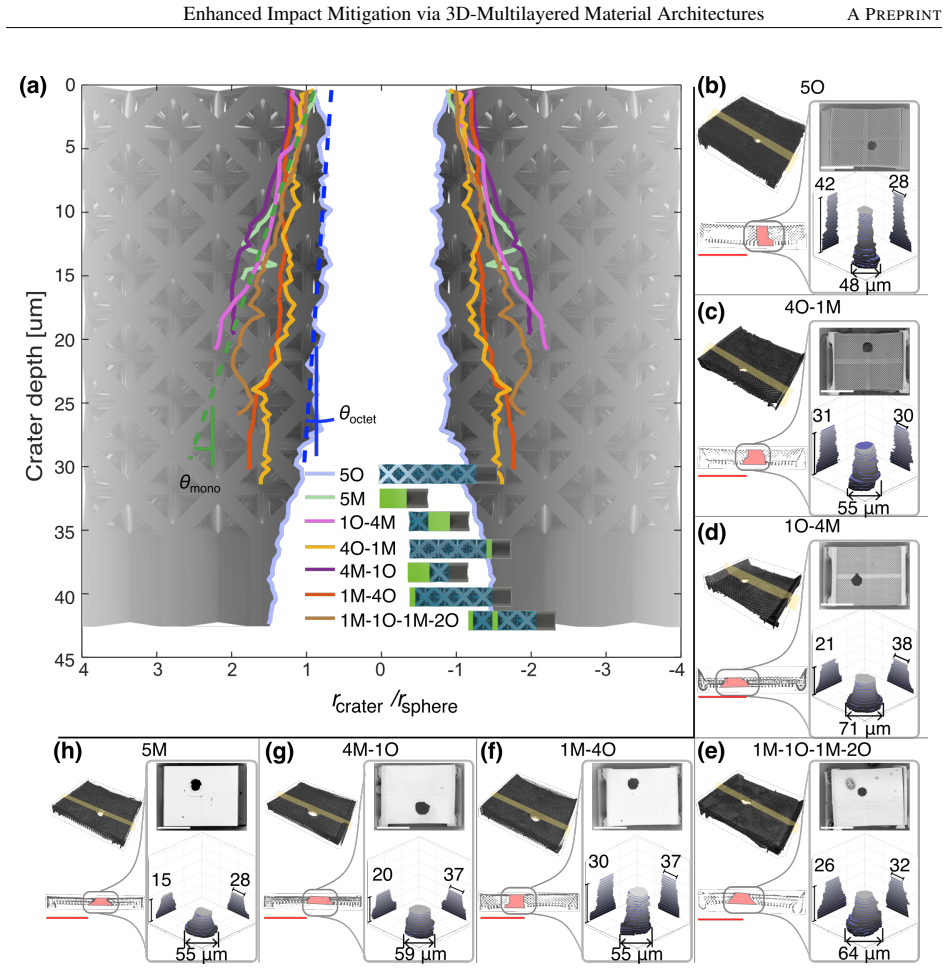
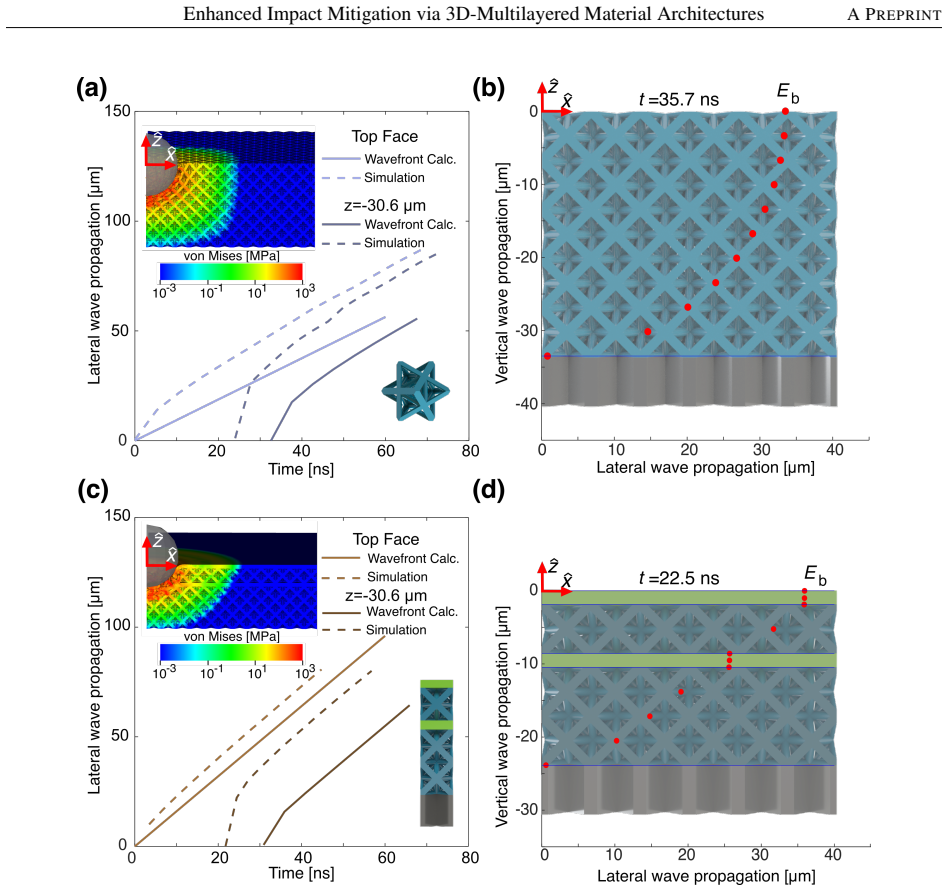
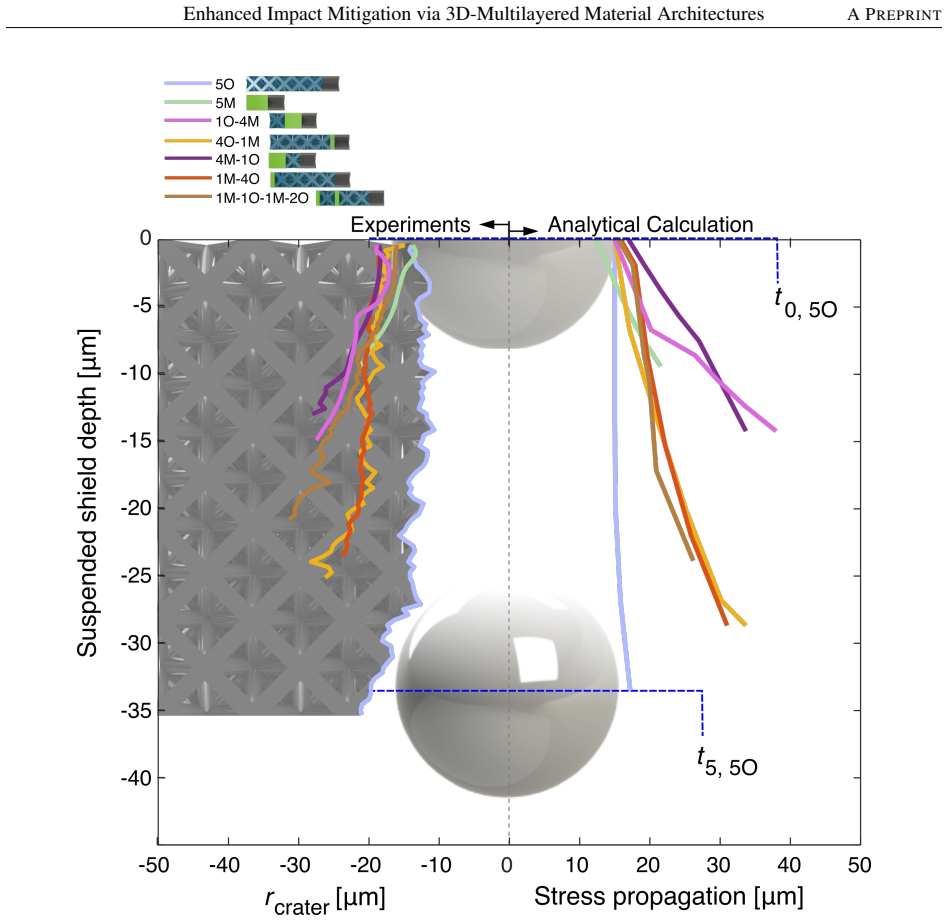
By alternating monolithic and octet lattice layers in different orders and proportions while keeping total mass equivalent, the resulting heterostructures outperform single-architecture lattices by more than 50% in mass-specific energy dissipation during supersonic microparticle impact, with layer-by-layer mechanical properties directly linked to observed cratering and dissipation through wave analysis, finite-element modeling, and crater reconstruction.
What carries the argument
Alternating monolithic and octet-lattice layers that control wave propagation and localize failure to improve overall energy absorption.
If this is right
- Layer ordering and proportions can be adjusted to tune crater depth and energy absorption for specific impact velocities.
- The same heterostructure concept extends functional grading from dense composites into porous architected materials.
- Predictable responses under extreme conditions support design of Whipple shields and sports protective gear.
- Layer-by-layer mapping enables optimization without full-scale retesting of every configuration.
Where Pith is reading between the lines
- Similar alternating designs might improve resistance under repeated or oblique impacts not covered in the reported tests.
- The framework could be applied to other lattice topologies beyond the octet unit cell to broaden the performance range.
- This layering strategy connects naturally to biological graded structures and suggests routes for bio-inspired synthetic materials in other extreme environments.
Load-bearing premise
That performance gains arise specifically from the alternating layer ordering rather than from differences in overall density, manufacturing consistency, or unaccounted wave interactions.
What would settle it
A side-by-side test of mass-matched uniform octet lattices manufactured to identical quality standards that shows no more than marginal improvement over the layered versions under the same impact conditions.
Figures



read the original abstract
Materials designed by nature commonly exhibit functional grading and laminated structures, particularly when intended for enhanced impact protection. Synthetic materials have also found success in exploiting this concept with fully dense but spatially varying architectures, as is the case with advanced fiber-based composites. In the lightweight materials space, porous architected materials have shown benefits for extreme impact mitigation, proving to be advantageous in dissipating large amounts of energy per unit mass, but rarely harness the benefits of layering or functional grading in designs. Here, a design paradigm for lightweight multilayered materials towards high impact-mitigation efficacy is demonstrated, showing that the use of alternating monolithic and beam-based architectures leads to enhanced and predictable responses under extreme conditions. These layered, mass-equivalent `heterostructures' with different ordering and proportions of octet and monolithic layers outperform single-architecture lattices on a mass-normalized energy dissipation basis by >50% when subjected to supersonic microparticle impact. Through analysis that combines wave-propagation analysis, nonlinear finite element simulations, and post-impact crater reconstruction, layer-by-layer mechanical properties are mapped to crater formation and energy dissipation behaviors. This heterostructure design framework offers a simple approach towards tuning failure and impact resistance of materials for protective applications from Whipple shields to sports equipment.
Editorial analysis
A structured set of objections, weighed in public.
Referee Report
Summary. The paper claims that mass-equivalent multilayered heterostructures alternating between monolithic and octet-truss architectures achieve >50% higher mass-normalized energy dissipation than single-architecture lattices under supersonic microparticle impact. This is supported by a combination of wave-propagation analysis, nonlinear finite-element simulations, and post-impact crater reconstruction that maps layer properties to overall dissipation behavior.
Significance. If the performance advantage is attributable specifically to the alternating-layer architecture rather than manufacturing variations, the work supplies a simple, tunable design rule for improving impact resistance in lightweight porous materials. The multi-method validation (theory, simulation, experiment) is a positive feature that could inform applications ranging from Whipple shields to protective equipment.
major comments (2)
- [Experimental section / Results] The central >50% mass-normalized dissipation claim (Abstract) rests on comparisons between heterostructures and single-architecture controls, yet no quantitative data on sample-to-sample density uniformity (e.g., micro-CT porosity statistics or strut-thickness distributions) are provided. Systematic differences in overall porosity or manufacturing quality between the two classes could independently alter wave scattering and crater formation, undermining architectural attribution.
- [Methods / Results] Layer proportions, ordering, and the exact criteria used to select the reported heterostructure configurations are not stated with sufficient precision (Abstract and Results). Without a pre-specified design-space exploration or sensitivity analysis, it is unclear whether the >50% figure reflects a robust architectural effect or post-hoc selection among tested variants.
minor comments (2)
- [Figures] Figure captions and axis labels should explicitly state whether energy-dissipation values are normalized by total mass or by impacted mass; the current presentation leaves this ambiguous.
- [Theory section] The wave-propagation analysis section would benefit from a brief statement of the assumed material constitutive model and any damping parameters used in the analytic estimates.
Simulated Author's Rebuttal
We thank the referee for their constructive feedback on our manuscript. We address each major comment below and have revised the manuscript to incorporate additional details and data where appropriate to strengthen the attribution of performance gains to the architectural design.
read point-by-point responses
-
Referee: [Experimental section / Results] The central >50% mass-normalized dissipation claim (Abstract) rests on comparisons between heterostructures and single-architecture controls, yet no quantitative data on sample-to-sample density uniformity (e.g., micro-CT porosity statistics or strut-thickness distributions) are provided. Systematic differences in overall porosity or manufacturing quality between the two classes could independently alter wave scattering and crater formation, undermining architectural attribution.
Authors: We agree that quantitative metrics on density uniformity would better support architectural attribution. In the revised manuscript we have added micro-CT porosity statistics and strut-thickness distributions for representative samples from both heterostructure and single-architecture cohorts. These data show overall densities matched to within 2 % and comparable strut-thickness variation (standard deviation ~5 % of mean), indicating that manufacturing differences are not the primary driver of the observed dissipation improvement. Representative micro-CT slices are now included in the supplementary information. revision: yes
-
Referee: [Methods / Results] Layer proportions, ordering, and the exact criteria used to select the reported heterostructure configurations are not stated with sufficient precision (Abstract and Results). Without a pre-specified design-space exploration or sensitivity analysis, it is unclear whether the >50% figure reflects a robust architectural effect or post-hoc selection among tested variants.
Authors: The reported configurations were guided by wave-propagation analysis that identified favorable impedance-mismatch sequences, followed by targeted finite-element screening of mass-equivalent layer fractions. We have now expanded the Methods section to state the precise proportions (equal mass fractions of monolithic and octet layers in alternating order) and ordering criteria. A new sensitivity subsection shows that the >50 % mass-normalized dissipation gain is maintained across a range of layer thicknesses and orderings within the explored design space, confirming the effect is robust rather than the result of isolated post-hoc selection. revision: yes
Circularity Check
No significant circularity in derivation chain
full rationale
The paper's core claims rest on direct experimental comparisons of mass-equivalent heterostructures against single-architecture lattices under supersonic impact, supported by independent wave-propagation analysis, nonlinear FE simulations, and post-impact crater reconstruction. These elements draw on external baselines and physical measurements rather than reducing to quantities defined by the paper's own fitted parameters or self-citations. No load-bearing step equates a prediction to its input by construction, and the mapping of layer properties to dissipation behavior is grounded in observable data without self-definitional loops.
Axiom & Free-Parameter Ledger
axioms (1)
- domain assumption Functional grading and lamination concepts from natural materials translate effectively to synthetic architected lattices for impact mitigation.
Lean theorems connected to this paper
-
IndisputableMonolith/Foundation/RealityFromDistinction.leanreality_from_one_distinction unclearThese layered, mass-equivalent 'heterostructures' with different ordering and proportions of octet and monolithic layers outperform single-architecture lattices on a mass-normalized energy dissipation basis by >50% when subjected to supersonic microparticle impact.
Reference graph
Works this paper leans on
-
[1]
Nayeon Lee, M. F. Horstemeyer, Hongjoo Rhee, Ben Nabors, Jun Liao, and Lakiesha N. Williams. Hierarchical multiscale structure–property relationships of the red-bellied woodpecker (Melanerpes carolinus) beak.Journal of The Royal Society Interface, 11(96), July 2014
work page 2014
-
[2]
Gisela M Luz and João F Mano. Biomimetic design of materials and biomaterials inspired by the structure of nacre.Philosophical Transactions of the Royal Society A: Mathematical, Physical and Engineering Sciences, 367(1893):1587–1605, April 2009
work page 2009
-
[3]
Muhammed Kamrul Islam, Paul J. Hazell, Juan P. Escobedo, and Hongxu Wang. Biomimetic armour design strategies for additive manufacturing: A review.Materials & Design, 205:109730, July 2021
work page 2021
-
[4]
Yaraghi, David Kisailus, and Pablo Zavattieri
Nobphadon Suksangpanya, Nicholas A. Yaraghi, David Kisailus, and Pablo Zavattieri. Twisting cracks in Bouligand structures.Journal of the Mechanical Behavior of Biomedical Materials, 76:38–57, December 2017
work page 2017
-
[5]
Rohit Pratyush Behera and Hortense Le Ferrand. Impact-resistant materials inspired by the mantis shrimp’s dactyl club.Matter, 4(9):2831–2849, September 2021. 14 Enhanced Impact Mitigation via 3D-Multilayered Material ArchitecturesA PREPRINT
work page 2021
-
[6]
N. A. Alderete, S. Sandeep, S. Raetz, M. Asgari, M. Abi Ghanem, and H. D. Espinosa. Does the mantis shrimp pack a phononic shield?Science, 387(6734):659–666, February 2025
work page 2025
-
[7]
Apple Academic Press, Inc, 1 edition, 2021
Magdi El Messiry.Protective Armor Engineering Design. Apple Academic Press, Inc, 1 edition, 2021
work page 2021
-
[8]
S. R. Skaggs. A Brief History of Ceramic Armor Development. In Waltraud M. Kriven and Hua-Tay Lin, editors, Ceramic Engineering and Science Proceedings, volume 24, pages 337–349. John Wiley & Sons, Inc., Hoboken, NJ, USA, January 2003
work page 2003
-
[9]
Ramdayal Yadav, Minoo Naebe, Xungai Wang, and Balasubramanian Kandasubramanian. Body armour materials: from steel to contemporary biomimetic systems.RSC Advances, 6(116):115145–115174, 2016
work page 2016
-
[10]
Impact compressive response of dry sand.Mechanics of Materials, 41(6):777–785, June 2009
Bo Song, Weinong Chen, and Vincent Luk. Impact compressive response of dry sand.Mechanics of Materials, 41(6):777–785, June 2009
work page 2009
-
[11]
Hiroaki Katsuragi and Douglas J. Durian. Unified force law for granular impact cratering.Nature Physics, 3(6):420–423, June 2007
work page 2007
-
[12]
Mehdi Omidvar, Magued Iskander, and Stephan Bless. Response of granular media to rapid penetration.Interna- tional Journal of Impact Engineering, 66:60–82, April 2014
work page 2014
-
[13]
C. Tan, B. M. Fung, J. K. Newman, and C. Vu. Organic Aerogels with Very High Impact Strength.Advanced Materials, 13(9):644–646, May 2001
work page 2001
- [14]
-
[15]
A.G. Evans, M.Y . He, V .S. Deshpande, J.W. Hutchinson, A.J. Jacobsen, and W.B. Carter. Concepts for enhanced energy absorption using hollow micro-lattices.International Journal of Impact Engineering, 37(9):947–959, September 2010
work page 2010
-
[16]
Christian J. Yungwirth, Haydn N.G. Wadley, John H. O’Connor, Alan J. Zakraysek, and Vikram S. Deshpande. Impact response of sandwich plates with a pyramidal lattice core.International Journal of Impact Engineering, 35(8):920–936, August 2008
work page 2008
-
[17]
Ken Wen, Xiao-wei Chen, and Yong-gang Lu. Research and development on hypervelocity impact protection using Whipple shield: An overview.Defence Technology, 17(6):1864–1886, December 2021
work page 2021
-
[18]
M.F Ashby. The properties of foams and lattices.Philosophical Transactions of the Royal Society A: Mathematical, Physical and Engineering Sciences, 364(1838):15–30, January 2006
work page 2006
-
[19]
Jens Bauer, Lucas R. Meza, Tobias A. Schaedler, Ruth Schwaiger, Xiaoyu Zheng, and Lorenzo Valdevit. Nanolat- tices: An Emerging Class of Mechanical Metamaterials.Advanced Materials, 29(40):1701850, October 2017
work page 2017
-
[20]
Design, Fabrication, and Mechanics of 3D Micro- /Nanolattices.Small, 16(15):1902842, April 2020
Xuan Zhang, Yujia Wang, Bin Ding, and Xiaoyan Li. Design, Fabrication, and Mechanics of 3D Micro- /Nanolattices.Small, 16(15):1902842, April 2020
work page 2020
-
[21]
James Utama Surjadi and Carlos M. Portela. Enabling three-dimensional architected materials across length scales and timescales.Nature Materials, 24(4):493–505, April 2025
work page 2025
-
[22]
Agyapal Singh and Nikolaos Karathanasopoulos. Strut and stochastic polymer reinforcement interpenetrating phase composites: Static, strain-rate and dynamic damping performance.Thin-Walled Structures, 198:111618, May 2024
work page 2024
-
[23]
Lucas R. Meza and Julia R. Greer. Mechanical characterization of hollow ceramic nanolattices.Journal of Materials Science, 49(6):2496–2508, March 2014
work page 2014
-
[24]
Meza, Frank Greer, and Julia R
Dongchan Jang, Lucas R. Meza, Frank Greer, and Julia R. Greer. Fabrication and deformation of three-dimensional hollow ceramic nanostructures.Nature Materials, 12(10):893–898, October 2013
work page 2013
-
[25]
T. A. Schaedler, A. J. Jacobsen, A. Torrents, A. E. Sorensen, J. Lian, J. R. Greer, L. Valdevit, and W. B. Carter. Ultralight Metallic Microlattices.Science, 334(6058):962–965, November 2011
work page 2011
-
[26]
M.R. O’Masta, L. Dong, L. St-Pierre, H.N.G. Wadley, and V .S. Deshpande. The fracture toughness of octet-truss lattices.Journal of the Mechanics and Physics of Solids, 98:271–289, January 2017
work page 2017
-
[27]
The toughness of mechanical metamaterials.Nature Materials, 21(3):297–304, March 2022
Angkur Jyoti Dipanka Shaikeea, Huachen Cui, Mark O’Masta, Xiaoyu Rayne Zheng, and Vikram Sudhir Deshpande. The toughness of mechanical metamaterials.Nature Materials, 21(3):297–304, March 2022
work page 2022
-
[28]
Sage Fulco, Michal K Budzik, Hongyi Xiao, Douglas J Durian, and Kevin T Turner. Disorder enhances the fracture toughness of 2D mechanical metamaterials.PNAS Nexus, 4(2), February 2025
work page 2025
-
[29]
Konstantinos Karapiperis and Dennis M. Kochmann. Prediction and control of fracture paths in disordered architected materials using graph neural networks.Communications Engineering, 2(1), June 2023. 15 Enhanced Impact Mitigation via 3D-Multilayered Material ArchitecturesA PREPRINT
work page 2023
-
[30]
V .S. Deshpande and N.A. Fleck. High strain rate compressive behaviour of aluminium alloy foams.International Journal of Impact Engineering, 24(3):277–298, March 2000
work page 2000
- [31]
-
[32]
S. Gaitanaros and S. Kyriakides. Dynamic crushing of aluminum foams: Part II – Analysis.International Journal of Solids and Structures, 51(9):1646–1661, May 2014
work page 2014
-
[33]
Stavros Gaitanaros and Stelios Kyriakides. On the effect of relative density on the crushing and energy absorption of open-cell foams under impact.International Journal of Impact Engineering, 82:3–13, August 2015
work page 2015
-
[34]
Nejc Novak, Oraib Al-Ketan, Anja Mauko, Yunus Emre Yilmaz, Lovre Krstulovi ´c-Opara, Shigeru Tanaka, Kazuyuki Hokamoto, Reza Rowshan, Rashid Abu Al-Rub, Matej Vesenjak, and Zoran Ren. Impact loading of additively manufactured metallic stochastic sheet-based cellular material.International Journal of Impact Engineering, 174:104527, April 2023
work page 2023
-
[35]
T. Tancogne-Dejean, X. Li, M. Diamantopoulou, C. C. Roth, and D. Mohr. High Strain Rate Response of Additively-Manufactured Plate-Lattices: Experiments and Modeling.Journal of Dynamic Behavior of Materials, 5(3):361–375, September 2019
work page 2019
-
[36]
Weeks, Vatsa Gandhi, and Guruswami Ravichandran
John S. Weeks, Vatsa Gandhi, and Guruswami Ravichandran. Shock compression behavior of stainless steel 316L octet-truss lattice structures.International Journal of Impact Engineering, 169:104324, November 2022
work page 2022
-
[37]
J. S. Weeks and G. Ravichandran. Effect of Topology on Transient Dynamic and Shock Response of Polymeric Lattice Structures.Journal of Dynamic Behavior of Materials, 9(1):44–64, March 2023
work page 2023
-
[38]
N.K. Naik and P. Shrirao. Composite structures under ballistic impact.Composite Structures, 66(1-4):579–590, October 2004
work page 2004
-
[39]
B. L. Lee, T. F. Walsh, S. T. Won, H. M. Patts, J. W. Song, and A. H. Mayer. Penetration Failure Mechanisms of Armor-Grade Fiber Composites under Impact.Journal of Composite Materials, 35(18):1605–1633, September 2001
work page 2001
-
[40]
Tien-Wei Shyr and Yu-Hao Pan. Impact resistance and damage characteristics of composite laminates.Composite Structures, 62(2):193–203, November 2003
work page 2003
- [41]
-
[42]
Quanjin Ma, Mrm Rejab, Jp Siregar, and Zhongwei Guan. A review of the recent trends on core structures and impact response of sandwich panels.Journal of Composite Materials, 55(18):2513–2555, August 2021
work page 2021
-
[43]
J. A. Hawreliak, J. Lind, B. Maddox, M. Barham, M. Messner, N. Barton, B. J. Jensen, and M. Kumar. Dynamic Behavior of Engineered Lattice Materials.Scientific Reports, 6(1):28094, June 2016
work page 2016
-
[44]
Dattelbaum, Axinte Ionita, Brian M
Dana M. Dattelbaum, Axinte Ionita, Brian M. Patterson, Brittany A. Branch, and Lindsey Kuettner. Shockwave dissipation by interface-dominated porous structures.AIP Advances, 10(7):075016, July 2020
work page 2020
-
[45]
Jae-Hwang Lee, Phillip E Loya, Jun Lou, and Edwin L Thomas. Dynamic mechanical behavior of multilayer graphene via supersonic projectile penetration.Science, 346(1092), 2014
work page 2014
-
[46]
Kooi, Yang Jiao, Ming-Siao Hsiao, Jason Streit, Richard A
Jinho Hyon, Olawale Lawal, Omri Fried, Ramathasan Thevamaran, Sadegh Yazdi, Mujin Zhou, David Veysset, Steven E. Kooi, Yang Jiao, Ming-Siao Hsiao, Jason Streit, Richard A. Vaia, and Edwin L. Thomas. Extreme Energy Absorption in Glassy Polymer Thin Films by Supersonic Micro-projectile Impact.Materials Today, 21(8):817–824, October 2018
work page 2018
-
[47]
David Veysset, Jae-Hwang Lee, Mostafa Hassani, Steven E. Kooi, Edwin L. Thomas, and Keith A. Nelson. High-velocity micro-projectile impact testing.Applied Physics Reviews, 8(1):011319, March 2021
work page 2021
-
[48]
Carlos M. Portela, Bryce W. Edwards, David Veysset, Yuchen Sun, Keith A. Nelson, Dennis M. Kochmann, and Julia R. Greer. Supersonic impact resilience of nanoarchitected carbon.Nature Materials, 20(11):1491–1497, November 2021
work page 2021
-
[49]
Thomas Butruille, Joshua C. Crone, and Carlos M. Portela. Decoupling particle-impact dissipation mechanisms in 3D architected materials.Proceedings of the National Academy of Sciences, 121(6), February 2024
work page 2024
- [50]
-
[51]
Marvin E. Backman and Werner Goldsmith. The mechanics of penetration of projectiles into targets.International Journal of Engineering Science, 16(1):1–99, January 1978. 16 Enhanced Impact Mitigation via 3D-Multilayered Material ArchitecturesA PREPRINT
work page 1978
-
[52]
K. A. Holsapple and R. M. Schmidt. Point source solutions and coupling parameters in cratering mechanics. Journal of Geophysical Research, 92(B7):6350, 1987
work page 1987
-
[53]
K A Holsapple. The Scaling of Impact Processes in Planetary Sciences.Annual Review of Earth and Planetary Sciences, 21:333–373, 1993
work page 1993
-
[54]
Runchen Zhao, Qianyun Zhang, Hendro Tjugito, and Xiang Cheng. Granular impact cratering by liquid drops: Understanding raindrop imprints through an analogy to asteroid strikes.Proceedings of the National Academy of Sciences, 112(2):342–347, January 2015
work page 2015
-
[55]
Meng Wen, Weitao Gao, Chao Zhang, Jun Pang, Chen Cui, Ling Gao, Zhijun Zheng, Ming Chen, and Hong Yu. Gradient double-twisted Bouligand structural design for high impact resistance over a wide range of loading velocities.Science Advances, 2025
work page 2025
-
[56]
A simple approach to modeling ductile failure
Gerald William Wellman. A simple approach to modeling ductile failure. Technical Report SAND2012-1343, Sandia National Laboratories, Albuquerque, NM, and Livermore, CA, 2012. 17 Enhanced Impact Mitigation via 3D-Multilayered Material ArchitecturesA PREPRINT Supporting Information Supporting figures Figure S1. Imaging of multilayered tetrakaidecahedron shi...
work page 2012
discussion (0)
Sign in with ORCID, Apple, or X to comment. Anyone can read and Pith papers without signing in.