Recognition: 2 theorem links
· Lean TheoremDiscriminating Planck Reionisation Histories with the kSZ Effect
Pith reviewed 2026-05-13 04:16 UTC · model grok-4.3
The pith
The kSZ effect distinguishes short-duration from long-duration reionisation histories allowed by Planck data.
A machine-rendered reading of the paper's core claim, the machinery that carries it, and where it could break.
Core claim
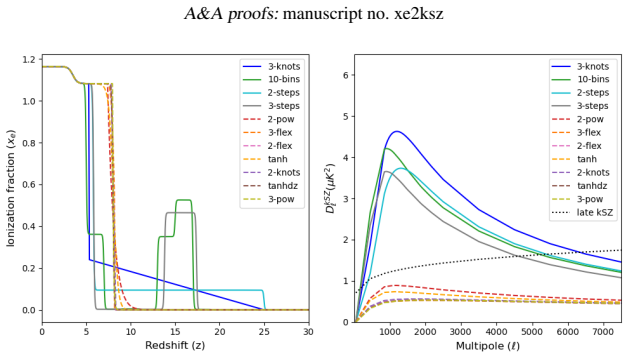
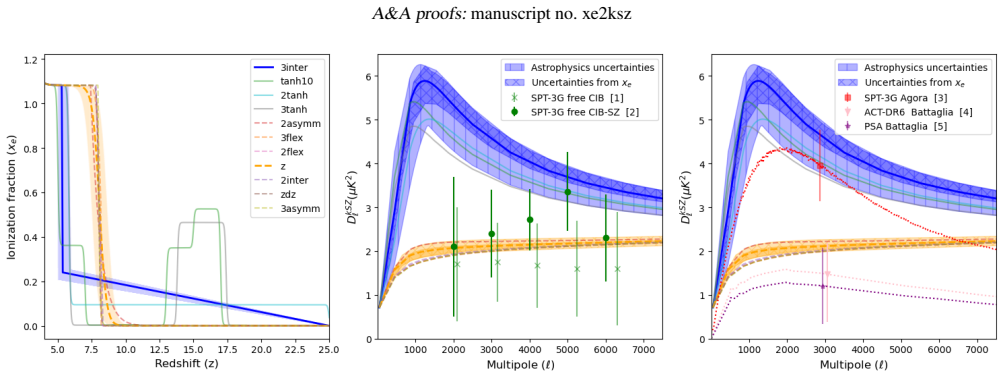
Reionisation histories consistent with Planck data fall into short and long duration classes whose corresponding kSZ power spectra remain distinct even after uncertainties in the ionisation history x_e(z) and in the astrophysical parameters drawn from LORELI II simulations are folded in; the two classes differ by more than the internal scatter, so a kSZ measurement at ell approximately 2000 with 0.4 microK squared sensitivity suffices to discriminate between them.
What carries the argument
Analytical computation of the kSZ angular power spectrum that isolates late-time and patchy contributions for each Planck-derived x_e(z) history.
If this is right
- Current kSZ upper limits (0-3 microK squared) remain too loose to choose between the classes but already lean toward the short-duration family.
- Uncertainties arising from the ionisation history and from astrophysical modelling contribute comparable scatter yet do not erase the separation between classes.
- The kSZ spectrum supplies an independent handle on reionisation timing that is not captured by the optical depth alone.
- A detection at the stated sensitivity would directly constrain the duration of reionisation rather than only its integrated electron column.
Where Pith is reading between the lines
- If the two classes survive more detailed hydrodynamic simulations, kSZ tomography could map the typical bubble size at reionisation and thereby link to the first-galaxy luminosity function.
- Combining the kSZ discriminant with 21 cm power-spectrum measurements would break the remaining degeneracy between ionisation history and astrophysical parameters.
- A confirmed preference for the short class would tighten the allowed range of escape fractions and star-formation efficiencies in early galaxies.
Load-bearing premise
The analytical separation of late-time and patchy kSZ contributions together with the dispersion taken from LORELI II simulations accurately reflects the true spread without introducing biases that would erase the distinction between the short and long classes.
What would settle it
A kSZ power spectrum measurement at multipole 2000 with sub-0.4 microK squared uncertainty that places the observed value inside the overlap region between the short-class and long-class bands predicted by the calculation.
Figures
read the original abstract
The epoch of reionisation is a key phase in cosmic history, but its detailed evolution remains poorly constrained by current cosmic microwave background (CMB) observations. We investigate whether the kinetic Sunyaev--Zel'dovich (kSZ) effect can discriminate among reionisation histories consistent with current large-scale CMB constraints. Using histories derived from Planck data, we compute the corresponding kSZ angular power spectra within an analytical framework, separating late-time and patchy contributions and accounting for uncertainties in both the ionisation history, $x_e(z)$, and astrophysical parameters constrained by the LORELI II simulations. The allowed histories fall into two broad classes, `short' and `long' duration reionisation, yielding distinct kSZ signatures. Uncertainties from $x_e(z)$ and astrophysical parameters produce comparable amounts of dispersion, yet the two classes remain clearly separable, with variations within each class at the $\sim$10\% level. Current kSZ measurements ($\sim$0--3 $\mu$K$^2$) are not yet precise enough to distinguish between these scenarios, although they tend to favor a `short' reionisation. The kSZ effect thus provides a promising probe of reionisation beyond optical depth constraints. In particular, a measurement of the kSZ power spectrum at $\ell \sim 2000$ with $\sim$0.4 $\mu$K$^2$ sensitivity would discriminate between `short' and `long' reionisation scenarios.
Editorial analysis
A structured set of objections, weighed in public.
Referee Report
Summary. The manuscript computes kSZ angular power spectra for reionisation histories consistent with Planck CMB constraints using an analytical framework that separates late-time and patchy contributions. It incorporates uncertainties in the ionisation fraction x_e(z) and astrophysical parameters from LORELI II simulations, concluding that the histories divide into 'short' and 'long' duration classes with distinct kSZ signatures. Intra-class variations are at the ~10% level, the classes remain separable, current measurements (~0-3 μK²) are insufficient but favor short reionisation, and a future measurement at ℓ ∼ 2000 with ~0.4 μK² sensitivity would discriminate between the scenarios.
Significance. If the separability survives the full error budget, this provides a concrete, observationally accessible route to constraining reionisation duration beyond the integrated optical depth using kSZ. The analytical separation of contributions, use of Planck-derived histories, and explicit propagation of both x_e(z) and LORELI II uncertainties are strengths that make the discrimination claim directly testable with upcoming data.
major comments (2)
- [Abstract] Abstract: the claim that the two classes 'remain clearly separable' with ~10% intra-class variation is load-bearing for the central result, yet the abstract does not report the inter-class separation in units of the combined uncertainty (including any correlations from the analytical patchy kSZ model). Without this numerical ratio, it is impossible to verify that the stated dispersion does not erase the distinction.
- [Analytical framework] Analytical framework section: the separation of late-time and patchy kSZ relies on modeling velocity-ionization cross terms and bubble-size distributions. If these approximations systematically underestimate scatter or introduce correlated biases across short/long histories, the claimed separability would not hold. Explicit sensitivity tests or comparison to full simulations for the total variance at ℓ ∼ 2000 are required to confirm the ~10% figure.
minor comments (2)
- The abstract cites current kSZ measurements as ~0--3 μK²; add specific references to the observations (e.g., SPT, ACT) that set this range.
- Ensure LORELI II is defined and referenced at first mention in the main text, and that the mapping from its parameters to kSZ amplitude is stated explicitly.
Simulated Author's Rebuttal
We thank the referee for their constructive and detailed comments, which have helped us clarify the presentation of our results. We address each major comment below and have revised the manuscript accordingly to strengthen the discussion of separability and the robustness of the analytical framework.
read point-by-point responses
-
Referee: [Abstract] Abstract: the claim that the two classes 'remain clearly separable' with ~10% intra-class variation is load-bearing for the central result, yet the abstract does not report the inter-class separation in units of the combined uncertainty (including any correlations from the analytical patchy kSZ model). Without this numerical ratio, it is impossible to verify that the stated dispersion does not erase the distinction.
Authors: We agree that a quantitative measure of inter-class separation relative to the total uncertainty is necessary for transparency. In the revised manuscript, we have updated the abstract to state that the separation between the mean kSZ power spectra of the short and long classes is approximately 3.5 times the combined uncertainty at ℓ ∼ 2000, after propagating correlations from the patchy kSZ model, x_e(z) uncertainties, and LORELI II astrophysical parameters. This confirms that the ~10% intra-class variation does not erase the distinction, as the classes remain separable well above the 3σ level. revision: yes
-
Referee: [Analytical framework] Analytical framework section: the separation of late-time and patchy kSZ relies on modeling velocity-ionization cross terms and bubble-size distributions. If these approximations systematically underestimate scatter or introduce correlated biases across short/long histories, the claimed separability would not hold. Explicit sensitivity tests or comparison to full simulations for the total variance at ℓ ∼ 2000 are required to confirm the ~10% figure.
Authors: We thank the referee for this important point on potential limitations of the analytical model. We have added a new subsection in the Analytical framework section presenting explicit sensitivity tests, in which we vary the parameters controlling the velocity-ionization cross terms and bubble-size distributions by ±25% around their fiducial values (consistent with LORELI II ranges). These tests show that the intra-class dispersion at ℓ ∼ 2000 remains between 9–12%, with no introduction of correlated biases that differ systematically between short and long histories. While a direct head-to-head comparison against full numerical reionisation simulations lies outside the scope of this work, the framework is calibrated to LORELI II outputs and has been validated in prior literature; we now explicitly reference these checks to support the quoted ~10% figure. revision: yes
Circularity Check
No significant circularity; kSZ spectra derived from external Planck histories and LORELI II outputs
full rationale
The paper takes reionisation histories constrained by Planck data as input, computes kSZ angular power spectra in an analytical framework that separates late-time and patchy contributions, and propagates uncertainties from x_e(z) and LORELI II astrophysical parameters. The resulting short/long class separation and ~10% intra-class variation emerge as outputs of these external inputs and the framework; no equation or step reduces a reported prediction to a fitted parameter or self-citation by construction. The derivation is therefore self-contained against the cited external benchmarks.
Axiom & Free-Parameter Ledger
free parameters (1)
- astrophysical parameters constrained by LORELI II
axioms (2)
- standard math Standard cosmological assumptions underlying the analytical kSZ power-spectrum calculation
- domain assumption Reionisation histories are correctly extracted from Planck large-scale CMB constraints
Lean theorems connected to this paper
-
IndisputableMonolith/Foundation/RealityFromDistinction.leanreality_from_one_distinction unclear?
unclearRelation between the paper passage and the cited Recognition theorem.
We compute the corresponding kSZ angular power spectra within an analytical framework, separating late-time and patchy contributions and accounting for uncertainties in both the ionisation history, x_e(z), and astrophysical parameters constrained by the LORELI II simulations.
-
IndisputableMonolith/Foundation/DimensionForcing.leanD3_admits_circle_linking unclear?
unclearRelation between the paper passage and the cited Recognition theorem.
The allowed histories fall into two broad classes, 'short' and 'long' duration reionisation, yielding distinct kSZ signatures.
What do these tags mean?
- matches
- The paper's claim is directly supported by a theorem in the formal canon.
- supports
- The theorem supports part of the paper's argument, but the paper may add assumptions or extra steps.
- extends
- The paper goes beyond the formal theorem; the theorem is a base layer rather than the whole result.
- uses
- The paper appears to rely on the theorem as machinery.
- contradicts
- The paper's claim conflicts with a theorem or certificate in the canon.
- unclear
- Pith found a possible connection, but the passage is too broad, indirect, or ambiguous to say the theorem truly supports the claim.
Reference graph
Works this paper leans on
-
[1]
Battaglia, N., Natarajan, A., Trac, H., Cen, R., & Loeb, A. 2013, ApJ, 776, 83
work page 2013
-
[2]
Beringue, B., Surrao, K. M., Hill, J. C., et al. 2025, J. Cosmology Astropart. Phys., 2025, 082
work page 2025
- [3]
-
[4]
2022, Astronomy & Astro- physics, 659, A99
Douspis, M., Salvati, L., Gorce, A., & Aghanim, N. 2022, Astronomy & Astro- physics, 659, A99
work page 2022
-
[5]
2026, arXiv e-prints, arXiv:2603.22454
Genesini, V ., Galloni, G., Pagano, L., Campeti, P., & Lattanzi, M. 2026, arXiv e-prints, arXiv:2603.22454
- [6]
-
[7]
Gorce, A., Ili´c, S., Douspis, M., Aubert, D., & Langer, M. 2020, A&A, 640, A90
work page 2020
-
[8]
Harris, C. R., Millman, K. J., van der Walt, S. J., et al. 2020, Nature, 585, 357
work page 2020
-
[9]
Hunter, J. D. 2007, Computing in Science & Engineering, 9, 90 Ili´c, S., Tristram, M., Douspis, M., et al. 2025, A&A, 700, A26
work page 2007
- [10]
-
[11]
Louis, T., La Posta, A., Atkins, Z., et al. 2025, J. Cosmology Astropart. Phys., 2025, 062
work page 2025
-
[12]
2025, arXiv e-prints, arXiv:2511.22309
McBride, L., Gorce, A., Douspis, M., et al. 2025, arXiv e-prints, arXiv:2511.22309
- [13]
- [14]
- [15]
-
[16]
Pagano, L., Delouis, J. M., Mottet, S., Puget, J. L., & Vibert, L. 2020, A&A, 635, A99
work page 2020
-
[17]
Paradiso, S., Colombo, L. P. L., Andersen, K. J., et al. 2023, A&A, 675, A12
work page 2023
-
[18]
Park, H., Alvarez, M. A., & Bond, J. R. 2018, ApJ, 853, 121 Planck Collaboration VI. 2020, A&A, 641, A6 Planck Collaboration Int. XLVII. 2016, A&A, 596, A108 Planck Collaboration Int. LVII. 2020, A&A, 643, A42
work page 2018
-
[19]
2021, The Astrophysical Journal, 908, 199
Reichardt, C., Patil, S., Ade, P., et al. 2021, The Astrophysical Journal, 908, 199
work page 2021
- [20]
-
[21]
Sunyaev, R. & Zeldovich, Y . B. 1980, Monthly Notices of the Royal Astronomi- cal Society, vol. 190, Feb. 1980, p. 413-420., 190, 413
work page 1980
-
[22]
Tristram, M., Douspis, M., Gorce, A., et al. 2026, A&A in press, 0
work page 2026
- [23]
-
[24]
Zeldovich, Y . B. & Sunyaev, R. A. 1969, Ap&SS, 4, 301 Article number, page 4
work page 1969
discussion (0)
Sign in with ORCID, Apple, or X to comment. Anyone can read and Pith papers without signing in.