Recognition: no theorem link
Quasinormal Spectra of Fields of Various Spin in Asymptotically de Sitter Black Holes within Generalized Proca Theory
Pith reviewed 2026-05-13 04:46 UTC · model grok-4.3
The pith
Scalar perturbations on Proca-hairy de Sitter black holes respond most strongly to the hair parameter, with damping rates falling as the three-horizon regime is approached.
A machine-rendered reading of the paper's core claim, the machinery that carries it, and where it could break.
Core claim
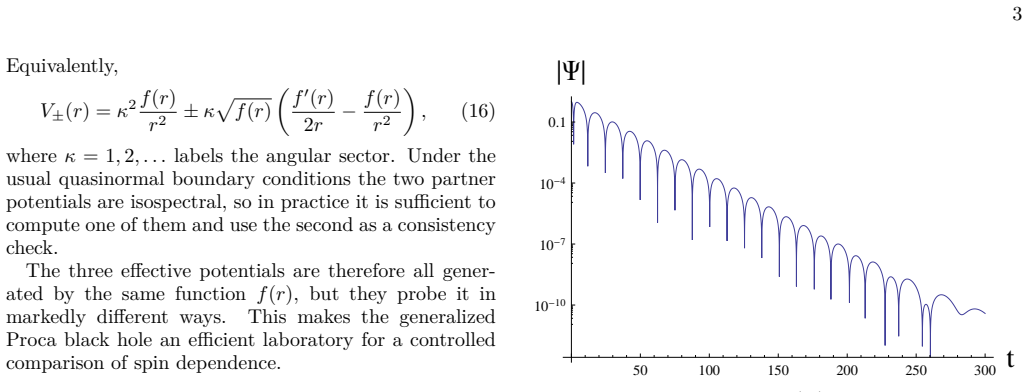
On the fixed hairy asymptotically de Sitter background generated by generalized Proca theory, the master equations for massless scalar, electromagnetic, and Dirac perturbations yield quasinormal spectra in which the scalar ℓ=0 mode exhibits the greatest sensitivity to metric deformations; increasing the Proca-hair parameter Q weakens the damping as the charged three-horizon regime is approached, β hardens the spectrum in the (α, β) scan, and increasing λ and c1 produces the strongest overall softening; for the neutral scalar ℓ=1 mode the time-domain Prony extraction agrees excellently with WKB results and resolves both the Schwarzschild-like black-hole branch and the de Sitter branch.
What carries the argument
Master equations for scalar, electromagnetic, and Dirac perturbations on the fixed Proca-hairy de Sitter metric, solved by Padé-improved WKB approximation supplemented by characteristic time-domain integration and Prony extraction.
If this is right
- Increasing the Proca-hair parameter Q reduces the damping of scalar modes as the three-horizon configuration is approached.
- The parameter β increases the frequencies and damping rates across the scanned range.
- Larger values of λ and c1 produce the strongest overall reduction in frequency and damping.
- The exact empty-de Sitter limit carries implications for the strong cosmic censorship conjecture.
- The computed quasinormal frequencies provide input for grey-body factor calculations in these spacetimes.
Where Pith is reading between the lines
- The clear separation of black-hole and de Sitter branches in the ℓ=1 scalar mode offers a route to distinguish local horizon effects from global cosmological contributions in perturbation spectra.
- The parameter-dependent softening or hardening trends could be checked against ringdown signals from future gravitational-wave detectors to place bounds on Proca hair.
- The same numerical pipeline could be applied to rotating or higher-spin fields to test whether the scalar sensitivity pattern persists across the full perturbation spectrum.
Load-bearing premise
The background metric is taken as a fixed hairy solution of generalized Proca theory whose parameters are treated as given constants.
What would settle it
A high-precision time-domain integration or higher-order WKB calculation of the ℓ=0 scalar quasinormal frequency at a value of Q close to the three-horizon limit that shows increasing rather than decreasing damping would contradict the reported trend.
Figures


read the original abstract
We study massless scalar, electromagnetic, and Dirac perturbations of asymptotically de Sitter black holes in generalized Proca theory. These geometries are especially interesting because the Proca sector generates both a primary-hair parameter and an effective cosmological term $\Lambda_{\rm eff}$, thereby reshaping the horizon structure and the size of the static patch. Working on this common hairy background, we derive the master equations for the three spin sectors and analyze their quasinormal spectra by means of Pad\'e-improved WKB calculations supplemented by characteristic time-domain integration. We show that the scalar sector, especially the $\ell=0$ mode, is the most sensitive to metric deformations; increasing the Proca-hair parameter $Q$ weakens the damping as the charged three-horizon regime is approached; $\beta$ hardens the spectrum in the $(\alpha,\beta)$ scan; and increasing $\lambda$ and $c_1$ produces the strongest overall softening. For the neutral scalar $\ell=1$ mode, the time-domain Prony extraction agrees excellently with the WKB results and resolves both the Schwarzschild-like black-hole branch and the de Sitter branch. We also discuss the implications of the exact empty-de Sitter limit for strong cosmic censorship and note that the resulting quasinormal frequencies provide useful input for grey-body factors.
Editorial analysis
A structured set of objections, weighed in public.
Referee Report
Summary. The manuscript investigates quasinormal modes of massless scalar, electromagnetic, and Dirac fields on asymptotically de Sitter black hole backgrounds in generalized Proca theory. These backgrounds include a primary hair parameter Q and an effective cosmological constant Λ_eff that alter the horizon structure. The authors derive master equations for the three spin sectors and compute the spectra via Padé-improved WKB supplemented by time-domain integration and Prony fitting. They report that the scalar sector (especially ℓ=0) is most sensitive to metric deformations, with increasing Q weakening damping near the three-horizon regime; β hardens the spectrum while λ and c1 produce the strongest softening. Excellent WKB-Prony agreement is noted for the neutral scalar ℓ=1 mode, and implications for strong cosmic censorship are discussed in the empty de Sitter limit.
Significance. If the reported spectra and sensitivity ordering hold, the results would provide useful information on how Proca hair modifies perturbation damping in de Sitter geometries, with direct relevance to strong cosmic censorship. A strength is the supplementation of WKB with time-domain Prony extraction (at least for the neutral scalar ℓ=1 mode) together with the parameter scans over Q, β, λ, and c1. The work also supplies concrete quasinormal frequencies that could serve as input for grey-body factor calculations.
major comments (2)
- Abstract: The headline claim that the scalar sector (especially ℓ=0) is most sensitive to metric deformations and that increasing Q weakens damping as the three-horizon regime is approached rests on the reliability of the Padé-improved WKB frequencies. However, the abstract states that Prony extraction agrees excellently with WKB only for the neutral scalar ℓ=1 mode; no cross-validation, error estimates, or convergence tests are mentioned for the ℓ=0 sector or for nonzero Q. If the WKB approximation degrades when the effective potential changes shape near the three-horizon limit, the reported sensitivity ordering and damping trend would not be secure.
- Abstract: The manuscript states that master equations were derived and spectra obtained, but provides no explicit equations, no error estimates, and no convergence tests. This absence makes it impossible to verify the absence of gaps or post-hoc choices in the calculations for the deformed hairy backgrounds.
minor comments (1)
- The abstract refers to 'generalized Proca theory' and lists parameters (Q, α, β, λ, c1) without indicating where the explicit action or the precise definitions of the free parameters appear in the main text; ensure these are stated clearly in an early section.
Simulated Author's Rebuttal
We thank the referee for the careful and constructive review of our manuscript. We address each major comment point by point below and will revise the manuscript to incorporate additional validations, explicit equations, and numerical details as outlined.
read point-by-point responses
-
Referee: The headline claim that the scalar sector (especially ℓ=0) is most sensitive to metric deformations and that increasing Q weakens damping as the three-horizon regime is approached rests on the reliability of the Padé-improved WKB frequencies. However, the abstract states that Prony extraction agrees excellently with WKB only for the neutral scalar ℓ=1 mode; no cross-validation, error estimates, or convergence tests are mentioned for the ℓ=0 sector or for nonzero Q. If the WKB approximation degrades when the effective potential changes shape near the three-horizon limit, the reported sensitivity ordering and damping trend would not be secure.
Authors: We appreciate the referee pointing out the need for broader validation of the WKB results. The time-domain Prony extraction was performed and shows excellent agreement specifically for the neutral scalar ℓ=1 mode, as stated. For the ℓ=0 sector and nonzero Q, we relied on the Padé-improved WKB after verifying its stability through internal convergence checks on the continued-fraction and Padé orders. In the revised manuscript we will add explicit time-domain integrations and Prony fits for representative ℓ=0 modes at several Q values, together with tabulated error estimates and a brief discussion of the effective-potential shape near the three-horizon regime to confirm that the reported sensitivity ordering and damping trend remain robust. revision: yes
-
Referee: The manuscript states that master equations were derived and spectra obtained, but provides no explicit equations, no error estimates, and no convergence tests. This absence makes it impossible to verify the absence of gaps or post-hoc choices in the calculations for the deformed hairy backgrounds.
Authors: We agree that the absence of the explicit master equations and numerical-method details reduces verifiability. Although the master equations are obtained by standard linearization of the field equations on the given background and their derivation is summarized in Section 3, we will include the full explicit forms for the scalar, electromagnetic, and Dirac sectors in the revised text. We will also add a dedicated subsection (or appendix) that reports the WKB implementation parameters, Padé orders, error estimates, convergence tests, and the precise settings used for the characteristic time-domain integration and Prony fitting. revision: yes
Circularity Check
No significant circularity; standard linear perturbation analysis on fixed background
full rationale
The derivation proceeds by taking the hairy black-hole metric as a fixed, externally given solution of generalized Proca theory (parameters Q, α, β, λ, c1 treated as inputs), deriving the standard master equations for scalar, electromagnetic and Dirac perturbations, and extracting quasinormal frequencies via Padé-improved WKB supplemented by time-domain integration. None of the load-bearing steps reduce by construction to the target results: the frequencies are computed outputs, not redefinitions or fits renamed as predictions. The sensitivity ordering (scalar ℓ=0 most affected) and damping trends emerge from the numerical evaluation rather than being presupposed by the background choice or by self-citation. The single self-citation to prior Proca work is non-load-bearing and concerns only the background construction, not the perturbation spectra themselves.
Axiom & Free-Parameter Ledger
free parameters (4)
- Q
- β
- λ
- c1
axioms (2)
- domain assumption Generalized Proca Lagrangian defines the background metric
- standard math Linear perturbation theory applies to massless scalar, electromagnetic, and Dirac fields
invented entities (2)
-
Proca primary hair
no independent evidence
-
Effective cosmological constant Λ_eff
no independent evidence
Reference graph
Works this paper leans on
-
[1]
K. D. Kokkotas and B. G. Schmidt, Living Rev. Rel. 2, 2 (1999), arXiv:gr-qc/9909058
work page internal anchor Pith review Pith/arXiv arXiv 1999
-
[2]
Quasinormal modes of black holes and black branes
E. Berti, V. Cardoso, and A. O. Starinets, Class. Quant. Grav. 26, 163001 (2009), arXiv:0905.2975 [gr-qc]
work page internal anchor Pith review Pith/arXiv arXiv 2009
-
[3]
R. A. Konoplya and A. Zhidenko, Rev. Mod. Phys. 83, 793 (2011), arXiv:1102.4014 [gr-qc]
work page internal anchor Pith review Pith/arXiv arXiv 2011
- [4]
-
[5]
A. Zhidenko, Class. Quant. Grav. 21, 273 (2004), arXiv:gr-qc/0307012
- [6]
- [7]
-
[8]
Quasinormal modes and Strong Cosmic Censorship,
V. Cardoso, J. a. L. Costa, K. Destounis, P. Hintz, and A. Jansen, Phys. Rev. Lett. 120, 031103 (2018), arXiv:1711.10502 [gr-qc]
- [9]
- [10]
- [11]
- [12]
- [13]
- [14]
-
[15]
A. Jansen, Eur. Phys. J. Plus 132, 546 (2017), arXiv:1709.09178 [gr-qc]
- [16]
- [17]
- [18]
- [19]
- [20]
- [21]
-
[22]
P. Kanti and R. A. Konoplya, Phys. Rev. D 73, 044002 (2006), arXiv:hep-th/0512257
- [23]
- [24]
-
[25]
S. Dyatlov, Commun. Math. Phys. 306, 119 (2011), arXiv:1003.6128 [math.AP]
- [26]
-
[27]
C. Charmousis, P. G. S. Fernandes, and M. Has- saine, arXiv e-prints (2025), arXiv:2504.13084 [gr-qc], arXiv:2504.13084 [gr-qc]
-
[28]
C. Charmousis, P. G. S. Fernandes, and M. Hassaine, arXiv e-prints (2026), 10.48550/arXiv.2603.25598, arXiv:2603.25598 [gr-qc], 2603.25598
-
[29]
A. De Felice, L. Heisenberg, R. Kase, S. Mukohyama, S. Tsujikawa, and Y.-l. Zhang, JCAP 06, 048 (2016), arXiv:1603.05806 [hep-th]
-
[30]
A. De Felice, L. Heisenberg, R. Kase, S. Tsujikawa, Y.- l. Zhang, and G.-B. Zhao, Phys. Rev. D 93, 104016 (2016), arXiv:1602.00371 [gr-qc]
-
[31]
L. Heisenberg, R. Kase, and S. Tsujikawa, Phys. Lett. B 760, 617 (2016), arXiv:1605.05565 [hep-th]
-
[32]
Heisenberg, JCAP 05, 015 (2014), arXiv:1402.7026 [hep-th]
L. Heisenberg, JCAP 05, 015 (2014), arXiv:1402.7026 [hep-th]
- [33]
- [34]
-
[35]
A. López-Ortega, Gen. Relativ. Gravit. 39, 1011 (2007), arXiv:0704.2468 [gr-qc]
-
[36]
D. R. Brill and J. A. Wheeler, Rev. Mod. Phys. 29, 465 (1957)
work page 1957
- [37]
- [38]
- [39]
- [40]
-
[41]
J. Matyjasek and M. Opała, Phys. Rev. D 96, 024011 (2017), arXiv:1704.00361 [gr-qc]
-
[42]
J. Matyjasek and M. Telecka, Phys. Rev. D 100, 124006 (2019), arXiv:1908.09389 [gr-qc]
-
[43]
J. Matyjasek, R. A. Konoplya, and A. Zhidenko, Int. J. Grav. Theor. Phys. 2, 5 (2026), arXiv:2603.12466 [gr- qc]
-
[44]
A. Dubinsky, Int. J. Grav. Theor. Phys. 2, 6 (2026), arXiv:2603.17644 [gr-qc]
- [45]
- [46]
-
[47]
Z. Malik, Int. J. Grav. Theor. Phys. 1, 6 (2025), arXiv:2509.15995 [gr-qc]
- [48]
-
[49]
M. Skvortsova, Eur. Phys. J. C 85, 854 (2025), arXiv:2411.06007 [gr-qc]
- [50]
-
[51]
Y. Guo and Y.-G. Miao, Phys. Rev. D 102, 064049 (2020), arXiv:2005.07524 [hep-th]
-
[52]
Malik, arXiv e-prints (2025), arXiv:2511.12335 [gr- qc]
Z. Malik, arXiv e-prints (2025), arXiv:2511.12335 [gr- qc]
- [53]
- [54]
-
[55]
A. Dubinsky, Annals Phys. 485, 170299 (2026), arXiv:2509.11017 [gr-qc]
- [56]
- [57]
- [58]
-
[59]
Z. Malik, Int. J. Grav. Theor. Phys. 2, 3 (2026), arXiv:2603.18887 [gr-qc]
-
[60]
M. Momennia, S. Hossein Hendi, and F. Soltani Bidgoli, Phys. Lett. B 813, 136028 (2021), arXiv:1807.01792 [hep-th]
-
[61]
A. Dubinsky and A. F. Zinhailo, EPL 149, 69004 (2025), arXiv:2410.15232 [gr-qc]
- [62]
- [63]
- [64]
-
[65]
Z. Malik, Annals Phys. 482, 170238 (2025), arXiv:2504.12570 [gr-qc]
- [66]
-
[67]
S. V. Bolokhov, (2026), arXiv:2605.03137 [gr-qc]
work page internal anchor Pith review Pith/arXiv arXiv 2026
- [68]
- [69]
- [70]
- [71]
-
[72]
M. Skvortsova, Grav. Cosmol. 30, 279 (2024), arXiv:2405.15807 [gr-qc]
-
[73]
Z. Malik, Int. J. Theor. Phys. 63, 199 (2024), arXiv:2308.10412 [gr-qc]
- [74]
- [75]
- [76]
-
[77]
A. Dubinsky, Int. J. Grav. Theor. Phys. 1, 2 (2025), arXiv:2507.00256 [gr-qc]
-
[78]
M. Skvortsova, Fortsch. Phys. 72, 2400132 (2024), arXiv:2405.06390 [gr-qc]
-
[79]
N. Varghese and V. C. Kuriakose, Gen. Rel. Grav. 43, 2757 (2011), arXiv:1011.6608 [gr-qc]
- [80]
discussion (0)
Sign in with ORCID, Apple, or X to comment. Anyone can read and Pith papers without signing in.