Recognition: 2 theorem links
· Lean TheoremThermal and spatial confinement effects in Podolsky electrodynamics
Pith reviewed 2026-05-13 04:47 UTC · model grok-4.3
The pith
Podolsky electrodynamics modifies the Stefan-Boltzmann law and Casimir effect under thermal and spatial confinement.
A machine-rendered reading of the paper's core claim, the machinery that carries it, and where it could break.
Core claim
Podolsky electrodynamics, a second-order extension of classical electrodynamics that remains Lorentz and gauge invariant, leads to modified expressions for the Stefan-Boltzmann law and the Casimir effect when finite temperature and spatial confinement are introduced through the topological structure of the Thermo Field Dynamics formalism.
What carries the argument
The Thermo Field Dynamics formalism applied to the Podolsky Lagrangian, which encodes finite temperature and spatial confinement via its topological structure.
Load-bearing premise
The Thermo Field Dynamics formalism applies directly and consistently to Podolsky electrodynamics without inconsistencies from the higher-derivative terms.
What would settle it
A precision measurement of the Casimir force between parallel plates at controlled elevated temperature that shows no deviation from the standard Maxwell prediction would falsify the claimed modifications.
Figures


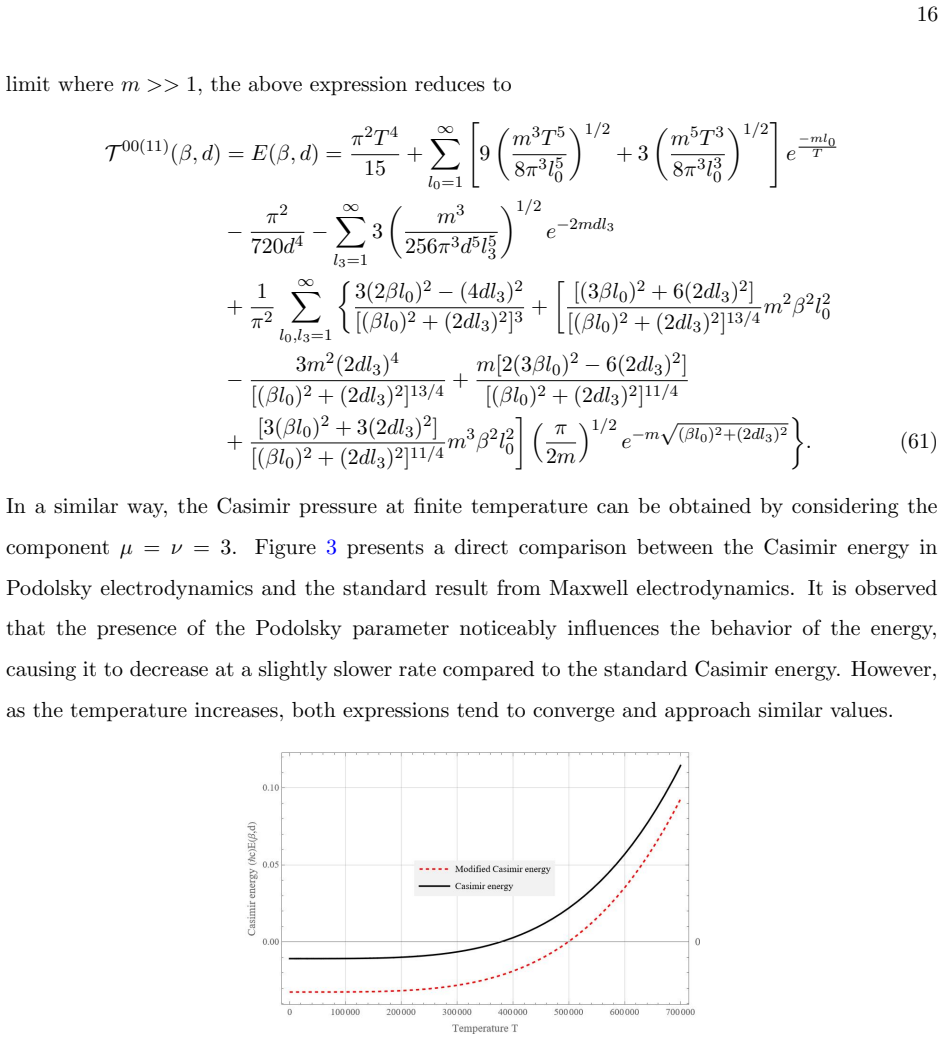
read the original abstract
In this work, Podolsky theory, a second-order, Lorentz- and gauge-invariant extension of classical electrodynamics, is considered. The effects of Podolsky's modification on fundamental phenomena such as the Stefan-Boltzmann law and the Casimir effect for the electromagnetic field are investigated. The Thermo Field Dynamics (TFD) formalism is employed to describe quantum fields at finite temperature and under spatial confinement through its topological structure.
Editorial analysis
A structured set of objections, weighed in public.
Referee Report
Summary. The paper applies the Thermo Field Dynamics (TFD) formalism to Podolsky electrodynamics (a second-order Lorentz- and gauge-invariant extension of Maxwell theory) to compute finite-temperature corrections to the Stefan-Boltzmann law and the Casimir effect, with spatial confinement incorporated via the topological structure of TFD.
Significance. If the central calculations hold, the work would provide concrete expressions for how the additional massive pole in the Podolsky propagator modifies thermal radiation and confined vacuum energies, offering a controlled test of higher-derivative effects in thermal QFT. No machine-checked proofs or parameter-free derivations are present, but the explicit use of TFD for both thermal and spatial effects is a clear methodological choice.
major comments (3)
- [TFD formalism section (likely §2 or §3)] The manuscript does not derive the TFD thermal propagator for the Podolsky Lagrangian. Standard TFD constructs the thermal vacuum via a Bogoliubov transformation that assumes a positive-definite spectrum and standard commutation relations; the Podolsky propagator contains a massless pole plus a massive pole at k² = M² with opposite residue sign. Without an explicit expression for the thermal two-point function (or the corresponding Bogoliubov coefficients for each mode), it is impossible to verify that the massive mode contributes with the correct sign and does not introduce negative-norm states into the ensemble.
- [Stefan-Boltzmann law calculation (likely §4)] In the Stefan-Boltzmann law computation, the energy-density integral must reduce to the standard Maxwell result when M → ∞. The paper provides no explicit integral or decomposition showing the separate massless and massive contributions; if the massive mode is integrated as an ordinary bosonic degree of freedom, the correction may acquire an unphysical term that survives the M → ∞ limit or violates the expected high-temperature behavior.
- [Casimir effect section (likely §5)] For the Casimir effect under spatial confinement, the mode sum or image-charge construction must be performed with the full fourth-order differential operator. The manuscript does not demonstrate how the boundary conditions are imposed on the massive mode or whether the opposite-residue pole produces a consistent (non-negative) contribution to the Casimir energy; this is load-bearing for the claim that spatial confinement effects are modified in a controlled way.
minor comments (2)
- [Abstract] The abstract supplies no equations, numerical results, or key expressions, making it impossible for a reader to assess the magnitude of the claimed modifications.
- [Throughout] Notation for the Podolsky mass parameter M and the TFD thermal parameter should be introduced once and used consistently; several passages appear to switch between Euclidean and Minkowski signatures without explicit comment.
Simulated Author's Rebuttal
We thank the referee for the careful reading of our manuscript and the constructive comments. We address each major point below and indicate the revisions that will be incorporated.
read point-by-point responses
-
Referee: The manuscript does not derive the TFD thermal propagator for the Podolsky Lagrangian. Standard TFD constructs the thermal vacuum via a Bogoliubov transformation that assumes a positive-definite spectrum and standard commutation relations; the Podolsky propagator contains a massless pole plus a massive pole at k² = M² with opposite residue sign. Without an explicit expression for the thermal two-point function (or the corresponding Bogoliubov coefficients for each mode), it is impossible to verify that the massive mode contributes with the correct sign and does not introduce negative-norm states into the ensemble.
Authors: We agree that an explicit derivation of the TFD thermal propagator for the Podolsky field was not provided in the manuscript. The Podolsky propagator indeed features a massless pole with positive residue and a massive pole at k² = M² with opposite residue. In the TFD approach, the thermal vacuum is constructed separately for each mode via the appropriate Bogoliubov transformation. We will add a new subsection deriving the thermal two-point function explicitly, including the Bogoliubov coefficients for both poles. This will demonstrate that the opposite residue is handled consistently within the higher-derivative structure and that the thermal ensemble contains no negative-norm states. revision: yes
-
Referee: In the Stefan-Boltzmann law computation, the energy-density integral must reduce to the standard Maxwell result when M → ∞. The paper provides no explicit integral or decomposition showing the separate massless and massive contributions; if the massive mode is integrated as an ordinary bosonic degree of freedom, the correction may acquire an unphysical term that survives the M → ∞ limit or violates the expected high-temperature behavior.
Authors: The referee is correct that the M → ∞ limit must recover the standard Maxwell Stefan-Boltzmann law. Our energy-density expression is obtained from the trace of the thermal propagator and decomposes naturally into massless and massive contributions. The massive-mode integral is suppressed by factors that vanish exponentially as M/T → ∞. We will revise the relevant section to display the explicit integral decomposition and the analytic demonstration that the massive term disappears in the stated limit, leaving only the Maxwell result. The high-temperature expansion remains free of unphysical surviving terms due to the structure of the Podolsky propagator. revision: yes
-
Referee: For the Casimir effect under spatial confinement, the mode sum or image-charge construction must be performed with the full fourth-order differential operator. The manuscript does not demonstrate how the boundary conditions are imposed on the massive mode or whether the opposite-residue pole produces a consistent (non-negative) contribution to the Casimir energy; this is load-bearing for the claim that spatial confinement effects are modified in a controlled way.
Authors: We acknowledge that the manuscript does not explicitly detail the imposition of boundary conditions on the massive mode or the sign of its contribution to the Casimir energy. The fourth-order operator requires that the full field (and hence both poles) satisfy the same boundary conditions at the plates. We will expand the Casimir section to present the adapted image-charge construction for the complete propagator, showing the separate massless and massive mode sums and verifying that the total Casimir energy remains consistent and non-negative. revision: yes
Circularity Check
No circularity: TFD application to Podolsky theory uses independent formalism on modified propagator
full rationale
The paper applies the standard Thermo Field Dynamics formalism to the Podolsky Lagrangian to compute thermal corrections to the Stefan-Boltzmann law and Casimir energy. No equations are exhibited that define a quantity in terms of itself, rename a fit as a prediction, or reduce the central result to a self-citation chain. The higher-derivative structure is taken as given input; the TFD doubling and Bogoliubov transformation are applied without the paper claiming to derive them from the target observables. Absent any quoted reduction (e.g., an energy density integral forced to equal its Maxwell limit by construction), the derivation chain remains self-contained against external benchmarks. The skeptic concern addresses physical consistency of the massive mode, not circularity of the derivation.
Axiom & Free-Parameter Ledger
Lean theorems connected to this paper
-
IndisputableMonolith/Foundation/BlackBodyRadiationDeep.leanstefan_boltzmann_zero_cost contradicts?
contradictsCONTRADICTS: the theorem conflicts with this paper passage, or marks a claim that would need revision before publication.
the generalized Stefan-Boltzmann law for the electromagnetic field, now modified by the presence of the Podolsky mass parameterm. ... ρ(T) = π²T⁴/15 + ... corrections ... m
-
IndisputableMonolith/Cost/FunctionalEquation.leanwashburn_uniqueness_aczel unclear?
unclearRelation between the paper passage and the cited Recognition theorem.
Podolsky electrodynamics ... Lagrangian L = −1/4 FμνFμν + a²/2 ∂αFαβ∂λFλβ ... propagator Dμν(k) = 1/k²(a²k²−1) [gμν − a²kμkν]
What do these tags mean?
- matches
- The paper's claim is directly supported by a theorem in the formal canon.
- supports
- The theorem supports part of the paper's argument, but the paper may add assumptions or extra steps.
- extends
- The paper goes beyond the formal theorem; the theorem is a base layer rather than the whole result.
- uses
- The paper appears to rely on the theorem as machinery.
- contradicts
- The paper's claim conflicts with a theorem or certificate in the canon.
- unclear
- Pith found a possible connection, but the passage is too broad, indirect, or ambiguous to say the theorem truly supports the claim.
Reference graph
Works this paper leans on
-
[1]
A Generalized Electrodynamics Part I-Non-Quantum
B. Podolsky, “A Generalized Electrodynamics Part I-Non-Quantum”, Phys. Rev.6268 (1942)
work page 1942
-
[2]
A Generalized Electrodynamics Part II-Quantum
B. Podolsky and C. Kikuchi, “A Generalized Electrodynamics Part II-Quantum”, Phys. Rev.65228 (1944)
work page 1944
-
[3]
Review of a Generalized Electrodynamics
B. Podolsky and P. Schwed, “Review of a Generalized Electrodynamics”, Rev. Mod. Phys.2040 (1948)
work page 2040
-
[4]
Debye screening in generalized quantum electrodynamics
C. A; Bonin, G. B. De Gracia, A. A. Nogueira and B. M. Pimentel, “Debye screening in generalized quantum electrodynamics”, Int. Jour. Mod. Phys. B,35, 2050179 (2020)
work page 2020
-
[5]
Effective field theory of Plasmas in Podolsky corrected Photonic field
P. Singh and P. Kumar , “Effective field theory of Plasmas in Podolsky corrected Photonic field” Phys. Rev. E,112, 045215 (2025)
work page 2025
-
[6]
Generalized Stueckelberg-Higgs gauge theory
C. A. Bonin, R. Bufalo, B. M. Pimentel and G. E. R. Zambrano, “Generalized Stueckelberg-Higgs gauge theory”, Theo. Braz. J. Phys.52, 127 (2022)
work page 2022
-
[7]
Y. Elskens and M. H. Kiessling, “Microscopic foundations of kinetic plasma theory: The relativistic Vlasov-Maxwell equations and their radiation-reaction-corrected generalization”, Jour. of Stat. Phys. 20, 749-772 (2020)
work page 2020
-
[8]
A new approach to quantum-statistical mechanics
T. Matsubara, “A new approach to quantum-statistical mechanics”, Prog. Theor. Phys.14, 351 (1955)
work page 1955
-
[9]
Brownian motion of a quantum oscillator
J. Schwinger, “Brownian motion of a quantum oscillator”, J. Math. Phys.2, 407 (1961)
work page 1961
-
[10]
Diagram technique for nonequilibrium processes
L. V. Keldysh, “Diagram technique for nonequilibrium processes”, Sov. Phys. JETP20, 1018 (1965)
work page 1965
-
[11]
Y. Takahashi and H. Umezawa, “Thermo Field Dynamics”, Int. Jour. Mod. Phys. B10, 1755 (1996)
work page 1996
-
[12]
F. C. Khanna, A. P.C. Malbouisson, J. M. C. Malbouisson e A. E. Santana, Thermal Quantum Field Theory: Algebraic Aspects and Applications, World Scientific, Singapore, (2009)
work page 2009
-
[13]
H. Umezawa, H. Matsumoto and M. Tachiki, Thermofield Dynamics and Condensed States, North- Holland, Amsterdan, (1982)
work page 1982
-
[14]
On the attraction between two perfectly conducting plates
H. B. G. Casimir, “On the attraction between two perfectly conducting plates”, Indag. Math.10, 261 (1948)
work page 1948
-
[15]
Measurements of attractive forces between flat plates
M. J. Sparnaay, “Measurements of attractive forces between flat plates”, Physica24, 751 (1958)
work page 1958
-
[16]
Demonstration of the Casimir Force in the 0.6 to 6µmRange
S. K. Lamoreaux, “Demonstration of the Casimir Force in the 0.6 to 6µmRange”, Phys. Rev. Lett. 78, 5 (1997)
work page 1997
-
[17]
Precision Measurement of the Casimir Force from 0.1 to 0.9µm
U. Mohideen and A. Roy, “Precision Measurement of the Casimir Force from 0.1 to 0.9µm”, Phys. Rev. Lett.81, 3341 (1998)
work page 1998
-
[18]
An Introduction To Quantum Field Theory
M. E. Peskin and D. V. Schroeder “An Introduction To Quantum Field Theory”, CRC Press (2019)
work page 2019
-
[19]
The Quantum Theory of Fields Volume I
S. Weinberg, “The Quantum Theory of Fields Volume I”, Cambridge University Press (1995). 19
work page 1995
-
[20]
Vacuum Stress between Conducting Plates: An Image Solution
L. S. Brown and G. J. Maclay, “Vacuum Stress between Conducting Plates: An Image Solution”, Phys. Rev.184, 1272 (1969)
work page 1969
-
[21]
C. A. Bonin, A Quantiza¸ c˜ ao da Eletrodinˆ amica de Podolsky em Equil´ ıbrio Termodinˆ amico no Formal- ismo de Matsubara-Fradkin, Thesis: PhD Sao Paulo, IFT (2011)
work page 2011
-
[22]
Podolsky electromagnetism at finite temperature: Implications on the Stefan-Boltzmann law
C. A. Bonin, R. Bufalo, B. M. Pimentel and G. E. R. Zambrano, “Podolsky electromagnetism at finite temperature: Implications on the Stefan-Boltzmann law”, Rev. Phys. D81025003 (2010)
work page 2010
discussion (0)
Sign in with ORCID, Apple, or X to comment. Anyone can read and Pith papers without signing in.